Tag Archives: Julia Guest

Keepers: Creamed coconut rice and raw vegetable marinade

Recently two recipes have entered my cooking repertoire. Both vegan (as it happens) they complement each other (as it happens). I want to record them with credits.

Creamed coconut rice

Step up, Claire Milne, the leading light behind the No Tesco in Stokes Croft campaign (and compadre), and the genius who came up with the easiest way to make the best coconut rice ever.

To cooked brown rice, add creamed coconut, cut small so it melts easily, and hey presto: soothing, luxurious coconut rice.

For 8 people: 3 mugs of rice for 6 mugs of water (how to cook brown rice here), 1 creamed coconut block (200g) cut in small pieces. (correction on rice proportions thanks for comment below).

(Experiment with adding cooked lentils, squash fried in small cubes, fresh herbs etc.).

Raw vegetable marinade

Step up,  Julia Guest. A filmmaker who made Letter To The Prime Minister in Bagdad during the bombing, in Fallujah during the occupation.

Julia’s current film, In Her Own Image, is an exploration of female divinity – in response to the war in Iraq as she explains at Indiegogo (where you can crowd-source/support the film). 

Anyway, food – where was I?

Raw vegetable marinade

A marinade is a sauce in which you soak your raw food (usually before cooking but in this case, no cooking required).

Which vegetables can you eat raw? Certainly not potatoes.  More info on raw food here.

I ate sliced mushroom, grated courgette, matchsticks of beetroot.

Choose veg you usually eat raw such as tomatoes, cucumber, radish, but think of others such as carrot or cabbage.

Sliver or slice or grate or anyway cut nice and slim.

Superfood dressing: tamari and cider vinegar and olive oil in equal proportions.

The marinade helps digestion of the vegetables.

Let the sliced veg soak in the dressing for a couple of hours before serving.

Would go well with the creamed coconut rice.
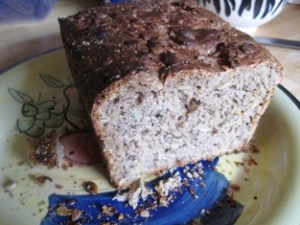
Speedy spelt loaf recipe – not speedy roads

I am still on real bread, the topic of my last post.

Julia made the loaf in the picture above from a recipe in the Telegraph.

Apart from bread, Julia Guest, filmmaker extraordinaire, also made A Letter to the Prime Minister.

The documentary follows the British peace activist, Jo Wilding, in Iraq before and during the 2003 invasion.

Talking about films, I was round at Julia’s on Sunday to watch Life In The Fast Lane, a documentary she was involved with about the M11 road protest (1995).

The M11 sliced through three East London boroughs and tore apart communities – all for the sake of saving motorists three minutes of time.

The M11 road protest along with similar ones at Twyford and Newbury did not stop the roads being built.

However the cost of evictions – both financially and morally – eventually halted the then-mania for road-building.

This report by the Campaign to Protect Rural England (CPRE) shows new roads are not evaluated. And grandiose claims for reducing traffic appear not to have been realised. For instance, according to Countryside Voice, the CPRE magazine (summer 2006), the Newbury town centre peak-hour traffic flows are almost back to pre-bypass levels. And, “the actual damage to protected landscapes is even worse than expected.” [added 2012]

So while we were watching Life In The Fast Lane, we ate Julia’s homemade squash-from-her-allotment soup with the amazing bread. It was delicious – tasty and healthy.

I was blown away by Life In The Fast Lane:

– the local residents who helped patrol the squat including the 93-year-old resident made a squatter in her own childhood home

– the anguished cries of schoolschildren as the 250-year old chestnut tree was torn down by a digger (reminiscent of a scene from Avatar) and despite the protestors’ beautiful tree-top home

– the spectacular London rooftop shots of squatters who locked-on themselves to chimney pots with concrete and handcuffs to stop being evicted.

It was a real insider’s view of a mega-squat resisting the onslaught of so-called progress.

The M11 movie put me in mind of the eviction of the Tesco squatters.

Julia writes: “I make this with fresh yeast from the Better Food Company and less flour. Let it rise for just over an hour in the tin, then bake it.. but no kneading at all. I use a mix of any seeds I fancy…and the quantities vary. I also add a little olive oil to stop it sticking – as well as coating the tin in oil and then a coat of small seeds. Baking only takes about 30 minutes.”

Check out Julia’s inspiration, a spelt recipe by Xanthe Clay in the Telegraph using dried yeast and requiring no kneading or proving, and an earlier one by Rose Prince that ditto is fast.

For further inspiration visit Real Bread campaigner and master baker, Andrew Whitley, and author of much-recommended Bread Matters.

And for my real-life experience of Julia’s recipe see my blog on Easy-to-make spelt loaf – it works!

Surely a quick-to-make loaf is a better use of speed than an unnecessary road?