In praise of Amtrak

Supper time on board the Amtrak train from New York to Chicago. Wild rice, trout and a medley of vegetables

The Hudson river (above) was our companion for a good while on the Lake Shore railroad.

Every meal time, we sat with different people. Several asked me about the British health care system. I said: “I bless the National Health Service.”

Socialism has a bad rap in the US but there is nothing to be scared of. It’s simply about society sharing the care of its citizens, especially the vulnerable ones.

This is my first time in the US.

We had flown from the UK to New York.

Going by train from New York to Arizona was initially for green reasons.

It was also more scenic, more convivial, more educational and also allowed more natural adjustment to time differences.

After sleeping on the train, we changed at Chicago. Like New York, it reminded me of European cities.

But the landscape became less familiar after Chicago.

Our conductor on the Southwest Chief gave us hot flannels, a welcome hangover from the days of steam trains.

We sat in the observatory lounge and watched the landscape change.

Agricultural fields of corn (see above), but few houses or people.

You get a lot of land for your money in the Midwest, said one passenger. But, he explained, it suffered from water shortages. There was competition for water between the states and much water went on golf courses.

The conductors had great lines of repartee and wit, such as:

“In a few moments we will be reaching Raton, New Mexico, and time for a brief smoke break. Have a few puffs on that cigarette but don’t wander far from the train or you will become a hitchhiker not a passenger although the good news is – there is another train in 24 hours.”

The landscape changed again after Albuquerque where we stopped for an hour in the intense heat, and an unexpected anti-genocide exhibition,
One Million Bones.

I fell in love with the railroad and big skies, the America of much loved novels.

I felt touched by the people I spent time with hearing something of their stories and why they are travelling: grandchildren, graduation, loss of loved ones.

I also had great chats about food: cinnamon in porridge; beer batter for frying flounders, and lavender and chamomile for restful herbal tea.

I feel sad how people from different countries and cultures can get divided from each other, through the iniquities of a profit-before-people system.

It took us two and half days to reach our destination in Arizona.

It was a privilege.
Eat organic – reduce carbon

Today I met my friend and ex-Soil Association colleague, Gundula Azeez, for lunch.

She wrote the Soil Association 2010 report, Soil carbon and organic farming.

I confess carbon used to confuse me.

As a journalist, my ignorance is my strength. If I can understand it, so can you.

Gundula kindly went back to basics for a beginner’s mind explanation.

Is carbon good or bad?

Carbon is both good and bad depending on where it is.

When it is in the soil, or locked up in oil and coal, it’s good.

When it’s in the atmosphere, it’s bad.

Carbon-in-the-air i.e. carbon dioxide is something we need to breathe OUT.

In the case of current planetary concerns, rising levels of carbon dioxide (or CO2) create rising greenhouse gases – too much of which contributes to climate change.

(Sentence rewritten following Georgie’s comment below).

Organic farming and the carbon cycle

Plants remove carbon from the atmosphere by breathing IN carbon dioxide.

That’s good.

When plants decay, the carbon is stored in the soil.

That’s good too.

Organic farmers uses this natural cycle to replenish the soil.

According to the Soil Association report, if all UK farmland were converted to organic farming, at least 3.2 million tonnes of carbon would be stored in the soil each year – the equivalent of taking nearly 1 million cars off the road

Not only that – but when carbon is stored in the soil, it does a LOT of good.

That’s because it is stored as organic matter which retains nutrients, soil structure and water.

Organic farmers create more carbon-rich organic matter through their farming practices.

They grow green manures and add compost to enrich the soil.

Soil life

Introducing soil microbes, the tiniest creatures on earth that perform vital functions to keep the soil healthy.

These soil microbes are exterminated by chemical farming practices but are actually encouraged by organic farmers.

Soil micro-organisms are essential to life on earth.

They help deliver nutrients to the growing plant.

They help it decompose when it is dead.

Thus creating more organic matter and its carbon-storage capacity.

Clods of earth

The soil actually clumps – or aggregates – around the carbon to protect it.

This delicious crumbly soil also provides a holding place for water, nutrients and air.

Which is why majority-world countries benefit from organic farming practices because they increase yield, and create water-retaining soil.

This gives developing countries more economic independence too.

They don’t have to pay the West for chemicals to feed the soil because organic farming does it naturally – by using the planet’s natural carbon cycle.

Lunch at Saint Stephen’s cafe

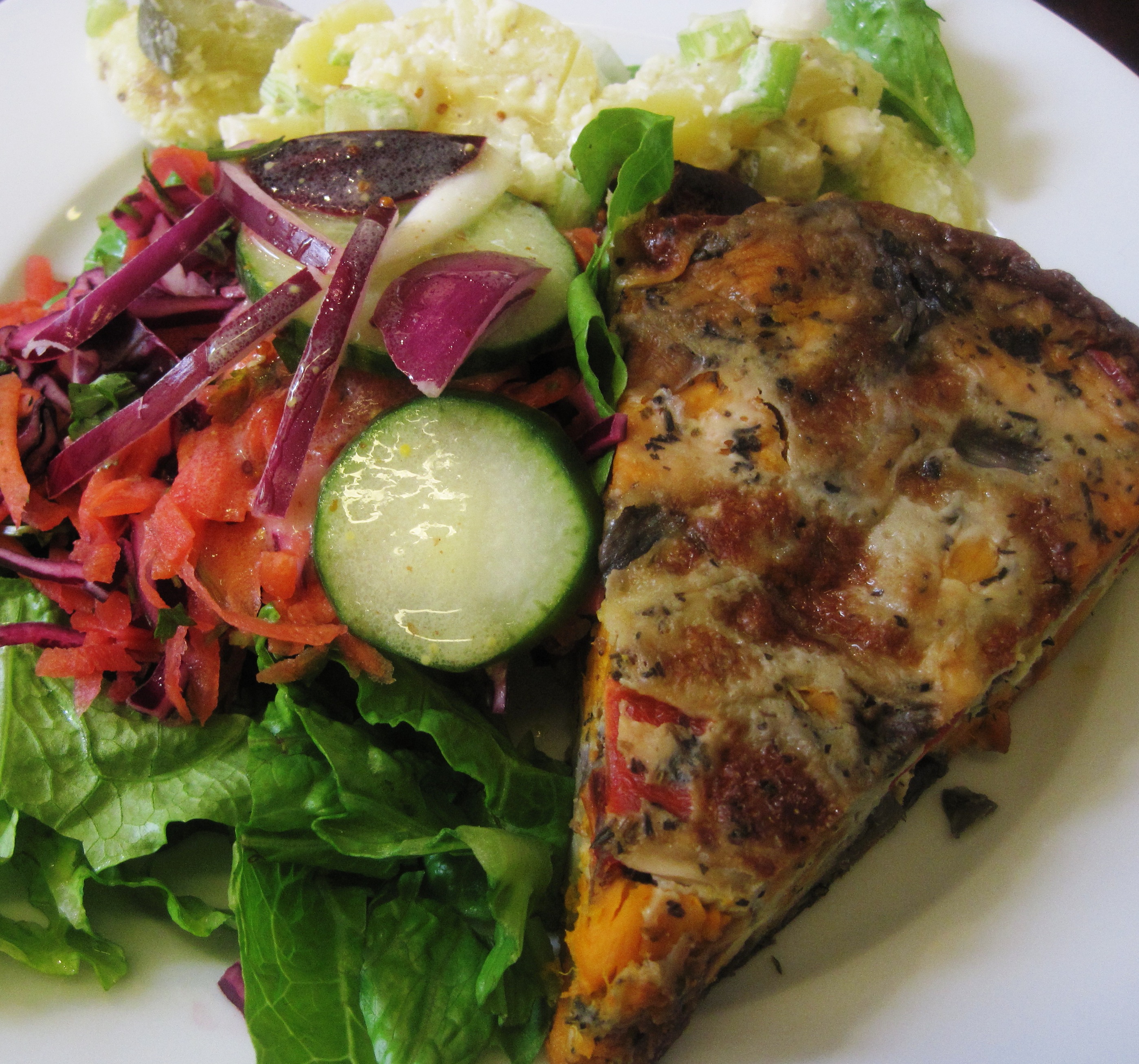
I had sweet potato frittata and salad – pictured – at Saint Stephen’s cafe.

The food is amazing – home-cooked and organic, seasonal, fair trade and local where possible.

Saint Stephen’s church cares deeply about the environment and this is reflected in its cafe food, conceived by one of Bristol’s best cooks, Edna Yeffet Summerel.

Nice to know when I eat organic food that I am enriching the soil and helping store carbon…

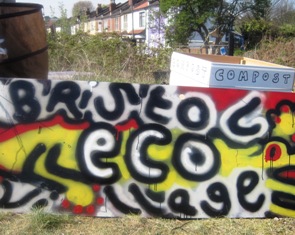
Bristol eco-village

Welcome to Bristol eco-village.

Welcome.

The squatters moved in on Saturday and already three acres of desolate wasteland in inner-city Bristol have been transformed.

What is dead has been brought back to life.

The beans are planted in the soil – on lined raised beds as the land used to be a scrapyard and may be contaminated by toxins.

The squatters are conducting soil tests.

If contamination is found, the squatters plan some soil restoration, such as feeding with compost tea and planting with nitrate-fixing plants (such as beans).

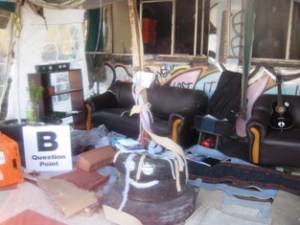
Here is their reception area where visitors can get more info.

It looks like something out of Mad Max or a similar post-apocalyptic movie – and that’s the point.

Rather than be victims of a future likely eco-disaster, some people would rather prepare positively in the present.

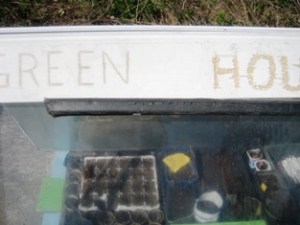
Here is a makeshift green house.

On Tuesday the squatters must got to court.

Why?

Must the land be repossessed by the owners so it may lie unused for another twenty years?

Or can it be restored to life as the squatters are doing, growing vegetables and rebuilding soil fertility?

“We come in peace they said

To dig and sow

We come to work the lands in common

And to make the waste ground grow

This earth divided

We will make whole

So it will be

A common treasury for all

We work, we eat together

We need no swords

We will not bow to the masters

Or pay rent to the lords.

Still we are free

Though we are poor

You Diggers all stand up for glory

Stand up now!”

Easy-to-make spelt loaf

This is the most delicious bread I have baked in my life, ever – and the fastest.

Spelt bread has three great things going for it:

1. Wheat-sensitive types like myself find spelt easier-to-digest

2. Because it is spelt, you can get away with no-kneading because, as Rose Prince says in her recipe for white spelt, “Spelt, an ancient wheat grain, reacts quickly to yeast”.

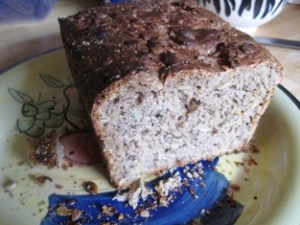
3. It tastes fantastic – the crust was seed-crunchy and the inside was moist and held together.

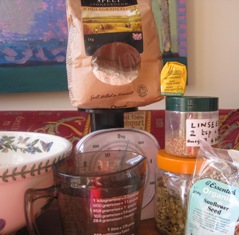
My leading characters:

Thank you to Julia for real-time baking advice, the recipe and the loaf we ate

while watching Life In The Fast Lane, about the 1990s M11 road protest.

Julia says you have to use real yeast to make it taste so good, and I did.

See Yeast ** further down for more info including using dried yeast.

Ingredients

1lb 2oz/ 500g spelt flour

½ tsp sea salt

2oz/ 50g pumpkin seeds

2oz/ 50g sunflower seeds

2oz/ 50g linseeds or sesame seeds

17floz/ 500ml warm water

15-20g fresh yeast with 1 teaspoon of honey

a slosh of olive oil (or any oil)

Method after Julia

Add the fresh yeast and honey (1 teaspoon) to the warm water and leave it somewhere warm for 10 minutes to activate the yeast. Feel it gently fizz in your face as you peer into the jug – smells like beer brewing.

Mix the ingredients above – flour + salt + seeds + oil (and anything else such as chilli for a devilish spicyness) – in a large mixing bowl, adding the yeast/water last.

Grease two loaf tins with oil and scatter seeds to line.

Size of tins? One 2lb tin and one 1lb tin did the job for me but you can improvise.

Pour in the mixture and leave it to rise in the tins

– about 30 minutes rising-time.

If you leave it longer, dough-mixture might collapse.

Bake in an oven pre-heated to Gas Mark 6 / 200C / 400F  for 30 minutes.

Turn out and eat as soon as it cools.

(The recipe does tell you to return the loaf to oven for 5 minutes after removing it from tin but this did not seem necessary).

Yeast

It’s exciting – a living organism.

If using dried yeast see Xanthe Clay‘s recipe – which is even faster as there is no need to wait for dough-mixture to rise in the tin (although dried yeast does have additives).

How much fresh yeast to use? Rose Prince says use 7g (1/4oz) of fresh yeast for making a white spelt loaf. Julia says use about 15g.

By mistake I used 42g. Read on.

My yeast story

In my ignorance I used the entire packet of organic fresh yeast instead of a third as Julia recommended.

It got very dramatic as the dough-mixture rose and rose and spilled over the loaf tin.

Domestic-slut that I am

I scooped the spilled mixture and slopped it into another greased loaf tin.

And let the mixture(s) rise again.

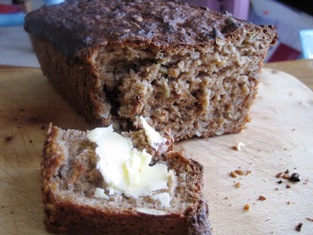
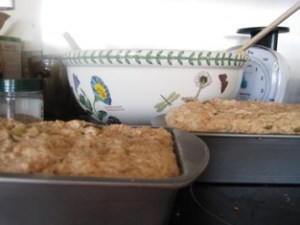
They behaved quite well this time, rising just-so – see pic below.

The bread was delicious and non-yeasty – maybe because the wholemeal spelt flour was strong enough to take the accidental extra yeast.

The moral of the tale?

You can make mistakes while cooking…

So to recap.

This spelt bread does not need kneading

making it fast to bake

Plus so damn delicious it’s also fast to partake.

Claudia Roden’s homemade falafel

The paparazzi caught me last Sunday buying herbs from the glorious Sweet Mart in Easton.

Easton in Bristol has three mosques, several churches, one synagogue and one Sikh temple

– in other words my sort of town.

Sweet Mart do mail order.

I was buying the herbs to make falafel for a family meal on Easter Monday.

I had spotted the recipe in my mum’s Claudia Roden international Jewish cookery book – I was very taken with it because it uses herbs, and butter beans instead of the traditional chick peas.

Here is my version of the wonderful Claudia Roden‘s recipe

Soak 500g of butter beans overnight and cook for a good hour.

Drain the beans (Claudia says pat them dry too)

Blend the drained beans in a food processor until they become a smooth puree.

Add chopped up onion and garlic, (Claudia says use 8 spring onions instead of onion) and ground spices such as chilli, ground cumin and coriander

(Claudia says 2 tsp of cumin and 2 tsp of ground coriander)

Add washed and drained herbs – I used fresh coriander, mint and fennel (see armfuls above).

Leave the paste for an hour or so to settle.

Then roll into balls

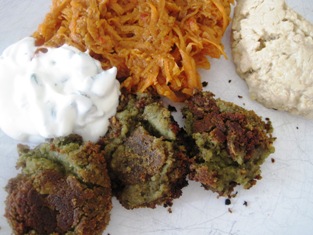
Deep fry and serve with homemade hummus, yogurt with garlic and mint, and grated carrot salad.

My falafel did not turn into hard crispy little balls. I think because

a) I used lots of herbs so they go too wet b) I hate deep-frying so did not use enough oil.

Despite not being crisp, they were

…DELICIOUS

(and even better cold at midnight).

Speedy spelt loaf recipe – not speedy roads

I am still on real bread, the topic of my last post.

Julia made the loaf in the picture above from a recipe in the Telegraph.

Apart from bread, Julia Guest, filmmaker extraordinaire, also made A Letter to the Prime Minister.

The documentary follows the British peace activist, Jo Wilding, in Iraq before and during the 2003 invasion.

Talking about films, I was round at Julia’s on Sunday to watch Life In The Fast Lane, a documentary she was involved with about the M11 road protest (1995).

The M11 sliced through three East London boroughs and tore apart communities – all for the sake of saving motorists three minutes of time.

The M11 road protest along with similar ones at Twyford and Newbury did not stop the roads being built.

However the cost of evictions – both financially and morally – eventually halted the then-mania for road-building.

This report by the Campaign to Protect Rural England (CPRE) shows new roads are not evaluated. And grandiose claims for reducing traffic appear not to have been realised. For instance, according to Countryside Voice, the CPRE magazine (summer 2006), the Newbury town centre peak-hour traffic flows are almost back to pre-bypass levels. And, “the actual damage to protected landscapes is even worse than expected.” [added 2012]

So while we were watching Life In The Fast Lane, we ate Julia’s homemade squash-from-her-allotment soup with the amazing bread. It was delicious – tasty and healthy.

I was blown away by Life In The Fast Lane:

– the local residents who helped patrol the squat including the 93-year-old resident made a squatter in her own childhood home

– the anguished cries of schoolschildren as the 250-year old chestnut tree was torn down by a digger (reminiscent of a scene from Avatar) and despite the protestors’ beautiful tree-top home

– the spectacular London rooftop shots of squatters who locked-on themselves to chimney pots with concrete and handcuffs to stop being evicted.

It was a real insider’s view of a mega-squat resisting the onslaught of so-called progress.

The M11 movie put me in mind of the eviction of the Tesco squatters.

Julia writes: “I make this with fresh yeast from the Better Food Company and less flour. Let it rise for just over an hour in the tin, then bake it.. but no kneading at all. I use a mix of any seeds I fancy…and the quantities vary. I also add a little olive oil to stop it sticking – as well as coating the tin in oil and then a coat of small seeds. Baking only takes about 30 minutes.”

Check out Julia’s inspiration, a spelt recipe by Xanthe Clay in the Telegraph using dried yeast and requiring no kneading or proving, and an earlier one by Rose Prince that ditto is fast.

For further inspiration visit Real Bread campaigner and master baker, Andrew Whitley, and author of much-recommended Bread Matters.

And for my real-life experience of Julia’s recipe see my blog on Easy-to-make spelt loaf – it works!

Surely a quick-to-make loaf is a better use of speed than an unnecessary road?

Do you eat real bread?

I took the above picture of real bread at Wholefoods Market, London last weekend.

Daringly I took it AFTER being told by a Wholefoods Market employer that it was “not company policy” to allow photographs.

Even though I was about to blog about the store’s amazing real bread made by a genuine master baker who makes his own yeast.

Bread was on  my mind.

A few days before, a press release from the Real Bread Campaign had arrived in my email inbox.

A nine-month investigation by the Real Bread Campaign found that – despite those tempting bread-baking smells in supermarkets – only one, Marks & Spencer, produces real bread.

Real bread is made with basic ingredients such as flour, yeast and water.

Real bread does not use weird substances designed to make bread seem like real bread but are actually potentially toxic ‘processing aids’ that do not even need to be declared on the label.

I must confess.

A bit of me was like ‘so what?’.

I mean I was hardly surprised to hear supermarkets sell pretend bread.

However my inner jaded-real food campaigner was put to shame when the Real Bread Campaign’s report was published in the Daily Mail.

I was staying at my mum’s; she is a daily Daily Mail reader.

“I knew it,” she said, pacing up and down the kitchen, brandishing the paper.

“I knew that smell of baking loaves was fake,” she said.

The report vindicated her suspicion that there was no real baking going on.

Unlike at Wholefood Market which may charge inflated Kensington prices on some items (such as hummus) and not wish me to take photos but

does bake the

most

amazing

real bread.

Find real bread here and tell me:

Do you eat real bread?

GM potato? I prefer blight-resistant beauties

I love the look of these potatoes and their healthy interesting purpleness.

They have just had their own launch in London at the sustainable London restaurant, Konstam.

Bred by the Sarvari Trust, these Sárpo potatoes are

  • blight-resistant thus reducing pesticides
  • high-yield
  • deep-rooting
  • have weed-smothering foliage
  • low-carbon footprint
  • and can be stored unrefrigerated.

Vegetable heroes, they are on the front-line of battle against the Genetic Modification industry.

Modification? Too mild a word! Manipulation would be better.

You may have heard. In March 2010, the European Union rode roughshod over the people’s wishes and approved the first GM crop in 12 years.

BASF’s GM Amflora potato carries a controversial antibiotic resistant gene which could enter the food chain.

The EU-funded pro-GM GMO Safety website says of the GM Amflora potato.

“In this potato the composition of the starch has been altered so that it is better suited for certain industrial purposes.”

Lovely. A GM industrial potato.

Crikey. It’s enough to make me want to join anti-Europe UKIP. (Only joking).

Luckily, there is an alternative.

The Avaaz petition aims to get 1 million signatures in order to officially request the European Commission to put a moratorium on the introduction of GM crops into Europe and set up an independent, ethical, scientific body to research the impact of GM crops and determine regulation.

The funding of GM science is driven by multinational agribusiness. GM is a money spinner perfectly suited to control-freaks because once a plant is genetically modified, it can be patented.

Monsanto sues farmers in North America for having unlicensed GM seeds – even if the GM seeds arrive on their fields (as seeds do) by wind, animal or insect.

Some scientists get excited about GM, genuinely believing the technology has the possibility of helping the world.

But GM science is out-of-date, based on the belief that Genes are King.

You can’t take a genetic characteristic from one organism, put it another and tra-la-la, create a GM plant in our best interests.

The Human Genome Project proved life is far more complex than that. We disturb the gene sequence at our peril.

Scientists,  if you want to explore the frontiers of life, there is plenty of mystery in the life we already have.

Defra has to decide whether to license two GM potato trials in England.

Come on Defra! Instead of putting my taxpayer money into unproven, disaster-in-the-making technology – why not put the research money into the beautiful blight-resistant purple potato?

What do you think?

Tesco squatters evicted

I stood in the cold bright sunshine watching No Tesco squat protestors being removed from the roof by baillifs.

It took  all of yesterday as many of the squatters had secured their bodies to the premises.

About 200 supporters stood vigil too, cheering and clapping them.

Some had a sound system (which blared out Ghost Town at one point, aptly), a musician played Klezmer on a clarinet.

A disturbing spectacle played out on the roof of the old Jesters comedy club which Tesco wants to turn into its sixth supermarket within a mile.

I don’t want a Tesco in Stokes Croft.

It’s a funky up-and-coming area with some of the best food shops and cafes in Bristol.

Herbert’s Bakery, the Radio 4 award-winning Thali Cafe, the Radford Mill organic farm shop, Licata the family-run delicatessen, Galliford’s late night corner shopBell’s diner, The Bristolian and Cafe Kino are some of the local businesses that would be at risk.

Supermarkets kill local business and the character of local communities.

There are two main strands to this protest.

1) The No Tesco in Stokes Croft campaign which has already collected over 4,000 signatures.

2) The squatters, who have been occupying the old Jesters comedy club since February after hearing about Tesco’s plans.

I admire the squatters for putting their lives on the line for a just cause.

I am not saying they are perfect.

For instance, a protestor in a Halloween mask squirted liquid at a balliff.

I thought: surely that is not in the Gandhian spirit of passive resistance?

I felt moved to turn to a nearby policeman (one of 70 including several on horseback) to explain this was not non-violent direct action as I understood it.

The policeman said he sympathised. He had not wanted a Tesco in South Bristol. (Local Bedminster residents successfully saw off Tesco but now has Sainsbury’s to contend with).

Another protestor had attached himself to the top of a tripod.

The baillifs used a blue cherry-picker with a crane to get him down.

When they were not looking, he slid down the tripod and onto the arm of the crane, hugging it with his body, trying to skate its length.

But a bailliff grabbed him from behind, and five joined him. He tried to shuffle down the crane’s arm. They kept yanking him back and it must have hurt – he yelled with pain.

Of course the baillifs succeeded. It was six against one.

This is the way society is structured. The law of the land is upheld by physical force.

And the law is not always fair or correct.

In my view the planning laws need to be changed to protect local shops.

The protestors were using their bodies to express a need to change the status-quo.

Two other protestors had their arms in a barrel of concrete. The baillifs assessed the situation (see above) then used an electric hacksaw to remove them, as the Daily Mail reported.

As the tripod man was escorted to the ground, a section of the crowd chanted: “Let him go.”

The mounted police surged forward. I smelled horse manure on the ground.

Most of the squatters were not arrested. Four face charges for public order offences, according to the BBC.

“The police let them go, bless them,” one of the supporters said.

The BBC video clip has highlighted the most dramatic bits, natch – there is also a quote from yours truly.

Meanwhile Tesco has one more planning hurdle to negotiate and the No Tesco in Stokes Croft campaign – along with 100s of others taking place all over the UK – continues.

Still time to add your signature to the Bristol City Council petition.

PS A few blogs ago I announced I was standing for the Green party in Bishopston. Last week I withdrew from standing. I am currently a full-time carer; I just did not have the capacity to do it properly. Huge decision. Hard to make. Feel relieved. Green beliefs means respecting nature’s limits – I had to respect mine!

Peaceful protestors await Tesco eviction

I am in awe of the No Tesco squatters.

They are putting their safety and freedom on the line, taking non-violent direct action to keep the old Jesters building as a community centre.

It’s a lovely space with its wooden bars and stage and has become a hub of homemade entertainment and education since the squatters moved in.

In time, it could become a food coop selling affordable healthy food.

Instead Tesco wants to turn it into another soulless supermarket selling mass-produced food – even though there are five Tescos within walking distance.

The idea of another Tesco is unpopular.

Many (numbers tbc) have signed the e-petition at Bristol City Council.

3,500 have signed postcards complaining to Bristol City Council about the lack of consultation over the building’s change of use from ‘comedy club’ to ‘shop’.

Supermarkets are bad for local business and communities.

Supermarkets ‘will kill corner shops by 2015’ according to the Times.

Local shops create neighbourliness – and local profit.

Spend money with your local shopkeeper (instead of a supermarket) and the money doubles in value to the community because it is re-spent locally.

Planning laws are toothless – they cannot protect its own.

So the squatters moved into the beautiful old building Tesco wants.

Sadly, on the 2 March they lost their court case to keep it for the community.

The peaceful squatters want to save the building.

Inspired by Gandhi, they practice passive resistance, or Satyagraha.

My photo

The poles on the roof (see my pic above) are an urban version of climbing up a tree and refusing to leave in order to stop it being cut down.

It’s called manufactured vulnerability.

If Tesco wants to repossess the building, then the police and bailiffs acting on court orders will have to evict the squatters by force.

A terrible situation for all involved.

The squatters remind me of the suffragettes who chained themselves to railings.

Sometimes people take brave and desperate action to improve the quality of life for future generations.

Tesco could choose to hand the building back to the community.

What a graceful PR coup for Tesco that would be!

What do you think?