Category Archives: vegetarian

Meditation pot-luck lunch with Claude AnShin

“Bring cushion, blanket and vegetarian food to share,” were the instructions for yesterday’s meditation workshop at the Pierian Centre.

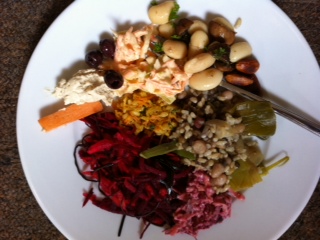
I have never known a pot luck not to work: my plate was filled with favourite foods such as raw beetroot and seaweed, butter bean salad, rice and lentil salad, raw carrot and hummus…

We practiced eating meditation. We ate in silence, aiming to chew each mouthful consciously, with 50 chews.

Eating silently and slowly in company was strangely relaxing.

I had helped promote this event with Saint Stephen’s and the Pierian Centre so it made sense to go.

But I had dreaded it. What? A whole day of meditation? I felt trapped.

Instead the day was rich and intense.

The workshop was led by Claude AnShin Thomas supported by KenShin.

(“How do I address you?” I had asked KenShin. “Ken – like Ken and Barbie – and shin as in leg,” she answered.)

Claude AnShin Thomas was a Vietnam veteran with post-traumatic stress – like many in the military or caught in war.

His spiritual practice helped him cope with flashbacks and emotional pain.

Meditation does not make horrifying experiences go away.

But being conscious, or awake, paradoxically makes trauma easier to cope with.

You learn to sit with discomforting feelings rather than self-medicate or distract yourself to push them away.

Claude AnShin Thomas is funny, straightforward, down-to-earth, profound and deeply touching.

A mendicant monk, he is homeless, goes wherever he can make a difference, and lives on donations.

He works for peace with the Zaltho Foundation by being as conscious as possible. “Everyone has their Vietnam,” he says.

I have marched for peace but peace activists can work for peace by healing the war inside, too.

I am reading his book, At Hell’s GateBeautifully written, so worth reading.

He’s not a new-age guru making money from spirituality, but a man with a troubled past who found his spiritual practice bought him peace, and who has dedicated his life to sharing this to help others.

And this real-ness transmits, I swear.

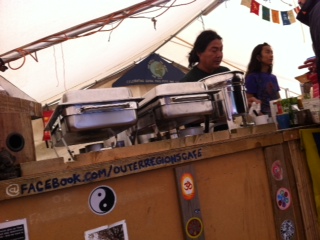
Tibetan soup at Buddhafield 2011

Buddhafield has all the wildness of a festival – live music, dance tent, cafes, workshops, healing area, fires, plunge pool, sauna; but without intoxicants.

There was so much on offer: every hour 10 simultaneous workshops and/or live gigs  to choose from.

Abundance was the festival’s theme. At first I moaned, stressed by having to choose, and being catapulted outside my comfort zone, cut off from home and the internet.

I plodded around the three field-festival site. I got effortlessly fitter from plodding.

This Tibetan soup – from the Outer Regions cafe – sustained me. So nourishing. light and warming. Perfect for rainy days and before dance workshops.


(Soup – something you can make quickly with what’s in the fridge. Fry onions or leeks, chilli and garlic. Slice or chop veg: carrots, courgettes, green beans, potatoes – the smaller you cut ’em the quicker they cook. Add a handful of cooked dried beans such as butter beans or open a tin of plain beans. The trick with soup is how much water: it is easier to add than than remove. So start with two mugfuls and see how it goes. Add noodles towards the end of cooking.  Season with black pepper.)

I am grateful to Mike for making healthy refreshing breakfast every morning.

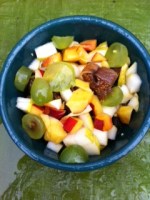
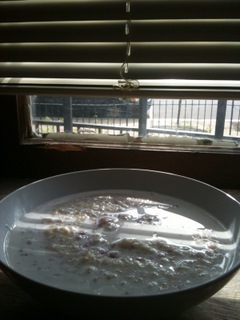
A camping-must. Muesli and fruit (bring knife to chop). Add water, so no cooking needed.

Festivals are up-and-down (like life) – all I know is I felt great when I got back.

Tesco re-opens and elderflower cordial

After being “trashed” in the early hours of Good Friday 22 April, Tesco re-opened on the 24 May following a neighbourhood meeting the night before.

Monday 23 May 6.30pm: St Paul’s Unlimited neighbourhood meeting.

This excellent Guardian feature gives some background to the intensity of emotion present.

People with complaints against the police (“Why was extreme force used? Why was my arm broken by thugs in police uniform and three dogs attacked me?” asked one man).

The police was represented by Chief Superintendent, John Stratford, who listened well. Clearly, he was not a riot-type with batons and adrenaline-pumping, lashing-out fear.

Someone in the audience who’d been a policeman for 30 years – now an artist with a studio in Stokes Croft – said he was holding a riot shield in the St Paul’s 1981 riot. And scared.

A woman describing herself as a “lone voice” showed support for Tesco. Sadly, she mixed-up the riot with the campaign to stop Tesco opening. Not true.


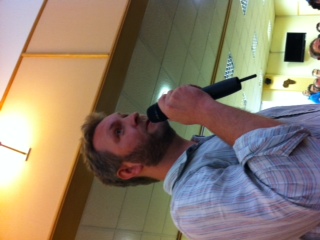
As Ashley ward’s first Green Party councillor, Gus Hoyt, (pictured) has said the media has framed the debate: Against the riot = For Tesco. It’s more bigger-picture than that and why he is calling for independent public inquiry.

At the meeting, I heard about a move to make it harder for squatters to squat legally.

Harder for people with no home – and no hope of a home – to make a temporary home in one lying empty.

Homes lying empty, as I learnt at the meeting, so they can increase in value for their owner. Such as Westmoreland House.  “A death trap” someone called it.

One of the Bristol City Council representatives told us the council had asked the government for retail classification A1 to be changed. Currently the same classification applies to both a supermarket chain and a one-off local shop.

Eric Pickles, the Conservative minister, replied with no. “…Not its role to restrict competition.”

Ha. It’s supermarkets that restrict competition. They buy cheap, sell cheap. They only need to take a small percentage of a local shop’s business to sink it.

The profit a small shop makes is tiny.

But is economic power the only measure of success? Local independent shops create community. They support wholesalers and the local economy.

Money spent locally is worth more locally than when it is spent in a supermarket because it is recycled locally.

However, it does not take long for local shops to wither. Look at Tesco on Golden Hill. A row of small shops closed and Tesco’s promises broken: not to open on a Sunday; not to have a cafe.

Head of Property Communications, Michael Kissman, arrived late at the neighbourhood meeting.

Pity. He did not hear the majority of the Stokes Croft audience eloquently voice  love for their local community – without a Tesco, thank you.

(One said: “We don’t want Tesco. And we don’t want the police protecting Tesco.”)

However Tesco’s Michael Kissman did hear people after the meeting asking him for Tesco’s support for impoverished local groups.

And at least I got an answer to my question: Where did the figure of 3,000 people, that Tesco claimed walked through Tesco, Cheltenham Road in Stokes Croft store in its first weeks of trading, come from?

Answering my question via the chair, Tesco’s Michael Kissman, said these 3,000 customers were, in fact: “3,000 transactions”. O.

No mention was made at the neighbourhood meeting of Tesco reopening the following morning. But open it did at 7 am on the 24 May.

Lot of media interest, I gave three interviews that day, including to Radio Bristol (1:40 mins in, after Michael Kissman, who was given the final word.)

Tesco claimed 400 customers came on its first day of opening but hmmnnnnn.

Looked pretty empty when I took the pic at 3pm.

Tesco can afford to stay half-empty (like the Tesco five minutes away in the Gloucester Road), playing the waiting game while local shops close.

On a more positive note, there may be another chance to review the planning process concerning Tesco’s traffic impact on Cheltenham Road. The  No Tesco in Stokes Croft campaign has won the right to appeal against the decision to not grant a Judicial Review (the rejection came coincidentally after Good Friday).

We plan a fluffy good-humoured self-contained lawful protest in front of Tesco’s before we set off on Wednesday 15 June for the 2 pm hearing in Cardiff .

And the Stokes Croft People’s Supermarket readies itself in the wings.

I’ll drink a glass of homemade foraged elderflower cordial to that.

Homemade elderflower cordial

A revelation. I did not realise how easy it is to make.

You soak the elderflower blossom in water with sugar for two days, covered with a lid. Then strain through muslin or a sieve. Then pour into clean bottles.

Second revelation: how the scent fills a room. Light fresh notes, as I snip the blossoms off their stems into a vat of hot sugared water.

Elderflower blossom is plentiful now.

Mike picked a plastic bag-full.

We added two pots of organic pear preserve  – as the Elemental Sanctuary’s Carole Fofana advised. I have some brown muscavado sugar. About 500g.

We estimate six pints of water. Mounds of elderflower blossom take up most of the room in the pan. I reckon our version has more blossom and less sugar than most recipes (hence its deliciousness).

The only technical bit is straining it through a sieve covered with muslin (organic muslin £2 from Born).

For more precision, see the Self-Sufficient-ish elderflower cordial recipe.

Lemon juice will preserve it but requires more sugar to sweeten the taste. We do not use lemons (or citric acid) or lots of sugar, and the cordial is not too sweet and has the heady taste of nature.

Third revelation:  homemade elderflower cordial tastes amazing.

I am drinking some now.

It tastes how elderflower blossom smells. And somehow feels substantial – nourishing.

Elderflowers are nutrient-rich and immune-boosting.

Not nutrients added artificially, or over-processed thus inneffective.

I often dream of going into a bar and ordering a health-giving revitalising drink.

Homemade elderflower cordial is that dream-drink: it has natural vitality.

(To think Coca-Cola had the cheek to call itself: The Real Thing).

I glimpse the satisfaction of foraging. It’s unmediated.

Nothing between me and something growing on a tree.

Stokes Croft Tesco opens and butter bean salad


It’s hard to be happy about the 41st Tesco opening in Bristol (figure according to Tesco’s store locator).

93% of 500 locals surveyed had said No to Tesco’s in Stokes Croft. After over a year’s campaigning, it was bitter to see Bristol City Council bow to Tesco pressure last December.

Still, we are making the best of it.

On Friday 16 April, Tesco opened in Stokes Croft.

Friendly activists gave a Bristol-style welcome. They put a comfy sofa and lampshade outside on the pavement. Someone played a guitar.

Another strode into Tesco’s with a wad of Monopoly money. When he was not allowed to spend it, he tried to bribe a security guard with it.

A woman passer-by who also objected to Tesco’s monopoly, took up the Monopoly money-action.

On Saturday, a performer (see pic above) invited us in to ‘his’ Tesco, while outside on the pavement, stalls served free food, and promoted Picton Street’s local independent shops, in the street behind the dreaded Tesco.

Picton Street is a marvel, and includes the Bristolian Cafe, Yogasara yoga studio, vintage dress shops, an art gallery, Radford Mill organic farm shop and Licata, the family-owned Italian delicatessen.

Licata often has great bargains in olive oil and tins of beans. I am crazy about beans as they are a wonderful source of health. Licata has many variety of tinned beans, which to me = fast food.

I owe everything I know about beans to vegetarian hero, Rose Elliot. The Bean Book changed my eating habits for life.

The following recipe comes from there. Please consult The Bean Book for measurements, nutritional facts and top inventive recipes using dried beans and pulses.

Here is my sloppy fast-food version.

Gently fry sliced fresh mushrooms in (olive) oil so they are still succulent. Add a tin of drained butter beans and warm with the mushrooms. Add lemon juice squeezed from two lemons and chopped fresh herbs such as parsley or coriander. You can’t have too many fresh herbs so over-estimate. Mix it all in the frying pan, with salt to taste, and serve still warm with brown rice, or cold as a salad.

I used organic ingredients from Better Food organic supermarket, a 20-minute walk away from Tesco’s, and land cress as the fresh herb.

Rose Elliot’s recipe fries fresh cut-up garlic with the mushrooms and adds cumin spice, with coriander as the fresh herb.

PS I met a neighbour on Saturday who said she had to buy something at Tesco’s in Stokes Croft, and I am haunted by her anxious look.

So, just so you know: If it makes life easier to shop there, then do. Life’s too short for guilt and sacrifice.

I am not against people who use Tesco. I am against Tesco.

Bread – what’s left unsaid


Look, if you are not in the mood for cooking (a state I know) then make sure basics, such as bread, are doing you good.

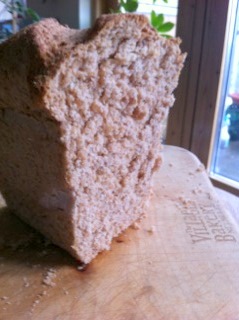
Bread gets messed-around with. This sticky label, from the 2009 Real Food Festival, lists ingredients that might be found on bread – but are never listed.

The label said:

~~~~~~~~~~~~~~~

“!!!WARNING!!!

This ‘bread’ may be made using the following:

Amylase, hemicellulase, phospholipase, peptidase, xylanase, protease, oxidase and other enzymes, some of animal or GM origin.

The law says bakers don’t need to declare them.

DISCLAIMER

These stickers are only for use in your own home. The Real Bread Campaign, Sustain and The Real Food Festival take no responsibility for any consequences, legal or otherwise, of you using them elsewhere such as wrappers of factory bread, supermarket shelves or advertising posters.”

~~~~~~~~~~~~~~~~

As Michael Pollan says: if they are more than five ingredients on a label, avoid.

The long list of enzymes above are “processing aids”. In other words they are used to make the bread rise faster, look nicer, last longer.

But because these processing aids are not classified as food ingredients then – by law – they do not need to be listed on the label.

Whaaat? You eat them but they are not food ingredients?

It reminds me of adulterated food sold to the Victorian poor

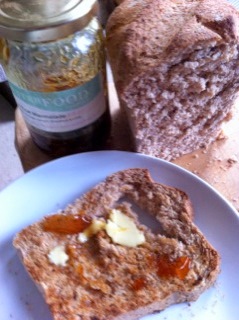
My real bread came from the Better Food Company in St Werburgh’s, Bristol where I also got marmalade made by their chef (as good as homemade…hey, it’s January, time for marmalade-making again) and organic butter from Nature’s Genius in Fishponds, Bristol.

Yes, the bread cost more than supermarket bread but I got more food for my cash. My grandmother would say money spent on un-nutritious food is money wasted. And I agree. Do you?

Quick carrot soup

Grab organic carrots and small onion from organic veg box. Wash or peel carrots; top, tail and skin onion.

Carrots take longer to cook than onions. Cut the onions as usual but cut carrots thinly – the smaller the bits, the quicker they cook.

Simmer veg in butter or (olive) oil. Enough to comfortably coat the veg. (suggest half ounce of butter/1.5 tablespoon oil).

If you have this spice, add a teaspoon of ground coriander or coriander seeds, crushed. Then a mugful and a half of milk or plant milk. Bring to the boil and simmer for 15 minutes or until the carrots are soft.  Season with black pepper, generously, and salt, carefully – start with a quarter of a teaspoon, then taste-test.

My favourite kitchen implement is a hand blender which is about £20 new or can be found in charity shops as my current one was.

So I whizzed the carrot soup and that is why it has that bubbly look in the photo.

It tasted sweet and creamy.

As I cooked, I thought of a blog I had just read.

Alberto Gonzalez, the founder of GustOrganics, New York’s 100% organic restaurant, writes on Maria Rodale’s Maria’s Farm Country Kitchen:

“We live in the most powerful country in the world.  However, America’s food system is probably one of the weakest on earth….About 98% of the food grown in America comes from factory farming.”

Recently, BBC TV’s Panorama investigated the power of supermarkets – four control 80% of the UK’s food.

Supermarkets and factory farming are intrinsically linked.

The soulless rows of biscuits brands, cabinets of ready meals, chemically sprayed salads and trays of birds that never saw the light of day are all the product of factory farming.

The land, animals and farmers bear the true cost to make the price seem cheap – but the profits real. Supermarkets make 55 p for every pound we spend, according to Panorama.

It’s a gloomy January day, the sky thick-grey again.

But humans tend towards balance, not extremes, and I see hopeful signs with this Guardian news report:

Ethical consumer spending bucks recession with 18% growth.

UK ethical sales have grown nearly 20% in the last two years, according to a Coop bank report .
People care about fair wages for farmers – Fairtrade food has grown by 65% to £750 m.
People care about their health and the planet’s – organic food is still strong at £1.7 bn having settled from 30% to 14% growth.
Eco and organic cosmetics and clothing now equal organic food’s pre-recession sales, and also grown 30%.
These figures show people do care about the bigger picture.
What are your hopeful glimmers of light?

Top Chef DC – real-life reality food


Back in the UK.

Blog-mind filled with unwritten posts.

Like that Tuesday in Washington DC.

We’d been on the Amtrak train since 5.30am Sunday morning

– passed Gallup and our Dine (Navajo) friends (another blog to come)

– woke that morning in Kansas station where I stretched my legs in the light and sun

– ate three meals a day in the dining car and watched Amerika‘s gigantic land roll by.

Planned to do the tourist thing at Washington DC.

Its railway station heralded grandeur.

But by the time we reached our hostel, we were exhausted.

After two days of train-rocking, all we wanted was stillness.

A night-in.

What a night-in!

Turned out we were in the funkiest hostel in the funkiest part of town.

On a empty parking lot, surrounded by modern neighbours, the 19th century wood-panelled brick house with sash windows (first sash windows in six weeks of US travel!) that had belonged to the National Advancement of Colored People.

To add to the hostel’s homeliness, a shared (modern, paint-white) kitchen.

A good place for gossip: a TV journalist showed us a picture on his phone of David Cameron’s visit that day to the White House.

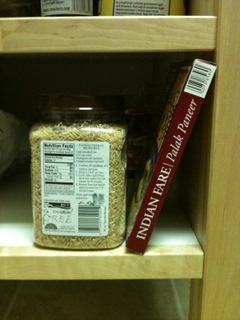
While cooking my staple stand-by, brown rice, I found a unopened packet of interesting Indian spices and spinach from Trader Joe’s. A previous guest had labelled it: “to share”.

I debated with myself: was it selfish or unselfish to use it?

A young Danish guest urged me to. He said I reminded him of his mother, also a brown rice ex-hippy. (And like my children would have done, encouraging me to think of myself).

Enter the hostel manager, Kevin, who turned out to be a would-be blogger for the hostel (and I about to give a social media workshop when I got back to the UK) and into real food.

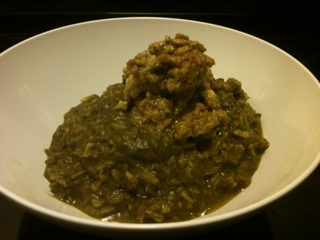
So we shared the brown rice and spicy spinach, and Kevin invented a crunchy-soft topping of avocado and peanut butter. Like most home concoctions, its looks belie its taste.

Since arriving in the US, six weeks before, I had been watching reality TV show, Top Chef DC, marvelling how the US,  as mired as the UK in obesity and junk food, is as obsessed as the UK with food on TV.

Now I was in the foodie capital, eating the kind of spontaneous, messy, healthy, tasty concoction I would eat at home.

And here’s a picture of my bowl of porridge the next morning – real-life reality food, and my take on Top Chef DC.

Thank you, Capital View.

Carrot cake at the Grand Canyon

I ask the Grand Canyon rancher: “What is the trail for the scaredy-cats with no heads for heights?”

Nonplussed, she sends us to the start of the Bright Angel trail.

Looks steep and scary to me.

I do not dare take in the view. Just focus on my feet.

Try to ignore the images of pitching headlong over the edge which my mind is generously supplying.

We see a zag of lightning.

Thunder hollers in the canyon.

Anxiety about heat exhaustion (it was 100 degrees when we started) is replaced by fear of being struck by lightning.

Fat plops of rain fall.

When we reach the Mile-and-a-half shelter, I am soaked. Chilly.

Three US students and a  family from Amsterdam are also sheltering. We commiserate over Holland losing the World Cup.

The students have been hiking since early morning.

They witnessed a helicopter rescue for a hiker with a scorpion bite. The helicopter took six hours to arrive, the rancher two.

Not enough money, say the students. The Grand Canyon is feeling the recession.

The rain stops.

We set off on our return journey up the trail.

Miraculously, my mind is no longer furnishing scenes of disaster.

I am no longer hugging the side of the rock.

I am taking in the view. And stride.  A miracle.

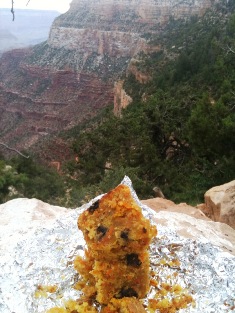
Time for the carrot cake’s photo-shoot (see pic above).

I baked it the night before, amalgamating and adjusting several recipes found on the web for the simplest.

Here it is before I forget it.

Whisk five small eggs (or four big ones) with 1+1/4 cups of sugar and 1+1/4 of organic coconut oil

Fold in 2 cups of organic flour and 2 teaspoons of cinnamon.

Plus 3 cups of grated organic carrot and some cut-up raisins.

Bake in a greased loaf tin for 1 hour at 350 degrees.

Insert a knife to check it is not wet when withdrawn. If wet, the cake is not sufficiently cooked.

Because of the high altitude (7,000 feet) of Flagstaff, the cake took another twenty minutes.

I concocted a separate topping of whisked organic tofu, lime juice and organic agave nectar (the un-organic kind is highly processed and not worth it).

The topping did not come with us to the Grand Canyon.

Unlike the brave carrot cake, that did.

Food I eat in the US

Leaving Las Vegas

on the US Asia bus (tip: cheaper than Greyhound bus).

I have my bag of provisions from New Frontiers. Organic roasted cashews, plums, bananas, chocolate almonds.

I had oatmeal porridge for breakfast in the Sahara hotel and casino on the Strip.

My palatial room with en-suite was only $28 a night. I could live cheaply in Las Vegas.

The vast lobby filled with a 100 gambling machines holds no temptation.

Nor does the food.

It is plentiful alright. But nothing I want.

I am in the land of GM.

No labelling on food. No choice.

My list of food I don’t want includes:
anything with corn in it – one of the native American ‘three sisters’, it is a prime victim of genetic modification.

That cuts out a lot including, sadly, tortillas.

I don’t want to be fussy about food.

But I know too much.

I can’t unknow that cattle are pumped with grain and hormones, or shrimp is laced with antibiotics, or the gene to resist the weedkiller Roundup Ready has been inserted into the corn plant’s cells.

Plus my delicate digestion is like a canary down a mine.

I had a rice drink in my first week from a cafe. Rice sounded nice. But the next day my bowels knew it. I think it was the high-fructose corn syrup.

As the US food writer, Michael Pollan, says:

If it comes from a plant, eat it, if it was made in a plant don’t.

I am in the land of the overfed – and I am losing weight.

How ironic.

PS Just after writing this moany blog,  the bus stopped mid-desert. I eschewed McDonald’s and plumped for Chinese fast food. Joy! I rate Panda Express.

Eat organic – reduce carbon

Today I met my friend and ex-Soil Association colleague, Gundula Azeez, for lunch.

She wrote the Soil Association 2010 report, Soil carbon and organic farming.

I confess carbon used to confuse me.

As a journalist, my ignorance is my strength. If I can understand it, so can you.

Gundula kindly went back to basics for a beginner’s mind explanation.

Is carbon good or bad?

Carbon is both good and bad depending on where it is.

When it is in the soil, or locked up in oil and coal, it’s good.

When it’s in the atmosphere, it’s bad.

Carbon-in-the-air i.e. carbon dioxide is something we need to breathe OUT.

In the case of current planetary concerns, rising levels of carbon dioxide (or CO2) create rising greenhouse gases – too much of which contributes to climate change.

(Sentence rewritten following Georgie’s comment below).

Organic farming and the carbon cycle

Plants remove carbon from the atmosphere by breathing IN carbon dioxide.

That’s good.

When plants decay, the carbon is stored in the soil.

That’s good too.

Organic farmers uses this natural cycle to replenish the soil.

According to the Soil Association report, if all UK farmland were converted to organic farming, at least 3.2 million tonnes of carbon would be stored in the soil each year – the equivalent of taking nearly 1 million cars off the road

Not only that – but when carbon is stored in the soil, it does a LOT of good.

That’s because it is stored as organic matter which retains nutrients, soil structure and water.

Organic farmers create more carbon-rich organic matter through their farming practices.

They grow green manures and add compost to enrich the soil.

Soil life

Introducing soil microbes, the tiniest creatures on earth that perform vital functions to keep the soil healthy.

These soil microbes are exterminated by chemical farming practices but are actually encouraged by organic farmers.

Soil micro-organisms are essential to life on earth.

They help deliver nutrients to the growing plant.

They help it decompose when it is dead.

Thus creating more organic matter and its carbon-storage capacity.

Clods of earth

The soil actually clumps – or aggregates – around the carbon to protect it.

This delicious crumbly soil also provides a holding place for water, nutrients and air.

Which is why majority-world countries benefit from organic farming practices because they increase yield, and create water-retaining soil.

This gives developing countries more economic independence too.

They don’t have to pay the West for chemicals to feed the soil because organic farming does it naturally – by using the planet’s natural carbon cycle.

Lunch at Saint Stephen’s cafe

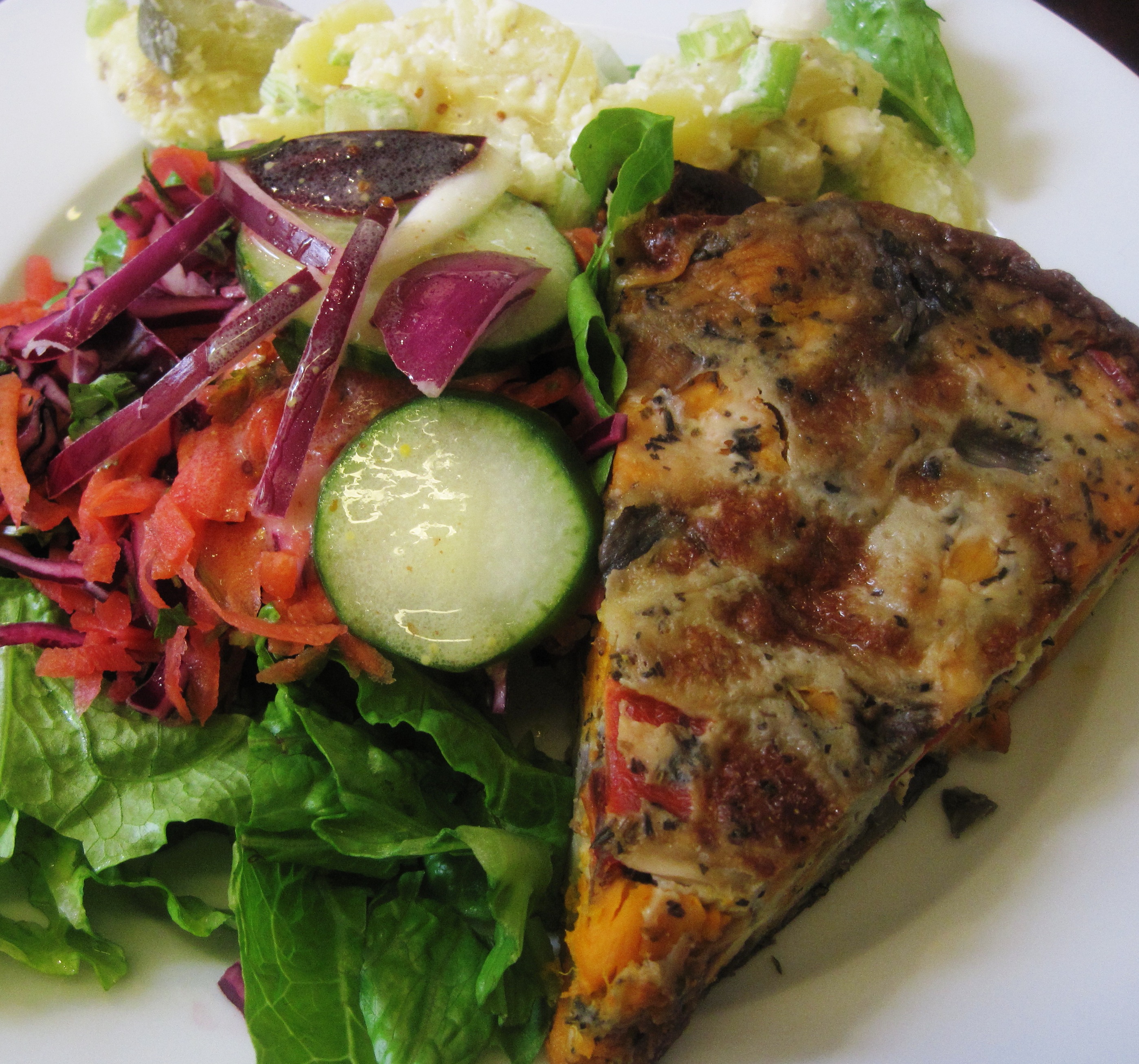
I had sweet potato frittata and salad – pictured – at Saint Stephen’s cafe.

The food is amazing – home-cooked and organic, seasonal, fair trade and local where possible.

Saint Stephen’s church cares deeply about the environment and this is reflected in its cafe food, conceived by one of Bristol’s best cooks, Edna Yeffet Summerel.

Nice to know when I eat organic food that I am enriching the soil and helping store carbon…