Category Archives: sustainable

Tesco re-opens and elderflower cordial

After being “trashed” in the early hours of Good Friday 22 April, Tesco re-opened on the 24 May following a neighbourhood meeting the night before.

Monday 23 May 6.30pm: St Paul’s Unlimited neighbourhood meeting.

This excellent Guardian feature gives some background to the intensity of emotion present.

People with complaints against the police (“Why was extreme force used? Why was my arm broken by thugs in police uniform and three dogs attacked me?” asked one man).

The police was represented by Chief Superintendent, John Stratford, who listened well. Clearly, he was not a riot-type with batons and adrenaline-pumping, lashing-out fear.

Someone in the audience who’d been a policeman for 30 years – now an artist with a studio in Stokes Croft – said he was holding a riot shield in the St Paul’s 1981 riot. And scared.

A woman describing herself as a “lone voice” showed support for Tesco. Sadly, she mixed-up the riot with the campaign to stop Tesco opening. Not true.
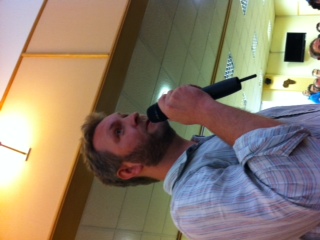

As Ashley ward’s first Green Party councillor, Gus Hoyt, (pictured) has said the media has framed the debate: Against the riot = For Tesco. It’s more bigger-picture than that and why he is calling for independent public inquiry.

At the meeting, I heard about a move to make it harder for squatters to squat legally.

Harder for people with no home – and no hope of a home – to make a temporary home in one lying empty.

Homes lying empty, as I learnt at the meeting, so they can increase in value for their owner. Such as Westmoreland House.  “A death trap” someone called it.

One of the Bristol City Council representatives told us the council had asked the government for retail classification A1 to be changed. Currently the same classification applies to both a supermarket chain and a one-off local shop.

Eric Pickles, the Conservative minister, replied with no. “…Not its role to restrict competition.”

Ha. It’s supermarkets that restrict competition. They buy cheap, sell cheap. They only need to take a small percentage of a local shop’s business to sink it.

The profit a small shop makes is tiny.

But is economic power the only measure of success? Local independent shops create community. They support wholesalers and the local economy.

Money spent locally is worth more locally than when it is spent in a supermarket because it is recycled locally.

However, it does not take long for local shops to wither. Look at Tesco on Golden Hill. A row of small shops closed and Tesco’s promises broken: not to open on a Sunday; not to have a cafe.

Head of Property Communications, Michael Kissman, arrived late at the neighbourhood meeting.

Pity. He did not hear the majority of the Stokes Croft audience eloquently voice  love for their local community – without a Tesco, thank you.

(One said: “We don’t want Tesco. And we don’t want the police protecting Tesco.”)

However Tesco’s Michael Kissman did hear people after the meeting asking him for Tesco’s support for impoverished local groups.

And at least I got an answer to my question: Where did the figure of 3,000 people, that Tesco claimed walked through Tesco, Cheltenham Road in Stokes Croft store in its first weeks of trading, come from?

Answering my question via the chair, Tesco’s Michael Kissman, said these 3,000 customers were, in fact: “3,000 transactions”. O.

No mention was made at the neighbourhood meeting of Tesco reopening the following morning. But open it did at 7 am on the 24 May.

Lot of media interest, I gave three interviews that day, including to Radio Bristol (1:40 mins in, after Michael Kissman, who was given the final word.)

Tesco claimed 400 customers came on its first day of opening but hmmnnnnn.

Looked pretty empty when I took the pic at 3pm.

Tesco can afford to stay half-empty (like the Tesco five minutes away in the Gloucester Road), playing the waiting game while local shops close.

On a more positive note, there may be another chance to review the planning process concerning Tesco’s traffic impact on Cheltenham Road. The  No Tesco in Stokes Croft campaign has won the right to appeal against the decision to not grant a Judicial Review (the rejection came coincidentally after Good Friday).

We plan a fluffy good-humoured self-contained lawful protest in front of Tesco’s before we set off on Wednesday 15 June for the 2 pm hearing in Cardiff .

And the Stokes Croft People’s Supermarket readies itself in the wings.

I’ll drink a glass of homemade foraged elderflower cordial to that.

Homemade elderflower cordial

A revelation. I did not realise how easy it is to make.

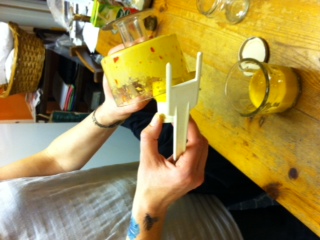
You soak the elderflower blossom in water with sugar for two days, covered with a lid. Then strain through muslin or a sieve. Then pour into clean bottles.

Second revelation: how the scent fills a room. Light fresh notes, as I snip the blossoms off their stems into a vat of hot sugared water.

Elderflower blossom is plentiful now.

Mike picked a plastic bag-full.

We added two pots of organic pear preserve  – as the Elemental Sanctuary’s Carole Fofana advised. I have some brown muscavado sugar. About 500g.

We estimate six pints of water. Mounds of elderflower blossom take up most of the room in the pan. I reckon our version has more blossom and less sugar than most recipes (hence its deliciousness).

The only technical bit is straining it through a sieve covered with muslin (organic muslin £2 from Born).

For more precision, see the Self-Sufficient-ish elderflower cordial recipe.

Lemon juice will preserve it but requires more sugar to sweeten the taste. We do not use lemons (or citric acid) or lots of sugar, and the cordial is not too sweet and has the heady taste of nature.

Third revelation:  homemade elderflower cordial tastes amazing.

I am drinking some now.

It tastes how elderflower blossom smells. And somehow feels substantial – nourishing.

Elderflowers are nutrient-rich and immune-boosting.

Not nutrients added artificially, or over-processed thus inneffective.

I often dream of going into a bar and ordering a health-giving revitalising drink.

Homemade elderflower cordial is that dream-drink: it has natural vitality.

(To think Coca-Cola had the cheek to call itself: The Real Thing).

I glimpse the satisfaction of foraging. It’s unmediated.

Nothing between me and something growing on a tree.
Stokes Croft Tesco opens and butter bean salad


It’s hard to be happy about the 41st Tesco opening in Bristol (figure according to Tesco’s store locator).

93% of 500 locals surveyed had said No to Tesco’s in Stokes Croft. After over a year’s campaigning, it was bitter to see Bristol City Council bow to Tesco pressure last December.

Still, we are making the best of it.

On Friday 16 April, Tesco opened in Stokes Croft.

Friendly activists gave a Bristol-style welcome. They put a comfy sofa and lampshade outside on the pavement. Someone played a guitar.

Another strode into Tesco’s with a wad of Monopoly money. When he was not allowed to spend it, he tried to bribe a security guard with it.

A woman passer-by who also objected to Tesco’s monopoly, took up the Monopoly money-action.

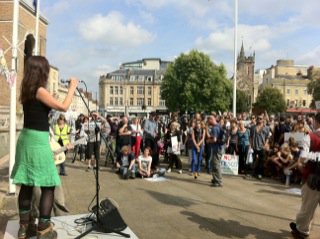
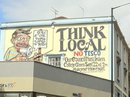
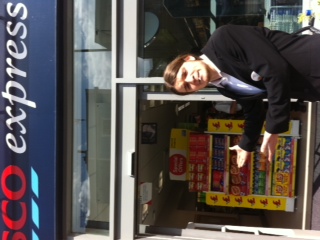
On Saturday, a performer (see pic above) invited us in to ‘his’ Tesco, while outside on the pavement, stalls served free food, and promoted Picton Street’s local independent shops, in the street behind the dreaded Tesco.

Picton Street is a marvel, and includes the Bristolian Cafe, Yogasara yoga studio, vintage dress shops, an art gallery, Radford Mill organic farm shop and Licata, the family-owned Italian delicatessen.

Licata often has great bargains in olive oil and tins of beans. I am crazy about beans as they are a wonderful source of health. Licata has many variety of tinned beans, which to me = fast food.

I owe everything I know about beans to vegetarian hero, Rose Elliot. The Bean Book changed my eating habits for life.

The following recipe comes from there. Please consult The Bean Book for measurements, nutritional facts and top inventive recipes using dried beans and pulses.

Here is my sloppy fast-food version.

Gently fry sliced fresh mushrooms in (olive) oil so they are still succulent. Add a tin of drained butter beans and warm with the mushrooms. Add lemon juice squeezed from two lemons and chopped fresh herbs such as parsley or coriander. You can’t have too many fresh herbs so over-estimate. Mix it all in the frying pan, with salt to taste, and serve still warm with brown rice, or cold as a salad.

I used organic ingredients from Better Food organic supermarket, a 20-minute walk away from Tesco’s, and land cress as the fresh herb.

Rose Elliot’s recipe fries fresh cut-up garlic with the mushrooms and adds cumin spice, with coriander as the fresh herb.

PS I met a neighbour on Saturday who said she had to buy something at Tesco’s in Stokes Croft, and I am haunted by her anxious look.

So, just so you know: If it makes life easier to shop there, then do. Life’s too short for guilt and sacrifice.

I am not against people who use Tesco. I am against Tesco.

Fay’s fish soup with fennel

My mother is the original Real Food Lover. She says the original Real Food Lover was her mother. Because this is how we learn about food: from the people close to us.

My mum always says the best education you can give a child is to educate the palate.

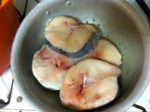
My mum bought this hake the day before at Tachbrook Street market, Victoria, where my dad used to be a one-man GP.

Here is a link to a video of my mum explaining to my eldest daughter how to make fish soup.

It starts with the drama of stopping the fishmonger from throwing away fish-heads:

“‘I’ll have the head!'” she cries. “He was going to throw it into the bin,” she says, with disbelief.

My mum makes the stock from the (rescued) sea bass head and its bones, the head from the large hake from whence come the cutlets, as well as prawn shells.

She adds bay leaf and peppercorns, with just enough water to cover, and cooks it for twenty minutes, with the lid on.

Here is a video of my mum agonising over how much water she used and describing the importance of a lid.

She remembers the way her mother cooked:

“Now, my mother used to tilt the lid – her soups were never watery…But I don’t trust myself.”

While the stock is simmering, she sweats the fennel and leeks in olive oil.

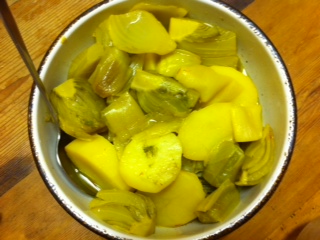
After twenty minutes, she drains the stock, keeping the liquid, to which she adds quartered potatoes and a pinch of saffron which gives the soup the yellow-colour, and a delicate aroma.

Here are the drained remains of the fish head and bones after they have yielded their flavour to the liquid stock.

Fay pours the stock over the vegetables and cooks until tender but “not too tender,” she adds.

When she is ready to serve, she removes the vegetables with a slotted spoon.

Here are the saffron-coloured vegetables, removed temporarily from the saucepan.

Then Fay heats the stock and adds the fish.

You must never cook the fish too long.

According to my mum, her mother “used to scream down the ‘phone: “Don’t cook it too long.'”

What is too long?

What? You want measurements?

As my mum says: “Nothing is made to measure.”

Basically, as soon as the fish starts to gently flake, you take the fish off the heat.

It all depends on the thickness of the fillet, or, in this case, the hake cutlets. Five to ten minutes?

Here is my eldest daughter scooping out the rouille my mum made.

“You know how to make rouille?” My mother asks my eldest daughter.

With garlic, cloves and red chilli pepper – I’d better check that.

Geraldine  (added after publication) gives rouille recipe:

“The rouille will be made with crushed cloves of garlic and red chilli pepper, and mashed as you say into a paste made of stock soaked bread (instead of egg yolks).”

Fay adds bread soaked in the fish stock, then carefully drips-and-whirrs olive oil to make a mayonnaise.

And you don’t just eat the meal. You have to analyse it in detail.

My mum remembers her parents discussing the make-up of every dish back in the 1930s.

And here we are, in the 21st century, still doing it.

Bread – what’s left unsaid


Look, if you are not in the mood for cooking (a state I know) then make sure basics, such as bread, are doing you good.

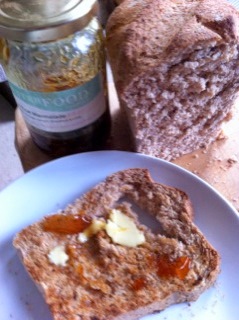
Bread gets messed-around with. This sticky label, from the 2009 Real Food Festival, lists ingredients that might be found on bread – but are never listed.

The label said:

~~~~~~~~~~~~~~~

“!!!WARNING!!!

This ‘bread’ may be made using the following:

Amylase, hemicellulase, phospholipase, peptidase, xylanase, protease, oxidase and other enzymes, some of animal or GM origin.

The law says bakers don’t need to declare them.

DISCLAIMER

These stickers are only for use in your own home. The Real Bread Campaign, Sustain and The Real Food Festival take no responsibility for any consequences, legal or otherwise, of you using them elsewhere such as wrappers of factory bread, supermarket shelves or advertising posters.”

~~~~~~~~~~~~~~~~

As Michael Pollan says: if they are more than five ingredients on a label, avoid.

The long list of enzymes above are “processing aids”. In other words they are used to make the bread rise faster, look nicer, last longer.

But because these processing aids are not classified as food ingredients then – by law – they do not need to be listed on the label.

Whaaat? You eat them but they are not food ingredients?

It reminds me of adulterated food sold to the Victorian poor

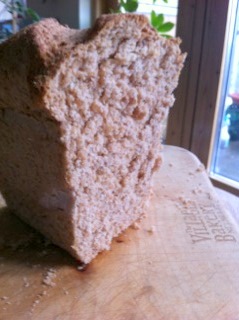
My real bread came from the Better Food Company in St Werburgh’s, Bristol where I also got marmalade made by their chef (as good as homemade…hey, it’s January, time for marmalade-making again) and organic butter from Nature’s Genius in Fishponds, Bristol.

Yes, the bread cost more than supermarket bread but I got more food for my cash. My grandmother would say money spent on un-nutritious food is money wasted. And I agree. Do you?

Quick carrot soup

Grab organic carrots and small onion from organic veg box. Wash or peel carrots; top, tail and skin onion.

Carrots take longer to cook than onions. Cut the onions as usual but cut carrots thinly – the smaller the bits, the quicker they cook.

Simmer veg in butter or (olive) oil. Enough to comfortably coat the veg. (suggest half ounce of butter/1.5 tablespoon oil).

If you have this spice, add a teaspoon of ground coriander or coriander seeds, crushed. Then a mugful and a half of milk or plant milk. Bring to the boil and simmer for 15 minutes or until the carrots are soft.  Season with black pepper, generously, and salt, carefully – start with a quarter of a teaspoon, then taste-test.

My favourite kitchen implement is a hand blender which is about £20 new or can be found in charity shops as my current one was.

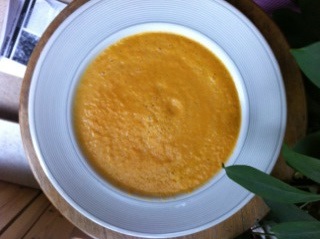
So I whizzed the carrot soup and that is why it has that bubbly look in the photo.

It tasted sweet and creamy.

As I cooked, I thought of a blog I had just read.

Alberto Gonzalez, the founder of GustOrganics, New York’s 100% organic restaurant, writes on Maria Rodale’s Maria’s Farm Country Kitchen:

“We live in the most powerful country in the world.  However, America’s food system is probably one of the weakest on earth….About 98% of the food grown in America comes from factory farming.”

Recently, BBC TV’s Panorama investigated the power of supermarkets – four control 80% of the UK’s food.

Supermarkets and factory farming are intrinsically linked.

The soulless rows of biscuits brands, cabinets of ready meals, chemically sprayed salads and trays of birds that never saw the light of day are all the product of factory farming.

The land, animals and farmers bear the true cost to make the price seem cheap – but the profits real. Supermarkets make 55 p for every pound we spend, according to Panorama.

It’s a gloomy January day, the sky thick-grey again.

But humans tend towards balance, not extremes, and I see hopeful signs with this Guardian news report:

Ethical consumer spending bucks recession with 18% growth.

UK ethical sales have grown nearly 20% in the last two years, according to a Coop bank report .
People care about fair wages for farmers – Fairtrade food has grown by 65% to £750 m.
People care about their health and the planet’s – organic food is still strong at £1.7 bn having settled from 30% to 14% growth.
Eco and organic cosmetics and clothing now equal organic food’s pre-recession sales, and also grown 30%.
These figures show people do care about the bigger picture.
What are your hopeful glimmers of light?

St Werburgh’s City Farm Cafe at Christmas

I took this picture through the stained-glass window of St Werburgh’s City Farm Cafe at the weekend.

Bristol is a mega-city but blessed by pockets of seclusion – enchanted sanctuaries such as St Werburgh’s.

This little corner of green near the M32 shields the eco-self-build houses, the Wild Goose space,  the Climbing Wall, the Better Food Company, St Werbugh’s City Farm and Cafe and more, and, as my luck would have it, is a ten-minute walk through the allotments from home.

The icy-cold weather of late has been leavened by such pockets of warmth.

Last night, for instance, we went through powdery snow in the empty allotments to the wildness of a contact dance improvisation jam at the eco-built Wild Goose Space where I lay on the floor watching this compelling film, Baraka, then dropped by afterwards to St Werburgh’s City Farm Cafe for the drinks bit of the staff meal.

St Werburgh’s City Farm Cafe has Wifi and real coffee, and a splendid selection of heart-warming home-made dishes many made with produce from the adjoining City Farm.

It’s run by Leona Williamson – unassuming, hard-working and friendly. She and her team won the 2008 Observer Food Monthly award for outstanding ethical achievement, calling it the “ultimate green eatery…(using) not food miles but food yards”.

I wrote about the Cafe in 2008, and – see comments – received fierce rebuke for praising the Cafe’s use of animals from the Farm. I am with Simon Fairlie and the Soil Association on the meat issue. Although I passionately believe factory-farmed meat is wrong – over-produced, cruel, unhealthy, unsustainable and unnecessary – a few creatures on a family farm is another matter entirely.

Back to last night: I met Jack, and discovered he is the Ethicurean now running the Walled Garden Cafe at Wrington, Somerset. I remet (I know this sounds like a poncy eco-roll-call but it wasn’t really like that) Andy Hamilton, of the Self-Sufficientish Bible,  who is finishing a book (a brilliant idea and once O.K-ayed it, I will mention here…) (and it is Booze for Free – good innit?), and Jamie Pike from Co-Exist at Hamilton House, currently congregating food people to make creative use of a communal kitchen at Hamilton House in Stokes Croft.

We talked about the recent Tesco planning fiasco and the importance of creating alternatives (as Jamie and co has done at Hamilton House).

As we left, Leona gave us a bottle of refreshing homemade rosemary and apple cordial from (very) local produce.

St Werburgh’s City Farm Cafe is now closed for Christmas until 15 January.

Apparently Baraka (the movie) means: blessings in a multitude of languages, and this is appropriate, as I felt blessed indeed as we walked home through the moonlit snow.

Tesco in Frome? Meeting 1 Dec 2010

Frome is a delightful market town.

I lived there for ten years in the 1980s bringing up small children and working as a National Childbirth Trust (NCT) teacher.

A bunch of us set up the Frome NCT playgroup, while another bunch of us – the West Country Childbirth Group – founded the birthing room in nearby Bath.

Back then, there was Safeways (only one) and a cattle market every Wednesday in the market place.

Now the cattle market has moved out-of-town and Frome is awash with supermarkets.

And now Tesco has plans to invade of Frome’s historic Saxon Vale.

Whaaaat? Another unwanted soulless hypermarket in this precious town with its thriving Artisan market and independent shops?

There will be a public meeting on Wednesday 1 December 2010 at 7.30pm at the Cheese and Grain in Frome.

John Harris, Guardian journalist, will be speaking at the meeting.

[PS He wrote brilliant article published 1 December 2010 and pledged at the meeting to fight Tesco and plot positive alternatives added 9 Dec]

The very successful Transition group, Sustainable Frome, will be involved.

I will be talking about what I have learnt from the No Tesco in Stokes Croft campaign.

Kevin McCloud of Channel 4’s Grand Designs will speak from the floor.

Too big Tesco

If you Google the two words: Tesco + Stop, you will see how many UK towns are using valuable energy trying to stop supermarkets, such as Tesco, destroying the fabric of their communities.

I am not against the odd Tesco supermarket, and I am certainly not against anyone who shops in Tesco.

But I do object to aggressive empire-building from food corporates with the power to overrule the wishes of councils and communities.

What do you think?

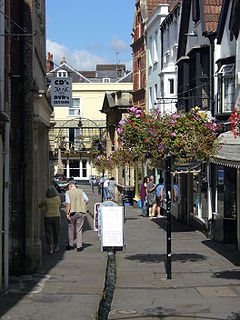
(Pic of Cheap St, Frome, from Wikipedia)

<h3>Update – added 9 December 2010</h3>

Over 300 locals attended the meeting and many people spoke, the vast majority directed at the developer, Quentin Webster, representing St James’s Investments Ltd.

The mood was overwhelmingly anti-Tesco and pro-local character and shops.

Quentin Webster took it well.

Halfway through the meeting, Quentin Webster said publicly: “I hate Tesco. I do.”

Publicly, I asked him why.

He said: “They are immoral as developers.”

He added St James’s Investments was a tempering force on Tesco.

And John Harris was a funny, acerbic and heart-stirring speaker.

Do we really need more meat?

We need to double food output by 2050.

Oh yeah?

Who says?

Monsanto and a few other agri-companies say so.

Not the most trusted sources, as far as I am concerned.

A far more trusted source, the organic charity, the Soil Association, believes that the message currently driving food-policy to “double food production by 2050” is based on a lie.

This call to double food production (convenient for agribiz) is based on a forecast that production of animal feed would need to increase by 70% in order to feed developing countries with the same fast-food junk that is making the west ill.

Apparently half the world’s crops are feeding animals not humans. This is nuts. Do we really need more meat?  If we ate less meat, we could use the crops to feed more humans.

The ideal organic vision is for a “closed” system – that is, where the animals are fed by crops grown on the farm, and in turn help fertilise the soil with their poo.

This is Simon Fairlie’s argument in his new book, Meat, which even persuaded George Monbiot that meat thus produced could be ethical.

A mixed farming system (crops+animals+poo all on the same farm) is completely different way of producing meat in factory farms – where the animals are treated as a commodities without sensibilities and their poo goes to waste (literally).

Carnivores – eat meat by all means – but in moderation (remember when we had chicken as a treat?) and from mixed organic farms.

I am at the launch of a new Soil Association report.

Peter Melchett, policy director, gives us the lowdown, starting with above context.

Feeding the animals that feed us is the first of several Soil Association reports on the future of farming including phosphate, water and oil.

Not promising answers – more starting a discussion.

Tesco fiasco

Yesterday Bristol City Council appeared to give Tesco what it wanted – planning permission for its red, white and blue shop front in OUR amazing and unique Stokes Croft.

Tesco does NOT however have permission to open a shop on Stokes Croft – see clarification below. (And my post after this)

After a rally (above), free food and music, over 200 supporters of the No Tesco in Stokes Croft trooped into the Council house.

Claire, Rachel and Sam – who have been working on this campaign for seven months and were representing over 2,000 people – got 7.5 minutes each to speak. I got 3 minutes. You need Internet Explorer to watch proceedings here.

Then we descended into two hours of planning law hell where we were actually banned from asking questions, or even pointing at a document that someone held aloft (we were only trying to be helpful as councillors did not seem to know the relevant page number).

At one point, the chair shhhhhed us, as if we were naughty children.

Not responsible citizens who care enough about our community to take a whole day out of our lives to sit in Council chambers.

Here is what struck me.

Tesco power.

Its shameless abuse of power.

Tesco steamrollers local councils all over the country, according to the Daily Mail.

Yesterday I saw it with my own eyes.

The horrible thing is does Tesco not have to do anything, or even turn up.

The stick Tesco wields is the fear that Tesco might appeal against a planning decision, costing local taxpayers’ money.

Tesco can afford a legal appeal – peanuts to the mighty corporate that makes nearly £3.5 billion a year.

The councillors could have ignored their planning officer – as they did in North Norfolk.  Tesco might not have appealed – Stokes Croft is already a Tesco PR nightmare.

But our council bowed to the bully.

Yesterday we saw the unedifying site of planning officers doing Tesco’s bidding.  And councillors – despite asking all the right concerned questions – voting for it.

The other thing I saw with my very eyes was how Tesco’s underhand trick of using a third-party to apply for planning permission worked.

Let me explain.

Last September 2009  Tesco applied for the premises in Stokes Croft to be turned from a comedy club to a shop. But sneakily – using a third-party.

Thus change-of-use to a shop was granted without anyone being aware that “shop” actually meant a Tesco store.

Here is how this dreadful trick worked in Tesco’s favour:

Yesterday in Bristol City’s council house, we expressed concerns about how a Tesco would increase traffic.  At least 42 deliveries a week can be expected on a street with a cycle lane. And how will a huge lorry negotiate the one-track cobblestoned Picton Lane?

However these genuine concerns for threats to life-and-limb were not considered significant. Why?

Because they were part-and-parcel of the “change-of-use to shop” decision back in September 2009.

i.e. based on the lie that the proposed Tesco store was an ordinary local shop.

This is a Tesco planning fiasco.

Clarification: The Council granted two applications yesterday – 1) shop front and 2) illuminated signage – with conditions such as wooden lettering. So the applications must return for Council approval.

The third application re external works was postponed until a noise assessment has been done.

In other words, Tesco does NOT have planning permission to open.

I repeat: Tesco does NOT have planning permission to open.

Organic Food Festival 2010, Bristol

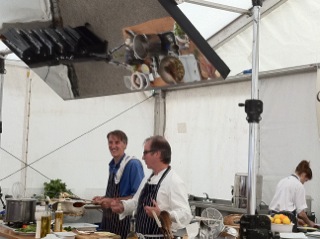
The Soil Association Organic Food Festival (see Demo kitchen above) now in its tenth year, lifts my spirits.

“79% of food we buy comes from just four shops,” says Real Food Festival’s Philip Lowery at the launch of Europe’s biggest organic food market.

The Organic Food Festival showcases real food producers who cannot be shoehorned into the supermarket-system, with its gargantuan requirement for uniformity.

After a week objecting to a multi-billion-backed Tesco (39th store in Bristol) in Stokes Croft, this is just what I need to revive my flagging spirits.

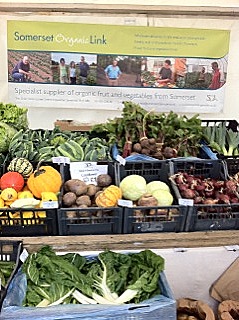
Somerset Organic Link displays freshly-harvested vegetables grown in carbon-rich organic soil without polluting the land with nitrate fertiliser.

And a variety of pumpkins you won’t find in a supermarket.

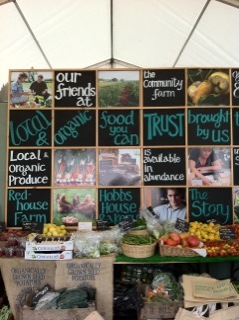
Better Food Company (a 20 minutes walk from the proposed Tesco) has a field outside Bristol supplying the shop with much of its seasonal local organic produce.

Better Food’s Community Farm is open to all, including helping in return for a share of the harvest.

I buy a spelt loaf from the Bertinet Bakery based in Bath.

Bertinet Bakery were exhilarated having just been awarded a Soil Association Organic Food award for Baked Goods by Hugh Fearnley-Whittingstall at the awards ceremony held earlier that day in At-bristol.

The theme of this year’s Organic Fortnight is Choose Organic Everyday.

According to the latest Soil Association market report on the recession-hit 2009, 33% of organic purchases are now made by shoppers including manual and casual workers, students, pensioners and people on benefits.

In other words, recession or not, people care about healthy food, where it comes from and how it was grown.

Some organic businesses in common with many non-organic ones were hurt by the recession – overall a near 13% decline in 2009 organic sales.

But  others resisted the downward trend: organic milk sales were up 1%, organic baby food up 21%. By 2010 UK farmland that is organic rises above 5% for the first time.

Junk food high in cheap fat, sugar and additives, or chickens raised in giant sheds  never seeing natural daylight – these are the product of an industrialised and centralised food system that profits shareholders – not the consumer.

Tesco and the other three supermarkets control over three-quarters of our food. They seek market-dominance and make vast profits – Tesco’s profits increased 12% in half-year profits to £1.6bn. [October 2010 figures added after blog was posted].

Supermarkets promise cheapness but it’s an illusion.

The costs are externalised – in other words, they are picked up elsewhere: rivers polluted by farm chemicals are cleaned by taxpayers’ money; obesity from eating junk food is paid for by the NHS. Farmers are squeezed; animals farmed inhumanely.

A shopping survey in Stokes Croft – the Bristol area currently fighting off a Tesco – shows food is cheaper in the local shops than Tesco Express.

Devon-based Riverford farm’s monthly price comparisons show the organic fruit and veg in its delivery box is on average 20% cheaper than supermarkets.

Can you imagine a world where the only food you can buy comes from industrialised food systems?

(Well, that is if oil supplies remain steady because if not we will be stuffed if we are relying on only four suppliers ferrying in food from afar).

Another – local organic – world is possible.

PS Thanks to Juliet Wilson for encouraging this post.

PPS Deadline for objecting to Tesco in Stokes Croft: 14 September.