Category Archives: recipe

Marmalade 2011

I made the marmalade early-Feb. Blimey, this blog is well-overdue.

So although not exactly hot-off-the-press, I want to record it because my last year’s marmalade-making post was useful when making this year’s. Like notes in a cookery book. See actual recipe, below.

Last year, as I made marmalade, Haiti’s earthquake was on my mind. This year, my mind was on Bradley Manning. The young soldier alleged to have leaked US documents to Wikileaks is being held in severe isolation in a US military prison. Bradley’s mother is Welsh so Amnesty is taking up his case as a British citizen.

Here’s how to donate to Bradley Manning’s public defense.

Back in early-Feb, I was also thinking about the trees. Privatising the nation’s woodlands? Wrong. Since then, there’s been a temporary reprieve in the face of public opposition. But don’t get complacent.

I was not the only one cooking and thinking about trees. Fairycakemother and Save Our Woods presented cakes on the day of the Opposition Day Debate to try to persuade MPs to go with their conscience, not their party whips.

Zac Goldsmith, Conservative MP, voted against his party and for the trees. Hooray. While making marmalade, I had a vision of the former-editor of the Ecologist leaving the Conservatives and joining the Green party. Glad to hear Zac Goldsmith is now working on green farming in all-party group including UK’s first Green MP, Caroline Lucas . I have met them both and feel in ma bones they are spiritually alligned.

The marmalade cast assembled on February 4 2011.

This year I reduced the sugar even further  to 1 lb of sugar to 1 lb of Seville oranges. It worked brilliantly. Chunky, tangy.

(Eeek I promised a US reader on Facebook to also use metrics. Gad, I wish I had a PA to do things like that, like converting measurements and stuff. My dream…. In the meantime, here is a converter.)

The recipe

5 lbs organic Seville oranges
5 lbs organic cane sugar
4 pints of water + 1 extra pint to extract the pectin

Marmalade-making has four stages.

1. Cooking oranges to soften

Scrub non-organic oranges (I used organic ones for health and the extra taste due to the fact organic produce has less water as nature intended) and remove the stalks. Cook in a large pan or two smaller ones – with lids – in 4 pints of water and simmer heartily for about an hour until peel is soft. Smells heavenly…

Drain oranges and cool, keeping the water for the sugar-boiling stage.

Put weighed sugar in a preserving pan (or two of your widest pans) in a low oven to warm. Clean jars thoroughly with hot water and dry them in the  oven.

Place a few saucers in the freezer so you can quickly cool a teaspoon of hot jam in Stage 3, the setting stage.

2. Extracting pectin and slicing peel

Cut cooked-cooled oranges in half. Scoop out pith and pips and add them to a pan with 1 extra pint of water and two cut-up lemons. Simmer merrily for ten minutes then drain: this pectin-rich liquid is used to help jam set in Stage 3.

Now cut up orange (and lemon) peel, thinly or thickly, as you like it.

3. Boil and set
Add the following to preserving pan: the drained pectin-juice, the water you used to boil the oranges, the cut-up peel and the  warmed sugar. It takes 15-20 minutes for the marmalade to set and you must not overboil or you can lose that magic-setting moment.

So says my trusted-over-twenty years (presciently-seasonal) Katie Stewart’s Times Calendar Cookbook.

But do not start timing until the jam is actually boiling like mad i.e. not just ordinary bubbles but when the liquid goes into a furious fast-boiling whirl – then start timing those 15-20 minutes.

It’s a bit like timing the start of labour – not from the first contraction – but from dilation. I think this gives a better reading on how long labour is and can prevent unnecessary inductions. But I digress.

So, after 15 minutes, take the pan off the heat and drop some hot jam on one of those icy-cold plates. Let jam-droplet cool, tilting plate to encourage cooling, then push droplet gently with your finger. You are looking for tell-tale wrinkles and jelly-like character. (The opposite of an ideal lover?).

If droplet is still runny, carry on boiling the big pan for a few minutes then test again. And so on.

Stage 4 – Marmalade in jars

The marmalade drops are now unequivocally set. So, let the jam cool in the pan until it is not-too-hot nor too-set for pouring . This is the sticky bit. Use newspaper to cover the kitchen surface, use a ladle or a small cup. And good luck!

Recipes say use waxed discs to keep out condensation and mould but, cutting-corners-cook that I am, I have not not done so for the last two years, with no adverse reactions. Wipe the jars from stickiness and proudly label.

I was a day too-late to send a jar off for the Marmalade awards.

Just as well because I did not want to part with any.

Real Food Lover postscript

By chance I was invited by GM Freeze to the second meeting of the green farming all party parliamentary group (mentioned above) on 15 March .

Security was tight at the Houses of Parliament and my marmalade, a gift for my mother, was held in temporary custody.

Dr Hans Herren spoke to a packed committee room.  He co-chaired the 2008 IAASTD report, the first-ever scientific assessment of global agriculture. Co-sponsored by the United Nations, the World Health Organisation and the World Bank, the International Assessment of Agricultural Knowledge, Science and Technology for Development report concluded that small-scale ecological farming was the answer to food prices, hunger and environmental disasters.

Dr Hans Herren’s message was one of passion and urgency – farming must become ecological as soon as possible.

Well, I was just sorry Cameron, Spelman and co were not there to hear his sound science-sense and Cassandra plea.

I collected my jar of marmalade from parliamentary custody and photographed it on the ramparts.

My mother was also pleased the organic marmalade made it to freedom as her note below attests.

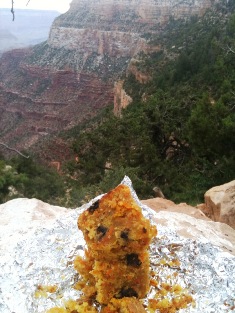
Carrot cake at the Grand Canyon

I ask the Grand Canyon rancher: “What is the trail for the scaredy-cats with no heads for heights?”

Nonplussed, she sends us to the start of the Bright Angel trail.

Looks steep and scary to me.

I do not dare take in the view. Just focus on my feet.

Try to ignore the images of pitching headlong over the edge which my mind is generously supplying.

We see a zag of lightning.

Thunder hollers in the canyon.

Anxiety about heat exhaustion (it was 100 degrees when we started) is replaced by fear of being struck by lightning.

Fat plops of rain fall.

When we reach the Mile-and-a-half shelter, I am soaked. Chilly.

Three US students and a  family from Amsterdam are also sheltering. We commiserate over Holland losing the World Cup.

The students have been hiking since early morning.

They witnessed a helicopter rescue for a hiker with a scorpion bite. The helicopter took six hours to arrive, the rancher two.

Not enough money, say the students. The Grand Canyon is feeling the recession.

The rain stops.

We set off on our return journey up the trail.

Miraculously, my mind is no longer furnishing scenes of disaster.

I am no longer hugging the side of the rock.

I am taking in the view. And stride.  A miracle.

Time for the carrot cake’s photo-shoot (see pic above).

I baked it the night before, amalgamating and adjusting several recipes found on the web for the simplest.

Here it is before I forget it.

Whisk five small eggs (or four big ones) with 1+1/4 cups of sugar and 1+1/4 of organic coconut oil

Fold in 2 cups of organic flour and 2 teaspoons of cinnamon.

Plus 3 cups of grated organic carrot and some cut-up raisins.

Bake in a greased loaf tin for 1 hour at 350 degrees.

Insert a knife to check it is not wet when withdrawn. If wet, the cake is not sufficiently cooked.

Because of the high altitude (7,000 feet) of Flagstaff, the cake took another twenty minutes.

I concocted a separate topping of whisked organic tofu, lime juice and organic agave nectar (the un-organic kind is highly processed and not worth it).

The topping did not come with us to the Grand Canyon.

Unlike the brave carrot cake, that did.

Easy-to-make spelt loaf

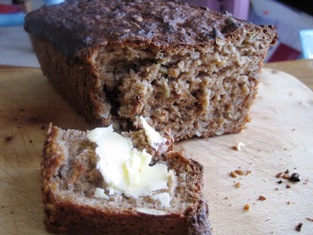
This is the most delicious bread I have baked in my life, ever – and the fastest.

Spelt bread has three great things going for it:

1. Wheat-sensitive types like myself find spelt easier-to-digest

2. Because it is spelt, you can get away with no-kneading because, as Rose Prince says in her recipe for white spelt, “Spelt, an ancient wheat grain, reacts quickly to yeast”.

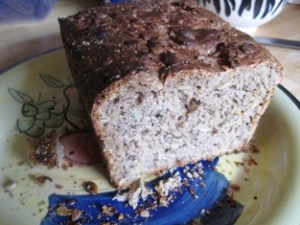
3. It tastes fantastic – the crust was seed-crunchy and the inside was moist and held together.

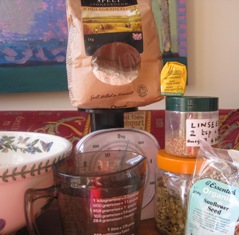
My leading characters:

Thank you to Julia for real-time baking advice, the recipe and the loaf we ate

while watching Life In The Fast Lane, about the 1990s M11 road protest.

Julia says you have to use real yeast to make it taste so good, and I did.

See Yeast ** further down for more info including using dried yeast.

Ingredients

1lb 2oz/ 500g spelt flour

½ tsp sea salt

2oz/ 50g pumpkin seeds

2oz/ 50g sunflower seeds

2oz/ 50g linseeds or sesame seeds

17floz/ 500ml warm water

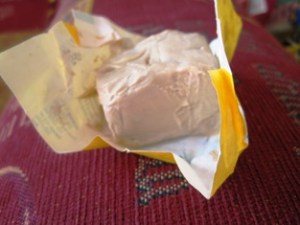
15-20g fresh yeast with 1 teaspoon of honey

a slosh of olive oil (or any oil)

Method after Julia

Add the fresh yeast and honey (1 teaspoon) to the warm water and leave it somewhere warm for 10 minutes to activate the yeast. Feel it gently fizz in your face as you peer into the jug – smells like beer brewing.

Mix the ingredients above – flour + salt + seeds + oil (and anything else such as chilli for a devilish spicyness) – in a large mixing bowl, adding the yeast/water last.

Grease two loaf tins with oil and scatter seeds to line.

Size of tins? One 2lb tin and one 1lb tin did the job for me but you can improvise.

Pour in the mixture and leave it to rise in the tins

– about 30 minutes rising-time.

If you leave it longer, dough-mixture might collapse.

Bake in an oven pre-heated to Gas Mark 6 / 200C / 400F  for 30 minutes.

Turn out and eat as soon as it cools.

(The recipe does tell you to return the loaf to oven for 5 minutes after removing it from tin but this did not seem necessary).

Yeast

It’s exciting – a living organism.

If using dried yeast see Xanthe Clay‘s recipe – which is even faster as there is no need to wait for dough-mixture to rise in the tin (although dried yeast does have additives).

How much fresh yeast to use? Rose Prince says use 7g (1/4oz) of fresh yeast for making a white spelt loaf. Julia says use about 15g.

By mistake I used 42g. Read on.

My yeast story

In my ignorance I used the entire packet of organic fresh yeast instead of a third as Julia recommended.

It got very dramatic as the dough-mixture rose and rose and spilled over the loaf tin.

Domestic-slut that I am

I scooped the spilled mixture and slopped it into another greased loaf tin.

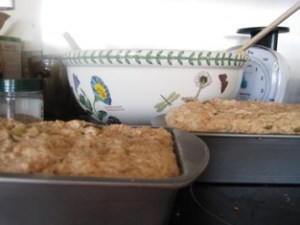
And let the mixture(s) rise again.

They behaved quite well this time, rising just-so – see pic below.

The bread was delicious and non-yeasty – maybe because the wholemeal spelt flour was strong enough to take the accidental extra yeast.

The moral of the tale?

You can make mistakes while cooking…

So to recap.

This spelt bread does not need kneading

making it fast to bake

Plus so damn delicious it’s also fast to partake.

Claudia Roden’s homemade falafel

The paparazzi caught me last Sunday buying herbs from the glorious Sweet Mart in Easton.

Easton in Bristol has three mosques, several churches, one synagogue and one Sikh temple

– in other words my sort of town.

Sweet Mart do mail order.

I was buying the herbs to make falafel for a family meal on Easter Monday.

I had spotted the recipe in my mum’s Claudia Roden international Jewish cookery book – I was very taken with it because it uses herbs, and butter beans instead of the traditional chick peas.

Here is my version of the wonderful Claudia Roden‘s recipe

Soak 500g of butter beans overnight and cook for a good hour.

Drain the beans (Claudia says pat them dry too)

Blend the drained beans in a food processor until they become a smooth puree.

Add chopped up onion and garlic, (Claudia says use 8 spring onions instead of onion) and ground spices such as chilli, ground cumin and coriander

(Claudia says 2 tsp of cumin and 2 tsp of ground coriander)

Add washed and drained herbs – I used fresh coriander, mint and fennel (see armfuls above).

Leave the paste for an hour or so to settle.

Then roll into balls

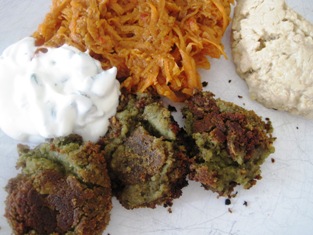
Deep fry and serve with homemade hummus, yogurt with garlic and mint, and grated carrot salad.

My falafel did not turn into hard crispy little balls. I think because

a) I used lots of herbs so they go too wet b) I hate deep-frying so did not use enough oil.

Despite not being crisp, they were

…DELICIOUS

(and even better cold at midnight).

Speedy spelt loaf recipe – not speedy roads

I am still on real bread, the topic of my last post.

Julia made the loaf in the picture above from a recipe in the Telegraph.

Apart from bread, Julia Guest, filmmaker extraordinaire, also made A Letter to the Prime Minister.

The documentary follows the British peace activist, Jo Wilding, in Iraq before and during the 2003 invasion.

Talking about films, I was round at Julia’s on Sunday to watch Life In The Fast Lane, a documentary she was involved with about the M11 road protest (1995).

The M11 sliced through three East London boroughs and tore apart communities – all for the sake of saving motorists three minutes of time.

The M11 road protest along with similar ones at Twyford and Newbury did not stop the roads being built.

However the cost of evictions – both financially and morally – eventually halted the then-mania for road-building.

This report by the Campaign to Protect Rural England (CPRE) shows new roads are not evaluated. And grandiose claims for reducing traffic appear not to have been realised. For instance, according to Countryside Voice, the CPRE magazine (summer 2006), the Newbury town centre peak-hour traffic flows are almost back to pre-bypass levels. And, “the actual damage to protected landscapes is even worse than expected.” [added 2012]

So while we were watching Life In The Fast Lane, we ate Julia’s homemade squash-from-her-allotment soup with the amazing bread. It was delicious – tasty and healthy.

I was blown away by Life In The Fast Lane:

– the local residents who helped patrol the squat including the 93-year-old resident made a squatter in her own childhood home

– the anguished cries of schoolschildren as the 250-year old chestnut tree was torn down by a digger (reminiscent of a scene from Avatar) and despite the protestors’ beautiful tree-top home

– the spectacular London rooftop shots of squatters who locked-on themselves to chimney pots with concrete and handcuffs to stop being evicted.

It was a real insider’s view of a mega-squat resisting the onslaught of so-called progress.

The M11 movie put me in mind of the eviction of the Tesco squatters.

Julia writes: “I make this with fresh yeast from the Better Food Company and less flour. Let it rise for just over an hour in the tin, then bake it.. but no kneading at all. I use a mix of any seeds I fancy…and the quantities vary. I also add a little olive oil to stop it sticking – as well as coating the tin in oil and then a coat of small seeds. Baking only takes about 30 minutes.”

Check out Julia’s inspiration, a spelt recipe by Xanthe Clay in the Telegraph using dried yeast and requiring no kneading or proving, and an earlier one by Rose Prince that ditto is fast.

For further inspiration visit Real Bread campaigner and master baker, Andrew Whitley, and author of much-recommended Bread Matters.

And for my real-life experience of Julia’s recipe see my blog on Easy-to-make spelt loaf – it works!

Surely a quick-to-make loaf is a better use of speed than an unnecessary road?

Making marmalade


Marmalade lovers, if you have only ever eaten shop-bought marmalade, you MUST try making homemade marmalade at least once in your life.

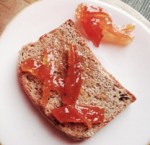
Last Sunday at 7.30pm, I committed myself to an evening of marmalade making so I could enjoy real marmalade on toast (above).

Ingredients and cost

4lbs (1.80kg) Seville oranges

I bought 1.975g  of organic Seville oranges for £5.89 at Better Food organic supermarket

4lbs (1.80kg) granulated sugar

I bought the non-organic kind at Scoopaway – 1.990g white sugar @ 1.29kg = £2.57

Sugar

Sugar is cheap compared to the fruit because it is so heavily subsidised. As a commodity, its future gets gambled on and prices look set to rise.

Would much prefer organic vegetables to be subsidised, rather than sugar.

I weighed out 4 lbs (1.8kg) granulated sugar into a pan, now warming in a low oven.

Warming the sugar makes it easier to melt into the fruit.

Softening oranges

I scrubbed the oranges and removed the stalks on each one.

They are now in a preserving pan with 4 pints of boiling water.

I have found a baking tray to cover the pan. The pan hisses.

Katie Stewart says it takes 1.5 hours to soften the oranges.

Katie (whom I once met when she won a Guild of Food Writers Lifetime Achievement Award) says 3lbs of fruit, 6lbs of sugar and 5 pints of water. In my bid for less sugar, I have experimented over the years and now use equal sugar to fruit.

Christabel who works at Better Food suggested adding orange blossom water for extra orange zing.

Haiti

Very aware of Haiti. Grateful for my life where I can calmly make marmalade. A fellow food blogger, Sabrina Ghayour is organising a Food Lovers fundraiser for Haiti. Please support this event with donations and helping promote it.

Pectin

9.30pm. I have cut the softened oranges in half and scooped out pith and pips with a teaspoon. Pith and pips (repeat-very-fast) are boiling for 10 minutes in 1 extra pint of water to extract the pectin. Pectin is crucial for helping the jam to set.

After 10 minutes of vigorous boiling, I strain the pith and pips. This takes ages as I can only get a small amount in my small strainer. The pectin-filled water goes into the preserving pan with the cut-up peel and the warmed sugar. I add the juice of two lemons.  And its flesh for good luck.

If you don’t have a preserving pan, use your biggest pan or divide amounts into two pans. You need to boil sugar-fruit-water super-vigorously for 15-30 minutes without worrying about it boiling over the sides.

Making up for lost water

The lid on the softening oranges was makeshift and inadequate, and I am paying the price: I lost precious pints in steam. I ended up (after adding strained pith-and-pips water) with 1.5pts in total. I have boldly added an extra 2pts making it up water total to 3.5 pints.

PS A few days later: And it worked! Marmalade as delicious ever.

Boiling fast to set

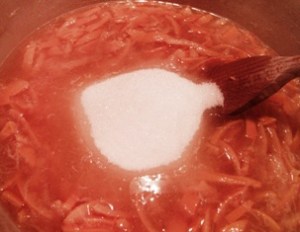
10.30pm. I have added the sugar to the cut-up peel and water

For some reason Jeanette Winterson is in my head. I am thinking about her organic shop in East London and wondering if she is as driven to write now she has her shop. But perhaps she arrived in my mind because Oranges Are Not The Only Fruit.

11.20pm. The marmalade has been fast-boiling for 20 minutes.

I draw it off the heat to test for a set because if you over-boil, it can lose its setting point. Who says cooking is boring? It is full of drama.

Earlier I put two plates in the freezer. I will now drip some hot jam on its cold surface and wait a few minutes. If the cooling jam crinkles when I push it with my finger – then success, it has set.

Then finally – after the second lot of 15 mins of fast boiling, that tell-tale crinkling. Joy.

The marmalade cooled while I set up a Facebook page for Foodlovers Fundraiser for Haiti, a small thing that I could do to help this cause.

12.45am. And here are my 8 pots of marmalade.

It was a palaver but it was worth it.

What do you think?

Butternut squash and spinach lasagne

Snowed-in.  Good excuse to make Butternut and spinach lasagne.

Christmas has had me confused: am I vegan or carnivore?  This light vegetably vegetarian dish is a compromise.

And..it does NOT require a white sauce!

As I had been planning to make the dish for a week, I had the main ingredients:

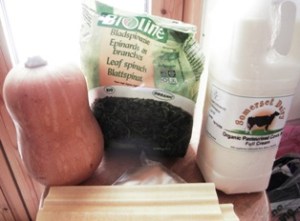
In my pic, lined up for their photoshoot, from left to right:

1 organic butternut squash, 1 packet of frozen organic spinach, 1 organic milk and 3 sheets of lasagne pasta. You need mozzarella for topping.

I got the recipe from a free promotional recipe booklet from Olive Magazine two years ago (when I had advised Hardeep Singh Kholi on going organic).

Here is the beautiful butternut squash cut in half.

I used the whole squash for the recipe and produced just over the 500g required.

I cut the squash into manageable pieces with a small sharp knife, peeled the skin using a potato peeler and scooped out the seeds.

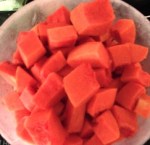
Love the way the butternut squash is so orange.

You fry 1 onion in a large frying pan then add the 500g cut-up squash. I cut-them up smaller when I realised they had to fry.

The recipe said fry until tender and slightly brown round edges but I put the lid on – answered a few emails – and in 15 minutes it had gone very soft indeed, but not brown.

Then add 100 mls of milk (or plant milk, vegan-me).

The BEST things about this recipe are:

  • no need for a white sauce
  • 500g of squash and 150g of (frozen) spinach makes it LIGHT and vegetably.

So you cook the 3 lasagne sheets in boiling water for 3 minutes then drain.

Then layer: one sheet of pasta, followed by half of the cooked squash and half the warmed spinach.

Another sheet of lasagne pasta, then rest of squash and spinach.

Finish with the third lasagne sheet and tear a 125g ball of mozzarella over it.

(I used Buffalo Mozzarella from Laverstoke Farm, the organic farm ‘university’ owned and run by ex-racing car driver, Jody Scheckter. 20% off in Better Food organic supermarket just before New Year).

Put the dish under a heated grill until it bubbles and browns.

I photographed it against the snow.

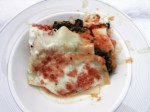
No food-stylist, I! Look at the food splashes…not very stylish.

But definitely delicious.

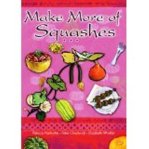
For more squash recipes, including recipes for carnivores and vegetarians, nutritional information and how to grow squash from seed, see the book I co-authored, Make More of Squash. Aad on the right of this post offers 20% discount…

Interested in reviewing a copy? Email me at elisabeth.winkler   AT yahoo.co.uk

Anjum’s Gujarati lamb curry

My children are carnivores so when they (now grown-up) visit, meat is a treat.

Cheaply produced meat means people can eat it every day as a cheap takeaway.

But eating meat daily is neither good for the health of the animals, consumers or planet.

Some people need to eat meat, while others argue our soils need  manure for soil-strength.

We just don’t need to be mass-producing meat on an industrial scale.

So it’s about trying to get a balance. There’s a spontaneous revival of the traditional way of eating:  have a feast of (well-reared) meat once a week and live on the leftovers.

Join the Feastarians, Weekend Carnivore or Paul McCartney on a Meat-free Monday.

Which leads me to this delicious lamb curry.

Quadrille Books had offered – on Twitter – a free copy of Anjum’s New Indian.

Canny New Media marketing device, eh? I like – and copied it for my own books!

So I contacted Quadrille on Twitter and the big beautiful hardback copy signed-by-Anjum arrived by post.

Its subtitle is Indian Food Made Easy.

Sadly, not easy enough for me. The ingredients list looked too long. The pages too big and glossy.

I felt daunted.

For simplified Indian dishes, I rate Quick Indian Cooking.

However after months of free-book-on-Twitter-guilt, I finally tackled a recipe.

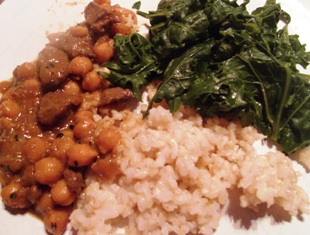
Gujarati lamb and dumpling stew – it was bloody delicious.

But I did simplify it. I left out the dumplings for a start.

Note: I substituted raw ginger for horseradish because Middle Child cannot stand ginger and takes it Very Personally if I cook with it.

Horseradish works incredibly well. Grate it raw, cover with white wine vinegar and it keeps in a jar in the fridge for 3-4 weeks.

Here’s my version: 

Ask the butcher for lamb for stewing – or mutton. Mutton is cheaper because it is  a grown-up animal. Stewing will soften the tough older meat of mutton.

Unlike pigs and poultry, it is harder to farm sheep intensively – sheep continue to roam freely and eat grass. So if you are going to eat non-organic meat, lamb is your best bet.  

I bought about 400g of organic lamb (about £4) which fed 4. I cut up the pieces quite small.

Then I browned the lamb pieces in a pan to seal the taste, then removed them.

Add a teaspoon of mustard seeds and when they pop, add the sliced onions and fry until brown.

My gratitude to Anjum grew – I don’t know what to do with mustard seeds and now I was using them like a pro.

Meanwhile, in a blender (I used the grinder attachment), make a paste of 20g of ginger – or raw grated horseradish – and 5 large peeled garlic.

This paste is a great discovery. I use it for spicy vegetarian dishes too.

Add the paste to the onions until it gently colours, about 3 minutes. Add salt to taste (I omitted the 1 tsp. of sugar), 1 Tbs of ground coriander and 1 Tbs of ground cumin; 1/2 tsp of turmeric and 1/2 tsp of chilli powder. Cook for 20 seconds.

Add about 100 ml water (I omitted the 3 pureed tomatoes) and cook gently until completely reduced, then fry the paste for 5 mins until the oil comes out.

These instructions were brill as I tend to overcook spices and not get the ratio of water-to-spices right (too watery or too dry). This worked! Thanks, Anjum.

I added a quarter of a block of coconut, not the recipe’s can of coconut milk. I also forgot the 1-2 tsp of lemon juice. I didn’t measure the water but Anjum said 200ml (for 600g of lamb).

I forgot the sweet potato but that would have been a wonderful addition.

I chose this recipe because of the chickpeas. I can’t eat a lot of meat – although I do love its rich gravy flavours – so I was happy to have meat-bits with my beloved chickpeas.

I had already soaked 200g of the raw chickpeas overnight and cooked them for an hour (or, as Anjum says, use a can).

I served it with organic curly kale and brown rice.

And it went down a treat with the carnivores.

Beetroot soup and a good deed gone wrong

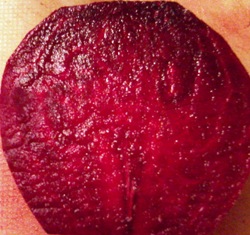
Last night’s cut raw organic beetroot.

Its insides look so mysterious.

I was making beetroot soup (again). Simplifying it.

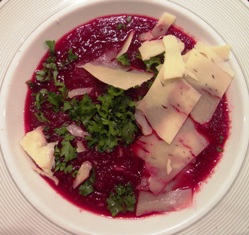
Cut up two large peeled/scrubbed organic beetroot and place in a large pan with two peeled onions, sliced. Cover with water and bring to the boil, then simmer with a lid for 30 minutes.

I blend with an electric hand blender, my favourite kitchen power tool.

Mine was £20 second-hand, or try Freecycle for a free one, or Just for the love of it for swops.

While blending the beets (bought from Better Food), I travelled back in time:

– to fifteen years ago, and I was trying to be helpful in someone else’s kitchen.

I was in charge of the chocolate mousse.

I poured it into the mixer and pressed the button to mix.

Mayem. Chocolate mousse on every kitchen surface in spattering distance.

I had forgotten to out the lid on the mixer.

So now I practice conscious blending.

Schadenfreude means the pleasure you get from someone’s else’s pain.

I wonder if there is a word to describe the ouch you feel when you end up

causing even more ouch to the very person you are trying to help?

Served with home-grown parsley, plant from St Werburgh’s City Farm, and Yeo Valley organic cheddar shavings.

Evelyn Rose’s Luscious Lemon Cake

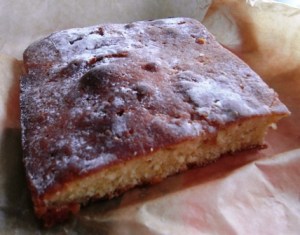
Luscious lemon cake

We had a bit of a crisis and it was all-hands-on-deck, as friends and family came on board to support my youngest daughter, Maude.

Yael and Maude made this cake as part of Maude’s rehab.

I provided the recipe from my 30-year-old copy of The Complete International Jewish Cookbook by the late and wonderful Evelyn Rose.

It’s a great cake to make. You mix everything together in one bowl and once baked, you prick holes in it then pour-in a homemade lemon syrup for tangy-taste heaven.

I used to bake this cake a lot for our West Country Childbirth Group cake stall in the 1980s until I overdosed, vowing I would never bake another fundraising cake again.

We were aiming to improve maternity services. In 1982 we invited the water-birth obstetrician, Michel Odent, to give a talk and over 1,000 turned up. This demonstrated parents’ wishes for a gentle birth and led, eventually, to the UK’s first birthing room in the Royal United Hospital, Bath.

So maybe all that cake baking was worth it.

Put in one bowl: 100g softened butter + 150g caster sugar + 150g self-raising flour + 4 Tbs milk + grated rind of one lemon + two large organic eggs.

I substituted the self-raising flour for plain and used an extra egg instead, on one occasion  – it worked well.

Line the bottom of an oiled loaf tin or 15cm square tin with oiled/greased greasproof paper. Evelyn Rose says this extra insulation from the greaseproof paper is important. So heed the cooking maven (Yiddish for expert).

Put the oven on Gas 4/350F/180C to heat up.

Beat all the ingredients in the bowl with a wooden spoon or electric beater, then turn the smooth mixture into the well-oiled baking tin.

Bake for 45 minutes.

Watch the animated movie, Flushed Away, while waiting, as Yael and Maude did.

Take the cake out of the oven and let it cool, still in its tin.

Now make the lemony syrup. Heat the 75g icing sugar with the juice of 2 large lemons (about 4 Tbs) until it gets all-syrupy.

Prick the cake’s surface with a fork then gently pour the syrup over it.

Once the cake is cold, turn out and dust with caster sugar. Share with friends.

Thank you, Yaelski.