Category Archives: producers

What is Tesco Real Food?

Tesco Real Food is the name of of Tesco’s recipe magazine and website, Tesco.com/realfood.

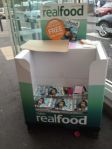
Launched by Tesco PLC in 2011,  the magazine is given away free by Tesco six times a year as a marketing promotion (see pic above).

Tesco sells real food in the sense it is tangible, not imaginary. But Tesco food is not what this Real Food Lover calls real food.

I have had this definition on my Real Food Lover blog since 2008.

“What do I mean by real food? As close to nature as it can get. I want mine grown organically – without chemicals and with respect, as close to my home as possible. And wholefoody and unprocessed too, please.”

Others have a similar definition.

The Real Food Festival says: “Real Food is all about great tasting, sustainably and ethically produced food.”

Real Foods, based in Edinburgh, has, for the last 30 years, sold: “healthy, natural, organic (real) food to the nation at affordable prices.”

In a blog post responding to Tesco’s recent use of the term “real food”, Real Foods writes: “… ‘real food’ is food from which the body can extract the maximum amount of nutrition with the minimum amount of waste; food in its most natural state with the best bits still left in rather than foods that have been processed so that the goodness has been removed and replaced by chemicals which, if not actually harmful, are nutritionally ’empty’.”

Like the efficient retailer it is, Tesco has done its consumer market research and understands the nation’s need for nourishment. The result is its Real Food marketing initiative. Will it help people eat real food?

The magazine promises 32 “seasonal” recipes on the front cover.

Out of Tesco’s three “Season’s Best” recipes, one features mangoes from Peru. Mangoes are not grown in this country. They can never be seasonal for the UK.

Ten out of the 32 “seasonal” recipes were puddings with no fresh produce at all. Some were for Valentine’s day, Pancake day and Mother’s day. Are these annual celebrations what Tesco means by “seasonal”?

If so, Tesco has misunderstood the importance of seasonal for real food lovers.

Eating seasonally is about enjoying freshly-harvested produce. The fresher and more seasonal the produce is, the more nutrients it has and the better it tastes. That is one of the (many) reasons why local is important because it means the food is fresher when you eat it.

Tesco Real Food magazine’s current issue invites readers to Love Local and check out online its “wide variety of food from local producers around the UK”.

I checked out Tesco.com/local with my Bristol postcode and was directed to the Gloucestershire region. I was offered only eight products, four of which were beer. Yes, all good local produce, including Pieminister pies and cold-pressed rape seed oil.

But eight products do not a local-food-supply-chain make.

Like most supermarkets, Tesco sources globally not locally.

This article on apples gives us a clue.

According to the Telegraph, at the height of the UK apple-growing season in 2010, Tesco sourced only ten per cent of apples from Britain. The rest were imported. However its billboard ads promised ten different British varieties (subject to availability).

I get the feeling Tesco likes using words such as real and seasonal and local and organic because they sound good. But does Tesco subscribe to the principles and practices that underpin these words?

Tesco Real Food magazine’s current issue has an advertising feature for Tesco Organic. It says organic produce is grown “with reduced reliance on fertilisers”.

This is incorrect. Let me explain. Natural fertilisers – such as composted green and animal manures, and nitrogen-rich crops – are crucial to organic farming. This is how the soil is nourished.

On the other hand, chemical fertilisers are banned in organic farming because they strip the soil of life and cause environmental damage including water pollution.

Tesco’s Organic range is truly organic, and I am not questioning that [added after publication for clarification]. But does Tesco understand organic farming methods? Or is it using organic to make Tesco’s other products – such as intensively-farmed chickens – seem more wholesome?

Here is another example of the mismatch between Tesco Real Food and the reality of Tesco food.

As far as I know (please tell me I am wrong) Tesco still sells foods with trans fats despite a promise to ban them by 2011. Trans fats may make food last longer, but they are essentially candle-wax with huge health risks.

Trans fats are not real food. In fact, they are not even food.

Tesco’s Real Food magazine is glossy, handbag-size and beautifully-presented. In thick bold type, it emphasises words such as “nutritious” and “soul-warming”.

Is Tesco Real Food  the marketing version of trans fats, a cheap filler that tricks us into thinking we’ve been nourished?

Real food producers can tell you exactly what is in their food: how and when and where it was grown, reared, produced and processed – how the land was fertilised, and the farm animals cared for.

Why is Tesco spending its marketing millions pretending to be real?


Sheepdrove organic goose

There is no getting away from it. Eating meat means taking a life.

I understand the horror vegetarians feel. I love vegan cuisine.

But I am a meat eater. Maybe once a week. I can feel the nutritional value it brings to my body.

If I were a hunter – I imagine – I would kill the animal, and lie down and cry because I had killed it. (I saw this on TV once). Then eat it. Hopefully with reverence.

But I could be romanticising.

The fact is I cannot square killing for food.

At least I can make sure the animal was well looked-after while alive.

Which is why I choose organic meat.

On Christmas day, we cooked and ate a goose from Sheepdrove Organic Farm.

Declaration of interest: I work with Sheepdrove Organic Farm. But – you know me – I can only work with a cause or company I believe in.

Check out Sheepdrove Organic Farm. Lots of great info on its website: including the importance of grass-fed creatures and Eating less meat? Eat better meat!

Sheepdrove Organic Farm’s head butcher, Nick Rapps, is passionate about showing people how to eat organic meat in a budget.

For instance, buy cheaper organic cuts (not pre-cut packages) from an actual butcher who can provide the unusual cheaper cuts. Cheaper cuts need slower cooking.

Nick Rapps’s The Organic Butcher’s Blog at Food Magazine is a treasure trove of tips. Here’s Nick on the organic Christmas turkey on a budget.

My sister, Geraldine, cooked our Christmas goose.

Listen-up. True to our ancestors, she is a real food lover.

My sister said: “How did I cook the goose? It was good, wasn’t it? And simple to cook. I rubbed salt and pepper and fresh grated ginger on the skin. Then scrunched wet greaseproof paper, smoothed it out and covered the goose. The formula is 20 minutes per pound on a low heat roughly 150/Gas Mark 2/300  and 20 minutes over. Our goose took about 5 hours. Regularly,  pour fat off the roasting pan (and keep it later for roasting veg) otherwise the goose fat will overfill the pan. Most importantly, let it “rest” a good half-an-hour after taking it out the oven.”

We served the Sheepdrove goose with an array of colourful vegetables, cooked by other members of the family so not one person did all the work.

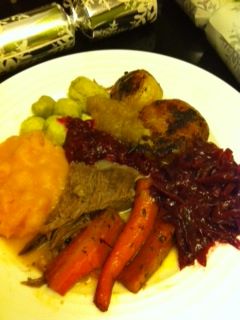
Red cabbage and apples, squash and coconut, cranberry sauce, roast potatoes, Brussels sprouts, gravy.

PS I lost my ‘phone over Christmas. However – curiously – on the day I lost my ‘phone, I sent a picture of our Christmas meal (above) to myself. Which was lucky as I had not backed up my images since November so the Christmas meal pic would have been lost. Funny, eh?

Sprouts and raw hummus

I was told yesterday that today is the last day of the Mayan calendar.

That means the end of 28,000 years of hierarchy and oppression.

Yippee!

And I have finally found a spouting system that works.

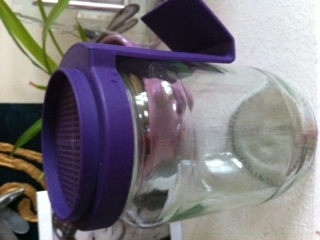
I bought this jar with its plastic perforated lid from Harvest, part of Essential Trading Worker Co-op.

DIY types can make their own. Or use old tights or muslin as the lovely Alys Fowler suggests.

Or buy one like mine (after years of experimentation, I can vouch that This One Works), and get loads of sprouting info from Living Food of St Ives.

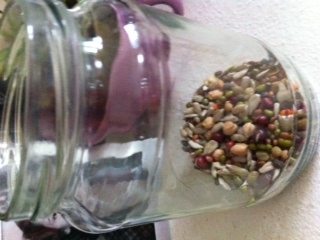
First you put the dry (organic) seeds in the jar.

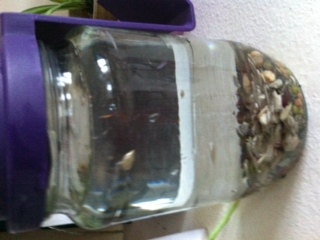
Add water and leave them overnight to bring them to life.

After that first long soak, you wash the seeds daily (or twice, thrice).

The seeds like being clean and wet (not soaked or drowned).

So after filling the jar with water, swill the seeds around then drain away the water (hence the natty perforated lid which makes life so much easier).

And how is this for a virtuous circle? I drain the water on the indoor plants so they get a regular watering.

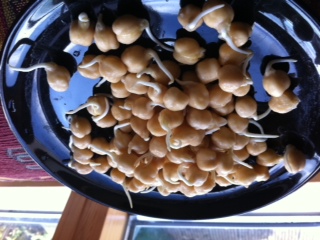
After a few days, I have produced living things.

Here are some sprouting chickpeas, looking positively Lawrentian.

(DH Lawrence being one of my fave authors because he describes life on its different levels: soul, mundane etc and because: “Lawrence believed that industrialised Western culture was dehumanising…”).

So now I am going sprout-mad. Sprouts in stews. On toast with cream cheese.

Whizzed with Organico Artichoke Spread for instant hummus.

Hold on a minute. Did I say hummus?

I ask myself: WHY make hummus with cooked chickpeas when you can use extra-bursting-with-vitality FRESH sprouting raw chickpeas?

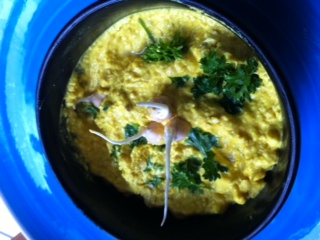
So, I substitute the cooked chickpeas for my Lawrentian darlings, add some turmeric and crushed coriander seeds (must sprout THEM one day) and of course lemon juice, olive oil, tahini, raw garlic, as in my usual recipe for hummus .

And it was delicious.

Fish4Ever challenges big brands

As a journalist and food campaigner, I help Fish4Ever with its communications. I cannot work for a cause or company I don’t believe in.

So, I have the privilege of asking nosy questions and learning about the politics of fish.

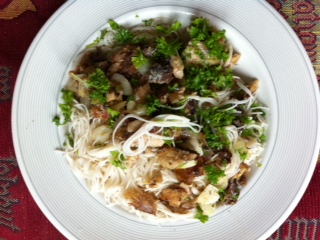
Lunch: a fried-medley of Fish4Ever sardine fillets (Steenberg’s Organic online £1.60) on a bed of organic rice vermicelli.

Medly: I fry sliced shallots/onions, garlic and chilli in the organic oil in which the fish are canned – Fish4Ever uses 100% organic land ingredients.

I add the sardine fillets, mashing them (was that respectful?). I snip-in fresh parsley .

Fish4Ever canned fish is in a class of its own, fished traditionally (70% MSC-certified, the rest artisan) and quickly-conserved for freshness.

I am a real food lover and here’s why: you do good – it tastes good.

Why is it important to look after the fish?

Fishing technology is too effective. Desired species are being hunted to extinction.

Its hunting methods are indiscriminate, killing turtles, sea birds, dolphins.

There are too many factory boats and not enough fish. Regulations to control catches are insufficient and often ignored. Out at sea, where no one is looking, rules can be flouted. Poor countries suffer from foreign piracy on an industrial scale.

Hugh’s Fish Fight on Channel 4 earlier this month focused on changing the fishing methods of the big tuna brands and own-label supermarkets.

The food corporations’ proposed changes are far better than nothing.

However, although the big brands may well promise a “pole and line” range, their primary business remains likely unchanged.

Each Fish4Ever can has a story – including the smallest tuna fishing boats in the world.

This is not an eco-add-on. Fish4Ever’s raison d’être is care of land, sea and people.

That’s what I call an ethical company.

Organic Food Awards 2011

This year I was a Soil Association Organic Food Awards judge, judging cheese (wonderful taste memories, quality outstanding).

So I was invited to the actual awards last Wednesday.

They were held this year at the launch of the 12-day Start festival to celebrate sustainable living.

And at Clarence House gardens, open to the public for the first time.

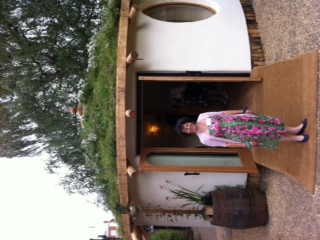
So I made an effort, bought a reclaimed frock for £25 at Dutty’s in Bristol, caught the coach (National Express not golden) to Victoria, and walked to the Mall.


Me (in sister’s shoes) in front of earth house with grass roof and circular windows.

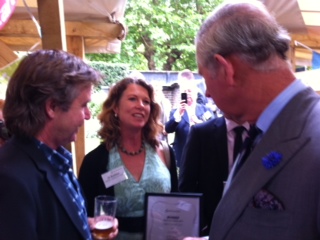
My first royal photo of Higher Hacknell Farm Organic Food Award winners, Jo and her husband Tim Budden, receiving rightful organic congratulations from HRH Prince Charles.

I had a touching royal moment myself exchanging greetings – I feel Prince Charles (and Soil Association patron) is an earth ally, and uses his position well. I award him the Winkler Seal of Approval.

It was an uplifting evening, meeting old friends and new, especially enlivening because it was held outdoors. Outdoors on a summer evening = good!

Here is a pic from the Bee keeping stall with Daylesford foundation

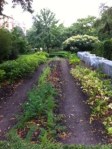
And a pic of the organic veg garden at Clarence House (could the bare earth do with more plants growing, permaculture-style?).

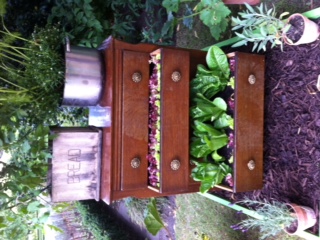
Here is a chest of drawers imaginatively filled with plants from Garden Organic

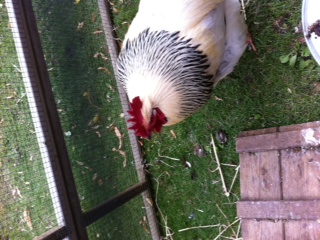
And an organic chicken

Pic of the Organic Food Awards certificates awaiting collection by their winners.

At the end of the evening, on my way to Green Park station, I saw the ubiquitous discarded Tesco plastic bag.

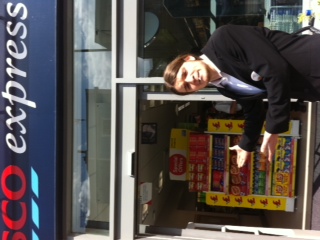
Funny. Because my day had begun by taking a Guardian photographer round Stokes Croft in Bristol for a feature by John Harris in next weekend’s Weekend Guardian on UK-wide campaigns against Tescos.

What does it mean?

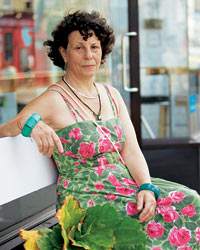
PS Here is the pic that Guardian photographer, Jon Tonks, took of me outside Cafe Kino in my Dutty royal get-up.

Peaceful No Tesco Tea Party


Well, the No Tesco Tea Party has to be one of the most fun, friendly, heart-filled

musical protests I have ever been on.

Here’s a delightful news item from ITV: over a minute of dancing protest.

But it was also possibly the most stressful because – post-riot – it wasn’t just a matter of ringing up our local bobby.

Instead, we were invited to respectful, professional meetings with Silver and Bronze commanders, who supported our right for a peaceful protest but were thinking worst-case scenarios, and asking: how would we deal with them?

I realised the police, like the medical profession, are (bless ’em) fear-driven.

So, for a few weeks leading up to the No Tesco Tea Party I felt the weight of responsibility. Dreamed of police on horseback bursting through my front door. Worried about upsetting local charities such as Relate and the Salvation Army who’d been damaged in the riots. Angsted about offending rock throwers, too.

(Rock throwing is not my style but anyone caught-up in those two crazy riot nights might need support so please contact BristolArresteeSupport@Riseup.net, mentioned in June’s edition of The Autonomist.

And anyone with unanswered questions about the Stokes Croft disturbances, please sign the petition asking Bristol City Council for a public inquiry.)

Our protest took place in front of Tesco in Stokes Croft. I was glad to talk with Tesco managers because this campaign is not against supermarket employees.

It’s against supermarkets destroying communities in their single-minded drive for market shares.

The truth is I am a communicator.

I find enemy positions deeply unhelpful. I would rather build bridges.

Listen, we are all victims of the same soulless system that puts profit before people. So let’s find our common humanity and work together for a better world.

When Monday 13 June dawned – bright sunshine after Sunday’s torrential rain – I felt confident. Our protest would be – as all our protests have always been – peaceful.

And it was.

I was moved by the joy and the dancing

and the homemade cakes

and cucumber sandwiches (note Princess Diana tea-tray)


and anti-Tesco knitting protestor.

I was moved by Mark who did not agree with our campaign but became a volunteer peace marshall because he supported our right to a peaceful protest.

For goodness sake, there is disagreement even when you are on “the same side”. So, shaking hands with Richard whom I had met online when our political views clashed made me happy: this is what community is all about.

The No Tesco in Mill Road campaigners had come all the way from Cambridge to join our protest. Thank you!

Our Tea Party protest was to create awareness for our appeal for a judicial review.

Our appeal was heard on Wednesday 15 June in Cardiff.

And we won.

Thanks to People’s Republic of Stokes Croft, Jake and peace marshalls

and People’s Supermarket for donating free food.

O and here’s one of me, thanks to Nadia of GRO-FUN.

Stokes Croft Tesco opens and butter bean salad


It’s hard to be happy about the 41st Tesco opening in Bristol (figure according to Tesco’s store locator).

93% of 500 locals surveyed had said No to Tesco’s in Stokes Croft. After over a year’s campaigning, it was bitter to see Bristol City Council bow to Tesco pressure last December.

Still, we are making the best of it.

On Friday 16 April, Tesco opened in Stokes Croft.

Friendly activists gave a Bristol-style welcome. They put a comfy sofa and lampshade outside on the pavement. Someone played a guitar.

Another strode into Tesco’s with a wad of Monopoly money. When he was not allowed to spend it, he tried to bribe a security guard with it.

A woman passer-by who also objected to Tesco’s monopoly, took up the Monopoly money-action.

On Saturday, a performer (see pic above) invited us in to ‘his’ Tesco, while outside on the pavement, stalls served free food, and promoted Picton Street’s local independent shops, in the street behind the dreaded Tesco.

Picton Street is a marvel, and includes the Bristolian Cafe, Yogasara yoga studio, vintage dress shops, an art gallery, Radford Mill organic farm shop and Licata, the family-owned Italian delicatessen.

Licata often has great bargains in olive oil and tins of beans. I am crazy about beans as they are a wonderful source of health. Licata has many variety of tinned beans, which to me = fast food.

I owe everything I know about beans to vegetarian hero, Rose Elliot. The Bean Book changed my eating habits for life.

The following recipe comes from there. Please consult The Bean Book for measurements, nutritional facts and top inventive recipes using dried beans and pulses.

Here is my sloppy fast-food version.

Gently fry sliced fresh mushrooms in (olive) oil so they are still succulent. Add a tin of drained butter beans and warm with the mushrooms. Add lemon juice squeezed from two lemons and chopped fresh herbs such as parsley or coriander. You can’t have too many fresh herbs so over-estimate. Mix it all in the frying pan, with salt to taste, and serve still warm with brown rice, or cold as a salad.

I used organic ingredients from Better Food organic supermarket, a 20-minute walk away from Tesco’s, and land cress as the fresh herb.

Rose Elliot’s recipe fries fresh cut-up garlic with the mushrooms and adds cumin spice, with coriander as the fresh herb.

PS I met a neighbour on Saturday who said she had to buy something at Tesco’s in Stokes Croft, and I am haunted by her anxious look.

So, just so you know: If it makes life easier to shop there, then do. Life’s too short for guilt and sacrifice.

I am not against people who use Tesco. I am against Tesco.

Bread – what’s left unsaid


Look, if you are not in the mood for cooking (a state I know) then make sure basics, such as bread, are doing you good.

Bread gets messed-around with. This sticky label, from the 2009 Real Food Festival, lists ingredients that might be found on bread – but are never listed.

The label said:

~~~~~~~~~~~~~~~

“!!!WARNING!!!

This ‘bread’ may be made using the following:

Amylase, hemicellulase, phospholipase, peptidase, xylanase, protease, oxidase and other enzymes, some of animal or GM origin.

The law says bakers don’t need to declare them.

DISCLAIMER

These stickers are only for use in your own home. The Real Bread Campaign, Sustain and The Real Food Festival take no responsibility for any consequences, legal or otherwise, of you using them elsewhere such as wrappers of factory bread, supermarket shelves or advertising posters.”

~~~~~~~~~~~~~~~~

As Michael Pollan says: if they are more than five ingredients on a label, avoid.

The long list of enzymes above are “processing aids”. In other words they are used to make the bread rise faster, look nicer, last longer.

But because these processing aids are not classified as food ingredients then – by law – they do not need to be listed on the label.

Whaaat? You eat them but they are not food ingredients?

It reminds me of adulterated food sold to the Victorian poor

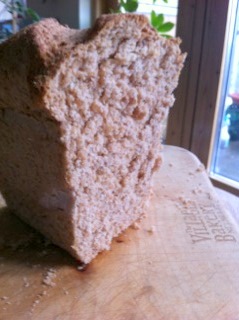
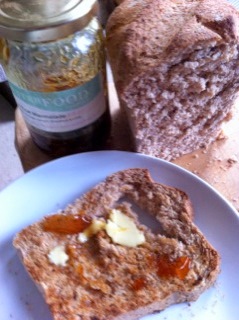
My real bread came from the Better Food Company in St Werburgh’s, Bristol where I also got marmalade made by their chef (as good as homemade…hey, it’s January, time for marmalade-making again) and organic butter from Nature’s Genius in Fishponds, Bristol.

Yes, the bread cost more than supermarket bread but I got more food for my cash. My grandmother would say money spent on un-nutritious food is money wasted. And I agree. Do you?

St Werburgh’s City Farm Cafe at Christmas

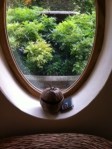
I took this picture through the stained-glass window of St Werburgh’s City Farm Cafe at the weekend.

Bristol is a mega-city but blessed by pockets of seclusion – enchanted sanctuaries such as St Werburgh’s.

This little corner of green near the M32 shields the eco-self-build houses, the Wild Goose space,  the Climbing Wall, the Better Food Company, St Werbugh’s City Farm and Cafe and more, and, as my luck would have it, is a ten-minute walk through the allotments from home.

The icy-cold weather of late has been leavened by such pockets of warmth.

Last night, for instance, we went through powdery snow in the empty allotments to the wildness of a contact dance improvisation jam at the eco-built Wild Goose Space where I lay on the floor watching this compelling film, Baraka, then dropped by afterwards to St Werburgh’s City Farm Cafe for the drinks bit of the staff meal.

St Werburgh’s City Farm Cafe has Wifi and real coffee, and a splendid selection of heart-warming home-made dishes many made with produce from the adjoining City Farm.

It’s run by Leona Williamson – unassuming, hard-working and friendly. She and her team won the 2008 Observer Food Monthly award for outstanding ethical achievement, calling it the “ultimate green eatery…(using) not food miles but food yards”.

I wrote about the Cafe in 2008, and – see comments – received fierce rebuke for praising the Cafe’s use of animals from the Farm. I am with Simon Fairlie and the Soil Association on the meat issue. Although I passionately believe factory-farmed meat is wrong – over-produced, cruel, unhealthy, unsustainable and unnecessary – a few creatures on a family farm is another matter entirely.

Back to last night: I met Jack, and discovered he is the Ethicurean now running the Walled Garden Cafe at Wrington, Somerset. I remet (I know this sounds like a poncy eco-roll-call but it wasn’t really like that) Andy Hamilton, of the Self-Sufficientish Bible,  who is finishing a book (a brilliant idea and once O.K-ayed it, I will mention here…) (and it is Booze for Free – good innit?), and Jamie Pike from Co-Exist at Hamilton House, currently congregating food people to make creative use of a communal kitchen at Hamilton House in Stokes Croft.

We talked about the recent Tesco planning fiasco and the importance of creating alternatives (as Jamie and co has done at Hamilton House).

As we left, Leona gave us a bottle of refreshing homemade rosemary and apple cordial from (very) local produce.

St Werburgh’s City Farm Cafe is now closed for Christmas until 15 January.

Apparently Baraka (the movie) means: blessings in a multitude of languages, and this is appropriate, as I felt blessed indeed as we walked home through the moonlit snow.

Time to stop Tesco in Stokes Croft

There is still time to stop Tesco in Stokes Croft.

I have just written to Nigel Butler, Bristol City Council’s planning officer.

The deadline to write to Nigel is today. I am sorry this is last-minute but – like for the rest of us, life is pressured. It is hard to find time to campaign in between working and caring for dependents (let alone eating and sleeping!).

Stop press: Submit letters to Nigel, the planner, until 8 December 2010 – get writing/emailing!

Please go to the No to Tesco Stokes Croft campaign website for the template letter to help you raise planning issues with the Council – see Two more ways to take action, below, for a summary.

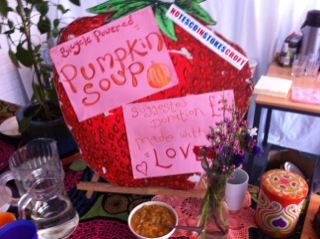
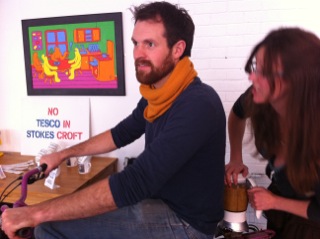
The No Tesco in Stokes Croft campaign team has unsung heros, giving their precious time to make the planning laws intelligible and relevant. They also make fabulous fund-raising bicycle-powered fresh pumpkin and ginger soup (see pic above and below).

<h2>Success so far</h2>

Campaigning by the No Tesco in Stokes Croft and a fiercely active community has kept the multinational out of Stokes Croft for a year.

Reputed to be the last high street in the UK not to have corporate retailer, Stokes Croft wants it to stay that way.

Tesco did not get full planning permission on 22 September 2010, an historic community day which saw over 200 protestors fill the Council chambers.

Nor did Tesco get an alcohol license for its proposed store in Stokes Croft, thanks to hundreds of letters of objection sent to Bristol City Council.

The community’s objections were supported by the police who argued that another retailer selling (cheap) alcohol in the area would increase existing problems of “pre-loading” and street drinking.

<h2>Two more ways to take action</h2>

1. WRITE / EMAIL Bristol City Council about two vital planning issues before 7 December

a) Noise
Tesco’s recent noise report is wholly inaccurate and misleading. Tesco cannot comply with the Council’s noise conditions.

b) Traffic
Because goods are delivered “just-in-time” from centralised depots, a Tesco Express (by Tesco’s own reckoning) would get 6 deliveries a day, 42 a week. These would block the cycle path, bus stop and two pedestrian crossings on either side.

Please see No Tesco in Stokes Croft’s detailed template letter.

Copy, paste, add your address and personalise.

Email: nigel.butler AT bristol.gov.uk (CC: rachel.h.bibb AT gmail.com so campaigners have a copy) or write to: Nigel Butler, Development Management, City Development, Bristol City Council, Brunel House, St, George’s Road, Bristol BS1 5UY.

2) ATTEND the Council meeting to find out if these objections have been heard – it will be another historic day for the community.

Wed 8 December 2010 at 2pm at the Bristol City Council, College Green.

Anyway, here is a copy of my letter:

“Dear Nigel

Re. Applications for proposed Tesco on Cheltenham Road

I have lived in walking distance of Stokes Croft for over 20 years. It is my shopping area and my community, and I strongly object to a planning application from a supermarket which will undermine the area’s unique character, local trade and community cohesion.

I attended the Council planning meeting on October 22. Like many who did so, I was appalled and disheartened by the process.

Over 200 people crowded into the Council chambers. There were over 50 in the overspill room. We took time out of our busy lives – caring for our families, studying or working – because of the depths of our concern for our community.

We had three learned submissions from our representatives, Claire Milne, Sam Allen and Rachel Bibb. These clearly outlined to the letter of the planning law, why the application from Tesco should not go ahead.

Planners dismissed our concerns on the basis they had received legal advice that they were not relevant (material considerations) to the external works and shop front applications.

This dismissive response was shocking and incomprehensible.

We expressed concerns about how a successful application from Tesco would increase traffic on Cheltenham Road, a main artery high-street with a cycle lane.

And how would a huge lorry negotiate the one-track cobblestoned Picton Lane at the back of the proposed store?

I was shocked to discover that these genuine concerns for safety were not considered significant. Why? Because change of use had already been granted in September 2009, and traffic issues were supposedly dealt with at the time in that application.

How can this be a satisfactory response?

Tesco used a third party to make its application so change of use was granted on the basis that it was a “shop” – an ordinary shop like its neighbours.

Traffic issues were dealt with not knowing the true identity of the application.

Now the planners know the real situation – that change of use was actually granted to a multinational corporation that operates just-in-time deliveries and, in this case, at least 42 a week at up to 40 minutes each within a 6 hour period – should they not re-examine traffic concerns?

Why have the impacts to public and highway safety not been assessed when servicing a store is a material consideration?

The Government’s Planning Inspectorate has already ruled that servicing is a material consideration for external works and shop frontage applications, as shown in the case of Mill Road in Cambridge and Sunningdale in Berkshire.

I now refer to a letter drafted by the No Tesco in Stokes Croft campaign which I support – I am grateful to the campaign for the hours of unpaid work that have gone into studying the applications and drafting a detailed, informed and intelligent response.

When drafting your report to the councillors, I would like you to address the following questions:

1. Why, when the Government’s Planning Inspectorate has already ruled that servicing is a material consideration for these applications, are you denying this and ignoring the significant risks to public and highway safety?

2. Why has there been no impact assessment of the significant risks to public and highway safety posed by the servicing of this proposed store, now that you have information about the intensity of such servicing at clearly precarious locations?

It would be negligent to grant permission for these applications in the absence of an adequate impact assessment.

Bristol’s Statement of Community Involvement

Why did the planners ignore Bristol’s Community Involvement Statement?

Again, I am grateful to my campaigning colleagues, for expressing my concerns so thoughtfully and thoroughly. Here they are:

Bristol’s Community Involvement Statement is a statutory requirement from central government and significant amounts of public money have been spent producing it.

It is therefore entirely unacceptable to grant permission for these applications until the directives within the Statement have been followed.

Whilst the specifics of how applicants comply with the Statement is discretional, it is unacceptable that the Council’s Planning Officers have made no attempts to encourage compliance with it – or sought any explanation for why the applicant is refusing to comply with it.

The fact that both the Council and applicant have shown complete disregard for the Statement must also be recognised as showing complete disrespect for the need to involve the community in their operations and plans.

Bristol’s Community Involvement Statement states that:

“Developers will be expected to involve the local community and Ward Members in early discussion of the implications of their proposals and how these might be dealt with. [our emphasis]”

The document also states that the Council will encourage developers to undertake various specific community involvement activities. This particular proposed development falls under category 2 – sensitive sites. The document outlines a variety of activities the Council is supposed to encourage developers to carry out.

Tesco has not meaningfully involved the community or Ward members in the development of its plans. Nor have we seen evidence of the Council encouraging Tesco to do this.

In fact, when our local MP and Barbara Janke asked Tesco to carry out a consultation, the company said it would only do this if it did not need to call it a consultation as it was not prepared to act on the results.

This is clear evidence of Tesco’s complete disregard the needs of our local community.

It would be entirely negligent to grant permission for this proposed store in the absence of efforts to adhere to Bristol’s Community Involvement Statement. Refusal to do so by the applicant can only be viewed as further evidence of Tesco’s disregard for its impact on our community.

When drafting your report to Councillors, I would like planners to address the following questions:

What efforts has the Council made to encourage Tesco to adhere to the Community Involvement Statement? If none, please explain why.

What activities has Tesco carried out to involve the community in the development of its plans?

What is the purpose of the Community Involvement Statement if the Council ignores it in Planning decisions such as these?

SPD10 and the Stokes Croft Plan are relevant to these applications

We were not allowed to ask questions in the October 22 meeting nor even to point silently to a document which was so crucial to your understanding.

SPD10 contains a directive on page 13 that ‘Development proposals are expected to address … the Stokes Croft Study’.

The page on which this directive is given, also includes a map clearly showing the boundary including the proposed site.

So, whilst SPD10′s boundaries fall metres short of the proposed site, page 13 [the page we stood up to point to, silently!] contains an exception where the boundary is extended to include the Stokes Croft area.

SPD10 explicitly identifies this area as being in need of particular attention and, more specifically, that independent traders must be protected from supermarkets.

Planning officers have dismissed the relevance of SPD10 and the Stokes Croft Plan on the basis that SPD10′s boundaries fall metres short of the proposed site.

However if this directive on page 13 of SPD10 did not intend the proposed site to be included, then surely the inclusion of the map would be accompanied by a note explaining that this stretch of Cheltenham Road is not included in this directive.

In the absence of this stated exclusion, then the map must be interpreted to delineate the expanded boundary for this particular directive.

The Stokes Croft Plan makes it clear that care must be taken to ensure the range of small shops is not supplanted by supermarkets. It is unacceptable to dismiss this.

As someone who has used, supported and engaged with these local shops for the last 20 years, I feel very strongly about this.

Permission cannot be granted for these applications until an adequate explanation has been provided as to why planning officers are choosing to ignore the clear boundaries set within SPD10, with respect to the Stokes Croft Plan.

When drafting your report to Councillors I would like planners to address the following questions:

Why the map on page 13 of SPD10 clearly showing the proposed site being included within the Stokes Croft Plan is being ignored?

Why, if the proposed site was not intended to be included within SPD10′s directive to address the Stokes Croft Plan, there is no annotation on the map (that includes the proposed site), clearly stating that despite the Stokes Croft Plan including this site, that for the purposes of SPD10, this is not the case?

Why, when the official Plan for Stokes Croft makes it clear that care must be taken to protect independent traders from supermarkets, absolutely nothing has been done to address this?

For the proposed store to open, Tesco must apply and be granted permission for an extension

Again I am grateful for the preparation and research that has gone into my co-campaigners’ assessment of the situation. I could not have expressed it better myself.

The addition of 26 square metres of pre-fabricated buildings in the form of walk-in chiller and freezer rooms clearly constitutes an extension to the existing building.

Tesco has not applied for this and is attempting to pass these prefabricated buildings as external works.

Permission to open the proposed store cannot be granted in the absence of an additional application for an extension.

When drafting your report to councillors, I would like planners to address the following questions:

Why there has been no application for an extension for these pre-fabricated buildings?

Why the Council has not requested such an application as a condition to opening the proposed store?

Why, when the need for this extension was raised ahead of the meeting on 22 September, planning officers failed to respond to this and the issue was completely ignored?

Tesco’s recently submitted noise report

Tesco’s noise report entirely flawed and full of inconsistencies and therefore completely invalid.

Tesco’s BS4142 acoustic report, submitted by KR Associates, is highly inaccurate.

In several areas, incorrect methods and have been used, leading to a distorted and inaccurate noise assessment which wrongly states that Tesco’s proposed external works will fall within Bristol City Council’s stated noise requirements for new developments of 6dB below background levels.

Background noise level assessment

To assess background noise level, the report states that for night time assessments, 5 minute noise readings should be measured throughout the night, and the lowest 5 minute reading should be taken as the background noise level. The lowest 5 minute reading KRA measured was 27.1 dB (see p26). However, they have not used the lowest 5 minute reading in their background noise level assessment, but have instead worked out the average reading from the entire night. This means they assessed the background noise level at 30dB, which is 2.9dB higher than if they had used the lowest reading as required.

Acoustic Feature Correction of plant

In BS4142 noise assessments, the measured noise emitted by the plant should bepenalised by 5dB if the noise contains a distinguishable, discrete, continuous note (whine, hiss, screech, hum etc), distinct impulses (bangs, clicks, clatters or thumps) or an irregular occurrence. The report has not applied the acoustic feature correction which makes the readings incorrect because:

The plant will emit a distinguishable, discrete note: The condenser (Searle MGB124) and the AC units (Mitsubishi) have a high frequency whine caused by the motors and a low frequency hum created by the fan blades.

The noise emitted will be irregular and will include distinct impulses: the plant will be operated by a thermostat, meaning it will consistently turn off when it reaches a desired temperature, and on again when the temperature drops below a certain level. This will create a sudden jump in noise from the plant which will normally be accompanied by a clicking noise from a solenoid in the motor.
The measurements in Tesco’s report misrepresent the situation because:

It assessed the condenser within controlled conditions, where the air through the fan would have been uniform and not caused much noise. In real conditions (i.e. outside), even a slight wind can cause the fan blades to make a hum noise.

Data beyond 5000Hz has not been included despite the human ear being able to detect sound as high as 20,000Hz. This means the report does not determine tonal content on this range of audible hearing and therefore does not represent an adequate assessment of the actual noise of the plants.

Searle Condenser Data

Tesco’s report rates the condenser as having a sound power level of 50.5 dB when running at 2V 216prm. However, the manufacturer’s (Searle) Sales Deparment have provided data which suggests the sound power level will be much higher than this.

According to Tesco’s report their proposed external works will fall within the Council’s stated noise requirements of 6dB below background levels. However, when recalculated to take into account the inaccuracies highlighted above, both night and day time levels are in fact above this figure and will therefore exceed the Council’s condition of being 6dB below background levels.

This acoustic report is wholly inaccurate and misleading.

Tesco is renowned for submitting similarly misleading and inaccurate reports elsewhere in the country.

They are wasting our precious time and resources and cannot be allowed to continue to make a farce of this situation.

Having initially failed to even produce an acoustic report when clearly required in order to meet conditions set by the Council and now presenting an invalid report, permission must be denied for this external works application on the basis that they are unable to meet the conditions set.

In the Development Control meeting on 22 September, the No Tesco campaign submitted an acoustic report carried out by an accredited noise consultant.

This clearly showed that the external works would create too much noise to meet the Council’s condition.

The Committee dismissed this report and asked Tesco to submit their own report. This then allowed Tesco to hire a company willing to distort its findings in order to gain the results Tesco desired.

This draws into question the appropriateness of Tesco (or any applicant), rather than an independent body appointed by Bristol City Council, being responsible for commissioning such reports.

When drafting your report to councillors, I would like planners to address the following questions:

How can Tesco’s report be valid if it has incorrectly used the average, rather than lowest background noise levels?

Why does the report not incorporate the necessary 5dB penalty in light of it falling within the category of noise that requires this?

Why does the report only use data up to 5000Hz when the human ear detects noise up to 20 000Hz?

What mechanism does the Council have to prevent applicants from submitting misleading noise reports that fail to comply with UK standards, and to disqualify applicants who do this from submitting further applications?

Ahead of the 22 September Development Control meeting, you received hundreds of letters making an official complaint about the handling of this case by the Planning team, specifically asking to be notified of what action will be taken to investigate this.

What action is being taken around this? Please ensure your team is no longer dismissing our valid concerns.

So far, I have spoken to no one who has been impressed by the planning process.

Genuine and informed concerns seem to have been too readily dismissed.

I trust that you can restore our confidence in the planning process

With best wishes

Elisabeth Winkler”

tescos_devalue_stoke_croft.jpg