Category Archives: organic

Stokes Croft Tesco opens and butter bean salad


It’s hard to be happy about the 41st Tesco opening in Bristol (figure according to Tesco’s store locator).

93% of 500 locals surveyed had said No to Tesco’s in Stokes Croft. After over a year’s campaigning, it was bitter to see Bristol City Council bow to Tesco pressure last December.

Still, we are making the best of it.

On Friday 16 April, Tesco opened in Stokes Croft.

Friendly activists gave a Bristol-style welcome. They put a comfy sofa and lampshade outside on the pavement. Someone played a guitar.

Another strode into Tesco’s with a wad of Monopoly money. When he was not allowed to spend it, he tried to bribe a security guard with it.

A woman passer-by who also objected to Tesco’s monopoly, took up the Monopoly money-action.

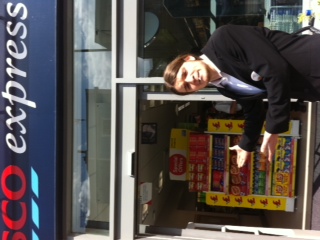
On Saturday, a performer (see pic above) invited us in to ‘his’ Tesco, while outside on the pavement, stalls served free food, and promoted Picton Street’s local independent shops, in the street behind the dreaded Tesco.

Picton Street is a marvel, and includes the Bristolian Cafe, Yogasara yoga studio, vintage dress shops, an art gallery, Radford Mill organic farm shop and Licata, the family-owned Italian delicatessen.

Licata often has great bargains in olive oil and tins of beans. I am crazy about beans as they are a wonderful source of health. Licata has many variety of tinned beans, which to me = fast food.

I owe everything I know about beans to vegetarian hero, Rose Elliot. The Bean Book changed my eating habits for life.

The following recipe comes from there. Please consult The Bean Book for measurements, nutritional facts and top inventive recipes using dried beans and pulses.

Here is my sloppy fast-food version.

Gently fry sliced fresh mushrooms in (olive) oil so they are still succulent. Add a tin of drained butter beans and warm with the mushrooms. Add lemon juice squeezed from two lemons and chopped fresh herbs such as parsley or coriander. You can’t have too many fresh herbs so over-estimate. Mix it all in the frying pan, with salt to taste, and serve still warm with brown rice, or cold as a salad.

I used organic ingredients from Better Food organic supermarket, a 20-minute walk away from Tesco’s, and land cress as the fresh herb.

Rose Elliot’s recipe fries fresh cut-up garlic with the mushrooms and adds cumin spice, with coriander as the fresh herb.

PS I met a neighbour on Saturday who said she had to buy something at Tesco’s in Stokes Croft, and I am haunted by her anxious look.

So, just so you know: If it makes life easier to shop there, then do. Life’s too short for guilt and sacrifice.

I am not against people who use Tesco. I am against Tesco.

Marmalade 2011

I made the marmalade early-Feb. Blimey, this blog is well-overdue.

So although not exactly hot-off-the-press, I want to record it because my last year’s marmalade-making post was useful when making this year’s. Like notes in a cookery book. See actual recipe, below.

Last year, as I made marmalade, Haiti’s earthquake was on my mind. This year, my mind was on Bradley Manning. The young soldier alleged to have leaked US documents to Wikileaks is being held in severe isolation in a US military prison. Bradley’s mother is Welsh so Amnesty is taking up his case as a British citizen.

Here’s how to donate to Bradley Manning’s public defense.

Back in early-Feb, I was also thinking about the trees. Privatising the nation’s woodlands? Wrong. Since then, there’s been a temporary reprieve in the face of public opposition. But don’t get complacent.

I was not the only one cooking and thinking about trees. Fairycakemother and Save Our Woods presented cakes on the day of the Opposition Day Debate to try to persuade MPs to go with their conscience, not their party whips.

Zac Goldsmith, Conservative MP, voted against his party and for the trees. Hooray. While making marmalade, I had a vision of the former-editor of the Ecologist leaving the Conservatives and joining the Green party. Glad to hear Zac Goldsmith is now working on green farming in all-party group including UK’s first Green MP, Caroline Lucas . I have met them both and feel in ma bones they are spiritually alligned.

The marmalade cast assembled on February 4 2011.

This year I reduced the sugar even further  to 1 lb of sugar to 1 lb of Seville oranges. It worked brilliantly. Chunky, tangy.

(Eeek I promised a US reader on Facebook to also use metrics. Gad, I wish I had a PA to do things like that, like converting measurements and stuff. My dream…. In the meantime, here is a converter.)

The recipe

5 lbs organic Seville oranges
5 lbs organic cane sugar
4 pints of water + 1 extra pint to extract the pectin

Marmalade-making has four stages.

1. Cooking oranges to soften

Scrub non-organic oranges (I used organic ones for health and the extra taste due to the fact organic produce has less water as nature intended) and remove the stalks. Cook in a large pan or two smaller ones – with lids – in 4 pints of water and simmer heartily for about an hour until peel is soft. Smells heavenly…

Drain oranges and cool, keeping the water for the sugar-boiling stage.

Put weighed sugar in a preserving pan (or two of your widest pans) in a low oven to warm. Clean jars thoroughly with hot water and dry them in the  oven.

Place a few saucers in the freezer so you can quickly cool a teaspoon of hot jam in Stage 3, the setting stage.

2. Extracting pectin and slicing peel

Cut cooked-cooled oranges in half. Scoop out pith and pips and add them to a pan with 1 extra pint of water and two cut-up lemons. Simmer merrily for ten minutes then drain: this pectin-rich liquid is used to help jam set in Stage 3.

Now cut up orange (and lemon) peel, thinly or thickly, as you like it.

3. Boil and set
Add the following to preserving pan: the drained pectin-juice, the water you used to boil the oranges, the cut-up peel and the  warmed sugar. It takes 15-20 minutes for the marmalade to set and you must not overboil or you can lose that magic-setting moment.

So says my trusted-over-twenty years (presciently-seasonal) Katie Stewart’s Times Calendar Cookbook.

But do not start timing until the jam is actually boiling like mad i.e. not just ordinary bubbles but when the liquid goes into a furious fast-boiling whirl – then start timing those 15-20 minutes.

It’s a bit like timing the start of labour – not from the first contraction – but from dilation. I think this gives a better reading on how long labour is and can prevent unnecessary inductions. But I digress.

So, after 15 minutes, take the pan off the heat and drop some hot jam on one of those icy-cold plates. Let jam-droplet cool, tilting plate to encourage cooling, then push droplet gently with your finger. You are looking for tell-tale wrinkles and jelly-like character. (The opposite of an ideal lover?).

If droplet is still runny, carry on boiling the big pan for a few minutes then test again. And so on.

Stage 4 – Marmalade in jars

The marmalade drops are now unequivocally set. So, let the jam cool in the pan until it is not-too-hot nor too-set for pouring . This is the sticky bit. Use newspaper to cover the kitchen surface, use a ladle or a small cup. And good luck!

Recipes say use waxed discs to keep out condensation and mould but, cutting-corners-cook that I am, I have not not done so for the last two years, with no adverse reactions. Wipe the jars from stickiness and proudly label.

I was a day too-late to send a jar off for the Marmalade awards.

Just as well because I did not want to part with any.

Real Food Lover postscript

By chance I was invited by GM Freeze to the second meeting of the green farming all party parliamentary group (mentioned above) on 15 March .

Security was tight at the Houses of Parliament and my marmalade, a gift for my mother, was held in temporary custody.

Dr Hans Herren spoke to a packed committee room.  He co-chaired the 2008 IAASTD report, the first-ever scientific assessment of global agriculture. Co-sponsored by the United Nations, the World Health Organisation and the World Bank, the International Assessment of Agricultural Knowledge, Science and Technology for Development report concluded that small-scale ecological farming was the answer to food prices, hunger and environmental disasters.

Dr Hans Herren’s message was one of passion and urgency – farming must become ecological as soon as possible.

Well, I was just sorry Cameron, Spelman and co were not there to hear his sound science-sense and Cassandra plea.

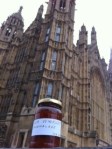
I collected my jar of marmalade from parliamentary custody and photographed it on the ramparts.
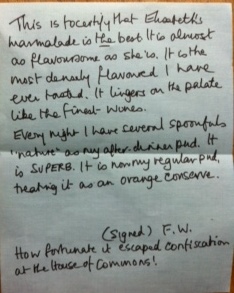
My mother was also pleased the organic marmalade made it to freedom as her note below attests.
Bread – what’s left unsaid


Look, if you are not in the mood for cooking (a state I know) then make sure basics, such as bread, are doing you good.

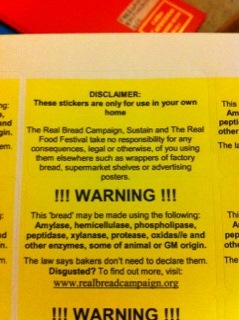
Bread gets messed-around with. This sticky label, from the 2009 Real Food Festival, lists ingredients that might be found on bread – but are never listed.

The label said:

~~~~~~~~~~~~~~~

“!!!WARNING!!!

This ‘bread’ may be made using the following:

Amylase, hemicellulase, phospholipase, peptidase, xylanase, protease, oxidase and other enzymes, some of animal or GM origin.

The law says bakers don’t need to declare them.

DISCLAIMER

These stickers are only for use in your own home. The Real Bread Campaign, Sustain and The Real Food Festival take no responsibility for any consequences, legal or otherwise, of you using them elsewhere such as wrappers of factory bread, supermarket shelves or advertising posters.”

~~~~~~~~~~~~~~~~

As Michael Pollan says: if they are more than five ingredients on a label, avoid.

The long list of enzymes above are “processing aids”. In other words they are used to make the bread rise faster, look nicer, last longer.

But because these processing aids are not classified as food ingredients then – by law – they do not need to be listed on the label.

Whaaat? You eat them but they are not food ingredients?

It reminds me of adulterated food sold to the Victorian poor

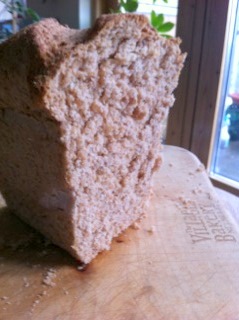
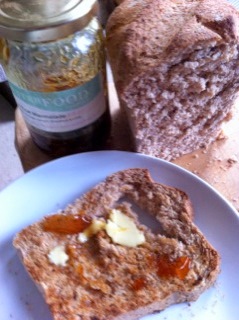
My real bread came from the Better Food Company in St Werburgh’s, Bristol where I also got marmalade made by their chef (as good as homemade…hey, it’s January, time for marmalade-making again) and organic butter from Nature’s Genius in Fishponds, Bristol.

Yes, the bread cost more than supermarket bread but I got more food for my cash. My grandmother would say money spent on un-nutritious food is money wasted. And I agree. Do you?

Quick carrot soup

Grab organic carrots and small onion from organic veg box. Wash or peel carrots; top, tail and skin onion.

Carrots take longer to cook than onions. Cut the onions as usual but cut carrots thinly – the smaller the bits, the quicker they cook.

Simmer veg in butter or (olive) oil. Enough to comfortably coat the veg. (suggest half ounce of butter/1.5 tablespoon oil).

If you have this spice, add a teaspoon of ground coriander or coriander seeds, crushed. Then a mugful and a half of milk or plant milk. Bring to the boil and simmer for 15 minutes or until the carrots are soft.  Season with black pepper, generously, and salt, carefully – start with a quarter of a teaspoon, then taste-test.

My favourite kitchen implement is a hand blender which is about £20 new or can be found in charity shops as my current one was.

So I whizzed the carrot soup and that is why it has that bubbly look in the photo.

It tasted sweet and creamy.

As I cooked, I thought of a blog I had just read.

Alberto Gonzalez, the founder of GustOrganics, New York’s 100% organic restaurant, writes on Maria Rodale’s Maria’s Farm Country Kitchen:

“We live in the most powerful country in the world.  However, America’s food system is probably one of the weakest on earth….About 98% of the food grown in America comes from factory farming.”

Recently, BBC TV’s Panorama investigated the power of supermarkets – four control 80% of the UK’s food.

Supermarkets and factory farming are intrinsically linked.

The soulless rows of biscuits brands, cabinets of ready meals, chemically sprayed salads and trays of birds that never saw the light of day are all the product of factory farming.

The land, animals and farmers bear the true cost to make the price seem cheap – but the profits real. Supermarkets make 55 p for every pound we spend, according to Panorama.

It’s a gloomy January day, the sky thick-grey again.

But humans tend towards balance, not extremes, and I see hopeful signs with this Guardian news report:

Ethical consumer spending bucks recession with 18% growth.

UK ethical sales have grown nearly 20% in the last two years, according to a Coop bank report .
People care about fair wages for farmers – Fairtrade food has grown by 65% to £750 m.
People care about their health and the planet’s – organic food is still strong at £1.7 bn having settled from 30% to 14% growth.
Eco and organic cosmetics and clothing now equal organic food’s pre-recession sales, and also grown 30%.
These figures show people do care about the bigger picture.
What are your hopeful glimmers of light?

St Werburgh’s City Farm Cafe at Christmas

I took this picture through the stained-glass window of St Werburgh’s City Farm Cafe at the weekend.

Bristol is a mega-city but blessed by pockets of seclusion – enchanted sanctuaries such as St Werburgh’s.

This little corner of green near the M32 shields the eco-self-build houses, the Wild Goose space,  the Climbing Wall, the Better Food Company, St Werbugh’s City Farm and Cafe and more, and, as my luck would have it, is a ten-minute walk through the allotments from home.

The icy-cold weather of late has been leavened by such pockets of warmth.

Last night, for instance, we went through powdery snow in the empty allotments to the wildness of a contact dance improvisation jam at the eco-built Wild Goose Space where I lay on the floor watching this compelling film, Baraka, then dropped by afterwards to St Werburgh’s City Farm Cafe for the drinks bit of the staff meal.

St Werburgh’s City Farm Cafe has Wifi and real coffee, and a splendid selection of heart-warming home-made dishes many made with produce from the adjoining City Farm.

It’s run by Leona Williamson – unassuming, hard-working and friendly. She and her team won the 2008 Observer Food Monthly award for outstanding ethical achievement, calling it the “ultimate green eatery…(using) not food miles but food yards”.

I wrote about the Cafe in 2008, and – see comments – received fierce rebuke for praising the Cafe’s use of animals from the Farm. I am with Simon Fairlie and the Soil Association on the meat issue. Although I passionately believe factory-farmed meat is wrong – over-produced, cruel, unhealthy, unsustainable and unnecessary – a few creatures on a family farm is another matter entirely.

Back to last night: I met Jack, and discovered he is the Ethicurean now running the Walled Garden Cafe at Wrington, Somerset. I remet (I know this sounds like a poncy eco-roll-call but it wasn’t really like that) Andy Hamilton, of the Self-Sufficientish Bible,  who is finishing a book (a brilliant idea and once O.K-ayed it, I will mention here…) (and it is Booze for Free – good innit?), and Jamie Pike from Co-Exist at Hamilton House, currently congregating food people to make creative use of a communal kitchen at Hamilton House in Stokes Croft.

We talked about the recent Tesco planning fiasco and the importance of creating alternatives (as Jamie and co has done at Hamilton House).

As we left, Leona gave us a bottle of refreshing homemade rosemary and apple cordial from (very) local produce.

St Werburgh’s City Farm Cafe is now closed for Christmas until 15 January.

Apparently Baraka (the movie) means: blessings in a multitude of languages, and this is appropriate, as I felt blessed indeed as we walked home through the moonlit snow.

Organic premium – who profits?

Why do we need organic food?

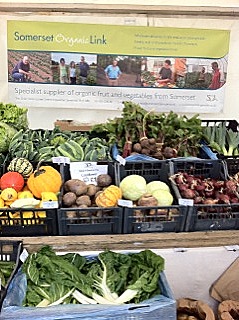
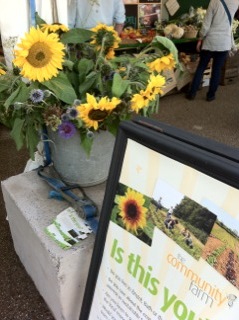
(As in the picture above of the beautiful stall from Somerset Organic Link, the farmers’ cooperative, at the Organic Food Festival last September).

What kind of topsy-turvy world do we live in that organic food has to be ring-fenced by regulations? Organic food should be the norm. It is food grown with chemicals that is the aberration!

NON-organic food should have to jump through all the hoops to be certified. Those that use the farm chemicals and potentially-harmful food additives should be paying extra in time and money to be regulated.

And people should pay more for the privilege: if industrial food factories had to pay for the damage they do – for instance polluting rivers and encouraging obesity – non-organic food would be very expensive indeed.

Instead it is organic food that attracts a “premium” (i.e. costs more).

Sometimes I wonder: Why? Who profits?

I include this letter from a farmer in the latest issue of Organic Farming which indicates that the profiteer is the supermarket.

“…If the Soil Association is serious [about challenging the public’s perception that organic is too expensive] it might do well to investigate the ongoing disparity between the supermarket shelf ‘premium’ and the ‘premium’ paid to farmers. Take lamb mince as an example: on 1 July 2010 Tesco was selling organic at £7.48/kg, compared to £5.74/kg for non-organic – that’s a difference of £1.74/kg or 23 per cent. Yet I am lucky to get a 5 per cent premium…..”

It’s annoying that eating organic often costs more (unless you are canny and take the extra effort to eat organic on a budget.)

It strikes me as grossly unfair that those of us who want to eat food – grown as nature intended – have to take more time, effort and money to do so.

What do you think?

Organic Food Festival 2010, Bristol

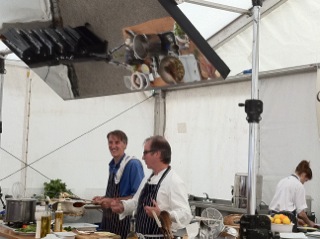
The Soil Association Organic Food Festival (see Demo kitchen above) now in its tenth year, lifts my spirits.

“79% of food we buy comes from just four shops,” says Real Food Festival’s Philip Lowery at the launch of Europe’s biggest organic food market.

The Organic Food Festival showcases real food producers who cannot be shoehorned into the supermarket-system, with its gargantuan requirement for uniformity.

After a week objecting to a multi-billion-backed Tesco (39th store in Bristol) in Stokes Croft, this is just what I need to revive my flagging spirits.

Somerset Organic Link displays freshly-harvested vegetables grown in carbon-rich organic soil without polluting the land with nitrate fertiliser.

And a variety of pumpkins you won’t find in a supermarket.

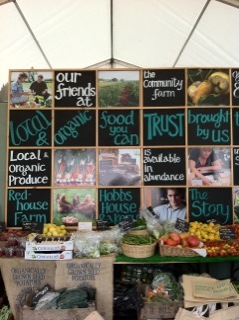
Better Food Company (a 20 minutes walk from the proposed Tesco) has a field outside Bristol supplying the shop with much of its seasonal local organic produce.

Better Food’s Community Farm is open to all, including helping in return for a share of the harvest.

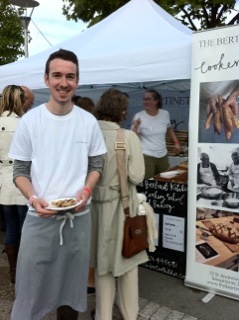
I buy a spelt loaf from the Bertinet Bakery based in Bath.

Bertinet Bakery were exhilarated having just been awarded a Soil Association Organic Food award for Baked Goods by Hugh Fearnley-Whittingstall at the awards ceremony held earlier that day in At-bristol.

The theme of this year’s Organic Fortnight is Choose Organic Everyday.

According to the latest Soil Association market report on the recession-hit 2009, 33% of organic purchases are now made by shoppers including manual and casual workers, students, pensioners and people on benefits.

In other words, recession or not, people care about healthy food, where it comes from and how it was grown.

Some organic businesses in common with many non-organic ones were hurt by the recession – overall a near 13% decline in 2009 organic sales.

But  others resisted the downward trend: organic milk sales were up 1%, organic baby food up 21%. By 2010 UK farmland that is organic rises above 5% for the first time.

Junk food high in cheap fat, sugar and additives, or chickens raised in giant sheds  never seeing natural daylight – these are the product of an industrialised and centralised food system that profits shareholders – not the consumer.

Tesco and the other three supermarkets control over three-quarters of our food. They seek market-dominance and make vast profits – Tesco’s profits increased 12% in half-year profits to £1.6bn. [October 2010 figures added after blog was posted].

Supermarkets promise cheapness but it’s an illusion.

The costs are externalised – in other words, they are picked up elsewhere: rivers polluted by farm chemicals are cleaned by taxpayers’ money; obesity from eating junk food is paid for by the NHS. Farmers are squeezed; animals farmed inhumanely.

A shopping survey in Stokes Croft – the Bristol area currently fighting off a Tesco – shows food is cheaper in the local shops than Tesco Express.

Devon-based Riverford farm’s monthly price comparisons show the organic fruit and veg in its delivery box is on average 20% cheaper than supermarkets.

Can you imagine a world where the only food you can buy comes from industrialised food systems?

(Well, that is if oil supplies remain steady because if not we will be stuffed if we are relying on only four suppliers ferrying in food from afar).

Another – local organic – world is possible.

PS Thanks to Juliet Wilson for encouraging this post.

PPS Deadline for objecting to Tesco in Stokes Croft: 14 September.

Why I object to Tesco in Stokes Croft, Bristol

On Tuesday I ate (well) in Zazu’s Kitchen in the cultural quarter of Stokes Croft.

A unique area featuring street art from vintage Banksy
to up-to-the-minute street art attracting visitors from far and wide including Italian food blogger, Jasmine.

“93% of local people say NO to Tesco in Stokes Croft,” says the fresh notice on Stokes Croft’s  creative response to street drinking, Turbo Island.

How many Tescos does a city need? There are already 38 Tescos in Bristol according to Tesco – and two within five minutes of the proposed site.

Tesco picked the wrong place to wield its corporate takeover of the high street when it set its sights on the eighteenth-century building at 138-142 Cheltenham Road in Stokes Croft.

Using an intermediary (to deflect suspicion?), it bought the lease on Jesters comedy club and applied for change-of-use to shop in November 2009.

Apparently, one Bristol City councillor said: had he known it was Tesco applying, he would not have agreed. But the application got passed, unnoticed.

Thus Tesco infiltrated the heartland of Stokes Croft, as part of its taking advantage of the recession master-plan. What a double-win for Tesco: cheapness and take-over. The more shops Tesco has, the less competition.

Local shops cannot compete against a supermarket’s marketing millions. Hello supermarket means goodbye local family businesses.

Stokes Croft happens to bring together a powerful group of people: freethinkers, food activists and artists. The area’s independent shops offer a wealth of cultural diversity and quality food – including a long-established Italian delicatessen and organic farm shop – and community.

People know each other and help each other.

The local shops have an informal agreement not to sell cheap-as-dirt super-strength alcohol – the liver-rotting stuff supermarkets sell. It will be the beginning of the end if Tesco moves in.

As Joni Mitchell sung in the Sixties: “They paved Paradise and put up a parking lot… You don’t know what you’ve got till it’s gone.”

There is still time to stop the juggernaut. All Bristolians have a right to object.

It’s true that current planning laws do not allow a Council to protect its own local shops as the Channel 4 Dispatches documentary: Tesco – the supermarket eating Britain – shows.

However the formal objection process against a shop front still gives plenty of scope for voicing concerns. Tesco front store branding promises cheapness but is a lie. Our local shops are cheaper than Tesco Express, according to a local survey.

I am helping run workshops to help people write their letters. We all need encouragement. I know I did.

The No Tesco in Stokes Croft campaignwebsite has a template letter to email to Bristol City Council. Copy and paste, then top-and-tail with a list of your concerns and your postal address.

The deadline for emailing your objection is the 14 September 2010.

I have also sent my written statement asking to speak at the planning committee on 22 September at Bristol City Council on College Green.

There will be a party on College Green from 12.30 – 2.00pm to celebrate our campaign. Whatever happens, our fight for fair planning laws has just begun.

Carrot cake at the Grand Canyon

I ask the Grand Canyon rancher: “What is the trail for the scaredy-cats with no heads for heights?”

Nonplussed, she sends us to the start of the Bright Angel trail.

Looks steep and scary to me.

I do not dare take in the view. Just focus on my feet.

Try to ignore the images of pitching headlong over the edge which my mind is generously supplying.

We see a zag of lightning.

Thunder hollers in the canyon.

Anxiety about heat exhaustion (it was 100 degrees when we started) is replaced by fear of being struck by lightning.

Fat plops of rain fall.

When we reach the Mile-and-a-half shelter, I am soaked. Chilly.

Three US students and a  family from Amsterdam are also sheltering. We commiserate over Holland losing the World Cup.

The students have been hiking since early morning.

They witnessed a helicopter rescue for a hiker with a scorpion bite. The helicopter took six hours to arrive, the rancher two.

Not enough money, say the students. The Grand Canyon is feeling the recession.

The rain stops.

We set off on our return journey up the trail.

Miraculously, my mind is no longer furnishing scenes of disaster.

I am no longer hugging the side of the rock.

I am taking in the view. And stride.  A miracle.

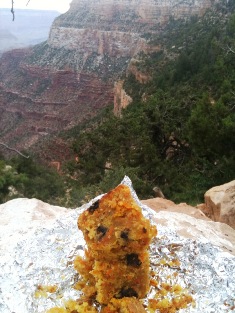
Time for the carrot cake’s photo-shoot (see pic above).

I baked it the night before, amalgamating and adjusting several recipes found on the web for the simplest.

Here it is before I forget it.

Whisk five small eggs (or four big ones) with 1+1/4 cups of sugar and 1+1/4 of organic coconut oil

Fold in 2 cups of organic flour and 2 teaspoons of cinnamon.

Plus 3 cups of grated organic carrot and some cut-up raisins.

Bake in a greased loaf tin for 1 hour at 350 degrees.

Insert a knife to check it is not wet when withdrawn. If wet, the cake is not sufficiently cooked.

Because of the high altitude (7,000 feet) of Flagstaff, the cake took another twenty minutes.

I concocted a separate topping of whisked organic tofu, lime juice and organic agave nectar (the un-organic kind is highly processed and not worth it).

The topping did not come with us to the Grand Canyon.

Unlike the brave carrot cake, that did.

You can’t beat US home cooked food

The US Asia bus from Las Vegas (hot tip: cheaper than the Greyhound) drops me on the outskirts of Los Angeles, at Monterey Park.

I buy a new watch strap and a refreshing green tea with succulent mango seeds from one of the many local Chinese shops.

I ask directions for downtown LA, using my rudimentary Spanish as the lady I ask speaks no English.

Poor people, and workers, on the no 70 bus. I am minority White. Everyone helpful and polite.

Downtown LA with its impressive skyscrapers.

After catching another bus, stressed from travelling in a strange land, I am picked up by my Servas host.

Servas was started after the Second World War to promote peace and understanding amongst nations.

Suddenly, I am whisked to heaven – yoga in the garden, fine wines on the veranda, then supper with soul conversations.

I realise that most of the food I have been eating in the US has been ethnic: Thai, Chinese or Indian.

This is my first taste of traditional American food.

Home cooked, with ingredients from the local farmers’ markets, it is superb.

Traditional July 4 food: barbecued and succulent spare ribs, homemade watermelon rind pickle, refrigerator cucumber pickle (Midwest speciality) and – officially – the best coleslaw I have ever tasted – courtesy of Angie’s father with spicy cayenne and refreshing parsley and cilantro.

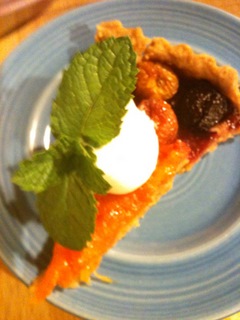
The pudding: seasonal cherries picked that day by Angie in Leona valley, a nearby microclimate defying the Californian desert. Plus apricots, a blob of creme fraiche, and the most elegantly thin wholemeal pastry (a feat as such pastry is usually cludgy).

Bless you, Angie and Hans, for giving me sanctuary.