Category Archives: health

Stokes Croft Tesco opens and butter bean salad


It’s hard to be happy about the 41st Tesco opening in Bristol (figure according to Tesco’s store locator).

93% of 500 locals surveyed had said No to Tesco’s in Stokes Croft. After over a year’s campaigning, it was bitter to see Bristol City Council bow to Tesco pressure last December.

Still, we are making the best of it.

On Friday 16 April, Tesco opened in Stokes Croft.

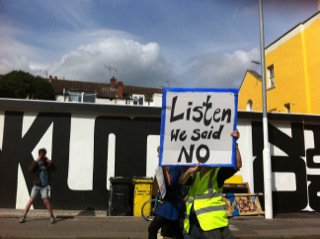
Friendly activists gave a Bristol-style welcome. They put a comfy sofa and lampshade outside on the pavement. Someone played a guitar.

Another strode into Tesco’s with a wad of Monopoly money. When he was not allowed to spend it, he tried to bribe a security guard with it.

A woman passer-by who also objected to Tesco’s monopoly, took up the Monopoly money-action.

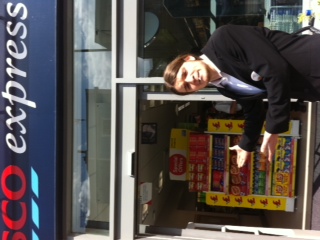
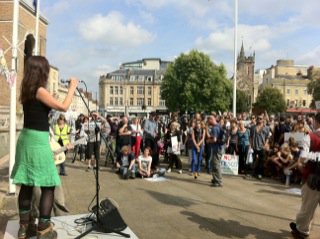
On Saturday, a performer (see pic above) invited us in to ‘his’ Tesco, while outside on the pavement, stalls served free food, and promoted Picton Street’s local independent shops, in the street behind the dreaded Tesco.

Picton Street is a marvel, and includes the Bristolian Cafe, Yogasara yoga studio, vintage dress shops, an art gallery, Radford Mill organic farm shop and Licata, the family-owned Italian delicatessen.

Licata often has great bargains in olive oil and tins of beans. I am crazy about beans as they are a wonderful source of health. Licata has many variety of tinned beans, which to me = fast food.

I owe everything I know about beans to vegetarian hero, Rose Elliot. The Bean Book changed my eating habits for life.

The following recipe comes from there. Please consult The Bean Book for measurements, nutritional facts and top inventive recipes using dried beans and pulses.

Here is my sloppy fast-food version.

Gently fry sliced fresh mushrooms in (olive) oil so they are still succulent. Add a tin of drained butter beans and warm with the mushrooms. Add lemon juice squeezed from two lemons and chopped fresh herbs such as parsley or coriander. You can’t have too many fresh herbs so over-estimate. Mix it all in the frying pan, with salt to taste, and serve still warm with brown rice, or cold as a salad.

I used organic ingredients from Better Food organic supermarket, a 20-minute walk away from Tesco’s, and land cress as the fresh herb.

Rose Elliot’s recipe fries fresh cut-up garlic with the mushrooms and adds cumin spice, with coriander as the fresh herb.

PS I met a neighbour on Saturday who said she had to buy something at Tesco’s in Stokes Croft, and I am haunted by her anxious look.

So, just so you know: If it makes life easier to shop there, then do. Life’s too short for guilt and sacrifice.

I am not against people who use Tesco. I am against Tesco.

Fay’s fish soup with fennel

My mother is the original Real Food Lover. She says the original Real Food Lover was her mother. Because this is how we learn about food: from the people close to us.

My mum always says the best education you can give a child is to educate the palate.

My mum bought this hake the day before at Tachbrook Street market, Victoria, where my dad used to be a one-man GP.

Here is a link to a video of my mum explaining to my eldest daughter how to make fish soup.

It starts with the drama of stopping the fishmonger from throwing away fish-heads:

“‘I’ll have the head!'” she cries. “He was going to throw it into the bin,” she says, with disbelief.

My mum makes the stock from the (rescued) sea bass head and its bones, the head from the large hake from whence come the cutlets, as well as prawn shells.

She adds bay leaf and peppercorns, with just enough water to cover, and cooks it for twenty minutes, with the lid on.

Here is a video of my mum agonising over how much water she used and describing the importance of a lid.

She remembers the way her mother cooked:

“Now, my mother used to tilt the lid – her soups were never watery…But I don’t trust myself.”

While the stock is simmering, she sweats the fennel and leeks in olive oil.

After twenty minutes, she drains the stock, keeping the liquid, to which she adds quartered potatoes and a pinch of saffron which gives the soup the yellow-colour, and a delicate aroma.

Here are the drained remains of the fish head and bones after they have yielded their flavour to the liquid stock.

Fay pours the stock over the vegetables and cooks until tender but “not too tender,” she adds.

When she is ready to serve, she removes the vegetables with a slotted spoon.

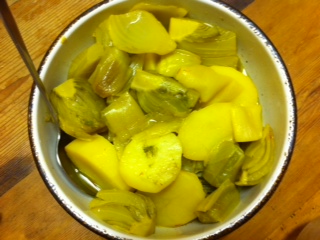
Here are the saffron-coloured vegetables, removed temporarily from the saucepan.

Then Fay heats the stock and adds the fish.

You must never cook the fish too long.

According to my mum, her mother “used to scream down the ‘phone: “Don’t cook it too long.'”

What is too long?

What? You want measurements?

As my mum says: “Nothing is made to measure.”

Basically, as soon as the fish starts to gently flake, you take the fish off the heat.

It all depends on the thickness of the fillet, or, in this case, the hake cutlets. Five to ten minutes?

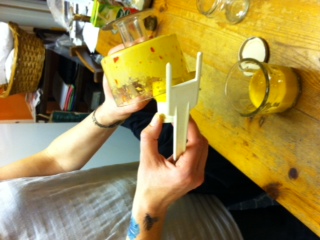
Here is my eldest daughter scooping out the rouille my mum made.

“You know how to make rouille?” My mother asks my eldest daughter.

With garlic, cloves and red chilli pepper – I’d better check that.

Geraldine  (added after publication) gives rouille recipe:

“The rouille will be made with crushed cloves of garlic and red chilli pepper, and mashed as you say into a paste made of stock soaked bread (instead of egg yolks).”

Fay adds bread soaked in the fish stock, then carefully drips-and-whirrs olive oil to make a mayonnaise.

And you don’t just eat the meal. You have to analyse it in detail.

My mum remembers her parents discussing the make-up of every dish back in the 1930s.

And here we are, in the 21st century, still doing it.

Bread – what’s left unsaid


Look, if you are not in the mood for cooking (a state I know) then make sure basics, such as bread, are doing you good.

Bread gets messed-around with. This sticky label, from the 2009 Real Food Festival, lists ingredients that might be found on bread – but are never listed.

The label said:

~~~~~~~~~~~~~~~

“!!!WARNING!!!

This ‘bread’ may be made using the following:

Amylase, hemicellulase, phospholipase, peptidase, xylanase, protease, oxidase and other enzymes, some of animal or GM origin.

The law says bakers don’t need to declare them.

DISCLAIMER

These stickers are only for use in your own home. The Real Bread Campaign, Sustain and The Real Food Festival take no responsibility for any consequences, legal or otherwise, of you using them elsewhere such as wrappers of factory bread, supermarket shelves or advertising posters.”

~~~~~~~~~~~~~~~~

As Michael Pollan says: if they are more than five ingredients on a label, avoid.

The long list of enzymes above are “processing aids”. In other words they are used to make the bread rise faster, look nicer, last longer.

But because these processing aids are not classified as food ingredients then – by law – they do not need to be listed on the label.

Whaaat? You eat them but they are not food ingredients?

It reminds me of adulterated food sold to the Victorian poor

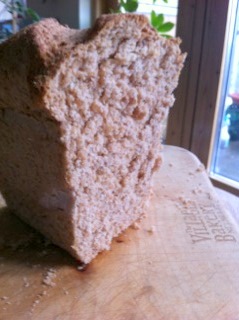
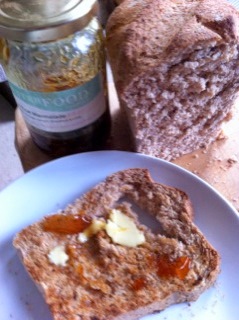
My real bread came from the Better Food Company in St Werburgh’s, Bristol where I also got marmalade made by their chef (as good as homemade…hey, it’s January, time for marmalade-making again) and organic butter from Nature’s Genius in Fishponds, Bristol.

Yes, the bread cost more than supermarket bread but I got more food for my cash. My grandmother would say money spent on un-nutritious food is money wasted. And I agree. Do you?

Quick carrot soup

Grab organic carrots and small onion from organic veg box. Wash or peel carrots; top, tail and skin onion.

Carrots take longer to cook than onions. Cut the onions as usual but cut carrots thinly – the smaller the bits, the quicker they cook.

Simmer veg in butter or (olive) oil. Enough to comfortably coat the veg. (suggest half ounce of butter/1.5 tablespoon oil).

If you have this spice, add a teaspoon of ground coriander or coriander seeds, crushed. Then a mugful and a half of milk or plant milk. Bring to the boil and simmer for 15 minutes or until the carrots are soft.  Season with black pepper, generously, and salt, carefully – start with a quarter of a teaspoon, then taste-test.

My favourite kitchen implement is a hand blender which is about £20 new or can be found in charity shops as my current one was.

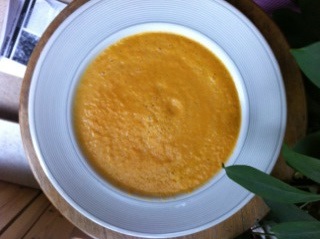
So I whizzed the carrot soup and that is why it has that bubbly look in the photo.

It tasted sweet and creamy.

As I cooked, I thought of a blog I had just read.

Alberto Gonzalez, the founder of GustOrganics, New York’s 100% organic restaurant, writes on Maria Rodale’s Maria’s Farm Country Kitchen:

“We live in the most powerful country in the world.  However, America’s food system is probably one of the weakest on earth….About 98% of the food grown in America comes from factory farming.”

Recently, BBC TV’s Panorama investigated the power of supermarkets – four control 80% of the UK’s food.

Supermarkets and factory farming are intrinsically linked.

The soulless rows of biscuits brands, cabinets of ready meals, chemically sprayed salads and trays of birds that never saw the light of day are all the product of factory farming.

The land, animals and farmers bear the true cost to make the price seem cheap – but the profits real. Supermarkets make 55 p for every pound we spend, according to Panorama.

It’s a gloomy January day, the sky thick-grey again.

But humans tend towards balance, not extremes, and I see hopeful signs with this Guardian news report:

Ethical consumer spending bucks recession with 18% growth.

UK ethical sales have grown nearly 20% in the last two years, according to a Coop bank report .
People care about fair wages for farmers – Fairtrade food has grown by 65% to £750 m.
People care about their health and the planet’s – organic food is still strong at £1.7 bn having settled from 30% to 14% growth.
Eco and organic cosmetics and clothing now equal organic food’s pre-recession sales, and also grown 30%.
These figures show people do care about the bigger picture.
What are your hopeful glimmers of light?

St Werburgh’s City Farm Cafe at Christmas

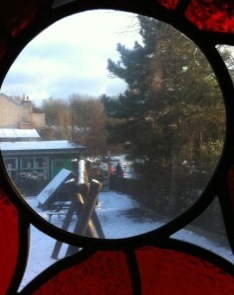
I took this picture through the stained-glass window of St Werburgh’s City Farm Cafe at the weekend.

Bristol is a mega-city but blessed by pockets of seclusion – enchanted sanctuaries such as St Werburgh’s.

This little corner of green near the M32 shields the eco-self-build houses, the Wild Goose space,  the Climbing Wall, the Better Food Company, St Werbugh’s City Farm and Cafe and more, and, as my luck would have it, is a ten-minute walk through the allotments from home.

The icy-cold weather of late has been leavened by such pockets of warmth.

Last night, for instance, we went through powdery snow in the empty allotments to the wildness of a contact dance improvisation jam at the eco-built Wild Goose Space where I lay on the floor watching this compelling film, Baraka, then dropped by afterwards to St Werburgh’s City Farm Cafe for the drinks bit of the staff meal.

St Werburgh’s City Farm Cafe has Wifi and real coffee, and a splendid selection of heart-warming home-made dishes many made with produce from the adjoining City Farm.

It’s run by Leona Williamson – unassuming, hard-working and friendly. She and her team won the 2008 Observer Food Monthly award for outstanding ethical achievement, calling it the “ultimate green eatery…(using) not food miles but food yards”.

I wrote about the Cafe in 2008, and – see comments – received fierce rebuke for praising the Cafe’s use of animals from the Farm. I am with Simon Fairlie and the Soil Association on the meat issue. Although I passionately believe factory-farmed meat is wrong – over-produced, cruel, unhealthy, unsustainable and unnecessary – a few creatures on a family farm is another matter entirely.

Back to last night: I met Jack, and discovered he is the Ethicurean now running the Walled Garden Cafe at Wrington, Somerset. I remet (I know this sounds like a poncy eco-roll-call but it wasn’t really like that) Andy Hamilton, of the Self-Sufficientish Bible,  who is finishing a book (a brilliant idea and once O.K-ayed it, I will mention here…) (and it is Booze for Free – good innit?), and Jamie Pike from Co-Exist at Hamilton House, currently congregating food people to make creative use of a communal kitchen at Hamilton House in Stokes Croft.

We talked about the recent Tesco planning fiasco and the importance of creating alternatives (as Jamie and co has done at Hamilton House).

As we left, Leona gave us a bottle of refreshing homemade rosemary and apple cordial from (very) local produce.

St Werburgh’s City Farm Cafe is now closed for Christmas until 15 January.

Apparently Baraka (the movie) means: blessings in a multitude of languages, and this is appropriate, as I felt blessed indeed as we walked home through the moonlit snow.

Time to stop Tesco in Stokes Croft

There is still time to stop Tesco in Stokes Croft.

I have just written to Nigel Butler, Bristol City Council’s planning officer.

The deadline to write to Nigel is today. I am sorry this is last-minute but – like for the rest of us, life is pressured. It is hard to find time to campaign in between working and caring for dependents (let alone eating and sleeping!).

Stop press: Submit letters to Nigel, the planner, until 8 December 2010 – get writing/emailing!

Please go to the No to Tesco Stokes Croft campaign website for the template letter to help you raise planning issues with the Council – see Two more ways to take action, below, for a summary.

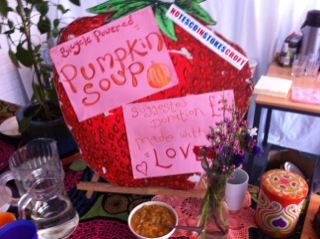
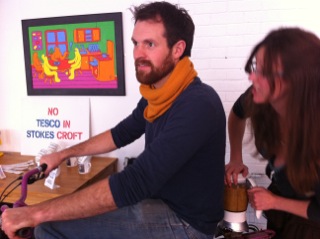
The No Tesco in Stokes Croft campaign team has unsung heros, giving their precious time to make the planning laws intelligible and relevant. They also make fabulous fund-raising bicycle-powered fresh pumpkin and ginger soup (see pic above and below).

<h2>Success so far</h2>

Campaigning by the No Tesco in Stokes Croft and a fiercely active community has kept the multinational out of Stokes Croft for a year.

Reputed to be the last high street in the UK not to have corporate retailer, Stokes Croft wants it to stay that way.

Tesco did not get full planning permission on 22 September 2010, an historic community day which saw over 200 protestors fill the Council chambers.

Nor did Tesco get an alcohol license for its proposed store in Stokes Croft, thanks to hundreds of letters of objection sent to Bristol City Council.

The community’s objections were supported by the police who argued that another retailer selling (cheap) alcohol in the area would increase existing problems of “pre-loading” and street drinking.

<h2>Two more ways to take action</h2>

1. WRITE / EMAIL Bristol City Council about two vital planning issues before 7 December

a) Noise
Tesco’s recent noise report is wholly inaccurate and misleading. Tesco cannot comply with the Council’s noise conditions.

b) Traffic
Because goods are delivered “just-in-time” from centralised depots, a Tesco Express (by Tesco’s own reckoning) would get 6 deliveries a day, 42 a week. These would block the cycle path, bus stop and two pedestrian crossings on either side.

Please see No Tesco in Stokes Croft’s detailed template letter.

Copy, paste, add your address and personalise.

Email: nigel.butler AT bristol.gov.uk (CC: rachel.h.bibb AT gmail.com so campaigners have a copy) or write to: Nigel Butler, Development Management, City Development, Bristol City Council, Brunel House, St, George’s Road, Bristol BS1 5UY.

2) ATTEND the Council meeting to find out if these objections have been heard – it will be another historic day for the community.

Wed 8 December 2010 at 2pm at the Bristol City Council, College Green.

Anyway, here is a copy of my letter:

“Dear Nigel

Re. Applications for proposed Tesco on Cheltenham Road

I have lived in walking distance of Stokes Croft for over 20 years. It is my shopping area and my community, and I strongly object to a planning application from a supermarket which will undermine the area’s unique character, local trade and community cohesion.

I attended the Council planning meeting on October 22. Like many who did so, I was appalled and disheartened by the process.

Over 200 people crowded into the Council chambers. There were over 50 in the overspill room. We took time out of our busy lives – caring for our families, studying or working – because of the depths of our concern for our community.

We had three learned submissions from our representatives, Claire Milne, Sam Allen and Rachel Bibb. These clearly outlined to the letter of the planning law, why the application from Tesco should not go ahead.

Planners dismissed our concerns on the basis they had received legal advice that they were not relevant (material considerations) to the external works and shop front applications.

This dismissive response was shocking and incomprehensible.

We expressed concerns about how a successful application from Tesco would increase traffic on Cheltenham Road, a main artery high-street with a cycle lane.

And how would a huge lorry negotiate the one-track cobblestoned Picton Lane at the back of the proposed store?

I was shocked to discover that these genuine concerns for safety were not considered significant. Why? Because change of use had already been granted in September 2009, and traffic issues were supposedly dealt with at the time in that application.

How can this be a satisfactory response?

Tesco used a third party to make its application so change of use was granted on the basis that it was a “shop” – an ordinary shop like its neighbours.

Traffic issues were dealt with not knowing the true identity of the application.

Now the planners know the real situation – that change of use was actually granted to a multinational corporation that operates just-in-time deliveries and, in this case, at least 42 a week at up to 40 minutes each within a 6 hour period – should they not re-examine traffic concerns?

Why have the impacts to public and highway safety not been assessed when servicing a store is a material consideration?

The Government’s Planning Inspectorate has already ruled that servicing is a material consideration for external works and shop frontage applications, as shown in the case of Mill Road in Cambridge and Sunningdale in Berkshire.

I now refer to a letter drafted by the No Tesco in Stokes Croft campaign which I support – I am grateful to the campaign for the hours of unpaid work that have gone into studying the applications and drafting a detailed, informed and intelligent response.

When drafting your report to the councillors, I would like you to address the following questions:

1. Why, when the Government’s Planning Inspectorate has already ruled that servicing is a material consideration for these applications, are you denying this and ignoring the significant risks to public and highway safety?

2. Why has there been no impact assessment of the significant risks to public and highway safety posed by the servicing of this proposed store, now that you have information about the intensity of such servicing at clearly precarious locations?

It would be negligent to grant permission for these applications in the absence of an adequate impact assessment.

Bristol’s Statement of Community Involvement

Why did the planners ignore Bristol’s Community Involvement Statement?

Again, I am grateful to my campaigning colleagues, for expressing my concerns so thoughtfully and thoroughly. Here they are:

Bristol’s Community Involvement Statement is a statutory requirement from central government and significant amounts of public money have been spent producing it.

It is therefore entirely unacceptable to grant permission for these applications until the directives within the Statement have been followed.

Whilst the specifics of how applicants comply with the Statement is discretional, it is unacceptable that the Council’s Planning Officers have made no attempts to encourage compliance with it – or sought any explanation for why the applicant is refusing to comply with it.

The fact that both the Council and applicant have shown complete disregard for the Statement must also be recognised as showing complete disrespect for the need to involve the community in their operations and plans.

Bristol’s Community Involvement Statement states that:

“Developers will be expected to involve the local community and Ward Members in early discussion of the implications of their proposals and how these might be dealt with. [our emphasis]”

The document also states that the Council will encourage developers to undertake various specific community involvement activities. This particular proposed development falls under category 2 – sensitive sites. The document outlines a variety of activities the Council is supposed to encourage developers to carry out.

Tesco has not meaningfully involved the community or Ward members in the development of its plans. Nor have we seen evidence of the Council encouraging Tesco to do this.

In fact, when our local MP and Barbara Janke asked Tesco to carry out a consultation, the company said it would only do this if it did not need to call it a consultation as it was not prepared to act on the results.

This is clear evidence of Tesco’s complete disregard the needs of our local community.

It would be entirely negligent to grant permission for this proposed store in the absence of efforts to adhere to Bristol’s Community Involvement Statement. Refusal to do so by the applicant can only be viewed as further evidence of Tesco’s disregard for its impact on our community.

When drafting your report to Councillors, I would like planners to address the following questions:

What efforts has the Council made to encourage Tesco to adhere to the Community Involvement Statement? If none, please explain why.

What activities has Tesco carried out to involve the community in the development of its plans?

What is the purpose of the Community Involvement Statement if the Council ignores it in Planning decisions such as these?

SPD10 and the Stokes Croft Plan are relevant to these applications

We were not allowed to ask questions in the October 22 meeting nor even to point silently to a document which was so crucial to your understanding.

SPD10 contains a directive on page 13 that ‘Development proposals are expected to address … the Stokes Croft Study’.

The page on which this directive is given, also includes a map clearly showing the boundary including the proposed site.

So, whilst SPD10′s boundaries fall metres short of the proposed site, page 13 [the page we stood up to point to, silently!] contains an exception where the boundary is extended to include the Stokes Croft area.

SPD10 explicitly identifies this area as being in need of particular attention and, more specifically, that independent traders must be protected from supermarkets.

Planning officers have dismissed the relevance of SPD10 and the Stokes Croft Plan on the basis that SPD10′s boundaries fall metres short of the proposed site.

However if this directive on page 13 of SPD10 did not intend the proposed site to be included, then surely the inclusion of the map would be accompanied by a note explaining that this stretch of Cheltenham Road is not included in this directive.

In the absence of this stated exclusion, then the map must be interpreted to delineate the expanded boundary for this particular directive.

The Stokes Croft Plan makes it clear that care must be taken to ensure the range of small shops is not supplanted by supermarkets. It is unacceptable to dismiss this.

As someone who has used, supported and engaged with these local shops for the last 20 years, I feel very strongly about this.

Permission cannot be granted for these applications until an adequate explanation has been provided as to why planning officers are choosing to ignore the clear boundaries set within SPD10, with respect to the Stokes Croft Plan.

When drafting your report to Councillors I would like planners to address the following questions:

Why the map on page 13 of SPD10 clearly showing the proposed site being included within the Stokes Croft Plan is being ignored?

Why, if the proposed site was not intended to be included within SPD10′s directive to address the Stokes Croft Plan, there is no annotation on the map (that includes the proposed site), clearly stating that despite the Stokes Croft Plan including this site, that for the purposes of SPD10, this is not the case?

Why, when the official Plan for Stokes Croft makes it clear that care must be taken to protect independent traders from supermarkets, absolutely nothing has been done to address this?

For the proposed store to open, Tesco must apply and be granted permission for an extension

Again I am grateful for the preparation and research that has gone into my co-campaigners’ assessment of the situation. I could not have expressed it better myself.

The addition of 26 square metres of pre-fabricated buildings in the form of walk-in chiller and freezer rooms clearly constitutes an extension to the existing building.

Tesco has not applied for this and is attempting to pass these prefabricated buildings as external works.

Permission to open the proposed store cannot be granted in the absence of an additional application for an extension.

When drafting your report to councillors, I would like planners to address the following questions:

Why there has been no application for an extension for these pre-fabricated buildings?

Why the Council has not requested such an application as a condition to opening the proposed store?

Why, when the need for this extension was raised ahead of the meeting on 22 September, planning officers failed to respond to this and the issue was completely ignored?

Tesco’s recently submitted noise report

Tesco’s noise report entirely flawed and full of inconsistencies and therefore completely invalid.

Tesco’s BS4142 acoustic report, submitted by KR Associates, is highly inaccurate.

In several areas, incorrect methods and have been used, leading to a distorted and inaccurate noise assessment which wrongly states that Tesco’s proposed external works will fall within Bristol City Council’s stated noise requirements for new developments of 6dB below background levels.

Background noise level assessment

To assess background noise level, the report states that for night time assessments, 5 minute noise readings should be measured throughout the night, and the lowest 5 minute reading should be taken as the background noise level. The lowest 5 minute reading KRA measured was 27.1 dB (see p26). However, they have not used the lowest 5 minute reading in their background noise level assessment, but have instead worked out the average reading from the entire night. This means they assessed the background noise level at 30dB, which is 2.9dB higher than if they had used the lowest reading as required.

Acoustic Feature Correction of plant

In BS4142 noise assessments, the measured noise emitted by the plant should bepenalised by 5dB if the noise contains a distinguishable, discrete, continuous note (whine, hiss, screech, hum etc), distinct impulses (bangs, clicks, clatters or thumps) or an irregular occurrence. The report has not applied the acoustic feature correction which makes the readings incorrect because:

The plant will emit a distinguishable, discrete note: The condenser (Searle MGB124) and the AC units (Mitsubishi) have a high frequency whine caused by the motors and a low frequency hum created by the fan blades.

The noise emitted will be irregular and will include distinct impulses: the plant will be operated by a thermostat, meaning it will consistently turn off when it reaches a desired temperature, and on again when the temperature drops below a certain level. This will create a sudden jump in noise from the plant which will normally be accompanied by a clicking noise from a solenoid in the motor.
The measurements in Tesco’s report misrepresent the situation because:

It assessed the condenser within controlled conditions, where the air through the fan would have been uniform and not caused much noise. In real conditions (i.e. outside), even a slight wind can cause the fan blades to make a hum noise.

Data beyond 5000Hz has not been included despite the human ear being able to detect sound as high as 20,000Hz. This means the report does not determine tonal content on this range of audible hearing and therefore does not represent an adequate assessment of the actual noise of the plants.

Searle Condenser Data

Tesco’s report rates the condenser as having a sound power level of 50.5 dB when running at 2V 216prm. However, the manufacturer’s (Searle) Sales Deparment have provided data which suggests the sound power level will be much higher than this.

According to Tesco’s report their proposed external works will fall within the Council’s stated noise requirements of 6dB below background levels. However, when recalculated to take into account the inaccuracies highlighted above, both night and day time levels are in fact above this figure and will therefore exceed the Council’s condition of being 6dB below background levels.

This acoustic report is wholly inaccurate and misleading.

Tesco is renowned for submitting similarly misleading and inaccurate reports elsewhere in the country.

They are wasting our precious time and resources and cannot be allowed to continue to make a farce of this situation.

Having initially failed to even produce an acoustic report when clearly required in order to meet conditions set by the Council and now presenting an invalid report, permission must be denied for this external works application on the basis that they are unable to meet the conditions set.

In the Development Control meeting on 22 September, the No Tesco campaign submitted an acoustic report carried out by an accredited noise consultant.

This clearly showed that the external works would create too much noise to meet the Council’s condition.

The Committee dismissed this report and asked Tesco to submit their own report. This then allowed Tesco to hire a company willing to distort its findings in order to gain the results Tesco desired.

This draws into question the appropriateness of Tesco (or any applicant), rather than an independent body appointed by Bristol City Council, being responsible for commissioning such reports.

When drafting your report to councillors, I would like planners to address the following questions:

How can Tesco’s report be valid if it has incorrectly used the average, rather than lowest background noise levels?

Why does the report not incorporate the necessary 5dB penalty in light of it falling within the category of noise that requires this?

Why does the report only use data up to 5000Hz when the human ear detects noise up to 20 000Hz?

What mechanism does the Council have to prevent applicants from submitting misleading noise reports that fail to comply with UK standards, and to disqualify applicants who do this from submitting further applications?

Ahead of the 22 September Development Control meeting, you received hundreds of letters making an official complaint about the handling of this case by the Planning team, specifically asking to be notified of what action will be taken to investigate this.

What action is being taken around this? Please ensure your team is no longer dismissing our valid concerns.

So far, I have spoken to no one who has been impressed by the planning process.

Genuine and informed concerns seem to have been too readily dismissed.

I trust that you can restore our confidence in the planning process

With best wishes

Elisabeth Winkler”

tescos_devalue_stoke_croft.jpg

Do we really need more meat?

We need to double food output by 2050.

Oh yeah?

Who says?

Monsanto and a few other agri-companies say so.

Not the most trusted sources, as far as I am concerned.

A far more trusted source, the organic charity, the Soil Association, believes that the message currently driving food-policy to “double food production by 2050” is based on a lie.

This call to double food production (convenient for agribiz) is based on a forecast that production of animal feed would need to increase by 70% in order to feed developing countries with the same fast-food junk that is making the west ill.

Apparently half the world’s crops are feeding animals not humans. This is nuts. Do we really need more meat?  If we ate less meat, we could use the crops to feed more humans.

The ideal organic vision is for a “closed” system – that is, where the animals are fed by crops grown on the farm, and in turn help fertilise the soil with their poo.

This is Simon Fairlie’s argument in his new book, Meat, which even persuaded George Monbiot that meat thus produced could be ethical.

A mixed farming system (crops+animals+poo all on the same farm) is completely different way of producing meat in factory farms – where the animals are treated as a commodities without sensibilities and their poo goes to waste (literally).

Carnivores – eat meat by all means – but in moderation (remember when we had chicken as a treat?) and from mixed organic farms.

I am at the launch of a new Soil Association report.

Peter Melchett, policy director, gives us the lowdown, starting with above context.

Feeding the animals that feed us is the first of several Soil Association reports on the future of farming including phosphate, water and oil.

Not promising answers – more starting a discussion.

Organic premium – who profits?

Why do we need organic food?

(As in the picture above of the beautiful stall from Somerset Organic Link, the farmers’ cooperative, at the Organic Food Festival last September).

What kind of topsy-turvy world do we live in that organic food has to be ring-fenced by regulations? Organic food should be the norm. It is food grown with chemicals that is the aberration!

NON-organic food should have to jump through all the hoops to be certified. Those that use the farm chemicals and potentially-harmful food additives should be paying extra in time and money to be regulated.

And people should pay more for the privilege: if industrial food factories had to pay for the damage they do – for instance polluting rivers and encouraging obesity – non-organic food would be very expensive indeed.

Instead it is organic food that attracts a “premium” (i.e. costs more).

Sometimes I wonder: Why? Who profits?

I include this letter from a farmer in the latest issue of Organic Farming which indicates that the profiteer is the supermarket.

“…If the Soil Association is serious [about challenging the public’s perception that organic is too expensive] it might do well to investigate the ongoing disparity between the supermarket shelf ‘premium’ and the ‘premium’ paid to farmers. Take lamb mince as an example: on 1 July 2010 Tesco was selling organic at £7.48/kg, compared to £5.74/kg for non-organic – that’s a difference of £1.74/kg or 23 per cent. Yet I am lucky to get a 5 per cent premium…..”

It’s annoying that eating organic often costs more (unless you are canny and take the extra effort to eat organic on a budget.)

It strikes me as grossly unfair that those of us who want to eat food – grown as nature intended – have to take more time, effort and money to do so.

What do you think?

Tesco on Stokes Croft halted

Will Tesco open on Stokes Croft?

No. Tesco does not have the planning permission it needs to open the 39th Tesco store in Bristol. (39th? O yes. Please see Tesco’s own store locator).

Here’s how:

Following the planning meeting on the 22 September, Tesco has to modify its shop front before Bristol City Council planning committee will give permission for it.

More significantly, the council did not approve Tesco’s application for “external works and installation of plant and machinery”.

The planning committee asked instead for a noise assessment.

Currently the plant Tesco would need to use to run the store would be far too noisy.

You may well ask why this was not done beforehand.

Our own campaigners managed to get an acoustic report done, included in its 37-page report (which by the way the planners advised the councillors not to read in depth as the planners insisted that all our points – including about noise and traffic – are “not material considerations” and thus irrelevant. Whaaaat?! I think we will find out in due course the planners got it very, very wrong. )

This comment from someone called Ruth at Bristol 247.com sums it up well:

“The planners gave very strict criteria for extra noise when they approved change of use for the site, and the plant Tesco want to install can’t meet it. It was concerns about this that caused councillors to delay the vote on this application. If the council doesn’t want to sign off on a breach of the condition it itself imposed less than a year ago (which would be an interesting thing to do from a legal standpoint, as some officials seem to be aware), the council can’t approve the application.”

What I would like to know: are increases of traffic also included as criteria for change-of-use?

Like all multi-nationals, Tesco exploits regulations.

O!  The wrongness of Tesco using a third party to apply for change-of-use, which hoodwinked the planning people into thinking they were giving permission for an ordinary shop.

From a traffic point-of-view there is a huge difference: an ordinary shop has to store its stock on-site, while Tesco delivers stock when needed.

Tesco’s six-a-day delivery lorries will create traffic problems on the Cheltenham Road, as Claire Milne points out.

But it is not just the food deliveries I object to: it is the Tesco marketing that promises cheapness that does not deliver and damages local communities instead.

Stokes Croft is an exciting up-and-coming area developing from the grass-roots up. People come from outside Bristol and different countries to admire its uniqueness. And this is just the beginning.

Stokes Croft is an asset to Bristol.

Let’s keep it that way.

Tesco fiasco

Yesterday Bristol City Council appeared to give Tesco what it wanted – planning permission for its red, white and blue shop front in OUR amazing and unique Stokes Croft.

Tesco does NOT however have permission to open a shop on Stokes Croft – see clarification below. (And my post after this)

After a rally (above), free food and music, over 200 supporters of the No Tesco in Stokes Croft trooped into the Council house.

Claire, Rachel and Sam – who have been working on this campaign for seven months and were representing over 2,000 people – got 7.5 minutes each to speak. I got 3 minutes. You need Internet Explorer to watch proceedings here.

Then we descended into two hours of planning law hell where we were actually banned from asking questions, or even pointing at a document that someone held aloft (we were only trying to be helpful as councillors did not seem to know the relevant page number).

At one point, the chair shhhhhed us, as if we were naughty children.

Not responsible citizens who care enough about our community to take a whole day out of our lives to sit in Council chambers.

Here is what struck me.

Tesco power.

Its shameless abuse of power.

Tesco steamrollers local councils all over the country, according to the Daily Mail.

Yesterday I saw it with my own eyes.

The horrible thing is does Tesco not have to do anything, or even turn up.

The stick Tesco wields is the fear that Tesco might appeal against a planning decision, costing local taxpayers’ money.

Tesco can afford a legal appeal – peanuts to the mighty corporate that makes nearly £3.5 billion a year.

The councillors could have ignored their planning officer – as they did in North Norfolk.  Tesco might not have appealed – Stokes Croft is already a Tesco PR nightmare.

But our council bowed to the bully.

Yesterday we saw the unedifying site of planning officers doing Tesco’s bidding.  And councillors – despite asking all the right concerned questions – voting for it.

The other thing I saw with my very eyes was how Tesco’s underhand trick of using a third-party to apply for planning permission worked.

Let me explain.

Last September 2009  Tesco applied for the premises in Stokes Croft to be turned from a comedy club to a shop. But sneakily – using a third-party.

Thus change-of-use to a shop was granted without anyone being aware that “shop” actually meant a Tesco store.

Here is how this dreadful trick worked in Tesco’s favour:

Yesterday in Bristol City’s council house, we expressed concerns about how a Tesco would increase traffic.  At least 42 deliveries a week can be expected on a street with a cycle lane. And how will a huge lorry negotiate the one-track cobblestoned Picton Lane?

However these genuine concerns for threats to life-and-limb were not considered significant. Why?

Because they were part-and-parcel of the “change-of-use to shop” decision back in September 2009.

i.e. based on the lie that the proposed Tesco store was an ordinary local shop.

This is a Tesco planning fiasco.

Clarification: The Council granted two applications yesterday – 1) shop front and 2) illuminated signage – with conditions such as wooden lettering. So the applications must return for Council approval.

The third application re external works was postponed until a noise assessment has been done.

In other words, Tesco does NOT have planning permission to open.

I repeat: Tesco does NOT have planning permission to open.