Category Archives: food

Tibetan soup at Buddhafield 2011

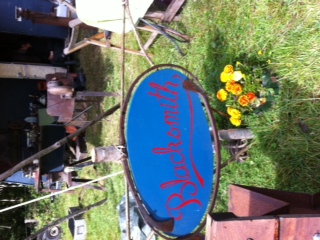
Buddhafield has all the wildness of a festival – live music, dance tent, cafes, workshops, healing area, fires, plunge pool, sauna; but without intoxicants.

There was so much on offer: every hour 10 simultaneous workshops and/or live gigs  to choose from.

Abundance was the festival’s theme. At first I moaned, stressed by having to choose, and being catapulted outside my comfort zone, cut off from home and the internet.

I plodded around the three field-festival site. I got effortlessly fitter from plodding.

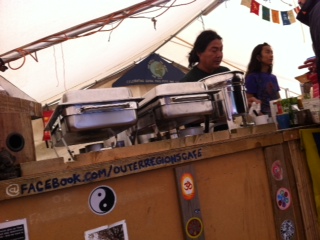
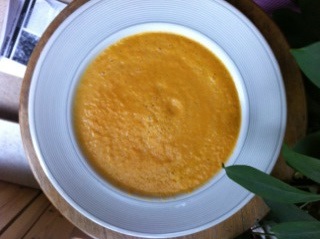
This Tibetan soup – from the Outer Regions cafe – sustained me. So nourishing. light and warming. Perfect for rainy days and before dance workshops.


(Soup – something you can make quickly with what’s in the fridge. Fry onions or leeks, chilli and garlic. Slice or chop veg: carrots, courgettes, green beans, potatoes – the smaller you cut ’em the quicker they cook. Add a handful of cooked dried beans such as butter beans or open a tin of plain beans. The trick with soup is how much water: it is easier to add than than remove. So start with two mugfuls and see how it goes. Add noodles towards the end of cooking.  Season with black pepper.)

I am grateful to Mike for making healthy refreshing breakfast every morning.

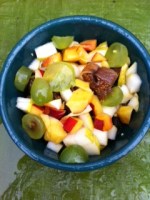
A camping-must. Muesli and fruit (bring knife to chop). Add water, so no cooking needed.

Festivals are up-and-down (like life) – all I know is I felt great when I got back.

Peaceful No Tesco Tea Party


Well, the No Tesco Tea Party has to be one of the most fun, friendly, heart-filled

musical protests I have ever been on.

Here’s a delightful news item from ITV: over a minute of dancing protest.

But it was also possibly the most stressful because – post-riot – it wasn’t just a matter of ringing up our local bobby.

Instead, we were invited to respectful, professional meetings with Silver and Bronze commanders, who supported our right for a peaceful protest but were thinking worst-case scenarios, and asking: how would we deal with them?

I realised the police, like the medical profession, are (bless ’em) fear-driven.

So, for a few weeks leading up to the No Tesco Tea Party I felt the weight of responsibility. Dreamed of police on horseback bursting through my front door. Worried about upsetting local charities such as Relate and the Salvation Army who’d been damaged in the riots. Angsted about offending rock throwers, too.

(Rock throwing is not my style but anyone caught-up in those two crazy riot nights might need support so please contact BristolArresteeSupport@Riseup.net, mentioned in June’s edition of The Autonomist.

And anyone with unanswered questions about the Stokes Croft disturbances, please sign the petition asking Bristol City Council for a public inquiry.)

Our protest took place in front of Tesco in Stokes Croft. I was glad to talk with Tesco managers because this campaign is not against supermarket employees.

It’s against supermarkets destroying communities in their single-minded drive for market shares.

The truth is I am a communicator.

I find enemy positions deeply unhelpful. I would rather build bridges.

Listen, we are all victims of the same soulless system that puts profit before people. So let’s find our common humanity and work together for a better world.

When Monday 13 June dawned – bright sunshine after Sunday’s torrential rain – I felt confident. Our protest would be – as all our protests have always been – peaceful.

And it was.

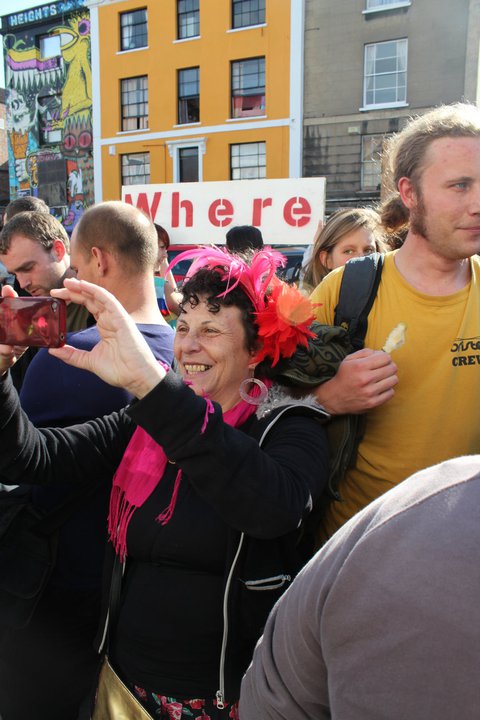
I was moved by the joy and the dancing

and the homemade cakes

and cucumber sandwiches (note Princess Diana tea-tray)


and anti-Tesco knitting protestor.

I was moved by Mark who did not agree with our campaign but became a volunteer peace marshall because he supported our right to a peaceful protest.

For goodness sake, there is disagreement even when you are on “the same side”. So, shaking hands with Richard whom I had met online when our political views clashed made me happy: this is what community is all about.

The No Tesco in Mill Road campaigners had come all the way from Cambridge to join our protest. Thank you!

Our Tea Party protest was to create awareness for our appeal for a judicial review.

Our appeal was heard on Wednesday 15 June in Cardiff.

And we won.

Thanks to People’s Republic of Stokes Croft, Jake and peace marshalls

and People’s Supermarket for donating free food.

O and here’s one of me, thanks to Nadia of GRO-FUN.

Tesco re-opens and elderflower cordial

After being “trashed” in the early hours of Good Friday 22 April, Tesco re-opened on the 24 May following a neighbourhood meeting the night before.

Monday 23 May 6.30pm: St Paul’s Unlimited neighbourhood meeting.

This excellent Guardian feature gives some background to the intensity of emotion present.

People with complaints against the police (“Why was extreme force used? Why was my arm broken by thugs in police uniform and three dogs attacked me?” asked one man).

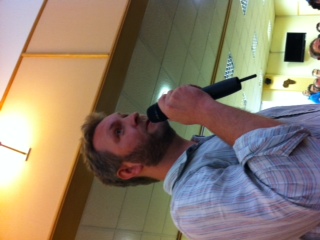
The police was represented by Chief Superintendent, John Stratford, who listened well. Clearly, he was not a riot-type with batons and adrenaline-pumping, lashing-out fear.

Someone in the audience who’d been a policeman for 30 years – now an artist with a studio in Stokes Croft – said he was holding a riot shield in the St Paul’s 1981 riot. And scared.

A woman describing herself as a “lone voice” showed support for Tesco. Sadly, she mixed-up the riot with the campaign to stop Tesco opening. Not true.


As Ashley ward’s first Green Party councillor, Gus Hoyt, (pictured) has said the media has framed the debate: Against the riot = For Tesco. It’s more bigger-picture than that and why he is calling for independent public inquiry.

At the meeting, I heard about a move to make it harder for squatters to squat legally.

Harder for people with no home – and no hope of a home – to make a temporary home in one lying empty.

Homes lying empty, as I learnt at the meeting, so they can increase in value for their owner. Such as Westmoreland House.  “A death trap” someone called it.

One of the Bristol City Council representatives told us the council had asked the government for retail classification A1 to be changed. Currently the same classification applies to both a supermarket chain and a one-off local shop.

Eric Pickles, the Conservative minister, replied with no. “…Not its role to restrict competition.”

Ha. It’s supermarkets that restrict competition. They buy cheap, sell cheap. They only need to take a small percentage of a local shop’s business to sink it.

The profit a small shop makes is tiny.

But is economic power the only measure of success? Local independent shops create community. They support wholesalers and the local economy.

Money spent locally is worth more locally than when it is spent in a supermarket because it is recycled locally.

However, it does not take long for local shops to wither. Look at Tesco on Golden Hill. A row of small shops closed and Tesco’s promises broken: not to open on a Sunday; not to have a cafe.

Head of Property Communications, Michael Kissman, arrived late at the neighbourhood meeting.

Pity. He did not hear the majority of the Stokes Croft audience eloquently voice  love for their local community – without a Tesco, thank you.

(One said: “We don’t want Tesco. And we don’t want the police protecting Tesco.”)

However Tesco’s Michael Kissman did hear people after the meeting asking him for Tesco’s support for impoverished local groups.

And at least I got an answer to my question: Where did the figure of 3,000 people, that Tesco claimed walked through Tesco, Cheltenham Road in Stokes Croft store in its first weeks of trading, come from?

Answering my question via the chair, Tesco’s Michael Kissman, said these 3,000 customers were, in fact: “3,000 transactions”. O.

No mention was made at the neighbourhood meeting of Tesco reopening the following morning. But open it did at 7 am on the 24 May.

Lot of media interest, I gave three interviews that day, including to Radio Bristol (1:40 mins in, after Michael Kissman, who was given the final word.)

Tesco claimed 400 customers came on its first day of opening but hmmnnnnn.

Looked pretty empty when I took the pic at 3pm.

Tesco can afford to stay half-empty (like the Tesco five minutes away in the Gloucester Road), playing the waiting game while local shops close.

On a more positive note, there may be another chance to review the planning process concerning Tesco’s traffic impact on Cheltenham Road. The  No Tesco in Stokes Croft campaign has won the right to appeal against the decision to not grant a Judicial Review (the rejection came coincidentally after Good Friday).

We plan a fluffy good-humoured self-contained lawful protest in front of Tesco’s before we set off on Wednesday 15 June for the 2 pm hearing in Cardiff .

And the Stokes Croft People’s Supermarket readies itself in the wings.

I’ll drink a glass of homemade foraged elderflower cordial to that.

Homemade elderflower cordial

A revelation. I did not realise how easy it is to make.

You soak the elderflower blossom in water with sugar for two days, covered with a lid. Then strain through muslin or a sieve. Then pour into clean bottles.

Second revelation: how the scent fills a room. Light fresh notes, as I snip the blossoms off their stems into a vat of hot sugared water.

Elderflower blossom is plentiful now.

Mike picked a plastic bag-full.

We added two pots of organic pear preserve  – as the Elemental Sanctuary’s Carole Fofana advised. I have some brown muscavado sugar. About 500g.

We estimate six pints of water. Mounds of elderflower blossom take up most of the room in the pan. I reckon our version has more blossom and less sugar than most recipes (hence its deliciousness).

The only technical bit is straining it through a sieve covered with muslin (organic muslin £2 from Born).

For more precision, see the Self-Sufficient-ish elderflower cordial recipe.

Lemon juice will preserve it but requires more sugar to sweeten the taste. We do not use lemons (or citric acid) or lots of sugar, and the cordial is not too sweet and has the heady taste of nature.

Third revelation:  homemade elderflower cordial tastes amazing.

I am drinking some now.

It tastes how elderflower blossom smells. And somehow feels substantial – nourishing.

Elderflowers are nutrient-rich and immune-boosting.

Not nutrients added artificially, or over-processed thus inneffective.

I often dream of going into a bar and ordering a health-giving revitalising drink.

Homemade elderflower cordial is that dream-drink: it has natural vitality.

(To think Coca-Cola had the cheek to call itself: The Real Thing).

I glimpse the satisfaction of foraging. It’s unmediated.

Nothing between me and something growing on a tree.

Tesco disturbed in Stokes Croft

I have been campaigning since February 2010 for No Tesco in Stokes Croft so imagine my mixed feelings when I woke up on Good Friday to hear the newly-opened supermarket had been “trashed”.

Alerted by friends in Stokes Croft, my first response was to gather information, with a Twitter search leading to several eye-witness accounts.

This blog by Neurobonkers.com described the dramatic effect of 160 riot police turning up on the streets – the tone bemused rather than partisan.

While giving a sense of folly on both sides, this blog by Oli Connor also questions the role of riot police in aggravating tension.

Jonathan Taphouse tells the story behind his photographs in the Guardian, and some turning-point moments.

Twitter helped me spot churnalism in action -the newspapers that repeated almost verbatim the police’s (understandly one-sided) press release, while this blog sums up the spin.

I was obsessed with gathering information and analysing its angles – media studies in action.

I wanted to piece it all together: what happened on the 21 April?

A volatile situation from the word go: a warm April night at the start of a bank holiday in a busy social area of the city.

Riot police turn up at 9 pm, some on horseback, some with dogs, and – according to Green councillor candidate, Gus Hoyt, on his way home – at least three with guns, one directing traffic with the gun, its holster strapped to his leg (Gus asked, “Is it real?” and “Of course it is, mate, where have you been living?” said the armed policeman).

The police raided Telepathic Heights, the squat opposite the newly-opened supermarket in Stokes Croft, looking for alleged petrol bombs.

(Surely a house squatted is better than left empty?).

This video includes interviews with squatters and eye-witness onlookers. As one pointed out, if you were conducting a drugs raid, you would send in uniformed police, and explain the situation to the neighbours.

But nothing was explained. The police operation seemed disproportionate and unnecessary military. I feel sorry for local police because this operation counters their good work in the community.

The drama was dramatically-lit by the searchlight from the police helicopter – its noise drew locals on to the streets to see what was happening.

Some reacted with the same fear-fight knee-jerk response that must affect the police; threatened, tribal, flooded with adrenaline.

Some of my fellow No Tesco campaigning friends who lived on a nearby street (which ended up kettled by riot police) tried to stop onlookers from grabbing stones from a skip and building barricades.

How quickly a scene turns raw. A push, a shove, a bottle thrown. The police have methods to deal with affray and are allowed to use force.

This video that shows Stokes Croft locals trying to quell the fight reaction from people feeling threatened.

“Stay calm and film everything. Do not instigate,” repeats a strong voice. Wise words.

The police left an empty police van outside Tesco and departed. That’s when a group of people spontaneously starting dismantling Tesco and smashing its windows. As one blogger reported: “The Tesco store – the very one the police operation had supposedly been set up to protect – had its front trashed.”

I am scared by violence and abhore it. I believe the ends do not justify the means. The means – the way we do things – is vital. We must create a peaceful society by enacting it.

Yet history tells us (the 1831 Bristol riots for vote reform, votes for women, the poll tax) that sometimes it takes violence from the voiceless to be heard. And damn it, violence is news – look at the media coverage that that night got.

Some violence is misplaced fighter-energy. I was in Stokes Croft in the early hours of 29 April, a week after the Tesco riot.

Eye-witnesses present on both nights told me that the police were calmer and less-reactive the second time, despite opportunistic bottle-throwing.

Stokes Croft had become – in a week – a magnet for fight-action. As I walked towards the epicentre, guided by the police helicopter’s beam, several masked and hooded lads passed me.

“Put the bin down, Bin Man!” shouted one of my fellow campaigners. The youth carrying the wheelie recycling bin put it down and we clapped to reinforce good behaviour.

Considering how hard-won the battle was for recycling, I would hate recycled bottles to come into disrepute as potential weapons.

Talking about recycling: Tesco has asked councils to remove their bins from Tesco car parks, depriving local councils of recycling revenue.

Tesco – which recently made profits of £3.8 billion – is taking the bins in-house.

A Tesco may be a convenient, clean shop but it also a powerful multinational that puts profit before everything. It may be staffed by good people but its policies are destroying small farms and the land, small businesses and local communities – while, according to UK Uncut, evading tax.

“If you don’t like Tesco, don’t shop there. Then they will close down,” some say.

But it is not that simple.

Tesco can afford to run its shops at a loss while local businesses start to fail. It’s hard to boycott Tesco if there are only a few food shops left.

In our unofficial role as peacekeepers last Friday we walked round the back of Tesco to see if the security guards were alright. On that surreal night of unexpected scenes at every street corner, we chatted through the steel fence. There was banter and good wishes expressed – this battle was not personal.

We walked round to Cheltenham Road.

Road block: riot van, riot police, police dogs, tension but also a kind of calm because there was no bottle throwing or police charging. The police helicopter whirred overhead. I heard a policeman explain to a girl expressing annoyance at the intrusion that he was normally on the beat and not a riot police.

I reported on Twitter (and had corroborated by another Tweeter): a tearful girl was helped by a policeman after being hurt by another. I wrote: “It’s not all black and white in Stokes Croft.”

Every side has its goodies and baddies.

The grey, nuanced bits are the compelling drama of a riot: the untamed rawness of chaos.

I wish I could channel that elemental energy into good cause and creativity.

Last Wednesday (between the two nights of disturbances), I was interviewed for the Politics Show about whether Tesco should reopen.

My answer: Tesco should never have opened in the first place. A council duped (the original planning permission was achieved anonymously) and so flawed that campaigners mounted a judicial review.

A local woman walking past joined us. She said she liked Tesco and shopped there and resented the rioters for setting a bad example to her son.

We chatted. We were both upset by the smashing of the Salvation Army and other local shops caught in the crossfire.

She said: you should open a shop to rival Tesco’s and sell fruit and veg wholesale.

I said that’s what we want to do: set up a food co-op and sell affordable healthy food with volunteers doing four hours a month.

(Nor is Tesco cheaper than local shops anyway, according to our survey).

She said: I’d volunteer every day for such a shop.

Stokes Croft Tesco opens and butter bean salad


It’s hard to be happy about the 41st Tesco opening in Bristol (figure according to Tesco’s store locator).

93% of 500 locals surveyed had said No to Tesco’s in Stokes Croft. After over a year’s campaigning, it was bitter to see Bristol City Council bow to Tesco pressure last December.

Still, we are making the best of it.

On Friday 16 April, Tesco opened in Stokes Croft.

Friendly activists gave a Bristol-style welcome. They put a comfy sofa and lampshade outside on the pavement. Someone played a guitar.

Another strode into Tesco’s with a wad of Monopoly money. When he was not allowed to spend it, he tried to bribe a security guard with it.

A woman passer-by who also objected to Tesco’s monopoly, took up the Monopoly money-action.

On Saturday, a performer (see pic above) invited us in to ‘his’ Tesco, while outside on the pavement, stalls served free food, and promoted Picton Street’s local independent shops, in the street behind the dreaded Tesco.

Picton Street is a marvel, and includes the Bristolian Cafe, Yogasara yoga studio, vintage dress shops, an art gallery, Radford Mill organic farm shop and Licata, the family-owned Italian delicatessen.

Licata often has great bargains in olive oil and tins of beans. I am crazy about beans as they are a wonderful source of health. Licata has many variety of tinned beans, which to me = fast food.

I owe everything I know about beans to vegetarian hero, Rose Elliot. The Bean Book changed my eating habits for life.

The following recipe comes from there. Please consult The Bean Book for measurements, nutritional facts and top inventive recipes using dried beans and pulses.

Here is my sloppy fast-food version.

Gently fry sliced fresh mushrooms in (olive) oil so they are still succulent. Add a tin of drained butter beans and warm with the mushrooms. Add lemon juice squeezed from two lemons and chopped fresh herbs such as parsley or coriander. You can’t have too many fresh herbs so over-estimate. Mix it all in the frying pan, with salt to taste, and serve still warm with brown rice, or cold as a salad.

I used organic ingredients from Better Food organic supermarket, a 20-minute walk away from Tesco’s, and land cress as the fresh herb.

Rose Elliot’s recipe fries fresh cut-up garlic with the mushrooms and adds cumin spice, with coriander as the fresh herb.

PS I met a neighbour on Saturday who said she had to buy something at Tesco’s in Stokes Croft, and I am haunted by her anxious look.

So, just so you know: If it makes life easier to shop there, then do. Life’s too short for guilt and sacrifice.

I am not against people who use Tesco. I am against Tesco.

Fay’s fish soup with fennel

My mother is the original Real Food Lover. She says the original Real Food Lover was her mother. Because this is how we learn about food: from the people close to us.

My mum always says the best education you can give a child is to educate the palate.

My mum bought this hake the day before at Tachbrook Street market, Victoria, where my dad used to be a one-man GP.

Here is a link to a video of my mum explaining to my eldest daughter how to make fish soup.

It starts with the drama of stopping the fishmonger from throwing away fish-heads:

“‘I’ll have the head!'” she cries. “He was going to throw it into the bin,” she says, with disbelief.

My mum makes the stock from the (rescued) sea bass head and its bones, the head from the large hake from whence come the cutlets, as well as prawn shells.

She adds bay leaf and peppercorns, with just enough water to cover, and cooks it for twenty minutes, with the lid on.

Here is a video of my mum agonising over how much water she used and describing the importance of a lid.

She remembers the way her mother cooked:

“Now, my mother used to tilt the lid – her soups were never watery…But I don’t trust myself.”

While the stock is simmering, she sweats the fennel and leeks in olive oil.

After twenty minutes, she drains the stock, keeping the liquid, to which she adds quartered potatoes and a pinch of saffron which gives the soup the yellow-colour, and a delicate aroma.

Here are the drained remains of the fish head and bones after they have yielded their flavour to the liquid stock.

Fay pours the stock over the vegetables and cooks until tender but “not too tender,” she adds.

When she is ready to serve, she removes the vegetables with a slotted spoon.

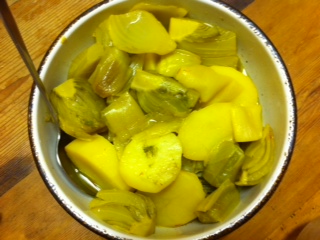
Here are the saffron-coloured vegetables, removed temporarily from the saucepan.

Then Fay heats the stock and adds the fish.

You must never cook the fish too long.

According to my mum, her mother “used to scream down the ‘phone: “Don’t cook it too long.'”

What is too long?

What? You want measurements?

As my mum says: “Nothing is made to measure.”

Basically, as soon as the fish starts to gently flake, you take the fish off the heat.

It all depends on the thickness of the fillet, or, in this case, the hake cutlets. Five to ten minutes?

Here is my eldest daughter scooping out the rouille my mum made.

“You know how to make rouille?” My mother asks my eldest daughter.

With garlic, cloves and red chilli pepper – I’d better check that.

Geraldine  (added after publication) gives rouille recipe:

“The rouille will be made with crushed cloves of garlic and red chilli pepper, and mashed as you say into a paste made of stock soaked bread (instead of egg yolks).”

Fay adds bread soaked in the fish stock, then carefully drips-and-whirrs olive oil to make a mayonnaise.

And you don’t just eat the meal. You have to analyse it in detail.

My mum remembers her parents discussing the make-up of every dish back in the 1930s.

And here we are, in the 21st century, still doing it.

Marmalade 2011

I made the marmalade early-Feb. Blimey, this blog is well-overdue.

So although not exactly hot-off-the-press, I want to record it because my last year’s marmalade-making post was useful when making this year’s. Like notes in a cookery book. See actual recipe, below.

Last year, as I made marmalade, Haiti’s earthquake was on my mind. This year, my mind was on Bradley Manning. The young soldier alleged to have leaked US documents to Wikileaks is being held in severe isolation in a US military prison. Bradley’s mother is Welsh so Amnesty is taking up his case as a British citizen.

Here’s how to donate to Bradley Manning’s public defense.

Back in early-Feb, I was also thinking about the trees. Privatising the nation’s woodlands? Wrong. Since then, there’s been a temporary reprieve in the face of public opposition. But don’t get complacent.

I was not the only one cooking and thinking about trees. Fairycakemother and Save Our Woods presented cakes on the day of the Opposition Day Debate to try to persuade MPs to go with their conscience, not their party whips.

Zac Goldsmith, Conservative MP, voted against his party and for the trees. Hooray. While making marmalade, I had a vision of the former-editor of the Ecologist leaving the Conservatives and joining the Green party. Glad to hear Zac Goldsmith is now working on green farming in all-party group including UK’s first Green MP, Caroline Lucas . I have met them both and feel in ma bones they are spiritually alligned.

The marmalade cast assembled on February 4 2011.

This year I reduced the sugar even further  to 1 lb of sugar to 1 lb of Seville oranges. It worked brilliantly. Chunky, tangy.

(Eeek I promised a US reader on Facebook to also use metrics. Gad, I wish I had a PA to do things like that, like converting measurements and stuff. My dream…. In the meantime, here is a converter.)

The recipe

5 lbs organic Seville oranges
5 lbs organic cane sugar
4 pints of water + 1 extra pint to extract the pectin

Marmalade-making has four stages.

1. Cooking oranges to soften

Scrub non-organic oranges (I used organic ones for health and the extra taste due to the fact organic produce has less water as nature intended) and remove the stalks. Cook in a large pan or two smaller ones – with lids – in 4 pints of water and simmer heartily for about an hour until peel is soft. Smells heavenly…

Drain oranges and cool, keeping the water for the sugar-boiling stage.

Put weighed sugar in a preserving pan (or two of your widest pans) in a low oven to warm. Clean jars thoroughly with hot water and dry them in the  oven.

Place a few saucers in the freezer so you can quickly cool a teaspoon of hot jam in Stage 3, the setting stage.

2. Extracting pectin and slicing peel

Cut cooked-cooled oranges in half. Scoop out pith and pips and add them to a pan with 1 extra pint of water and two cut-up lemons. Simmer merrily for ten minutes then drain: this pectin-rich liquid is used to help jam set in Stage 3.

Now cut up orange (and lemon) peel, thinly or thickly, as you like it.

3. Boil and set
Add the following to preserving pan: the drained pectin-juice, the water you used to boil the oranges, the cut-up peel and the  warmed sugar. It takes 15-20 minutes for the marmalade to set and you must not overboil or you can lose that magic-setting moment.

So says my trusted-over-twenty years (presciently-seasonal) Katie Stewart’s Times Calendar Cookbook.

But do not start timing until the jam is actually boiling like mad i.e. not just ordinary bubbles but when the liquid goes into a furious fast-boiling whirl – then start timing those 15-20 minutes.

It’s a bit like timing the start of labour – not from the first contraction – but from dilation. I think this gives a better reading on how long labour is and can prevent unnecessary inductions. But I digress.

So, after 15 minutes, take the pan off the heat and drop some hot jam on one of those icy-cold plates. Let jam-droplet cool, tilting plate to encourage cooling, then push droplet gently with your finger. You are looking for tell-tale wrinkles and jelly-like character. (The opposite of an ideal lover?).

If droplet is still runny, carry on boiling the big pan for a few minutes then test again. And so on.

Stage 4 – Marmalade in jars

The marmalade drops are now unequivocally set. So, let the jam cool in the pan until it is not-too-hot nor too-set for pouring . This is the sticky bit. Use newspaper to cover the kitchen surface, use a ladle or a small cup. And good luck!

Recipes say use waxed discs to keep out condensation and mould but, cutting-corners-cook that I am, I have not not done so for the last two years, with no adverse reactions. Wipe the jars from stickiness and proudly label.

I was a day too-late to send a jar off for the Marmalade awards.

Just as well because I did not want to part with any.

Real Food Lover postscript

By chance I was invited by GM Freeze to the second meeting of the green farming all party parliamentary group (mentioned above) on 15 March .

Security was tight at the Houses of Parliament and my marmalade, a gift for my mother, was held in temporary custody.

Dr Hans Herren spoke to a packed committee room.  He co-chaired the 2008 IAASTD report, the first-ever scientific assessment of global agriculture. Co-sponsored by the United Nations, the World Health Organisation and the World Bank, the International Assessment of Agricultural Knowledge, Science and Technology for Development report concluded that small-scale ecological farming was the answer to food prices, hunger and environmental disasters.

Dr Hans Herren’s message was one of passion and urgency – farming must become ecological as soon as possible.

Well, I was just sorry Cameron, Spelman and co were not there to hear his sound science-sense and Cassandra plea.

I collected my jar of marmalade from parliamentary custody and photographed it on the ramparts.

My mother was also pleased the organic marmalade made it to freedom as her note below attests.

Reasons to love the Organic Trade Board

Have you seen  Eddie the painter and decorator talk about why he loves organic?

Launched in January, ads are running on the back page of women’s magazines including Heat, OK!, Hello!, Waitrose Food Illustrated and Tesco magazine, to get the message across: organic is for everybody.

It’s all the brainchild of the Organic Trade Board.

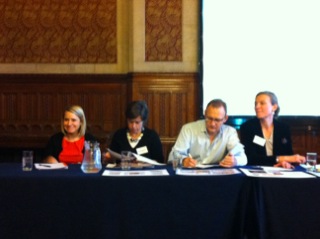
Catherine Fookes, campaign manager of the food and farming charity, Sustain and the Organic Trade Board, kicked off the session at the Soil Association conference, explaining the genesis of the campaign.

Worth £2 million over two years – £1m from organic companies and match-funded by European Union (EU) – the campaign aims to drive sales 15% year-on-year over three years.

Germany, France and Italy have had 24 of these kind of EU match-funded campaigns in total. This is the UK’s first.

First met in 2008, Sustain put the EU bid together with major pledges from nine companies including Rachel’s Organics, Alara, Green & Black’s, Yeo Valley, Organix, Rasanco and Community Foods.

Once the bid was successful, the tender was put out to advertising agencies. Haygarth won the brief. Its CEO, Sophie Daranyi, explains the job was two-fold:

1) Protect and retain the 8% who make up the 55% spend

2) And reach out to the 79% who spend 24%

Sophie Daranyi says: There is a disconnect between people who care about animal welfare, biodiversity and health – yet organics is at the bottom of their list.

What struck us: there are lots of reasons to buy organic.

Advertising campaigns are notoriously expensive, so this joint one makes it very accessible, says Paul Moore of Community Foods, one of the founder pledge companies.

“I don’t have a large budget to advertise. I can’t afford to go into Hello!

But the Organic Trade Board makes it possible. Let’s make the most of it, urges Paul Moore.

“You don’t often get the opportunity to join in these campaigns – it is now up to us as brand owners, retailers etc to do the bit we can to magnify this message.

“I don’t see our market is in decline. Our industry ticks all the boxes on all fronts. All we have to focus on is how to expand the market.”

“We don’t have to reinvent the wheel. Haygarth has done the work. It’s so well-coordinated – it’s a dream.

Eddie does not distract from the Crazy Jack / Community Farm branding, says Paul Moore.

His message: Put aside partisan problems. Don’t worry about working with your competitors. We will all gain.

Organic beauty companies have pledged to this campaign even though this is about organic food and drink – because this campaign will raise awareness about the benefits of organic generally.

All the messages have been approved by the Advertising Standards Agency who can jump on organic’s claims (but not the ones made by junk food companies fume fume).

What I like to about this campaign is the messages are clear and easy-to-understand.

What do you think?

Bread – what’s left unsaid


Look, if you are not in the mood for cooking (a state I know) then make sure basics, such as bread, are doing you good.

Bread gets messed-around with. This sticky label, from the 2009 Real Food Festival, lists ingredients that might be found on bread – but are never listed.

The label said:

~~~~~~~~~~~~~~~

“!!!WARNING!!!

This ‘bread’ may be made using the following:

Amylase, hemicellulase, phospholipase, peptidase, xylanase, protease, oxidase and other enzymes, some of animal or GM origin.

The law says bakers don’t need to declare them.

DISCLAIMER

These stickers are only for use in your own home. The Real Bread Campaign, Sustain and The Real Food Festival take no responsibility for any consequences, legal or otherwise, of you using them elsewhere such as wrappers of factory bread, supermarket shelves or advertising posters.”

~~~~~~~~~~~~~~~~

As Michael Pollan says: if they are more than five ingredients on a label, avoid.

The long list of enzymes above are “processing aids”. In other words they are used to make the bread rise faster, look nicer, last longer.

But because these processing aids are not classified as food ingredients then – by law – they do not need to be listed on the label.

Whaaat? You eat them but they are not food ingredients?

It reminds me of adulterated food sold to the Victorian poor

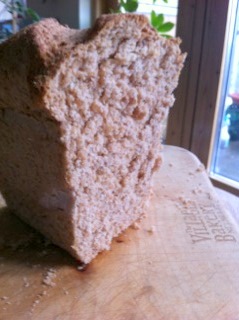
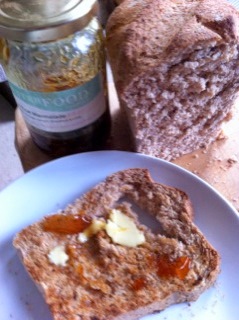
My real bread came from the Better Food Company in St Werburgh’s, Bristol where I also got marmalade made by their chef (as good as homemade…hey, it’s January, time for marmalade-making again) and organic butter from Nature’s Genius in Fishponds, Bristol.

Yes, the bread cost more than supermarket bread but I got more food for my cash. My grandmother would say money spent on un-nutritious food is money wasted. And I agree. Do you?

Quick carrot soup

Grab organic carrots and small onion from organic veg box. Wash or peel carrots; top, tail and skin onion.

Carrots take longer to cook than onions. Cut the onions as usual but cut carrots thinly – the smaller the bits, the quicker they cook.

Simmer veg in butter or (olive) oil. Enough to comfortably coat the veg. (suggest half ounce of butter/1.5 tablespoon oil).

If you have this spice, add a teaspoon of ground coriander or coriander seeds, crushed. Then a mugful and a half of milk or plant milk. Bring to the boil and simmer for 15 minutes or until the carrots are soft.  Season with black pepper, generously, and salt, carefully – start with a quarter of a teaspoon, then taste-test.

My favourite kitchen implement is a hand blender which is about £20 new or can be found in charity shops as my current one was.

So I whizzed the carrot soup and that is why it has that bubbly look in the photo.

It tasted sweet and creamy.

As I cooked, I thought of a blog I had just read.

Alberto Gonzalez, the founder of GustOrganics, New York’s 100% organic restaurant, writes on Maria Rodale’s Maria’s Farm Country Kitchen:

“We live in the most powerful country in the world.  However, America’s food system is probably one of the weakest on earth….About 98% of the food grown in America comes from factory farming.”

Recently, BBC TV’s Panorama investigated the power of supermarkets – four control 80% of the UK’s food.

Supermarkets and factory farming are intrinsically linked.

The soulless rows of biscuits brands, cabinets of ready meals, chemically sprayed salads and trays of birds that never saw the light of day are all the product of factory farming.

The land, animals and farmers bear the true cost to make the price seem cheap – but the profits real. Supermarkets make 55 p for every pound we spend, according to Panorama.

It’s a gloomy January day, the sky thick-grey again.

But humans tend towards balance, not extremes, and I see hopeful signs with this Guardian news report:

Ethical consumer spending bucks recession with 18% growth.

UK ethical sales have grown nearly 20% in the last two years, according to a Coop bank report .
People care about fair wages for farmers – Fairtrade food has grown by 65% to £750 m.
People care about their health and the planet’s – organic food is still strong at £1.7 bn having settled from 30% to 14% growth.
Eco and organic cosmetics and clothing now equal organic food’s pre-recession sales, and also grown 30%.
These figures show people do care about the bigger picture.
What are your hopeful glimmers of light?