Tag Archives: wild food

Food for free in Bristol

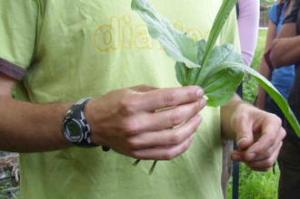
Dave Hamilton holding greater plantain

There is wild food for free in the city but you have to know what to look for. About 45 of us walked around Bristol’s inner-city St. Werburgh’s with Andy and Dave Hamilton, local eco-authors of The self-sufficientish bible. The “ish” is for people like me who don’t live on a farm.

Someone joked she thought the Food for Free talk would be about shoplifting. “Or stealing produce from someone’s allotment” bantered another.

Random weeds were revealed as herbs with stories, such as the greater plantain, held by Dave (above) and used by suffering soldiers in their shoes for trench foot.

Someone said he used its medicinal juice to help his hay fever. Must try this.

Dave said he has used the plantain’s leaves like spinach in saag aloo. Must try this too. (But crikey, would I be able to identify it from photo above? Supposing I picked a Poisonous Plant by mistake?)
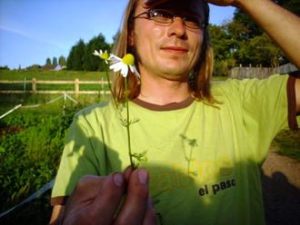
Dave Hamilton and chamomile

Phew, on safer ground – this looks like a daisy. But it is not. It’s chamomile, famous for soothing jangled nerves. I use it in tea bags so it was like spotting an off-duty celebrity.

A propos, the talk was organised by Mark Boyle, founder of freeconomy. When he turned back from walking to India, it was international news. My media-self was impressed.

Mark Boyle

Mark (above) organised this Bristol walk as part of a reskilling programme, so we can learn forgotten traditional crafts, like baking bread or knowing what wild plants to pick without poisoning ourselves.

Watch out for a future Mark (and Claire) project in the autumn – Local Food Week when you pledge to eat local and see how easy – or hard – it is. They will add details in the comments section…
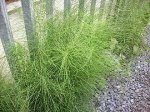
Horsetail

I picked some horsetail (above) and used it to clean the frying pan. A natural scourer, it broke up a bit but seemed to work – could be useful when camping.

Borage growing in inner-city Bristol

Borage, also pictured on our inner-city walk, is another free food to try. You cook it like spinach or use its tiny blue flowers in a salad. Or a Pimms.

Known as borage for courage, it is an anti-depressant (so don’t use if you are on anti-depressants). Fifteen of its leaves make you cheerful. Sounds like my kind of free food.

Thank you Andy, Dave and Mark for an amazing walk-the-talk walk.

And everyone else, such as Eric with fat hen (below) who walked to France with Mark.

Eric with fat hen

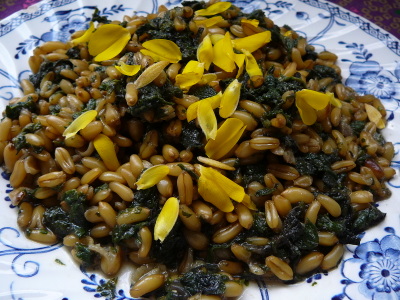
Kamut risotto with nettles and gorse flowers

Kamut wih nettles and gorse flowers

This dish is a bit like an Oscar-award winning ceremony so bear with me while I thank a few people.

Firstly Elena Renier for inspiring me to use nettle tops in a risotto. Secondly Chloë for telling me on a walk over the cliff path at Cockington in north Devon that gorse flowers are both edible – and nature’s cure for depression.

I have always loved the spiky gorse bushes’ bright yellow flowers but when I found out I could eat them – and have a mood-change into the bargain – I was ecstatic! (Or was it the gorse petals I was munching en route?).

So, back in the kitchen, I fried a sliced onion and added a mug of kamut grain (instead of rice) to the hot olive oil. Then I poured in two mugs of water, added a pinch of rock salt and let it all simmer for 30 minutes.

I washed the nettle tops that Mike had kindly helped me pick (another Oscar thank you to him) and snipped the plentiful dark green leaves (six ounces in weight) with scissors so they fitted in the pan. They took about ten minutes to wilt and add their wonderful creamy spinach-y taste.

I love nettles! I cannot believe that eight days ago I was a nettle-picking virgin. My first use in nettle soup is here.

It’s Be Nice to Nettles Week soon (14 – 25 May 2008) when we stop thinking of them as nasty weeds and realise how wonderful they are.

I know nettles sting if you forget your gloves or do not use the proper ‘folding’ procedure but I do not care. The sting is not dangerous and may even be good for me.

The world faces a rice shortage so can I do my bit by eating kamut grain instead? I have selfish reasons too for I have come to love this bursting-with-health grain.

So, oscar-thanks to the universe for providing good things to eat.

Oh, and universe, while I am in prayerful mode, please knock sense into the powers-that-be to ensure food is shared more fairly and no one goes starving.

Thank you (she says, waving her metaphorical statuette in the air and leaving the stage).

Nettle soup

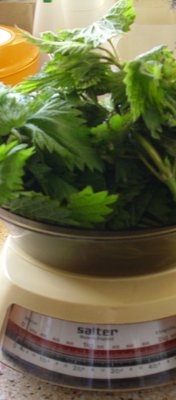
Nettles piled on scales

On the first day of spring I resolved to pick wild nettles for soup. I’d read about it often enough.

Luckily I was with Chloë who pointed out we had just passed a clump of nettles. I can understand why I have never made made soup from them before. They were indistinguishable from the rest of the greenery – until I felt the familiar sting from pinching their fresh tops.

Wearing gloves, I filled a small plastic bag. Back home (see pic) I weighed the young nettles. My yield? Four ounces. Not bad for a first wild harvest

I melted organic butter (2oz) in a pan, and gently fried an organically-grown onion, sliced thinly.

Most recipes use boiled potatoes to thicken the soup, or flour. I chose protein-rich ground almonds (2oz). And why not some cooked chickpeas too?

I took the nettle tops I had washed (discarding any brown ones) to the onions softening in butter. I turned the mass of nettles over in the pan with a wooden spoon. As the green leaves touched the bottom of the pan, they felt the heat and wilted.

I added this nettle mixture to a bigger pan holding half a pint of salted water (for stock) with aforementioned almonds and chick peas, crushed .

I simmered the nettle soup for a few minutes (most of the other recipes said 10 – too long). Then, using the noisy hand-held liquidiser, I vroomed my way through the chickpeas and nettles, so they became more creamy.

The soup needed contrast so I fried sunflower seeds in a little oil, and they crisped up nicely. (Seeds whack-up a dish’s nutritional value. The next best thing to fresh, because, given the right condition (water/light), seeds can sprout new life.)

The nettles tasted amazing as if they had captured water in their strong cells and were bursting with lushness. This was wild food. It tasted different. Enlivening.