I went to Shambala festival and got turned on by hemp. Every morning I would emerge from my tent to tramp across a field for hemp porridge breakfast.
Its creator, Eddie Callen, told me how he makes it: mixes it 50/50 with oats, by grinding 1/4 of the oats with all the hemp seeds, from Yorkshire Hemp. Once emulsified with the seed oil, the rest of the oats grind-in easily. Then water, hot or cold, to make the porridge, and a host of sprinkles: nuts, goji berries, agave syrup, cranberries, for taste and nutrition.
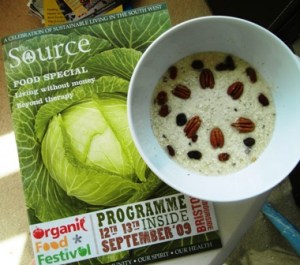
(I used pecan nuts and sultanas for my hemp breakfast back-home, see pic above).
A fount of hemp-knowledge, Eddie told me how hemp can grow abundantly in the UK without pesticides and fertilisers.
Hemp plants are so productive too: omega 3-rich seeds, and textiles, rope and paper. More sustainable than paper from trees – and cheaper.
We want hemp! ‘Tis the the earth’s most sustainable material.
Although hemp belongs to the same plant family as cannabis it has NONE of its mind-altering properties. It got a bad rap all the same and got outlawed in the 1930s but now it’s legal to grow although most UK hemp ends up as animal bedding.
Hemp-evangelist Eddie Callen was cheffing for the Community Medical Herbalists.
I had gone to see one, John E. Smith, for some remedies and it was he had told me about Eddie’s hemp-prowess.
Festivals are like that – it’s green networking city. I bumped into colleagues, past and present, as well as the legendary Simon Fairlie, editor of The Land. Its summer issue focuses on the enclosures of Britain’s commons – historical events I have long been fascinated by as I see the roots of our present-day ills in the past.
People’s right to grow food or forage was taken away by force or legal stealth from approx from 1300s to end-18th century. Just as indigeneous people are deprived of their land today.
O I am in the mood for digression. Last night I saw Winstanley, an amazing film. Set in 1647, shot in black and white, British weather featured strongly, with only a camp fire and thatched tents to protect the Diggers from the incessant dripping rain. (As a recent camper, I identified).
Gerrard Winstanley wrote: the earth was “a Common Treasury for all”. He tried to reclaim the top of a hill in Surrey with his fellow Diggers but was beaten by the establishment.
I read about Gerrard (am on first name-terms as he is new hero) in the Land and talking about magazines, note my pic above and the latest issue of The Source.
I am SO proud to be writing for The Source, the southwest’s great green magazine.
In this issue, The Source reviews the new Transition book, Local Food, and asks:
What will we eat when the oil runs out?
The answer is green, local, organic, healthy food…and hey – this means the freshest tastes too. Talk about win-win-win-win solutions.
The Source also carries the programme for The Organic Food Festival, taking place THIS weekend in Bristol.
Organic is farming for a green future.
I am with the Shambala witches on this one.






 Real Food Lover