Tag Archives: Real Bread Campaign

Bread – what’s left unsaid


Look, if you are not in the mood for cooking (a state I know) then make sure basics, such as bread, are doing you good.

Bread gets messed-around with. This sticky label, from the 2009 Real Food Festival, lists ingredients that might be found on bread – but are never listed.

The label said:

~~~~~~~~~~~~~~~
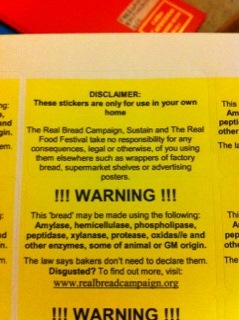
“!!!WARNING!!!

This ‘bread’ may be made using the following:

Amylase, hemicellulase, phospholipase, peptidase, xylanase, protease, oxidase and other enzymes, some of animal or GM origin.

The law says bakers don’t need to declare them.

DISCLAIMER

These stickers are only for use in your own home. The Real Bread Campaign, Sustain and The Real Food Festival take no responsibility for any consequences, legal or otherwise, of you using them elsewhere such as wrappers of factory bread, supermarket shelves or advertising posters.”

~~~~~~~~~~~~~~~~

As Michael Pollan says: if they are more than five ingredients on a label, avoid.

The long list of enzymes above are “processing aids”. In other words they are used to make the bread rise faster, look nicer, last longer.

But because these processing aids are not classified as food ingredients then – by law – they do not need to be listed on the label.

Whaaat? You eat them but they are not food ingredients?

It reminds me of adulterated food sold to the Victorian poor

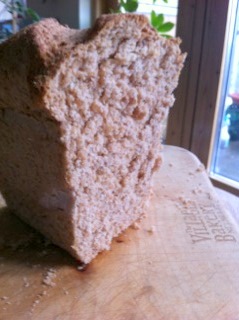
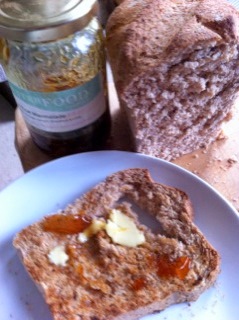
My real bread came from the Better Food Company in St Werburgh’s, Bristol where I also got marmalade made by their chef (as good as homemade…hey, it’s January, time for marmalade-making again) and organic butter from Nature’s Genius in Fishponds, Bristol.

Yes, the bread cost more than supermarket bread but I got more food for my cash. My grandmother would say money spent on un-nutritious food is money wasted. And I agree. Do you?
Speedy spelt loaf recipe – not speedy roads

I am still on real bread, the topic of my last post.

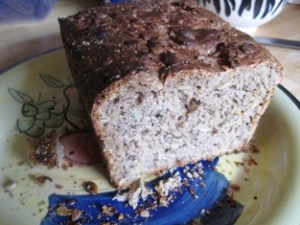
Julia made the loaf in the picture above from a recipe in the Telegraph.

Apart from bread, Julia Guest, filmmaker extraordinaire, also made A Letter to the Prime Minister.

The documentary follows the British peace activist, Jo Wilding, in Iraq before and during the 2003 invasion.

Talking about films, I was round at Julia’s on Sunday to watch Life In The Fast Lane, a documentary she was involved with about the M11 road protest (1995).

The M11 sliced through three East London boroughs and tore apart communities – all for the sake of saving motorists three minutes of time.

The M11 road protest along with similar ones at Twyford and Newbury did not stop the roads being built.

However the cost of evictions – both financially and morally – eventually halted the then-mania for road-building.

This report by the Campaign to Protect Rural England (CPRE) shows new roads are not evaluated. And grandiose claims for reducing traffic appear not to have been realised. For instance, according to Countryside Voice, the CPRE magazine (summer 2006), the Newbury town centre peak-hour traffic flows are almost back to pre-bypass levels. And, “the actual damage to protected landscapes is even worse than expected.” [added 2012]

So while we were watching Life In The Fast Lane, we ate Julia’s homemade squash-from-her-allotment soup with the amazing bread. It was delicious – tasty and healthy.

I was blown away by Life In The Fast Lane:

– the local residents who helped patrol the squat including the 93-year-old resident made a squatter in her own childhood home

– the anguished cries of schoolschildren as the 250-year old chestnut tree was torn down by a digger (reminiscent of a scene from Avatar) and despite the protestors’ beautiful tree-top home

– the spectacular London rooftop shots of squatters who locked-on themselves to chimney pots with concrete and handcuffs to stop being evicted.

It was a real insider’s view of a mega-squat resisting the onslaught of so-called progress.

The M11 movie put me in mind of the eviction of the Tesco squatters.

Julia writes: “I make this with fresh yeast from the Better Food Company and less flour. Let it rise for just over an hour in the tin, then bake it.. but no kneading at all. I use a mix of any seeds I fancy…and the quantities vary. I also add a little olive oil to stop it sticking – as well as coating the tin in oil and then a coat of small seeds. Baking only takes about 30 minutes.”

Check out Julia’s inspiration, a spelt recipe by Xanthe Clay in the Telegraph using dried yeast and requiring no kneading or proving, and an earlier one by Rose Prince that ditto is fast.

For further inspiration visit Real Bread campaigner and master baker, Andrew Whitley, and author of much-recommended Bread Matters.

And for my real-life experience of Julia’s recipe see my blog on Easy-to-make spelt loaf – it works!

Surely a quick-to-make loaf is a better use of speed than an unnecessary road?

Do you eat real bread?

I took the above picture of real bread at Wholefoods Market, London last weekend.

Daringly I took it AFTER being told by a Wholefoods Market employer that it was “not company policy” to allow photographs.

Even though I was about to blog about the store’s amazing real bread made by a genuine master baker who makes his own yeast.

Bread was on  my mind.

A few days before, a press release from the Real Bread Campaign had arrived in my email inbox.

A nine-month investigation by the Real Bread Campaign found that – despite those tempting bread-baking smells in supermarkets – only one, Marks & Spencer, produces real bread.

Real bread is made with basic ingredients such as flour, yeast and water.

Real bread does not use weird substances designed to make bread seem like real bread but are actually potentially toxic ‘processing aids’ that do not even need to be declared on the label.

I must confess.

A bit of me was like ‘so what?’.

I mean I was hardly surprised to hear supermarkets sell pretend bread.

However my inner jaded-real food campaigner was put to shame when the Real Bread Campaign’s report was published in the Daily Mail.

I was staying at my mum’s; she is a daily Daily Mail reader.

“I knew it,” she said, pacing up and down the kitchen, brandishing the paper.

“I knew that smell of baking loaves was fake,” she said.

The report vindicated her suspicion that there was no real baking going on.

Unlike at Wholefood Market which may charge inflated Kensington prices on some items (such as hummus) and not wish me to take photos but

does bake the

most

amazing

real bread.

Find real bread here and tell me:

Do you eat real bread?