
There is wild food for free in the city but you have to know what to look for. About 45 of us walked around Bristol’s inner-city St. Werburgh’s with Andy and Dave Hamilton, local eco-authors of The self-sufficientish bible. The “ish” is for people like me who don’t live on a farm.
Someone joked she thought the Food for Free talk would be about shoplifting. “Or stealing produce from someone’s allotment” bantered another.
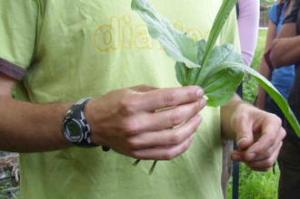
Random weeds were revealed as herbs with stories, such as the greater plantain, held by Dave (above) and used by suffering soldiers in their shoes for trench foot.
Someone said he used its medicinal juice to help his hay fever. Must try this.
Dave said he has used the plantain’s leaves like spinach in saag aloo. Must try this too. (But crikey, would I be able to identify it from photo above? Supposing I picked a Poisonous Plant by mistake?)
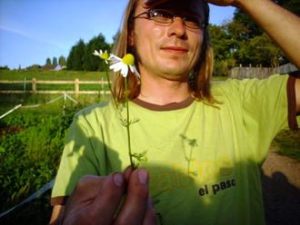
Phew, on safer ground – this looks like a daisy. But it is not. It’s chamomile, famous for soothing jangled nerves. I use it in tea bags so it was like spotting an off-duty celebrity.
A propos, the talk was organised by Mark Boyle, founder of freeconomy. When he turned back from walking to India, it was international news. My media-self was impressed.

Mark (above) organised this Bristol walk as part of a reskilling programme, so we can learn forgotten traditional crafts, like baking bread or knowing what wild plants to pick without poisoning ourselves.
Watch out for a future Mark (and Claire) project in the autumn – Local Food Week when you pledge to eat local and see how easy – or hard – it is. They will add details in the comments section…
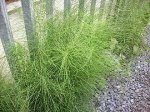
I picked some horsetail (above) and used it to clean the frying pan. A natural scourer, it broke up a bit but seemed to work – could be useful when camping.

Borage, also pictured on our inner-city walk, is another free food to try. You cook it like spinach or use its tiny blue flowers in a salad. Or a Pimms.
Known as borage for courage, it is an anti-depressant (so don’t use if you are on anti-depressants). Fifteen of its leaves make you cheerful. Sounds like my kind of free food.
Thank you Andy, Dave and Mark for an amazing walk-the-talk walk.
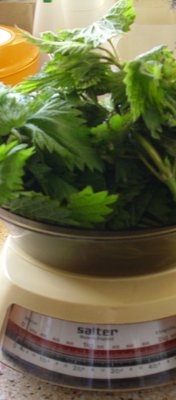
And everyone else, such as Eric with fat hen (below) who walked to France with Mark.



 Real Food Lover