Tag Archives: fish soup

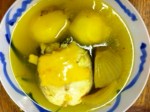
Fay’s fish soup with fennel

My mother is the original Real Food Lover. She says the original Real Food Lover was her mother. Because this is how we learn about food: from the people close to us.

My mum always says the best education you can give a child is to educate the palate.
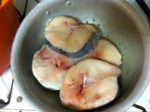
My mum bought this hake the day before at Tachbrook Street market, Victoria, where my dad used to be a one-man GP.

Here is a link to a video of my mum explaining to my eldest daughter how to make fish soup.

It starts with the drama of stopping the fishmonger from throwing away fish-heads:

“‘I’ll have the head!'” she cries. “He was going to throw it into the bin,” she says, with disbelief.

My mum makes the stock from the (rescued) sea bass head and its bones, the head from the large hake from whence come the cutlets, as well as prawn shells.

She adds bay leaf and peppercorns, with just enough water to cover, and cooks it for twenty minutes, with the lid on.

Here is a video of my mum agonising over how much water she used and describing the importance of a lid.

She remembers the way her mother cooked:

“Now, my mother used to tilt the lid – her soups were never watery…But I don’t trust myself.”

While the stock is simmering, she sweats the fennel and leeks in olive oil.

After twenty minutes, she drains the stock, keeping the liquid, to which she adds quartered potatoes and a pinch of saffron which gives the soup the yellow-colour, and a delicate aroma.

Here are the drained remains of the fish head and bones after they have yielded their flavour to the liquid stock.

Fay pours the stock over the vegetables and cooks until tender but “not too tender,” she adds.

When she is ready to serve, she removes the vegetables with a slotted spoon.

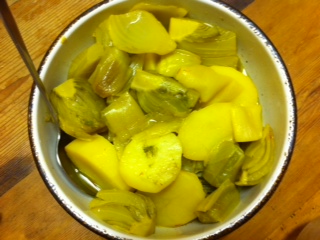
Here are the saffron-coloured vegetables, removed temporarily from the saucepan.
Then Fay heats the stock and adds the fish.

You must never cook the fish too long.

According to my mum, her mother “used to scream down the ‘phone: “Don’t cook it too long.'”

What is too long?

What? You want measurements?

As my mum says: “Nothing is made to measure.”

Basically, as soon as the fish starts to gently flake, you take the fish off the heat.

It all depends on the thickness of the fillet, or, in this case, the hake cutlets. Five to ten minutes?

Here is my eldest daughter scooping out the rouille my mum made.
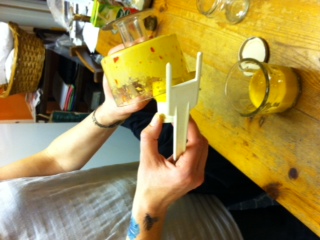
“You know how to make rouille?” My mother asks my eldest daughter.

With garlic, cloves and red chilli pepper – I’d better check that.

Geraldine  (added after publication) gives rouille recipe:

“The rouille will be made with crushed cloves of garlic and red chilli pepper, and mashed as you say into a paste made of stock soaked bread (instead of egg yolks).”

Fay adds bread soaked in the fish stock, then carefully drips-and-whirrs olive oil to make a mayonnaise.

And you don’t just eat the meal. You have to analyse it in detail.

My mum remembers her parents discussing the make-up of every dish back in the 1930s.

And here we are, in the 21st century, still doing it.
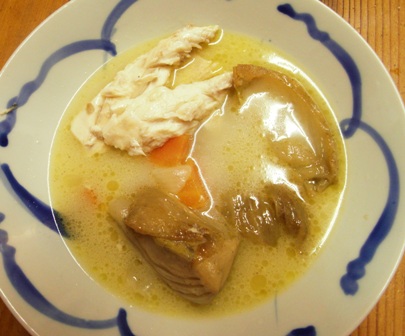
Fay’s fish soup

My mum Fay made this fish soup last Friday.

She bought the wild sea bass in Tachbrook street market, London, from Pat, the only fishmonger she trusts.

“If he packs up, I’ll pack up,” says my mum.

Here’s Fay’s riff on an Evelyn Rose recipe. Two medium-sized fish serves five.

Sweat sliced onion and carrots in butter. Once softened, add the two whole sea bass – or any pieces of fish – and turn over in the fat. Cover with water and add a bay leaf. Simmer until fish is cooked (flakes easily, about 15 minutes) with the lid on.

Cook the whole fish, gutted but with head intact – this will add flavour. Take off the head at the end. Skin and fillet before serving.

Add a dollop of cream fraiche or sour cream, braised fennel and rice with aromatic saffron.

The No Tesco in Stokes Croft campaign (note Saturday’s celebratory demonstration) has been on my mind (and blog) this week, along with the brave squatters who have now occupied the site that used to be a comedy club and which  Tesco wants to turn into a soulless supermarket.

On Wednesday I had the privilege of visiting the peaceful protestors in the occupied premises. They are doing a grand job and I am grateful for their action.

Funnily enough, my mum had a Tesco story last Friday.

“Jack Cohen, the founder of Tesco, had a barrow outside my grandmother’s shop in Morgan Street market in the East End. My family used to look down on him because he was just a barrow boy and they were shop-owners.”

Taking advantage of the property slump, Tesco is intent on buying up land.

Tesco wants control of every purchase from food to movies.

I can’t help wishing Jack stayed a barrow boy.

Fish soup with mussels and chilli prawns

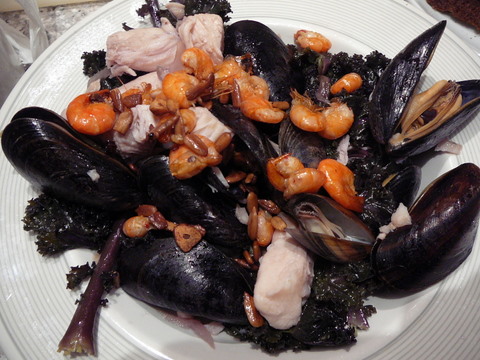
Fish soup in a bowl with mussels sticking out and tiny prawns

I am an ungrateful girlfriend. Here was Mike slaving at the stove and here was me finding fault: the kale was too big, and (listen to this bitterness) he never praised my cooking as much as he did his own.

He was raving about this dish (above) and I was jealous. He reassured me that a) he saw it as ‘our’ dish (especially as I had sourced the ingredients) and b) he was particularly chuffed because in the past this would have taken him all day to cook, what with making a fish stock from the bones.

And we (I feel I can say ‘we’ now) had rustled it up in half-an-hour.

Let me recap. One onion fried in olive oil, plus half a mug of water. Added snippets of smoked haddock for salty taste, and monkfish cheeks, in chunks. Then the purple kale.

I was detailed to remove the shells from the shrimps (but not obsessively – I was amazed by what Mike said I could leave on, and the remaining shells cooked up well-crispy). I fried the little creatures in a pan (see below) with sliced dried chili and two sliced cloves of garlic in olive oil.

I reflected how cooking makes the raw and free fall under our dominion. What power.

Mike added the scrubbed mussels (shells tightly closed) to the fish soup and kale.

Nigel Slater, who inspired this dish, says the mussels add more flavour at this point than the rest of the fish put together. I agree.

The shrimps fried with chili and garlic added another layer of gutsiness with the shells’ crispy crunchiness adding a spicy ‘wow’ to the final bowl (See top pic – the broth must have lingered at the bottom of the bowl because not visible in pic but most definitely there).

To Mike, Nigel, the mussels, shrimps, haddock and monkfish, a big thank you for one of the tastiest finger-slurping fish soup experiences of my existence.

Shrimps frying in pan

Help with mussels

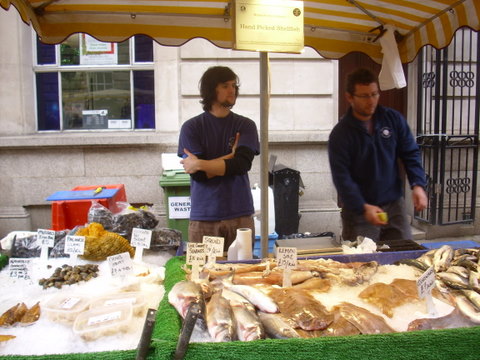
Shellfish stall at farmers’ market

I felt at sea (pardon pun) with the mussels, purchased earlier that day from the Handpicked Shellfish Company at Bristol farmers’ market (see pic, taken a few weeks ago).

10pm on Wednesday and we had not eaten supper. Luckily Mike took over. He was brought up by the sea so knows his fish.

He scrubbed the kilo of mussels (sounds a lot but their shells are heavy) under the tap with a brush, taking off any grey crusty barnacles.

Preparing fresh mussels is hardcore. They are (hopefully) alive when you buy them because a dead one is not fresh and could give you food poisoning. Scary.

When a mussel is dead, its tightly-closed shell opens. So, if when cleaning them, you find one open, you must chuck it. Mike only had to throw one away, which out of a whole kilo, is a testament of freshness.

Top recap. If it is open (before cooking), the mussel could poison you. Bad.

However, when you cook the mussels, the hot steam of your bubbling broth kills them. So the shells open. That’s Good. (Means the mussels are ready to eat).

Listen up, this is complex. If mussel’s shell remains tightly-closed, after cooking, that’s Bad. Means the mussel was unfresh before you started. Throw it away.

(I begun to see why the elders back in the desert said no to mussels.)

I wanted to sweat tinned anchovies (rinsed of the oil they were stored in) just like Nigel Slater told me about last Sunday. But I had none, so I fried an onion in olive oil instead and added half a mug water, slowly.

We now had a bit of bouillon going. Mike popped in some smoked haddock for salty flavouring and the monkfish cheeks, cut in chunky pieces. A firm fish, it keep that firmness when simmered in a stew or soup.

Then Mike added the organic purple kale from Better Food. At this moment I felt the pang of my lesser status, as commis to his chef. Could we not cut up the kale up a bit? I asked, looking with dismay at the large leaves in the pan.

The trouble with accepting help is you lose control. I had lost the right to muscle in on the mussels.

Two fishmongers

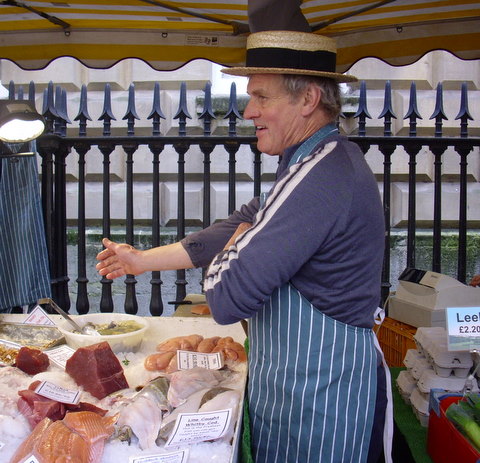
David Felce, fishmonger, at his stall, in profile

A fishmonger is like a hairdresser – a gal is only meant to have one at a time. Bristol Farmers’ market is blessed with two wet fish stalls, each in sight of the other. This makes any pretense of exclusivity hard to maintain.

On Wednesday my mission was to buy the ingredients for a fish soup, including mussels. This meant a visit to both fishmongers.

I went first to David Felce‘s (see above). I bought raw monkfish cheeks (enough for one and a half people) and smoked haddock (two fillets) smoked by the fishmonger himself.

Feeling disloyal to David, I sidled over to the Handpicked Shellfish Company. Outside a gale threatened, so both stalls were huddled in the same area, even closer together than usual. (The above pic was taken the week before when David’s stall was outside, as normal).

I am new to buying shellfish – it is not in my tribal background. In fact the old testament decrees no. Listen, why should that stop me? I bought mussels (1kg) and 100g of (cooked) prawns.

The mussels are well scary. They can cause food poisoning if they not fresh. So, you have to buy fresh ones, alive. Why did I take on this dish (because Nigel Slater inspired me last Sunday)? Read on.