

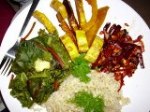
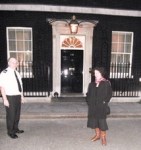
Last week I left my cosy brown rice world (centre) for that of Gordon Brown’s (right pic). An invite from the prime minister was hard to resist. I was not alone. A hundred other members of the British Society of Magazine Editors turned up at number 10 Downing Street for the reception.
The prime minister’s short talk featured self-deprecating anecdotes.
I’d heard him tell some before at a previous reception also organised by the society.
April 2007. After his talk, Gordon Brown, then-chancellor, went on a fifteen-minute steered-mingle round the packed reception room. I introduced myself.
“Elisabeth Winkler from the Soil Association. We were disappointed you did not include agriculture in your green budget.”
I explained how organic farming reduces farming’s carbon footprint because it bans the use of oil-guzzling artificial fertiliser.
He changed the subject by commenting on the growth of farmers’ markets. I furnished him with a figure: farmers’ markets now number over 500. He nodded, echoing the stat.
The trick in these conversations is not to wait for Gordon to give encouraging nods and smiles. You have to deliver your message regardless.
Fast forward to last week – I failed to listen to my own advice. I only got to press his flesh and give my name and rank.
I really wanted to say: if you want an easy win, Gordon, forget GM. It’s uneconomical for farmers and unpopular with the British public.
But I fell under his spell and let him pass. Listen, I can’t be superwoman all the time.
In his talk, Gordon Brown’s only mention of the current financial crisis was to tell us to blame the Treasury if we did not like the wine (joke). Despite the prime minister’s unwillingness to engage in the topic – and William Green, editor of Time Europe, tried hard enough – the credit crunch cropped up in every other conversation I had.
Several editors asked me if the recession would affect organic farming’s future.
I said organic farming sales had not faltered in the last recession; indeed Green & Black’s organic chocolate launched during that dire time.
And another thing, I continued, food prices are linked to oil. The price of organic food has the potential to become lower than non-organic food because organic farming uses less energy than non-organic farming.
Then I skedaddled down the road to Central Hall, Westminster, where the Soil Association’s new president, Monty Don, was giving the charity’s annual lecture in memory of its 1946 founder, Lady Eve Balfour.
Lady Eve was a cool cat who believed in caring for Mother Earth. She set about proving organic farming is better for the soil than agrichemicals. Food should be eaten as close to its source as possible, she said. Way to go.
Monty Don encouraged us to become organic vegetable gardeners. You can’t get more local than that.
Afterwards, in the Soil Association reception (organic wine, this time) several growers expressed concern that Monty’s message undervalues their skills. It’s the opposite for me: trying (failing) to grow veg has made me value the farmers more than ever.
Monty Don has reservations about the word organic, calling it “an albatross”. He is good with words (I headhunted him for Living Earth, the Soil Association magazine). Later I found myself at the bar with Monty and his wife Sarah. I said: “It’s not the word that’s the problem but the bad press associated with it. Like feminism,” I added (as a feminist).
Monty said the word ‘organic’ can make people feel guilty.
Is organic a good or bad word?
![Reblog this post [with Zemanta]](https://i0.wp.com/img.zemanta.com/reblog_b.png)


 Real Food Lover