Tag Archives: Bristol

Organic Food Festival 2010, Bristol

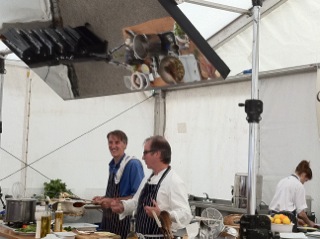
The Soil Association Organic Food Festival (see Demo kitchen above) now in its tenth year, lifts my spirits.

“79% of food we buy comes from just four shops,” says Real Food Festival’s Philip Lowery at the launch of Europe’s biggest organic food market.

The Organic Food Festival showcases real food producers who cannot be shoehorned into the supermarket-system, with its gargantuan requirement for uniformity.

After a week objecting to a multi-billion-backed Tesco (39th store in Bristol) in Stokes Croft, this is just what I need to revive my flagging spirits.

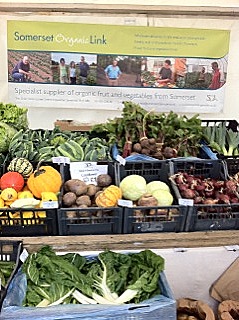
Somerset Organic Link displays freshly-harvested vegetables grown in carbon-rich organic soil without polluting the land with nitrate fertiliser.

And a variety of pumpkins you won’t find in a supermarket.
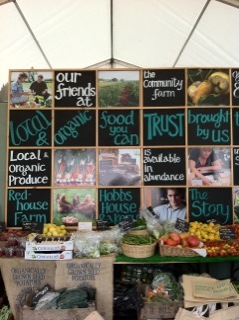
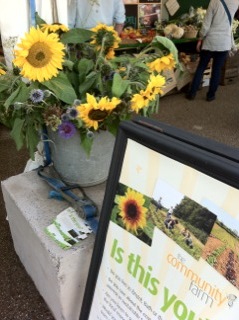
Better Food Company (a 20 minutes walk from the proposed Tesco) has a field outside Bristol supplying the shop with much of its seasonal local organic produce.

Better Food’s Community Farm is open to all, including helping in return for a share of the harvest.
I buy a spelt loaf from the Bertinet Bakery based in Bath.
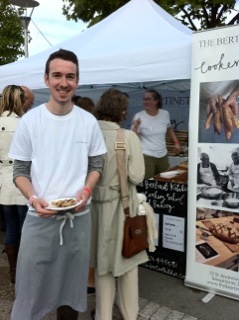
Bertinet Bakery were exhilarated having just been awarded a Soil Association Organic Food award for Baked Goods by Hugh Fearnley-Whittingstall at the awards ceremony held earlier that day in At-bristol.

The theme of this year’s Organic Fortnight is Choose Organic Everyday.

According to the latest Soil Association market report on the recession-hit 2009, 33% of organic purchases are now made by shoppers including manual and casual workers, students, pensioners and people on benefits.

In other words, recession or not, people care about healthy food, where it comes from and how it was grown.

Some organic businesses in common with many non-organic ones were hurt by the recession – overall a near 13% decline in 2009 organic sales.

But  others resisted the downward trend: organic milk sales were up 1%, organic baby food up 21%. By 2010 UK farmland that is organic rises above 5% for the first time.

Junk food high in cheap fat, sugar and additives, or chickens raised in giant sheds  never seeing natural daylight – these are the product of an industrialised and centralised food system that profits shareholders – not the consumer.

Tesco and the other three supermarkets control over three-quarters of our food. They seek market-dominance and make vast profits – Tesco’s profits increased 12% in half-year profits to £1.6bn. [October 2010 figures added after blog was posted].

Supermarkets promise cheapness but it’s an illusion.

The costs are externalised – in other words, they are picked up elsewhere: rivers polluted by farm chemicals are cleaned by taxpayers’ money; obesity from eating junk food is paid for by the NHS. Farmers are squeezed; animals farmed inhumanely.

A shopping survey in Stokes Croft – the Bristol area currently fighting off a Tesco – shows food is cheaper in the local shops than Tesco Express.

Devon-based Riverford farm’s monthly price comparisons show the organic fruit and veg in its delivery box is on average 20% cheaper than supermarkets.

Can you imagine a world where the only food you can buy comes from industrialised food systems?

(Well, that is if oil supplies remain steady because if not we will be stuffed if we are relying on only four suppliers ferrying in food from afar).

Another – local organic – world is possible.
PS Thanks to Juliet Wilson for encouraging this post.

PPS Deadline for objecting to Tesco in Stokes Croft: 14 September.

Why I object to Tesco in Stokes Croft, Bristol

On Tuesday I ate (well) in Zazu’s Kitchen in the cultural quarter of Stokes Croft.

A unique area featuring street art from vintage Banksy
to up-to-the-minute street art attracting visitors from far and wide including Italian food blogger, Jasmine.

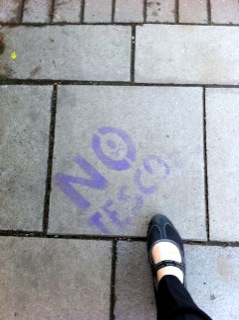
“93% of local people say NO to Tesco in Stokes Croft,” says the fresh notice on Stokes Croft’s  creative response to street drinking, Turbo Island.

How many Tescos does a city need? There are already 38 Tescos in Bristol according to Tesco – and two within five minutes of the proposed site.

Tesco picked the wrong place to wield its corporate takeover of the high street when it set its sights on the eighteenth-century building at 138-142 Cheltenham Road in Stokes Croft.

Using an intermediary (to deflect suspicion?), it bought the lease on Jesters comedy club and applied for change-of-use to shop in November 2009.

Apparently, one Bristol City councillor said: had he known it was Tesco applying, he would not have agreed. But the application got passed, unnoticed.

Thus Tesco infiltrated the heartland of Stokes Croft, as part of its taking advantage of the recession master-plan. What a double-win for Tesco: cheapness and take-over. The more shops Tesco has, the less competition.

Local shops cannot compete against a supermarket’s marketing millions. Hello supermarket means goodbye local family businesses.

Stokes Croft happens to bring together a powerful group of people: freethinkers, food activists and artists. The area’s independent shops offer a wealth of cultural diversity and quality food – including a long-established Italian delicatessen and organic farm shop – and community.

People know each other and help each other.

The local shops have an informal agreement not to sell cheap-as-dirt super-strength alcohol – the liver-rotting stuff supermarkets sell. It will be the beginning of the end if Tesco moves in.

As Joni Mitchell sung in the Sixties: “They paved Paradise and put up a parking lot… You don’t know what you’ve got till it’s gone.”

There is still time to stop the juggernaut. All Bristolians have a right to object.

It’s true that current planning laws do not allow a Council to protect its own local shops as the Channel 4 Dispatches documentary: Tesco – the supermarket eating Britain – shows.

However the formal objection process against a shop front still gives plenty of scope for voicing concerns. Tesco front store branding promises cheapness but is a lie. Our local shops are cheaper than Tesco Express, according to a local survey.

I am helping run workshops to help people write their letters. We all need encouragement. I know I did.

The No Tesco in Stokes Croft campaignwebsite has a template letter to email to Bristol City Council. Copy and paste, then top-and-tail with a list of your concerns and your postal address.

The deadline for emailing your objection is the 14 September 2010.

I have also sent my written statement asking to speak at the planning committee on 22 September at Bristol City Council on College Green.

There will be a party on College Green from 12.30 – 2.00pm to celebrate our campaign. Whatever happens, our fight for fair planning laws has just begun.

Peaceful protestors await Tesco eviction

I am in awe of the No Tesco squatters.

They are putting their safety and freedom on the line, taking non-violent direct action to keep the old Jesters building as a community centre.

It’s a lovely space with its wooden bars and stage and has become a hub of homemade entertainment and education since the squatters moved in.

In time, it could become a food coop selling affordable healthy food.

Instead Tesco wants to turn it into another soulless supermarket selling mass-produced food – even though there are five Tescos within walking distance.

The idea of another Tesco is unpopular.

Many (numbers tbc) have signed the e-petition at Bristol City Council.

3,500 have signed postcards complaining to Bristol City Council about the lack of consultation over the building’s change of use from ‘comedy club’ to ‘shop’.

Supermarkets are bad for local business and communities.

Supermarkets ‘will kill corner shops by 2015’ according to the Times.

Local shops create neighbourliness – and local profit.

Spend money with your local shopkeeper (instead of a supermarket) and the money doubles in value to the community because it is re-spent locally.

Planning laws are toothless – they cannot protect its own.

So the squatters moved into the beautiful old building Tesco wants.

Sadly, on the 2 March they lost their court case to keep it for the community.

The peaceful squatters want to save the building.

Inspired by Gandhi, they practice passive resistance, or Satyagraha.

My photo

The poles on the roof (see my pic above) are an urban version of climbing up a tree and refusing to leave in order to stop it being cut down.

It’s called manufactured vulnerability.

If Tesco wants to repossess the building, then the police and bailiffs acting on court orders will have to evict the squatters by force.

A terrible situation for all involved.

The squatters remind me of the suffragettes who chained themselves to railings.

Sometimes people take brave and desperate action to improve the quality of life for future generations.

Tesco could choose to hand the building back to the community.

What a graceful PR coup for Tesco that would be!

What do you think?

Fay’s fish soup

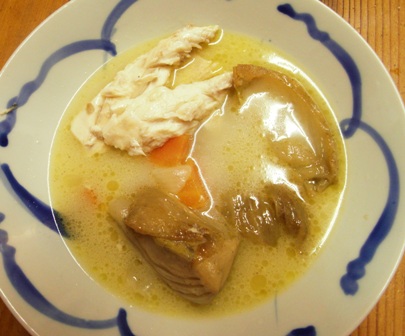
My mum Fay made this fish soup last Friday.

She bought the wild sea bass in Tachbrook street market, London, from Pat, the only fishmonger she trusts.

“If he packs up, I’ll pack up,” says my mum.

Here’s Fay’s riff on an Evelyn Rose recipe. Two medium-sized fish serves five.

Sweat sliced onion and carrots in butter. Once softened, add the two whole sea bass – or any pieces of fish – and turn over in the fat. Cover with water and add a bay leaf. Simmer until fish is cooked (flakes easily, about 15 minutes) with the lid on.

Cook the whole fish, gutted but with head intact – this will add flavour. Take off the head at the end. Skin and fillet before serving.

Add a dollop of cream fraiche or sour cream, braised fennel and rice with aromatic saffron.

The No Tesco in Stokes Croft campaign (note Saturday’s celebratory demonstration) has been on my mind (and blog) this week, along with the brave squatters who have now occupied the site that used to be a comedy club and which  Tesco wants to turn into a soulless supermarket.

On Wednesday I had the privilege of visiting the peaceful protestors in the occupied premises. They are doing a grand job and I am grateful for their action.

Funnily enough, my mum had a Tesco story last Friday.

“Jack Cohen, the founder of Tesco, had a barrow outside my grandmother’s shop in Morgan Street market in the East End. My family used to look down on him because he was just a barrow boy and they were shop-owners.”

Taking advantage of the property slump, Tesco is intent on buying up land.

Tesco wants control of every purchase from food to movies.

I can’t help wishing Jack stayed a barrow boy.

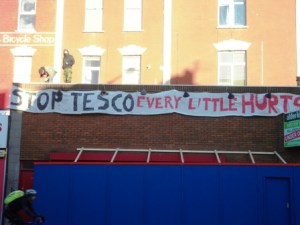
Stop Tesco banner in peaceful protest

Note  Tesco’s blue hoardings, put up on Saturday, and – I might add – taking up a large part of the pavement. Cheek!

So very grateful for the handpainted banner now draped on the building (see pic above) proclaiming: “Stop Tesco! Every little hurts”.

Here is my report on Monday’s meeting in Stokes Croft, Bristol, where we heard about Tesco’s plan to build a soulless supermarket on premises which used to be a comedy club – Tesco’s, you must be joking!

It is believed the premises are occupied by some brave individuals concerned about this supermarket takeover.

Good for them, I say.

Supermarket food is not cheap because the cost to our health is so high.

What would you prefer in the place of a purveyor of industrial food?

All creative and positive ideas welcome.

No Tesco in Stokes Croft

Last night’s meeting 

About 200 gather in Stokes Croft, Bristol to discuss the shock-news of Tesco opening a soulless supermarket in the area.

Not so fast, o supermarket giant – the local people of Stokes Croft want a say.

Local communities need local shops, not another soulless chain that swallows resources.

The intended site is a comedy club – they must be joking, as the campaign headline on Facebook says.

The area Tesco has chosen to site its 32nd supermarket in Bristol is Stokes Croft near St Paul’s.

The home territory of The People’s Republic of Stokes Croft which trials new ideas and celebrates creativity.

The very opposite of Tescopolis.

Supermarkets kill local business. The small shopkeeper does not survive.

The tragedy is Stokes Croft is an increasingly happening place.

Take Canteen, which serves seasonal and local food at affordable prices, hosts great music nights and is designed by award-winning architect, George Ferguson, above newly-reclaimed office space at Hamilton House run by Co-Exist.

Tesco’s planning application to change the use “from stand-up comedy venue to shop” was done under another name last November.

The minimum of public consultation took place – no responses were received – so no one knew until last week that Bristol County Council had given Tesco permission to set up shop.

Not even St Paul’s Unlimited, the body set up by Bristol City Council “to provide an open, accountable, community-led organisation to advocate and lobby for the community of St Paul’s”.

There is still time to stop the supermarket which by the way already has a Metro Express five minutes from the proposed site.

According to Rachael Marmite of the Planning Club (she knows her stuff …and how to explain it in plain English), the Bristol City City Council planning officer said:

“An inordinate amount of (responses) could rescind change of use.”

So lots of responses are planned, including surveying local traders and neighbours, petitions, lobbying councillors and a pledge bank.

Find out the latest at the No to Tesco in Stokes Croft campaign website.

And get general campaign material and advice from Tescopoly.

The people of Stokes Croft want a meaningful consultation.

Being a creative community, expect some street theatre along the way.

“If we all make an effort, it will be easier to achieve,” says co-organiser, Claire, at the first meeting last night.

“Every little helps,” added someone else in the audience, to laughter.

My night in Bristol’s rebel restaurant

Ra-ta-ta-tat on the big red door.

Entry into the wood panelled hall of Quay House.

Once Bristol’s customs house, now disused offices, the Quay House is squatted on behalf of Cloak and Dinner, Bristol’s rebel restaurant.

Seems criminal that such a place lies empty.

Good on the squatters, for invoking Section 6 and making such creative use of it.

For four nights, Quay house is host to what the Guardian calls the hottest ticket in town.

I pass the candlelit lounge where guests will be served gin and tonic.

Up another flight, past the red-curtained dining area, also wood panelled and candle-lit, where the diners will be served a four-course meal with vegan and vegetarian options.

Up the next flight to the brightly lit kitchen milling with volunteer helpers, which reduces to a core team of about seven, myself included.

An anarchist kitchen is the opposite of a  Gordon Ramsay one.

Amidst cries of “Table 7 just finished their starters” and “four vegetarian mains”, the kitchen is calm.

No one is throwing their weight around or shouting.

Anarchists believe – as do I – that human nature is basically cooperative.

And cooperate we did.

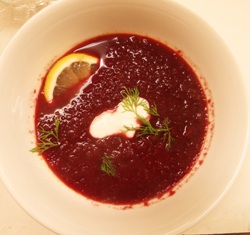
“Best borscht soup I’ve ever tasted,”  says a customer at the end of the night, the dreadlocked waiter reports.

Eve had made a soffrito of celery, onions, leeks – added grated beetroot and water to simmer. Blended when cooked. With Cabernet Sauvignon vinegar, grated lemon zest and sugar to taste. Indeed the best.

For starters: pillows of filo pastry filled with mashed pumpkin, carrots, wilted rocket and walnuts, served with Caerphilly cut from a truckle of cheese.

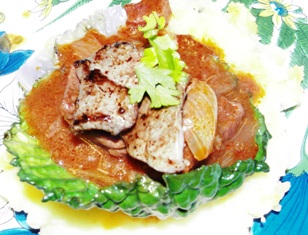
Steam rising on bean stew served on a cabbage leaf on top of potato mash flavoured with mustard seeds.

The venison comes from Fair Game in Nailsea. The young farmer shot the deer, skinned and butchered it last week. Chef Christopher cooked it with sloe gin and the bones until aromatically tender. “The venison was superb,” says another guest who visits the kitchen to praise.

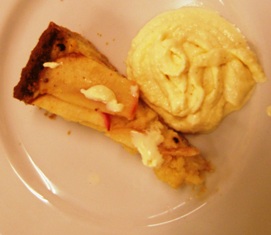
Canterbury pie about to be plated. The recipe for sweetened pastry comes courtesy of Irish chef, Richard Corrigan, while apple puree topped with thin apple slices is from classic cook, Mary Berry. The vanilla ice-cream is homemade, by Eve.

The vegan option at the open window.

I make the pies, following Sarah’s  instructions, based on the available ingredients. No scales, just guess work. My sort of cooking.

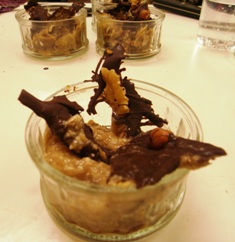
Crush biscuits in a bag, mix with melted Pure organic marge (just enough to moisten crumbs). Press into a plate. Mash bananas with ground almonds and cinnamon. Drizzle melted dark chocolate, add hazel and walnuts and drizzle more chocolate. That’s it.

The banana mixture was too slurpy to cut cleanly so it became a concoction in a ramekin with chocolate and nut lattice broken to sit on top.

The washer upper working with grace all evening, backbone of the operation.

Darren, Saturday’s chef, sweeping the floor in readiness for his shift the next night.
His day job, The Kensington Arms, lent the linen for the rebel restaurant.

“Some people like vegging out in front of the TV. But something like this brings people together,” he says.

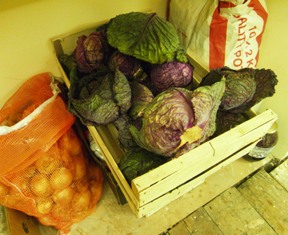
Cabbage in crates. Darren considers how to use them for his chef-shift.


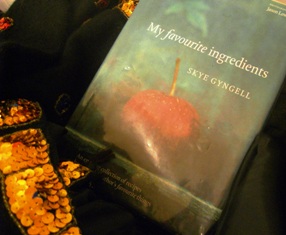
Skye Gyngell’s cookery book, My favourite ingredients, amongst the coats.


Art by Libby in the lounge where gin and tonic is served as the punters arrive.

Happy customers.

“Most restaurants have no soul,” says a guest. He and his girlfriend heard about the rebel restaurant through Facebook. The 50+ covers a night got booked up as soon as word got out.

Each chef has £75 a night to conjure with, money made from a previous project, topped up with food donations from local food businesses.

People paid what they could afford. Last night we made £800 – to go towards the next project.

Everyone gives their time freely. I end the night with a heart full of love.

Bristol’s rebel restaurant

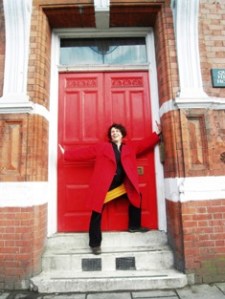
Here I am posing outside the premises for tonight’s rebel restaurant.

Here’s what the Guardian thought after dining there on Wednesday.

The anarchist collective has squatted this fine historic building (shocking it lies normally empty, eh?) and, working for free, has turned it into a mysterious restaurant.

The idea is to create an autonomous space – free space unmediated by landlords or employers.

It’s also about eating locally and seasonally – for donations of what you can afford.

Too late to dine, I am afraid – the 50 covers for each of the four nights of the restaurant’s ephemeral existence were booked a week ago, as soon as word got out.

The tables are laid, Cloak and Dinner‘s chefs and waiting staff with maitre d’ are at the ready.

I am crewing tonight for the chef and her team.

To report back!

Time to transition – now

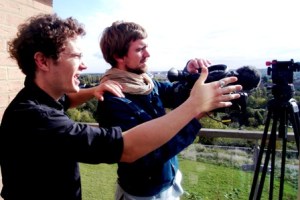
French film crew for Transition film

Last Sunday, the doorbell rung. Turned out to be a French camera crew wanting to film the allotments from our flats. I was the only one in our block who had answered the buzzer.

“Entrez,” I said. It was a random meeting but I recognised fellow media-types.

When the director came into my flat, I noticed he had a copy of The Spark under his arm.

“Tiens, voila,” I said, and introduced myself as its guest editor for the summer 2009 issue.

I gave him a copy of The Source, explaining I was now its food editor. (Never one to hold back on networking opportunities, moi. Even on Sunday morning).

He laughed. “I have just been reading that.”

He said he had really liked our features on local food:

Rachel Fleming’s take on UK food security policy and my review of Local Food, the great new practical action book by Tamzin Pinkerton and Transition co-founder Rob Hopkins.

Guess what? It turned out Nils Aguilar, the director, and his cameraman, Jérôme Polidor, were filming a movie on Transition. People in France are asking: how shall we eat when the oil runs out? Industrial food production relies on oil-based chemical fertilisers and long-distance transport.

The film is to introduce la belle France to Transition, the vibrant international green movement.  Transition encourages practical grassroot local solutions NOW – rather than waiting for the proverbial sh*t to hit fan – and works with existing green groups to achieve it.

Fortuitously, I had just seen the movie In Transition, premiered by Sustainable Redland. I liked it because it shows an amazing range of sustainable projects for food, transport etc which are already up-and-running.

The director agreed: good to be positive.

I had seen The Age of Stupid the previous Sunday at Coed Hills festival in Wales. The human stories were heart-breaking but seemed to link more in my mind to the destruction caused by oil wars and pollution rather than climate change. I can connect them in my head but not in my heart.  (Al Gore’s An Inconvenient Truth woke many up but made me go to sleep – all those graphs).

Is it because – despite my green beliefs – I am in denial too?

What I am trying to say is my meagre grasp of the science does not affect my drive to save the planet.

It is common sense to save our precious non-renewable resources and reduce CO2 emissions to stop the ice caps melting – to search for another way of living.

To paraphrase a comment on George Monbiot’s post about climate change denial:

If you believe in climate change, you end up living in a just and caring world. If you don’t believe in climate change, it’s business as usual: exploitation, pollution, disease and oil wars.

Or as climate change campaigner George Marshall says: the facts are not enough to effect change. You need belief too.

Stop press: I just read a comment on the Transition blog from a woman in Wales whose spring is running dry for the first time in over a hundred years.

Climate change is not an intellectual debate.

Wake up. We need to wake up.

Harvest supper with Grofun

Grofun - 12.7.09

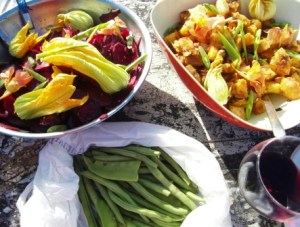
Sunday 6pm. Everything in the picture was grown on our community allotment: the beetroot, turned into slivered (use a potato peeler) salad, and the spiced Mumbai potatoes, both decorated with courgette flowers, and the green beans in their bag – all on the table in the evening sun, waiting to be eaten.

We have GROFUN, Growing Real Organic Food in Urban Neighbourhoods, to thank for this miracle.

Nadia Hillman, GROFUN’s 33 year-old Bristol-based founder, was on BBC’s Gardening World at Easter helping Birmingham set up a similar scheme.

Is your garden overgrown? Would you like help getting it fit to grow organic vegetables?

GROFUN volunteers pitch in and in return for their impressive labour they get reciprocal gardening-help either in their own garden or at the community allotment in St Werburgh’s, Bristol.

We are learning how to grow. And everyone involved gets invited to the harvest meals.

“The best thing for me is the connecting of people” says Nadia.

We sat around the fire into the evening. Mel played a haunting song on the guitar.

It sounds a moment of peace. And it was.