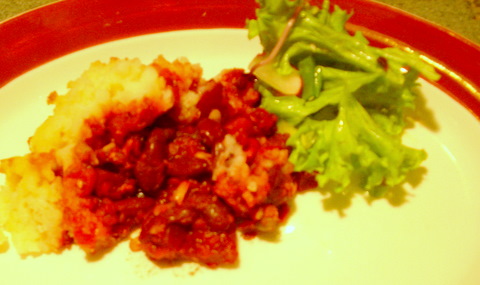
Bean and beetroot comfort pie

Bean and beetroot topped with mashed potato on a plate

With a gale blowing outside, it was time to cook up some comfort food. No ingredient was safe as I ransacked the kitchen.

I boiled some potatoes, and mashed ’em with butter. Then I drained and tipped tinned kidney beans into a pan with a raw beetroot, cubed, and mushrooms, sliced. Plus a palmful of dried roasted buckwheat for earthiness (thanks, Chloe) and sliced fresh chilli, some salt and ground cinnamon for perkiness.

Once cooked (beetroot cubes still crunchy, or al dente), I poured the kidney bean mush into a greased casserole dish and forked the mashed potato on top, dotting it with butter. Then baked it in the oven for 40 minutes at a medium heat.

The dish looks dramatically red but there’s nary a tomato in sight – the colour is all down to the beautiful beetroot (and those kidney beans). And the minimalist amount I put on the plate for the dish’s photo shoot bears absolutely no relation to the amount I wolfed down.

UK food prices are soaring, and meat and dairy most of all. So if I had slowed on the butter, this would have been a topical economy dish.

But saving money on food should not be about depriving oneself, I think, but making good ingredients go further. So a bit of butter makes things better – especially when the winds are howling.

Almond and chocolate cake

Cake with a pot of clotted cream

Cakes need precision. Although I rarely use scales, they come out in a baking moment. Still, as long as you have the basic riff down – such as the proportion to eggs to sugar to butter to flour – there’s some room to improvise.

My sister and her partner came for dinner on Saturday and I was visited by a vision of an almond and chocolate cake. (Mercedes was out of town so no chance of her faultless recipe.)

I alighted on a recipe from the internet, and another one from a back issue of Olive magazine. But oh. One recipe was in ounces, the other in grammes. And I am numerically challenged.

On top of which we all got soaked in the blustery rain which meant I had to lie down on our return. When I regained consciousness, I had 40 minutes to make dinner for four and whip up my almond vision.

I kept trying to talk myself out of attempting a cake under such circumstances. But I wouldn’t listen. While the brown rice was cooking, spinach steaming, sweet potato and coconut simmering and sunflower seeds roasting, I broke two eggs in a bowl and started whisking.

No turning back now. I was committed. The Olive magazine recipe said 2 eggs go with 90g of butter, 200g of chocolate, 55g of sugar and 150g of ground almonds. After that I was on my own.

I substituted raw cocoa nibs for the melted chocolate and chopped up goji berries and crystallised ginger as small as I could, as time unmercifully ticked by.

The scales were the sort that helpfully mark weights like 200g with a bold black stripe but leave the lesser 50g ones to your imagination.

I folded in the ground almonds, the raw chocolate, the melted butter (I thought I’d better melt something), the chopped berries and ginger into the eggs, whisked, with an invented amount of rapadura sugar.

My cake tin was too large so I filled it with water and placed a smaller one inside it. I forgot to grease the smaller one or the knowledge that cake tins are not watertight. I gave my concoction 30 minutes in a Gas Mark six oven and served it with local organic clotted cream from the other wonderful organic shop in my life, Marshford, in North Devon.

And miraculously, the cake was a winner. The combination of crunchy raw cocoa, goji berries and ginger was exotic. (Although a less hot oven might have made the almonds moister).

Synchronistically, on the same day, a fellow food blogger was making a similar cake, whose recipe I most heartily commend.

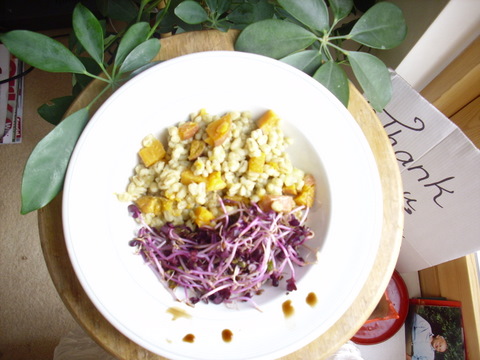
Barley and thank you

Barley and purple sprouts in white bowl, photo in very far corner

Sometimes I don’t pay attention while cooking. The other evening I put barley in the pan to boil for an hour and shook spirulina in for flavour and nutrition. I thought the raw superfood would add seaweed interest. (And my mind was elsewhere).

I was in denial for most of the hour barley was cooking then conceded defeat. I’d put too much of the strong algae powder in – it was revolting. I gave the barley grains (with sliced fennel) a quick rinse and started again.

New water, and now cubed sweet potato for colour and sweetness. It was touch-and-go but turned out alright. Especially served with Aconbury’s purple organic radish sprouts (a raw super salad) bought at Better Food in Bristol, and flicked with balsamic vinegar.

(I rate balsamic above all vinegars. Worth every penny.)

I served the dish up again for its photo shoot the next morning by the window next to my “Thank you John”.

John is my dad. He has had a big stroke that has changed him. In the light of losing him (last September) I suddenly became aware of how much I was made from him.

Hemp spaghetti with oyster mushrooms and seeds

Hemp spaghetti, with steamed veg and fried almond flakes and seeds

I have been on a cream and cheese fest for the last twenty-four hours. Last night Ingrid Rose brought me some Manor Farm organic double cream (Manor Farm is the real deal by the way – real food lover farming) which I spooned on last night’s pudding, my midnight snack and this morning’s porridge. At a lunch time meeting today, I positioned myself next to the cheese-board and grazed.

Finally my body went: Stop! It was craving something fresh and vegan, so I decided to humour it, the poor darling.

Once back in Bristol after my meeting in corporate London (see pic below), I dropped into one of the best organic shops in the universe, Better Food.

This real food lover supermarket based in Bristol BS2 yielded all I needed for my eat-for-health dish.

I cooked the hemp spaghetti (cannapasta) (fun to say!) in boiling water.

Over it, I steamed organic purple sprouting broccoli (still in season) from the Walled Garden, sliced fennel and oyster mushrooms. Served with grated raw carrots.

My tour de force was melting creamed coconut in slugs of olive oil and pan roasting flaked almonds, sunflower seeds and sesame seeds, with dribbles of tamari at the end to make succulent pan juices.

Good to be home.

Atrium of corporate offices

Gurnard my friend

Raw gunard in baking tin on a sofa

Ingrid Rose came to dinner and I pulled out all the stops. She feels strongly about looking after land and sea – so no cutting of ethical corners with Ingrid Rose.

The fish had to be caught sustainably – not plundered from the sea or factory-farmed, she said. I was grateful to be pushed in a real food lover direction.

I dithered at the Hand Picked Shellfish stall at the Bristol Farmer’s market, agonising between two sustainable fish. Would it be familiar mackerel or ugly-looking gurnard?

In an experimental mood, I chose the gurnard although it disturbed the very fibre of my being.

Yet gurnard never let us down. Flesh firm and sweet, similar to sea bass – and at £7 a kilo, about a third of the price.

Tragically and incomprehensibly, this sustainable fish is called “jetsam” – thrown back into the sea dead, discarded from a more glamorous, prized catch.

My grandmother would say: You can’t tell a book by its cover.

I felt a pang as I handled the sea creature’s body before cooking. I no longer felt judgmental about its heavy face and lugubrious name.

We roasted it (covered) with thyme, sliced shallots and mushrooms in olive oil for 20 minutes in a hot oven. Served it with faithful brown rice and trusty steamed kale.

I felt the gurnard had entered my life like a family animal or pet – and we ate it.

“Don’t be sad,” said Ingrid Rose. “Gurnards eat other fish.”

Gurnard, kale and brown rice plated with fish carcass in background

The Delia effect

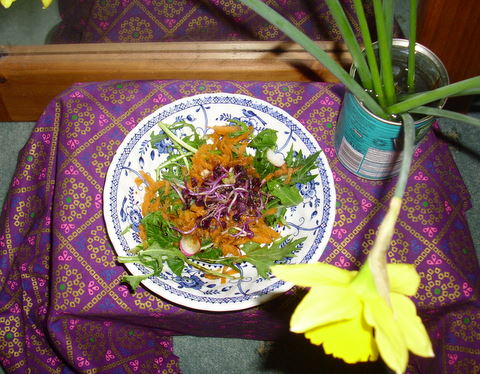
Small bowl of salad (green leaves, carrots and purple radish sprouts)

When Delia spoke to the masses and decreed the poor can eat battery-farmed chickens, did their sales rise?

The “Delia effect” describes the unprecedented sale of certain ingredients after being recommended by TV cook Delia Smith. Her influence is so vast that “Delia” has entered the dictionary.

I am pleased to report that sales for free-range poultry have soared.

This follows the high-profile campaign on TV’s Channel 4 by two other famous cooks, Hugh Fearnley-Whittingstall and Jamie Oliver. They called for higher standards of chicken welfare for all concerned, chickens and their eaters alike.

Sales of free-range poultry rose by 35 per cent in January (compared with January 2007) while sales of standard indoor birds fell by 7 per cent, according to market research company TNS. In response, Tesco doubled its order for higher-welfare chickens.

I mentioned what Delia said to my hairdresser.

Sharp intake of breath. “How can it ever be alright to eat a battery-farmed chicken?” she said.

Listen, she is an apprentice hairdresser so it was gratifying to hear being short of cash does not mean skimping on food quality.

Of course, you have to be a bit canny and cook from scratch. But that’s how most people in the world eat, and why so-called peasant food (such as pasta dishes, stews, curries) tastes so good.

Today’s picture is of a salad made by Chloe, with organic leaves, grated carrots and sprouting radish, that accompanied brown rice and lentils with fried onions, mushrooms and egg, that her dad Mike made. (PS the vase may be corporate but the beans were organic).

This princely meal that cost us about £1.50 each. I rest my case.

Porridge with heart

Porridge with heart-shaped cinnamon and nuts

I love porridge so much I could marry it – it is good for me and treats me nice.

You know when grown ups say: don’t play with your food? Wrong! Playing is the best way to learn.

There is always a moment in cooking where I think: this looks a mess.

“Be quiet,” I order my inner critic. I know I must persevere regardless, adding a bit of this, a bit of that.

The thing about porridge is it is meant to look like slop.

You can add fruit, nuts and seeds for extra taste and nutrition. I like sultanas, cinnamon, pecan nuts and pomegranate (see pic).

I love raw oats too. They are my top favourite comfort snack food with soya or rice milk, and sometimes, when in a dairy mood, organic cream.

This is how I make porridge. Using a cup – or half a mug – of jumbo oats (organic of course) per person, I soak them in water overnight.

If I forget to soak them (sometimes there are other things on a girl’s mind), I use rolled oats because they cook quickly without soaking.

So you get your oats, put them in a saucepan, add water and gently bring to the boil, stirring regularly with a wooden spoon to stop them sticking to the pan.

How much water? Well, enough to cover the oats, then add about a half a cupful more and keep simmering and stirring. Eventually the oats absorb the water and by trial and error, you can make porridge as lumpy or smooth as you like. Maybe you need to add more water, maybe you need to cook it a bit more (generally takes 10-15 minutes).

I would like to be more precise but it is not in my nature. Cooking is about experimenting.

It all comes good in the end – so take heart.

Poetic chamomile

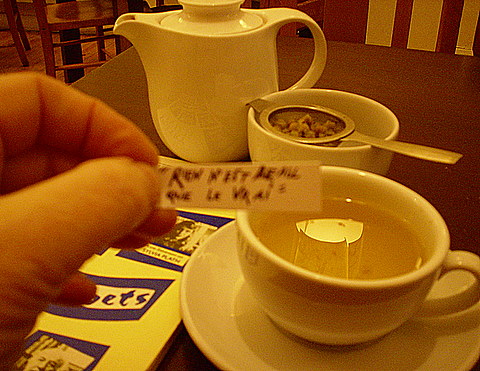
Cup of chamomile tea in the Poetry Café

I confess I don’t always do what’s good for me. For instance, I am prepared to sacrifice inner peace for a caffeine buzz. My intestines protest and I just ignore them.

Anyway, the other day in Soho, I decided to chase my over-exhilarating cappucino with a chamomile tea. Wow. Who says the herbs don’t work? My stomach was instantly soothed.

It was especially pleasing that the chamomile was made from dried flowers (although a chamomile tea bag works as well).

So here I was (see pic) in the Poetry Café – yes, a café devoted to verse, how cool is that?

I picked up an ’80s back issue of the Poetry Society magazine (I’m just as addicted to print as caffeine). That rhymed by itself (is poetry contagious?).

And I came across this quote in the Letters page. I’m sure you can see how apt it is, as well as sage. (Enough of the rhyming blog. Ed).

“Rien n’est beau que le vrai.”

“Nothing but the truth is beautiful.”

(Here is the original French poem).

Soho hummus

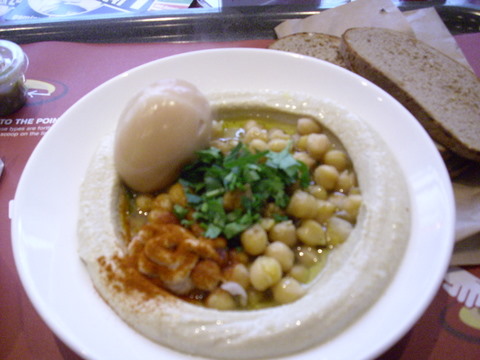
A dish of hummus

Down memory lane in London’s Soho. 1978, unmarried, pregnant, I saw a poster in a funky vegetarian cafe’s noticeboard that changed my life.

Fast forward to 2008. I walked past Food for Thought (it’s still there!) and smiled nostalgically. I did not stop as I was on my way to the 24/7 internet cafe, Netstream.

Starving at 2pm on Wardour Street I found my dream eaterie, Hummus Bros. If you love hummus and in London, you have to go.

Hummus Bros serve each dish (see pic) with a free and unexpected egg, a choice of rye bread (from Fresh and Wild) instead of the traditional pita bread, chilli relish, extra lemon juice and if that wasn’t enough love, a complimentary glass of mint tea made with the fresh herb.

One of my top fave foods, hummus is both comforting and nourishing. It packs protein by combining plant foods. Two different plant groups roughly equals one complete protein, and hummus, with pita, offers three: chickpeas (bean), tahini (seed), and the pita bread (grain).

I yearn to tell you how to make hummus at home because it will be a lifelong friend. The cooked (high fibre, low-GI) chickpeas are mixed in a blender to a creamy gunk with olive oil, lemon juice, a bit of garlic and tahini – now that’s a convenience food I approve of. I also prize tinned organic chickpeas as a larder-friend. (So there, Delia.)

Cooking from scratch saves money and takes planning (beans need an overnight soak and one hour of cooking). This recipe explains it really well. I have never used yogurt, as it suggests. Must try.

Love smoothie

smoothie.jpg

There is nothing more pleasant than a smoothie and its pleasures are fairly instant. If you love drinking smoothies in a café (as I did in La Ruca, see pic) it’s worth investing in a blender or smoothie maker. You need electricity to make a smoothie smooth. (If anyone knows differently, tell me.)

For those planning to live on smoothies (we all have times in our life like that) then vary the ingredients as much as possible.

The delight we derive from variety is nature’s way of making sure we get diverse nutrients.

Smoothies are personal. Everyone has different tastes. This website has loads of smoothie recipes to choose from. Luckily, so I can be lazy and tell you my favourite.

You need to stock up on a few things. I find cow’s milk makes me snuffle so I use soya milk (organic because I don’t want them GM beans) and also (if this is a week’s siege) I would splash out on a carton or two of rice or nut milk. You can make your own.

Banana forms the basis because it is a mood stabiliser (all that potassium, you know), as well as easy-to-eat and sweet. Add a grape or two, or a mango sliver. What fruits do you like?

Start by whisking/blending the banana. A teaspoon of nut butter (peanut, almond or cashew) for added protein? Some raw porridge oats? This is the time to whiz ’em in a mash with a tablespoon of milk or apple juice.

Pour the milk in slowly (a mugful for one). Look, if it gets gloopy, add liquid to gently thin it out.

You can blend in raw grated or ground ginger (great for my digestion) if you like. What I also adore is cinnamon.

Cooking is a bit of an experiment (no dish is the same each time) – that’s what keeps it interesting.