Andy’s vegan curry and a coincidence

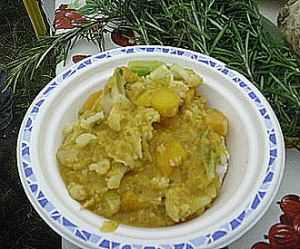
Andy\'s veg vegan curry

When you are partying in a field, a warming bowl of aromatic vegan veg curry on a bed of rice is most reassuring. The field had been transformed overnight into a human encampment with dance tents, music and smoking fires. And a kitchen under canvas to which I gravitated.

Andy was catering. He had borrowed pots, hired gas rings and an urn, and was cooking at a trestle table. I have a gypsy fantasy of being a festival cook but it’s bloody hard work.

Anyway, we chat about food and he mentions a friend studying at the Slow Food university called Henry.

“Henry who?” I ask, thinking of Henry Hoffman

“Henry Hoffman,” says Andy.

This is the one and the same Henry who commented about my pics from Italy saying, quite rightly, my header pic needs serious attention.

The sages say there is no such thing as a coincidence. Here I am in a Somerset field meeting someone who was schoolboy pal and is fellow foodie with the unknown stranger-person who commented on my blog.

If I am to extract a deeper meaning, I would say I need a new header pic asap. And possibly help from Henry Hoffman himself.

Beetroot tops

Beetroot tops

I confess there was a time when I did not know that you could eat the leafy tops of raw beetroots. Now I have that knowledge, the next trick is to eat them when they are still dark green and fresh-looking.

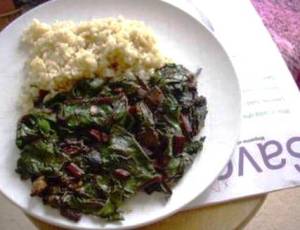
I shredded the leaves and cut up the purple bits into a frying pan where I had heated olive oil and garlic. Cooking them in melted butter works well too. I fried spices but that is optional. Cook the leaves slowly enough until soft. No need for water. I also chucked in chunks of mushroom and served this nutritious dish with brown rice.

(It is pictured on my copy of the Guild of Food Writers‘ new-look magazine, Savour, where I learnt that Japan was a Buddhist vegetarian country until the 19th century.)

Whether you eat the leaves or not, do cut them off otherwise they draw out moisture from the beetroots. I learnt that fact from reading The Riverford Farm Cook Book – what a fab book, that is.

Written by iconoclastic farmer, Guy Watson, and the chef of Riverford Farm’s restaurant, Jane Baxter (who trained at the Carved Angel and the River Cafe), it’s a useful, informative and entertaining read.

Guy started farming organically in 1985 on the family farm in South Devon. Thanks to his brilliant idea of forming a cooperative with other local farmers, Riverford is now one of the UK’s largest organic growers with a veg box scheme that delivers all over the country.

I think cooperatives are the way to go, and especially for small family farmers – there’s strength in numbers especially when you are competing against agribusiness.

Guy says what he thinks, which is very refreshing. Quite rightly, he says the term “organic movement” sounds like everyone agrees with each other when in truth there is (healthy) debate.

The book is way-not pretentious. Clearly, Guy and Jane think the media-darling aspect of organics sucks.

Instead their voices are…well, down-to-earth. They give you a real grasp of how and when organic vegetables are grown, and basic yet tempting ways to cook them.

You know where you are with this book. I recommend it. Big time.

Cover of Riverford farm cookbook

Roast organic chicken from Sheepdrove farm, half price!

organic Sunday lunch with roast chicken from Sheepdrove

A Merrier World inspired this blog, to raise awareness for chickens. Poor things. Prisoners on a factory-production line, they have turned into commodities. An organic chicken seems expensive in comparison because it gets to lead an ordinary life.

A cheap chicken is cheap because it does not lead a normal existence. Bred to quickly gain weight, it is sometimes too heavy to walk, and, kept indoors in a noisy shed with 40,000 other birds, it is denied its natural behaviour such as feeling the sun on its back, perching or stretching its wings.

“Poor people must have cheap healthy protein,” say the chicken-factory defenders. Hello? Cheap chicken is not exactly healthy – it is full of fat, antibiotics and is a food-poisoning risk, which is why it must be cooked so carefully. A false economy, if I’ve ever heard one.

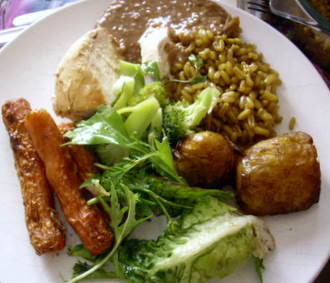
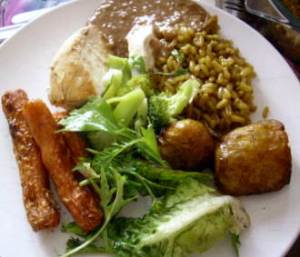
Here are ways to eat organic chicken on a budget. Buy a whole chicken and serve it as a once-a-week treat. Use its carcass for soup and leftovers for future meals. Serve it with a plateful of other goodies as I did yesterday (see the above pic with its Better Food organic salad leaves, carrots and potatoes, kamut grain and non-organic broccoli) so a little goes a long way.

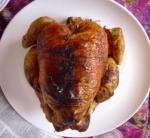
My chicken came from the Sheepdrove organic farm butcher shop in Bristol, belonging to Sheepdrove organic farm in Berkshire. Master butcher, Graham Symes, picked one out for me. “See its beautiful heart shape?” he said. “That’s the way a chicken should look with the breast falling over the legs (see pic below).”

Instead of £18 for 2.6 kilos, it was half-price because of a current surplus. You can get your half-price beauties here. Hurry while stocks last!

Sheepdrove organic farm is owned and run by the kind and visionary Peter and Juliet Kindersley. Peter has put his publishing profits to a good cause, developing top animal welfare systems. My favourite Sheepdrove fact: their chickens peck at healing herbs to self-medicate. Chickens are clever creatures when allowed to be their natural chicken-selves.

The Kindersleys have recently developed a terrific new safe way of feather-plucking on its on-farm abattoir. Usually the feathers are loosened by dunking the dead birds in a bacteria-infested hot bath. The new Sheepdrove method of steaming could dramatically reduce the number of bacteria for non-organic and organic poultry alike.

Our chicken was delicious. “It tastes like chicken should taste,” said my sister who is a regular Sheepdrove shopper.

Here’s how to roast a (preferably happy) chicken: allow 20 minutes of cooking time for every pound/500 grammes – and then 20 minutes extra. I smeared the breast and legs with olive oil, rubbed in paprika and salt, and slithered slices of garlic under the skin. I simmered the giblets in wine and water for stock, and made gravy with this and the cooking pan’s juices, thickened with my new discovery: an ounce of rolled oats.

A tip for the absent-minded cook: do not put a chicken – in a plastic bag – in the oven to get to room temperature, then forget it’s there and switch the oven on. Getting melted plastic off a hot oven is no fun. Trust me.
Sheepdrove organic chicken

Quick lettuce soup

Lettuce soup

It was buy one, get one free at the organic supermarket in Bristol.

The Better Food assistant pointed out the bargain gem lettuces, fresh from the company’s Walled Garden.

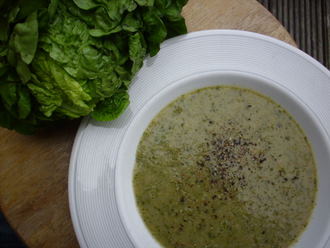
I thought: oat-thickened lettuce soup. The perfect opportunity to share the quickest healthy-soup recipe I know. You basically boil water with butter, add oats to thicken and then the lettuce which takes seconds to cook.

Boil 1 pint of water with 1 ounce (30g) of butter. Add 1 ounce of rolled oats. Bring the water, butter and oats to the boil. Simmer for five minutes to cook the oats. Add a lettuce, chopped. Season with lots of black pepper but a little salt. Turn off the heat after several minutes as lettuce cooks quickly. And will carry on cooking in the water.

I think blending this soup makes it more unctious. I blended mine (see pic).

I came across it the other day. My mother was cooking it when I got back from the Guild of Food Writers Awards. Appropriately, the recipe came from the pen of one of our best food writers, the late Jane Grigson (mother of Sophie).

I love Jane Grigson’s Vegetable Book, which has recipes for every veg from artichoke to yam. My mum made hers with spinach, but the Grigson original is Irish Nettle Pottage.

I have had this book since 1980 so why, oh why, did I not think to delve in, in my nettle-soup phase?

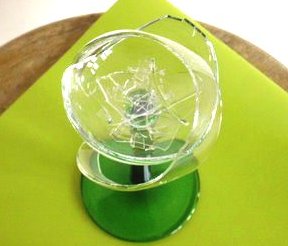
On the subject of mistakes, I broke one glass within ten minutes of leaving the charity shop with five (for a fiver). When I photographed the damage, it had beauty (see below).

I feel a moral coming on.

Mistakes are like jewels in the crown because we can learn from them.

Broken wine glass

St Werburgh’s City Farm Café, Bristol

Paul Burton, chef, at St Werburgh\'s city farm cafe

Lucky me. To get to this Observer ethical award-winning café from my home, all I have do is walk ten minutes through the allotments.

Here is chef, Paul Burton, holding my lunch – the aioli is homemade, with fennel from the next-door city farm and smoked mackerel from Cornwall. Paul used to work at Café Maitreya (another Bristol award-winning eaterie) and now he is a business partner in St Werburgh’s city farm café.

Note its hippy-trippy Hobbit-like décor, courtesy of artisan builders, Bristol Gnomes.

I wish I had a photo of the café’s owner, Leona Williamson, because she too has an ethereal quality – but like all fairies, she has power too.

When cooking in the Local Food Hero competition, she came up with a new concoction, with one hour to spare.

She made goat and beetroot sausage with a three-root mash (celeriac, potato and Jerusalem artichoke), and wowed the judges, Jay Rayner, Xanthe Clay and Gary Rhodes. The goat came from the city farm.

So impressed was Jay that he put her forward for the Observer‘s ethical awards.

It was Leona’s idea to use the animals on the city farm for food.

I totally approve.

Far better to be a conscious meat-eater that respects the animals than not give a thought to how they fared when alive.

These darling creatures currently living on the city farm may well end up in one of Leona’s famous goat stews. Reader, is this OK with you?

Bristol\'s St Werburgh\'s city farm goats

Tofu smoothie offering

Tofu smoothie

I lay on my bed, as heavy as a stone. How to eat when your energy deserts you? Gazing up at my lampshade reminded me of the yellow-themed photo competition in aid of Bri, the young food blogger who has breast cancer.

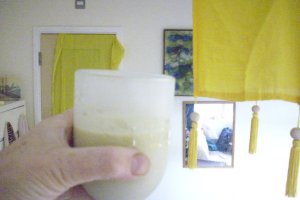
Here is my offering. A tofu smoothie in a recycled glass held up against my yellow lampshade (with yellow scarf draped over the door).

Tofu is a miracle food because it’s protein-rich but incredibly light and easy-to-digest. Made from bean curd, it’s a great invalid food because meat and dairy can be a bit hardcore when you are feeling weak.

Even chewing can be hardcore. So I blended everything and all you have to do is sip this creamy smoothie, gently.

I whizzed up 225g tofu, 2 tablespoons of ground almonds (or same amounts of peanut butter/almond butter), one sliced banana, 300 mls (half pint) rice milk and a teaspoon of cinnamon (and the same of turmeric for yellow-colour and its fabulous health properties).

Below, I pictured the half-empty tofu packet as well as a Tibetan mandala puja ceremony I went to at the Pierian centre today. The monk had spent the last week (it was Refugee week) making a mandala from rainbow-coloured sand but today he dismantled it, prayerfully.

We followed him to Bristol’s river Frome where he cast the sand grains into the water, a reminder of both life’s impermanence and the eternal and reviving now.

Tofu in a bagTibetan mandala puja ceremonyMandala puja ceremony

Guild of Food Writers awards 2008

Guild of Food Writers awardsJill Dupliex accepting her awardKatie Stewart and Elisabeth WinklerKatie Stewart and HughCookbook

The Guild of Food Writers’s annual awards party is a glittering must-go, this year held at Tamesa in the Oxo tower on the South Bank of the Thames. I was a judge of one of the awards but, shhhh, that’s all I can say about it.

Sustainability was a strong theme, from sponsors, the Alaska Seafood marketing institute and Bonterra organic wines, to the winners.

Listen, I rate the Observer’s ethical eco-hero, Hugh Fearnley-Whittingstall for his animal welfare work. But he endeared himself further by making sure (see pic 1) that his fellow author, Nick Fisher, shared the award for The River Cottage fish book. (If you click on that link, read the Amazon review by Henrietta Green of Food Lovers Britain.)

I loved Jill Dupleix‘s wise words on accepting (pic 2) the Miriam Polunin prize for Work on healthy eating. She said: “I look forward to the time when there isn’t a special category for healthy eating and all food writing is healthy.” Yeah, sister, bring it on!

The sustainability theme continued with Sarah Raven’s Garden Cookbook, which addressed food miles and provenance.

It’s always nice when you agree with the judges. Hattie Ellis won for Planet Chicken. It is a beautifully-written easy-read on a hard subject: how we treat intensively-reared chickens.

Then Bill Buckley announced that the winner (taratara) of the Lifetime achievement award was…Katie Stewart. I took this award personally (again) – The Times calendar cookbook with its seasonal recipes has been a favourite for decades. (See my beat-up food-stained version in pic 5).

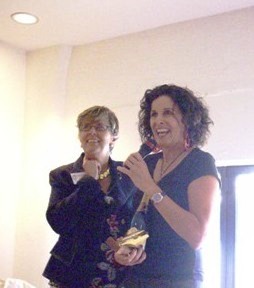
An awards ceremony is such an emotional event, I was starving by the end. My hunt for food took me to a quiet part of the room where Katie stood with friends. I am afraid I could not resist asking to be photographed with her (pic 3). She said the Times cookbook was her daughter-in-law’s favourite too because people nowadays want the classics, like toad in the hole.

Then Hugh approached – clearly another Stewart devotee. (I must admit Katie looks happier with Hugh than with me but hey, that’s show biz).

Prue Leith OBE presented the awards. She explained how she gave up cooking to campaign. A champion of real food in schools, she is a woman after my own heart.

This became more evident later. There was a queue for the ladies’ and on Prue’s advice, I used the (empty) gents’ while she stood guard. I liked that – the way she encouraged an unconventional route to get results.

Red lentil soup

My friend Sheila said, “come over,” and I said, “shall I bring something to eat?” With only an hour and a half to spare and no time to shop, soup made with split red lentils was the only answer.

Without much ado, I soaked 125g red lentils for half an hour in about 4 mugfuls of water. The little dried red things (a storecupboard-must!) absorbed some water and softened – then I applied the heat. As I brought the pan to the boil, I chopped one onion and chucked it in.

You can see the uncooked onion pieces and some lentils floating on the surface as the soup begins to boil (above).

The strange naked beast in the picture is a peeled turmeric root from Marshford organics. I have never seen turmeric’s root root before, only its powder. It is closely related to ginger, but unlike that root, turmeric stained my hand yellow as I sliced it.

I also added sliced organic carrots that had overstayed their welcome at the bottom of my fridge and quarter of a dried chilli, not enough to bite.

Once the soup had come to the boil, I simmered it for half an hour until it was a soup-y mush. To make sure of its mushiness, I gave it a quick whizz with my handheld electric blender.

I got the soup safely to Sheila’s and we ate in the garden (see below).

I first met Sheila when, pregnant, I wandered into the Birth Centre circa 1977 to find out more about natural childbirth. On impulse, Sheila offered me a job wo-manning the Birth Centre ‘phone. She was a signpost in my life, putting me on track for the start of my new career as an ante-natal teacher and writer.

Sheila is a natural pioneer. Ahead of her time, Sheila brought the French obstetrician, Frederick (birth without violence) Leboyer to the UK, and changed our views of birth forever.

I see parallels between real food and natural birth; both aim to understand and work with nature rather then supplant it with risky and often unnecessary intervention.

yellow flower in Sheila\'s gardenSheila in gardenLentil soup

Spinach soup thickened with couscous

Spinach soup

I would be useless in a post-peak oil world. What would I do without my electric blender?

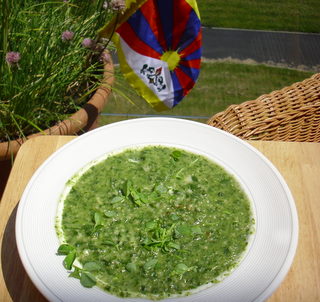
My teeth are troubling me so I made this spinach soup soothing with the help of the handheld machine. Its on-grid whirls fashioned the soup into a luxury item.

Here’s how I got there. The washed organic spinach leaves, stalks and all, went in a large pan. Spinach cooks in the water it is washed in (no need to add more) but do put a lid on to retain that moisture.

Once the spinach was cooked soft and waterless (drain to make sure), I added butter and immune-boosting garlic to frazzle in the meltedness.

But how to thicken it? I could have used flour but what is life without risk? So for the first time I sprinkled a smattering of couscous (I used organic kamut) to thicken a soup. I let it cook for a while then added a mugful of water, slowly, stirring all the time.

Reader, it worked. The couscous made it creamy.

Encouraged, I snipped in organic sprouted snow peas as a garnish.

The organic produce came from Bristol’s organic supermarket, Better Food, which is well-pleased, I imagine, with Sunday’s announcement as a finalist in the Observer Ethical Awards 2008.

Fluttering in the background is the Tibetan flag. Apparently it is illegal to fly in its home country, so it’s getting a workout on my balcony.

Chicken goes far

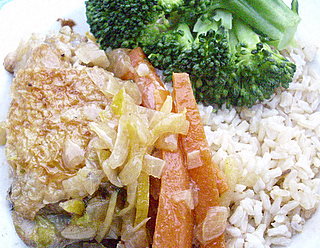
Chicken with carrots, broccoli and brown rice

Isn’t it a treat to be fed? I am always filled with gratitude when someone else cooks. Praise be to Paul for the aromatic chicken he served last night to my sister and me.

The surprise ingredient was the lemon peel which Paul added (after searing the chicken), with the chicken stock, parsley and celery. The peel (and juice) was fresh and tangy, while chilli added an undernote of fiery bite.

My sister and I much admired Paul’s precision and patience for he cut both lemon peel and carrots into long rectangle matchsticks, julienne-style.

We ate in the garden, sitting long after June’s hot sun had faded.

My sister quoted her colleague, Jess, who says: “It’s less rude to say you are a vegetarian than ask whether the meat was happy or battery.”

Paul’s chick was free range, from Sainsbury’s.

I was fascinated by the price issue. Paul had originally wanted four chicken breasts but the cost was not much different from two whole chickens (about £6.50 each).

From two chickens he made the following: teriyaki chicken breasts for four (one breast each); chicken noodle soup from both carcasses; two fried wings for salad; our aromatic chicken (two legs and two thighs). And he still had two legs, two thighs and two wings left over.

But are people put off by butchering a carcass, I pondered? We agreed you need a good pair of scissors and a sharp knife (plus no squeamishness).

Paul was recycling his newspapers and I grabbed the Guardian‘s June 4 supplement before it went to paper-pulp heaven.

Appropriately, G2 (how I love the supplements more than the news) had a review by witty Zoe Williams about the just-released, The Kitchen Revolution.

It’s is all about saving money by not letting the food you buy waste away at the back of your fridge. It is about eating well and saving food miles by cooking from scratch.

In other words it is about reversing the horrors of a junk food culture to return to everything real food lovers care about passionately.

Viva la revoluzione!