Bread to breast

Breastfeeding an infant

Image via Wikipedia

My first blog competition yielded two entrants and both were stunners.

I asked: “food bloggers, what is your favourite real food? Its tastes are enticing but not from a laboratory and it nourishes as nature intended.”

The prize? A DVD of the Austrian documentary, Our Daily Bread. I had organised its London premiere in October 2006 at the Institut Français on behalf of the Soil Association and the Guild of Food Writers. My brilliant colleague, Craig Sams, kindly introduced it. Our Daily Bread records the drama of industrial food production, without comment and with a keen eye for beauty in the wierdest places.

I am sending this DVD to Helen who wrote a superb winning post at her food blog, Haddock in the Kitchen. She brought all the issues in the film to life but with a hopeful spin.

Choosing bread as her favourite real food, Helen, who lives in rural France, explained how the local boulangeries are in danger of dying out and how “the ubiquitous sliced loaf is enjoying an increasingly high profile on supermarket shelves”.

However the country’s lively food culture won’t take this lying down and the French (who have hung on their flour mills unlike the Brits) are taking home-baking to heart: “There are literally mountains of bread machines for sale in every supermarket – with a price to suit every pocket,” writes Helen.

Helen explains how best to use a bread machine; she uses hers to mix and prove the dough, and her beloved Aga to bake it in.

My second entrant is Kate from A Merrier World whose post takes us on an info-packed journey, starting with the importance of play. This is how children learn: with touch and smell and feeling free to be creative. (My favourite way to learn too!).

Kate describes how home-baking provides those early sensory impressions hopefully laying the firm foundation for adult confidence in the kitchen.

I am sending Kate mix. by James McIntosh, the home economist on a mission to get us all cooking again by giving the quantities and instructions needed for everyday recipes.

Taking up my theme of how processed food is laced with cheap additives, Kate tells the story of the dangerous misuse of melamine to make food seem more protein-filled. She ends by reporting on the return to breastfeeding to avoid such contaminants.

Breastfeeding is a powerful example of a natural, real and healthy food that has been replaced by a money-making alternative.

Women are under great pressure not to breastfeed and those complex reasons are analysed in one of my top-favourite book, The Politics of Breastfeeding – when breasts are bad for business, by Gabrielle Palmer.

But then women can also feel under pressure if they want to  breastfeed and it did not work out. So this is no guilt-trip!

Reblog this post [with Zemanta]

Schadenfreude at the Sunshine café

There was a huge outcry when BBC entertainers, Jonathan Ross and Russell Brand, went too far with their overgrown-schoolboy humour.

I confess, I am finding their hubris more entertaining than their shows, hence my schadenfreude-shiver. Why am I so lacking in compassion for these two?

I’ll tell you why: because Ross and Brand are paid huge salaries from taxpayers’ money.

A ridiculous pyramid structure rewards the very few at the very top with obscene amounts of money. Meanwhile many performers of equal talent get overlooked and underpaid.

The BBC turns out excellent programmes that – true to the corporation’s original mission – educate, inform and entertain. Yet over the last few years, their budgets have been slashed.

I drown my sorrows at the Sunshine cafe in Westward Ho! which has a Gaggia coffee machine, is open until 10pm and serves eggs are from a local farmer.

Think how many wonderful performers we could pay with the sums saved from Ross and Brand’s salaries!

Let’s hope the BBC has the guts to do so.

Do you think there’s fresh talent is out there?

Reblog this post [with Zemanta]

BLOG08 – my round up

picture by Jeroen Mirck

BLOG08 had blogging wisdom between the wisecracks.

Loren Feldman gave courage: “Stay true to yourself. Someone is reading you but is too shy to comment.”

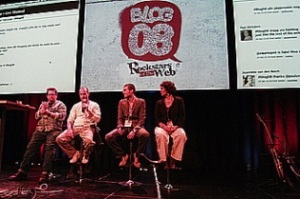
Feldman (second from left) advised: focus on your blog, forget Facebook or Twitter and let people come to you. “You have more juice if people discover you on their own. Let it happen organically and you’ll have a deeper connection with your audience…It’s more respectful.”

Food readers, apologies: this post is blog-jargon heavy.

Feldman “rarely links” because he says it is more valuable to would-be linkees if you have to do a Google search for them (tip given to him by Steve Gillmore). Me, I’m link-crazy, because it’s a reference, a credit – but I get his point. He has no faith in Wikipedia and believes it is a lazy form of journalism. Hmnnnn, food for thought (she says, as she looks up Wikipedia on Wikipedia).

Loren Feldman is an entertainer, going full-tilt at controversy. He says outrageous things (transparency is a con) but, as he puts it, “blogging is showbiz”.

After reading up on Hugh MacLeod (far left), I was inspired to draw cartoons of myself on the back of my bare business cards (done on the train to Amsterdam).

His cute and sharp cartoons formed part of his presentation, and were a great alternative to power point boringness, so that’s another idea I might mercilessly plunder.

I had already read his tips How to be Creative but they were worth hearing again.

These tips starting life as an e-book that were downloaded four million times from his website, convincing publishers he was worth a contract.  Next summer How to be Creative will be published as a book.

His advice suits all artists. He quoted Tim Burton telling him “this creative bug..it will never go away so you might as well get used to it.”

Further Macleod aphorisms: “The more talented the writer, the less they need the props,” and “Stay frugal – the more you need money, the more other people can tell you what to do.” And my favourite: “Savour obscurity.”

Can blogs make money (a recurring conference question)? The general consensus was no. But blogs lead to other things, like Hugh’s book. And anyway, “It’s not about how much money you make, it’s about how much sovereignty you have,” he said.

Sitting next to me in the picture above is Pete Cashmore (second from right), legendary founder of a blog empire yet endearingly unassuming – and reassuring. He said blogs are enduring, and “Once a blog is established – and it takes years – it has a solid foundation”. Twitter is good for marketing but is no substitute for blogs, he said.

Bloggers now have 27/7 news to compete with. Don’t bother, says Cashmore: “Choose a niche that’s small that you can be best at.”

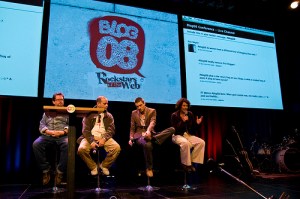
The picture above was kindly taken by Joeren Mirck (see his rocking review) when I thrust my camera into his hands as I accepted my impromptu invite from BLOG08 to join the boys on stage.

Be authentic and don’t copy and paste, said Nalden (not pictured). He answers all comments and, “Create a loyal crowd of daily visitors. People will find you. You’ve got to have swagger,” he said, with swagger a-plenty. He ‘monetises his blog’, (yeah, from audience seeking the holy grail), making money thanks to  investment from a company who saw his product-promotion potential.

BLOG08 was great entertainment, including a Vlogging performance; a band (see guitars in right of picture above); an unicycling internet millionaire with a timely reminder of how everything we write on the web is forever; a lively and interesting media crowd and good vibes. Can’t wait for BLOG09.

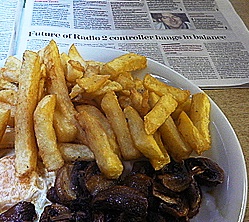
For £125 return, I travelled London-Amsterdam by train and boat, saving money on hotel rooms with two overnight crossings in my own restful cabin. I left Amsterdam at 7pm (continental time) last night and returned in time for organic Sunday lunch (below) at the Prince of Wales pub in Bristol.

I came back with two questions left unanswered.

What’s the best way to save a blog’s content?

And how can I encourage people who read my blog to make a comment?

Can you tell me?

Blog08 and the importance of self-expression

http://www.annehelmond.nl/2008/10/24/the-crowd-interviews-and-the-endless-debate-of-journalism-versus-blogging

That’s me in the spotlight, holding the mike. How did I end up on stage at Blog08?

Great conference, lively, entertaining and informative – but why were all the speakers, except for one, male?

It’s a fair question and one I could not help voicing. So, when charismatic compere, Patrick de Laive, introduced the afternoon panel, I asked from the floor (front row): “More guys?”

And got me a spontaneous invite to join the boys on stage.

It was a blogging moment. Express yourself – you never know who is listening and where it will lead.

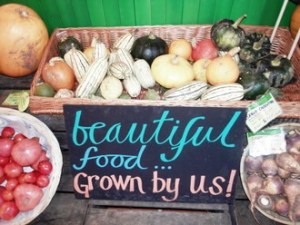
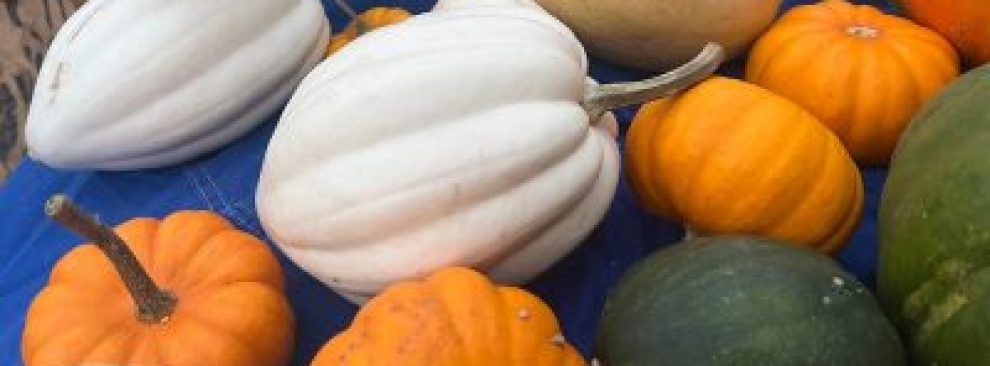
Beautiful food grown by us

The inspiration for this blog is manifold.

It owes its line-length to skinny writing

and the vegetables in the picture

to the organic Better Food Company

where I shop, happily, in Bristol.

I also want to multi-dedicate this post

to the planet’s coolest conference, Blog08

and the winner of my first blog competition.

More soon.

And please leave me a comment!

Jamie Oliver – the real thing

I once sat in a room with Jamie Oliver for two and a half hours as he gave five interviews on the trot to the Scottish media. Whether explaining his passion for organic food to a reporter, or pacing the small room in-between bouts, Jamie seemed comfortably himself.

It was 2004, and Jamie hinted his next step was to do something with school meals. I escorted him through the university building where the Soil Association was holding its annual conference (stop press: our next conference is in Bristol this coming November). As he passed the book stall, Jamie bought twenty pounds worth of books on organic farming. We shook hands and I have to report – this guy is for real. He exudes natural warmth and spontaneity.

Now he is on television teaching Rotherham how to cook. And I love him.

The TV show tonight could not have packed-in more touching scenes. Julie used to live on crisps and chocolate – now she cooks healthy fresh dinners. The miner who found food teaches fellow miners how to stir-fry. Stereotypes fall away. So-called feckless single mothers and ‘real’ men, the stuff of tabloid headlines, absorb Jamie’s lessons – eager to learn, brimming with untapped talents.

Jamie takes his inspiration from the wartime Ministry of Food – Marguerite Patten reminds Jamie “the Ministry never lectured…cooking has to be pleasurable.” Wise advice but pity we have to wait for a disaster to get people changing their behaviour.

Such as the obesity crisis that Jamie graphically illustrates when he drops by the hospital to see Julie’s scan (and the baby she might call after him). There is a hoist and equipment that costs £60,000 to help care for extremely obese people. Clinically-fat people who do not need to suffer if – as the NHS medics insist – they had learnt to cook from scratch from the start.

Jamie gets a thousand people together in one go for a mass cook-in. He is working on the theory of passing it on. If I learn a recipe and pass it on to five people then – do the maths. I marvel at the cheffy dishes he chooses for people who have never cooked before: flattening chicken breasts pressed with parma ham.  His chief ingredients are chilli, ginger and garlic to get everything tasty – top tips to pass on.

His Rotherham experiment is part of revolution, with cooks as guerilla fighters in the war against junk food.

[I changed ‘part of’ from ‘beginning of’ following Sarah Beattie‘s comment because she‘s right: there’s unseen work going on, which is precariously-funded.]

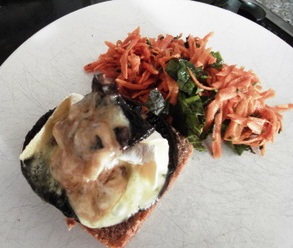
My recipe: I put flat mushrooms with slivered garlic under a grill, brushed them with olive oil top and bottom so they would not burn. When they had softened, I added a slice or two of camembert cheese that took five minutes to melt. I piled the mushrooms on wholemeal toast and served them with grated carrots and mustard leaves snipped from my potted salad plants.

I hope Jamie would be proud of me.

Reblog this post [with Zemanta]

Meeting Gordon Brown

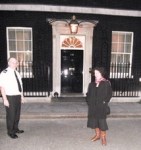
Last week I left my cosy brown rice world (centre) for that of Gordon Brown’s (right pic). An invite from the prime minister was hard to resist. I was not alone. A hundred other members of the British Society of Magazine Editors turned up at number 10 Downing Street for the reception.

The prime minister’s short talk featured self-deprecating anecdotes.

I’d heard him tell some before at a previous reception also organised by the society.

April 2007. After his talk, Gordon Brown, then-chancellor, went on a fifteen-minute steered-mingle round the packed reception room. I introduced myself.

“Elisabeth Winkler from the Soil Association. We were disappointed you did not include agriculture in your green budget.”

I explained how organic farming reduces farming’s carbon footprint because it bans the use of oil-guzzling artificial fertiliser.

He changed the subject by commenting on the growth of farmers’ markets. I furnished him with a figure: farmers’ markets now number over 500. He nodded, echoing the stat.

The trick in these conversations is not to wait for Gordon to give encouraging nods and smiles. You have to deliver your message regardless.

Fast forward to last week – I failed to listen to my own advice. I only got to press his flesh and give my name and rank.

I really wanted to say: if you want an easy win, Gordon, forget GM. It’s uneconomical for farmers and unpopular with the British public.

But I fell under his spell and let him pass.  Listen, I can’t be superwoman all the time.

In his talk, Gordon Brown’s only mention of the current financial crisis was to tell us to blame the Treasury if we did not like the wine (joke). Despite the prime minister’s unwillingness to engage in the topic – and William Green, editor of Time Europe, tried hard enough – the credit crunch cropped up in every other conversation I had.

Several editors asked me if the recession would affect organic farming’s future.

I said organic farming sales had not faltered in the last recession; indeed Green & Black’s organic chocolate launched during that dire time.

And another thing, I continued, food prices are linked to oil. The price of organic food has the potential to become lower than non-organic food because organic farming uses less energy than non-organic farming.

Then I skedaddled down the road to Central Hall, Westminster, where the Soil Association’s new president, Monty Don, was giving the charity’s annual lecture in memory of its 1946 founder, Lady Eve Balfour.

Lady Eve was a cool cat who believed in caring for Mother Earth. She set about proving organic farming is better for the soil than agrichemicals. Food should be eaten as close to its source as possible, she said. Way to go.

Monty Don encouraged us to become organic vegetable gardeners. You can’t get more local than that.

Afterwards, in the Soil Association reception (organic wine, this time) several growers expressed concern that Monty’s message undervalues their skills. It’s the opposite for me: trying (failing) to grow veg has made me value the farmers more than ever.

Monty Don has reservations about the word organic, calling it “an albatross”. He is good with words (I headhunted him for Living Earth, the Soil Association magazine). Later I found myself at the bar with Monty and his wife Sarah. I said: “It’s not the word that’s the problem but the bad press associated with it. Like feminism,” I added (as a feminist).

Monty said the word ‘organic’ can make people feel guilty.

Is organic a good or bad word?

Reblog this post [with Zemanta]

GM? No way, no thanks

First, an advert for healthy eating brought to you by Earthmother productions. Worried about your health? Eat organic and for colour! Nature has kindly colour-coordinated its plant nutrients so you can mix-and-match. Step forward orange carotenoids for vitamin A production and purple and deeply-green antioxidants for cell-restoration.

If the veg is organic you get more antioxidants for your money. Here’s why: if you spray a plant with pesticides (which is how most western food is grown), then its ability to produce antioxidants is decreased. Antioxidants are the fighting army that protect a plant from pests and there are more in organic food because the organic plant gets to keep its antioxidant army. Fade on ad.

And the UK government wants to re-open the GM debate! Crikey, as if we don’t have enough to contend with just trying to grow a few unsprayed organic veg.

GM crops are modified in a lab to tolerate a herbicide (weed killer) or produce an insecticide (insect killer). Farmers have to buy the GM seed and the proprietary pesticide (umbrella term for herbicide, insecticide and fungicide).

If GM seeds or pollen arrive accidentally on a field, GM companies can sue farmers for patent-infringement. California voted to protect farmers against such lawsuits in August. It’s more fair if the polluter-company pays for GM contamination, as the Welsh Assembly government proposes – and not the hapless farmer.

The pro-GM marketing spin says GM can feed the world – how selfish of me to stop a technology that saves the hungry! But it’s a lie. There are no GM crops designed to help the poor. The current GM crops are engineered for insect and weed-spraying – not to improve yields, vitamin A, drought-prevention or any of the other mythical scenarios dreamed up by well-meaning but misguided press officers.

The (so-called) environment minister, Phil Woolas, said people like me have a year to prove GM is unsafe.

A body of evidence is growing; the ill-health effects on animals is well-documented. But the fact is the science has not been done. Commercial planting of GM especially in the US has pushed ahead regardless.  Listen, there has only been one trial published worldwide on humans eating GM food. And that showed worrying results.

I think we need more science on the health effects of GM.

And, Woolas – it’s not up to me to provide it.

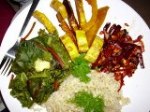
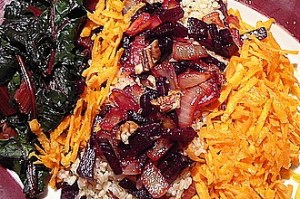
On a gentler note: the ingredients for supper came from Better Food organic supermarket, which also grew the organic veg 12 miles away. The chard was steamed, the carrots grated and the beetroot, cut very small, was – new discovery – pan-fried in olive oil for 20 minutes with sliced onion. Served on a bed of brown rice; 1 mug of rice to 2 mugs of water, simmered for 30 minutes – enough for two, and a rice salad the next day.

Baked apples

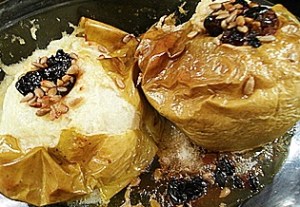
I searched my trusty cookery books but in the end only Mrs Beeton’s yielded a recipe for baked apples. I customised it, omitting sugar, and used chopped-up organic dates and prunes plus sultanas and sunflower seeds to stuff the de-cored apples. I dotted butter on top, and placed the stuffed unpeeled apples in an ovenproof dish with a thumbnail of water and baked it for an hour at Gas mark 4 (180 degrees).

They emerged from the oven, fluffed-up apple-flesh bursting from their heat-withered skin. Hmmmm, worthy contenders for a competition, methinks…

My apples were organic, natch, because I didn’t fancy the cocktail of factory-made pesticides sprayed on most apples.

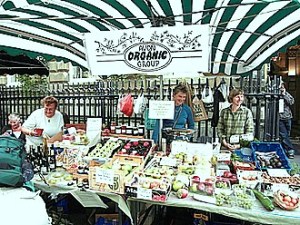
I had bought my big fat organic cooking apples at Bristol Farmers’ Market from the stall of the wondrous Avon Organic Group (below). I say wondrous because it is a voluntary group that helps maintain a local organic orchard and allotments in the city. Where would we be without such dedication?

It’s Apple day on October 21. I keep noticing the little darlings ripening on trees in the stillness of autumn.

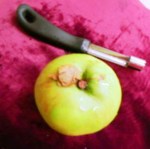
If you love baked apples, and you ever come across an apple-corer, do not hesitate. Just buy it. A corer costs a few pounds and will be your lifelong-kitchen friend even if you only use it once a year.

I value mine so much, I photographed it on a velvet cushion (see below).

PS Emboldened by Antonia’s invite (see comments), I hereby enter the humble apples into their second competition at Food Glorious Food, organised in aid of British Food Fortnight.

Bread and organic ghee

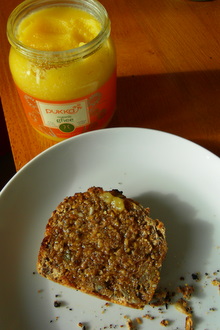
This morning’s breakfast: toast from Hobbs House Bakery and organic ghee from Pukka, both bought at the Soil Association’s Organic Food Festival this weekend.

I have wanted to buy ghee for months – it’s a healthy fat that can be used at high temperatures without burning. But I have been deterred by the ingredients list. This ghee, however, has nothing in it but clarified butter from organic milk.

I have pledged to eat unpackaged local and organic during Organic Fortnight. As this is impossible, I Ask Questions instead.

“Why is the organic ghee from Austria ?” I sternly ask Pukka’s Helena Kowalski. Turns out Pukka works with an Austrian farmer who specialises in making ghee on his small farm. Perhaps this is a new way for west country organic farmers to add value to their milk?

My breakfast toast is from Hobbs House Bakery in Bath – local points there. The Hobbs people (see their colourful stall below) were jubilant about their win at the Soil Association organic food awards on Friday. So they should be – their bread is so damn delicious, I was heartbroken when I ate my last slice an hour ago.

The whole mood of the Organic Food Festival was buzzy and warm. It’s a wonderful feeling to be involved in something which does the planet good. And is successful.

At the festival’s launch, Barny Haughton from sustainable gastro-paradise restaurant, Bordeaux Quay, said business had never been so good.

The recent food price rises are linked to the price of oil. The lynchpin of industrial farming is factory-made fertiliser, a process that relies entirely on burning oil.

In contrast organic farmers fertilise their fields naturally, courtesy of the sun, by using crop rotations, nitrogen-fixing clover and composting. As oil prices rise, organic farming becomes more profitable.

In an oil-depleted world, local organic is the future. Common sense, don’t you agree?