
Time to transition – now

French film crew for Transition film

Last Sunday, the doorbell rung. Turned out to be a French camera crew wanting to film the allotments from our flats. I was the only one in our block who had answered the buzzer.

“Entrez,” I said. It was a random meeting but I recognised fellow media-types.

When the director came into my flat, I noticed he had a copy of The Spark under his arm.

“Tiens, voila,” I said, and introduced myself as its guest editor for the summer 2009 issue.

I gave him a copy of The Source, explaining I was now its food editor. (Never one to hold back on networking opportunities, moi. Even on Sunday morning).

He laughed. “I have just been reading that.”

He said he had really liked our features on local food:

Rachel Fleming’s take on UK food security policy and my review of Local Food, the great new practical action book by Tamzin Pinkerton and Transition co-founder Rob Hopkins.

Guess what? It turned out Nils Aguilar, the director, and his cameraman, Jérôme Polidor, were filming a movie on Transition. People in France are asking: how shall we eat when the oil runs out? Industrial food production relies on oil-based chemical fertilisers and long-distance transport.

The film is to introduce la belle France to Transition, the vibrant international green movement.  Transition encourages practical grassroot local solutions NOW – rather than waiting for the proverbial sh*t to hit fan – and works with existing green groups to achieve it.

Fortuitously, I had just seen the movie In Transition, premiered by Sustainable Redland. I liked it because it shows an amazing range of sustainable projects for food, transport etc which are already up-and-running.

The director agreed: good to be positive.

I had seen The Age of Stupid the previous Sunday at Coed Hills festival in Wales. The human stories were heart-breaking but seemed to link more in my mind to the destruction caused by oil wars and pollution rather than climate change. I can connect them in my head but not in my heart.  (Al Gore’s An Inconvenient Truth woke many up but made me go to sleep – all those graphs).

Is it because – despite my green beliefs – I am in denial too?

What I am trying to say is my meagre grasp of the science does not affect my drive to save the planet.

It is common sense to save our precious non-renewable resources and reduce CO2 emissions to stop the ice caps melting – to search for another way of living.

To paraphrase a comment on George Monbiot’s post about climate change denial:

If you believe in climate change, you end up living in a just and caring world. If you don’t believe in climate change, it’s business as usual: exploitation, pollution, disease and oil wars.

Or as climate change campaigner George Marshall says: the facts are not enough to effect change. You need belief too.

Stop press: I just read a comment on the Transition blog from a woman in Wales whose spring is running dry for the first time in over a hundred years.

Climate change is not an intellectual debate.

Wake up. We need to wake up.

Coed Hills magic and more hemp

Wind turbine Coed Hills ++

What is it about living outdoors that feels so good?

Last weekend I was camping on a Welsh hill outside Cardiff.

End of September autumn solstice and time for a mini-festival at Coed Hills, the off-the-grid 20-strong arts community.

A fine excuse to live outdoors in a festive atmosphere with 200 other people with similar interests: music, healing, eco-education, meditation and other forms of consciousness-raising and eating delicious healthy mostly organic vegetarian food.

Coed meal after sauna

I went to some great talks including from BBC5.tv, saw The Age of Stupid, and gave two writing workshops myself, sitting in a yurt with talented students.

And followed the art trail in the 100-acre woods.

Indian summer autumn light but unseasonable climate-change warmth.

Being close to nature seems to open my heart. It hurts to take stock of our wasteful world.

But here at Coed Hills, people are living the dream, putting planet-saving sustainable ideas into action.

I loved the compost loos where poo is not flushed away to join our water supply but will go to feed the soil, and the willow reed beds that clean the site’s waste water.

Inspiringly, the site runs on sustainable energy including the wind turbine (see pic above) that presides over us.

Festivals are green networking cities – if not synchroni-cities.

Or just good timing.

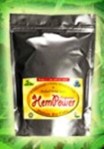
Before leaving, I don my hat as hemp ambassadress and present a packet of Amaru Hempower porridge to the Coed community.

Richard, the cook from Lost Horizons, and Coed communard, says I must meet Derek.

Soon – in festival-chaos style – I am sitting next to Derek Bielby, hemp consultant, on a deckchair in front of an open fire between the wooden sauna and a teepee.

Hemp keeps crossing my path, first at Shambala and then at The Organic Food Festival.

Incredibly nutritious, hemp is also perfectly suited to the UK climate.

Fast-growing , it is ready for harvest after 100-days of growth – and good for the land.

Hemp is super-sustainable – growing hemp for paper gives four times the yield than trees, Derek told me.

It also has many uses including for eco-building, paper and textiles.

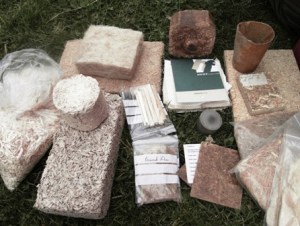
As Derek showed me:

The many uses of hemp

1. In the plastic bag on the left: the woody chips, or hurd.

2.The thing that looks like a round goat’s cheese? That, and the fibrous block it sits on, is hempcrete.

Forget the C02 criminal of the building world – use hempcrete instead.

3. Above are squares of hemp felt, a natural fibre. No more toxic fibres when you insulate a roof.

4. Next to the hemp felt, a ‘log’ of hemp waste for burning – this could be used to power the on-farm hemp-processing machine, or primary processor. Talk about sustainable.

5. ‘Woodchip’ made from hemp with a garden pot made of hemp. Plus boards of resin, also made from hemp. And swatches of hemp fabric.

I did not want to leave the magical world of Coed (pronounced coid, Welsh for wood ) where you live outdoors, treading the ground unmediated by cement,  and lit at night by fires and candlelight.

But I did.

Reblog this post [with Zemanta]

Hemp porridge and membrillo

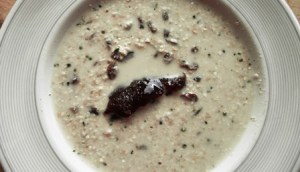
Amaru hemp porridge with membrillo

Above pic represents synchronicity and sustainability  – and a comforting, tasty and easy-peasy way to get top nutrition. Just add water…

I also dolloped on membrillo – recipe below. It’s nice with something a bit sweet such as sultanas.

Synchronicity: I went to Shambala and got so turned on by hemp porridge, it became the subject of my last post.

Two weeks later, I am at The Organic Food Festival – the after-festival party to be precise at Berwick Lodge, Christopher Wicks’ new fab place – when I find myself talking to what turns out to be:

Rebekah Shaman, founder and director of Amaru Hemp.

Oooooh, I like Rebekah. Right from the start, she plunges me into different worlds with her words for instance about her time as The Shaman’s Last Apprentice in the Amazon.

She also gives me the lowdown on the nutritional powers of hemp:

  • 19% protein (meat is 30%)
  • easily absorbed globular protein (must find out what globular means)
  • every known omega, with omega 3 and 6 ideally balanced
  • every known amino acid
  • every known essential fatty acid.

One conversation leads to another and soon we realise we were linked in a myriad of different ways, culturally, socially etc.

I am taking this seriously (in an excited way): Amaru organic Hempower and me may have some work to do together in the future. Watch this space.

As for The Organic Food Festival 2009 – wow. Hot brilliant sunshine, old friends, new friends, people trading in a wholesome, future-proof, sustainable ventures – no wonder the atmosphere was elated and connections were buzzing.

I was on The Source stall with my darling editor, Dr Rachel Fleming. We shared it with the renewable energy specialists, Kaieteur, and organic soap makers, Flo and Us, both from Sidmouth.

Also sharing our marquee was James Bond (yes, that is his name) of the Avon Organic Group – his organic damsons were a talking/ tasting point for the crowds.

James Bond, Avon Organic Group at The Source stall

James gave me some beautiful quince, and this week I made membrillo for the first time, with a recipe from the Avon Organic Group. Here it is (+ my comments).

1. Quarter quince, leaving core, skin, pips intact. Add just enough water for quince to float. Simmer 1 hour or more, or until it reduces to a smooth pulp.

2. Sieve to remove pips and skin.

I am afraid I got fed up of unsatisfactory sieving (and it was midnight when I started). So I blended the whole lot, skin, pips and all. As a result it did not have that pale pink translucency of traditional membrillo – but it packed more of a nutritional punch and tasted richer and denser. (And was less fiddly).

Making membrillo 1

3. Add sugar to equal weight of sieved pulp, or at least 3/4 of weight.

Not being a sugar-freak, I used 1lb 6oz rapadura sugar to 1lb 12oz of fruit. Apologies for imperial measures – this often happens when I cook.

4. Simmer for 1-2 hours or until it has reduced to a thick pulp and darkened considerably. Stir to avoid sticking.

I stirred non-stop for 1 hour, getting spattered with boiling jam when I stopped. Wear an apron!

Making membrillo 2

5. Pour into greased or non-stick baking pan to a depth of 1-1.5 inches.

6. Bake in a low oven (140c) for about 1 hour.

7. It should set to a firm paste. Cool and cut into bite-sized squares.

Mine set to a kind of thick jam.

And it goes really well with hemp porridge.

Stop press: Amaru co-director Carlo Dawson agrees to take Brixton Transition Town pound.

HemPower pic 448 X 336

Reblog this post [with Zemanta]

Hemp porridge knowledge

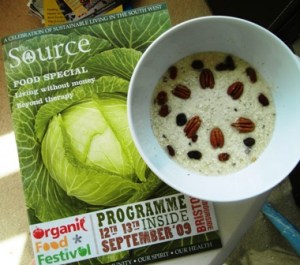
Hemp porridge and The Source (small)

I went to Shambala festival and got turned on by hemp. Every morning I would emerge from my tent to tramp across a field for hemp porridge breakfast.

Its creator, Eddie Callen, told me how he makes it: mixes it 50/50 with oats, by grinding 1/4 of the oats with all the hemp seeds, from Yorkshire Hemp. Once emulsified with the seed oil, the rest of the oats grind-in easily. Then water, hot or cold, to make the porridge, and a host of sprinkles: nuts, goji berries, agave syrup, cranberries, for taste and nutrition.

(I used pecan nuts and sultanas for my hemp breakfast back-home, see pic above).

A fount of hemp-knowledge, Eddie told me how hemp can grow abundantly in the UK without pesticides and fertilisers.

Hemp plants are so productive too: omega 3-rich seeds, and textiles, rope and paper. More sustainable than paper from trees – and cheaper.

We want hemp! ‘Tis the the earth’s most sustainable material.

Although hemp belongs to the same plant family as cannabis it has NONE of its mind-altering properties. It got a bad rap all the same and got outlawed in the 1930s but now it’s legal to grow although most UK hemp ends up as animal bedding.

Hemp-evangelist Eddie Callen was cheffing for the Community Medical Herbalists.

I had gone to see one, John E. Smith, for some remedies and it was he had told me about Eddie’s hemp-prowess.

Festivals are like that – it’s green networking city. I bumped into colleagues, past and present, as well as the legendary Simon Fairlie, editor of The Land. Its summer issue focuses on the  enclosures of Britain’s commons – historical events I have long been fascinated by as I see the roots of our present-day ills in the past.

People’s right to grow food or forage was taken away by force or legal stealth from approx from 1300s to end-18th century. Just as indigeneous people are deprived of their land today.

O I am in the mood for digression. Last night I saw Winstanley, an amazing film. Set in 1647, shot in black and white, British weather featured strongly, with only a camp fire and thatched tents to protect the Diggers from the incessant dripping rain. (As a recent camper, I identified).

Gerrard Winstanley wrote: the earth was “a Common Treasury for all”. He tried to reclaim the top of a hill in Surrey with his fellow Diggers but was beaten by the establishment.

I read about Gerrard (am on first name-terms as he is new hero) in the Land and talking about magazines, note my pic above and the latest issue of The Source.

I am SO proud to be writing for The Source, the southwest’s great green magazine.

In this issue, The Source reviews the new Transition book, Local Food, and asks:

What will we eat when the oil runs out?

The answer is green, local, organic, healthy food…and hey – this means the freshest tastes too. Talk about win-win-win-win solutions.

The Source also carries the programme for The Organic Food Festival, taking place THIS weekend in Bristol.

Organic is farming for a green future.

I am with the Shambala witches on this one.

Da witches have no Plan B (2)

GM feeds world? Don’t fall for spin

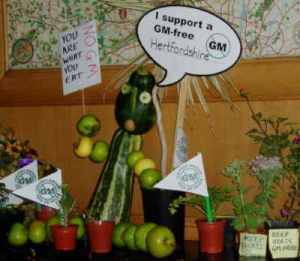
marrowman

Did you see yesterday’s print supplement to the Guardian?

Titled Agriculture, produced by the Lyonsdown media group, it was basically a huge advert for intensive farming.

Including promoting the use of GM crops in Africa.

Warning!  Spin-alert!

Don’t fall for the propaganda even if (especially if!) it comes with an ever-so-liberal paper such as the Guardian.

It is blatantly calculated to appeal to caring Guardian-reader types.

What makes me so cross is the way Africa is used in the sales talk.

Let us get one thing straight.

There is NO GM crop being grown commercially that improves yield. The only ones being grown are designed to make intensive farming tidier.

Currently, GM plants are engineered to be resistent to pesticide-spraying.  This means when a farm sprays the field, the GM crops won’t die.

How this is supposed to help a farmer in Africa?

All it does is increase dependency on agrichemical companies. The farmers have to buy the GM seed (which cannot be saved) AND the pesticides to go with it AND the licence to use it all.

One of the authors is Professor Derek Burke known as the godfather of biotech.

He writes how organic farmers are a “wealthy lobby group” preventing GM progress.

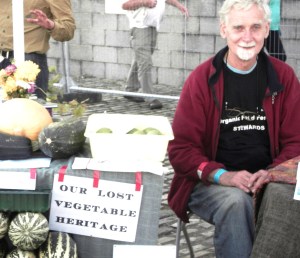
– see pic above for evidence of  “wealthy lobby group”.

So, according to the professor, a section representing 2% 0f the UK food industry, and made up of mainly small family farms, is the only thing holding back GM world domination?

No mention of the European public which does not want GM.

No mention of the African farmers who do not want GM.

And strangely, no mention of the marketing budget of  agrichemical corporations such as Monsanto and Bayer which are aggressively pushing their risky, unproven GM technology.

I wonder what the marketing-spend is on a supplement such as the one in the Guardian?

I can’t imagine a GM company is short of a bob or two for its PR war.

FSA wastes my money on rubbish organic research

Preparing for pesticide application.
Image via Wikipedia

The UK government food watchdog, the Food Standards Agency, has published a new report on organic food.

“Let’s stop this tomfoolery once-and-for-all about organic food being better for you,” seems to be the subtext.

In its attempts to convince us we are wrong to trust our senses (including common sense and sense of taste), the Food Standards Agency has had to undertake some mind-bending contortions. See for yourself – the actual report is here.

The Food Standards Agency (FSA) claims to have conducted an exhaustive review of all the literature comparing organic and non-organic produce in the last 50 years.

Its review of 162 studies seems rather meagre compared to the Soil Association‘s 2001 review by Shane Heaton of over 400 studies.

Perhaps the FSA managed to keep its numbers low by omitting studies. It conveniently left out:

  • studies on contaminants such as pesticide residues (see pic)
  • studies examining the environmental benefits of organic farming
  • results of a major European Union-funded study involving 31 research and university institutes and the publication of more than 100 scientific papers earlier this year.

Professor Carlo Leifert, who conducted the above EU-study, which found organic milk is way-much better for you than non-organic milk, remarked:

“With these literature reviews you can influence the outcome by the way that you select the papers that you use for your meta-analysis…My feeling – and quite a lot of people think this – is that this is probably the study that delivers what the FSA wanted as an outcome.”

The FSA could find only eleven studies that fitted its meta-criteria.

Hello?

I am no scientist, but since when was eleven a big-enough sample to draw conclusions?

The fact is we need more research on the nutritional differences.

But I don’t want my tax spent on a biased analysis.

The FSA has a reputation for being hysterically anti-organic and pro-GM.

This report is making me think its rep is live and kickin’ again.

Addendum 19 September 2009

Reblog this post [with Zemanta]My understanding of this report continues to grow.
Let me share my findings: the FSA report DID show higher levels of key nutrients in organic food in some of the data.
The London School of Hygiene and Tropical Medicine carried out the survey (goodness knows why)
rejected the findings because the samples did not meet its criteria.
If you add the samples together, the results would show organic food does have more nutrients.
Crikey – complicated, eh?
It’s the deceptions and obfuscations which make things hard to understand.
I always say: the truth is simple.

Slipped disc – natural healing

annotated diagram of preconditions for Anterio...

Image via Wikipedia

I am interrupting this food blog to share some useful information: natural healing methods for a slipped disc.

In 2006, I had a slipped disc and although surgery looked on the cards, I recovered naturally. Later, when I was better, I was told by my consultant physiotherapist, that “90% recover naturally”. Wish someone had told me that before.

Today in 2018: This has proved one of my popular blog posts. Although I have had no recurrence, I continue to care for my back daily with the tips below to alleviate pain and promote healing. I also add to the tips as time goes on.

Tips for natural healing of slipped disc

  • Find a healer who believes nature heals and whom you trust. Try several until you find the one who suits you and your condition.
  • The trick is to break the pain/tension/inflammation cycle by relaxing tense muscles and lessening pressure on the nerves. Breathe as if in labour to relax: out through the mouth, in through the nose. Relaxation relieves pain.
  • Immerse in a warm bath with Epsom Salts for at least 15 minutes – the heat will help relaxation. “Epsom salt is absorbed through the skin and will help replenish magnesium stores,” says Dr. Northrup on US Epsom Salt Council.
  • Let gravity be your ally.  Lie down in the Alexander Technique’s semi-supine position (spine flat, knees bent, feet flat and head slightly raised on a pillow) at regular intervals. This position allows the spine to elongate and relax.
  • Stay mobile. Walk, swim or dance. Practice gentle yoga, Pilates or T’ai chi. Avoid positions that increase discomfort such as sitting down on a chair.
  • Before even considering surgery, look at your footwear. I could write a thesis on the tragedy of women’s shoes which only for care for looks – not comfort. The holy grail is a stylish shoe that also supports arches and ankles. I recommend FitFlops – sign up with an email address for regular offers on less popular designs (I got great ankle boots for £30). AS FitFlop has got more successful, it has added a bewildering amount of styles. So make sure the style fits your width – for my slightly wide feet, I choose Microwobbleboard or Anatomicush.
  • How is your bed? Again, before even contemplating surgery, sort out your resting place. I would rather (and I have done) sleep on the floor than on a too soft or unsupporting mattress.
  • Use heat. My best friend was an electric heat-pad (like a mini-electric blanket) for the small of my back when lying down in the semi-supine position.
  • Drink water regularly to plump up those discs.
  • Eat foods with anti-inflammatory ingredients such as turmeric – add turmeric root or ground turmeric to savoury dishes. Or try the Ayurvedic recipe, Golden Milk, a comforting drink of heated milk with turmeric with black pepper which increases the bio-availability of turmeric‘s active ingredient, curcumin. If using plant milk, instead of cow’s milk, add coconut oil – the fat in oil or milk also boosts the bio-availability of curcumin.
  • Use a ginger compress to soften and relax the traumatised tissues. T’ai chi master and massager, Pete Glenn, insisted I use it daily and he was right. This traditional Chinese remedy sounds so simple – but it works. Try it for back or neck pain and be amazed by its effectiveness!

Ginger poultice

1 oz ground ginger simmered for 20 minutes in 1 pint of water.

Let the sludge cool slightly and immerse a flannel. Squeeze out the flannel and apply to the affected part of your spine. Either repeat at regular intervals OR do lazy version: cover the flannel with a plastic bag to contain the drips and wrap the whole lot with a long scarf or towel to keep it in place.

Ginger is hot to eat and aids digestion because it dilates the blood vessels – applied externally it has a similar, and penetrative, effect.

Long after the flannel has cooled down, you will feel the WARMTH of the ginger, doing its zingy thing.

If you do nothing, make and apply a ginger poultice, put on some calming music and lie down in the semi-supine position – now!

Reblog this post [with Zemanta]

Good intentions at Buddhafield

Bahji seller, Buddhafield

Buddhafield Festival boasted fast food: the best onion bhajis I have ever tasted.

Nutritious – made with gram (chick pea) flour, spices of fennel, ajwain and mustard seed, and – here is the miracle – ungreasy. Generous and sustaining, only £1.

The maker was Fish, another fascinating character; makes shamanic drums from deer skin.

Here was another fast food staple from the cafe near the Dance Tent.

Soup with momo dumpling

Stuffed with chunks of fresh vegetables including sweet potato and leeks, with olives for taste and butter beans for protein, and for an extra £1 a beautiful delicate stuffed Tibetan dumpling called a momo, bringing this princely dish to £5.

There was a fire outside the cafe. On the Friday night, I had a good chat with a lovely young woman from Sheffield.

The next night we bumped into each other again. One thing led to another until she said:

She said: “You remind me of someone  know – you have similar energy….Moira”

What? My mate from Somerset who moved to Wales.

Then it all fell into place. Her parents had come to my ante natal classes over 20 years ago. “Omigod!” I said, “I knew you as a baby!” and I could remember her baby dark eyebrows and eyes there in her young woman’s face.

I take issue with that old saying: “The path to Hell is paved with good intentions”

The organisers of Buddhafield set good intentions for the festival. And much good manifested, I am sure, as a result.

Setting an intention can guide you like a compass.

On day one of the festival, a kind stranger lent us his spare sleeping bag.

When we could not find him to return it, I randomly asked his ex-tent’s neighbour:

“You don’t need a sleeping bag, do you?”

“I have not got one! Thank you!” he said.

May that sleeping bag go on to give night-warmth to whomsoever shall needeth it.

MSG-free food leads to love

Pacific island soup

It rained on Buddhafield festival but I was dry and warm in the Lost Horizons travelling cafe.

My kitchen fairy-duties: cut courgettes at slivered angles, trim broccoli from woody stalks, grate organic ginger (unpeeled) and lemon zest for Pacific Island soup, above.

Brought up in New Zealand, Richard the chef was inspired by his feminist mother leaving most of the cooking to his stepfather.

As I prepped, I learnt. Here for me to remember (and to share) are Richard’s tips:

  • Cleaning a rusty wok: heat dry wok till rust pops, add a little water then heat till it evaporates. Dry wok. Add two palmfuls of salt, heat, then wipe away the dirty salt with its abrasive and oxydising action. Next, add salt and water, and heat till it has nearly evaporated. This time the salt is clean and can stay, adding flavour to your dish.
  • Cooking kidney beans: soak for a minimum of 16 hours then cook until beans dissolve like mash potato. A monocotyledon such as corn added to the cooking increases the kidney bean’s protein-availability. “In Bogota in Columbia,” said Tim, a fellow Lost Horizons cook, “we cooked kidney beans with plantain into a mush and served it with ground coriander.”
  • Monosodium Glutamate (MSG), as we know, is the nicotine of food. Addictive and a health-risk (banned from the start from EU organic standards), it bypasses the taste buds straight to the brain. Richard added a new idea: MSG destroys the part of the brain that makes us compassionate.

No MSG at Buddhafield Festival. So we could go around being kind and hug-gy.

Lunch was ready.

Lost Horizons lunchtime

Gwennie, the Washing-up Angel, is in the foreground (There  some discussion about the differing job descriptions between angels and kitchen fairies…)

I ate my well-earned soup listening to the open, engaging Janna Goodwille.

Janna Goodwille

Janna Goodwille (her real name) sang memorable songs with riveting lyrics. Her new album used sustainable waterless printing for its cover, and was recorded at the UK’s first solar-powered studio.

Pacific Island soup ingredients:

Onion + water + Thai red curry paste or Thai spices if available + dried seaweed + seasonal veg (cook what is hardest and biggest like carrot-chunks with slivered courgette last of all) + grated ginger + lemon zest + noodles.

Richard also sawed a coconut in half and chunked out bits for the soup.

All for £5 with fresh organic salad and bread. And leaves compassion-brain-cells intact.

Lunch board, Lost Horizons

Reblog this post [with Zemanta]

Kitchen fairy at Lost Horizons

backstage at Lost Horizons with yogurt

I went to Buddhafield festival and became a kitchen fairy.

I was sitting in a Bedouin tent, as one does, listening to Martha Tilston on stage at Lost Horizons, the legendary travelling café and wood-burning (mostly naked) sauna.

I heard a cry above the music:

“Can someone stir the milk? In exchange for a chai.

Can someone stir the milk?”

“I can stir the milk,” I said.

In the field kitchen, backstage at Lost Horizons, a wooden spoon in hand, I stirred a cauldron of milk coming to the boil.

A dramatic creature with blonde curls, tight trousers and a rocker’s face appeared.

“Turn it off when it comes to the boil. Do you know when it’s cool enough to add the yogurt?” he asked.

“You say Hare krishna hare krishna krishna krishna hare hare hare rama hare rama rama rama hare hare,” he said at such speed and with such authentic inflections that I did not recognise it.

He turned out to be the legendary and talented artiste, Prana, from the Bindoo Babas.

But I got the gist, and the yogurt got made ready to set

albeit with Nyam myo renge kyo a chant I do remember.

I also did loads of washing up.

The combination of working outdoors as the rain bounced off the canvas and being part of a crew gave me unusual washing-up energy.

My reward was a bowl of spicy hearty aduki bean soup with mostly organic ingredients cooked by Richard, the chef.

Richard, Lost Horizons kitchen chef

“Aduki and mung beans are the only ones that don’t need soaking,” he said.

I noticed a chalkboard sign calling for kitchen fairies.

I arranged to come back the next day.

Reblog this post [with Zemanta]