Christmas 2009 – how was yours?

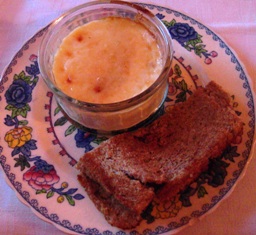
Christmas lunch. First course: parmesan custard with anchovy toast, recipe from Café Anglais, executed by my niece, Charlotte.

There was a time when my mother, Fay, good Jewish mother that she is, would insist on cooking every morsel of Christmas fare.

Finally we managed to persuade her we were old enough to take over.

Now we share the cooking.

My sister, Geraldine, cooked the goose reared by wise animal welfare expert, Sheepdrove Organic Farm, which has a shop in Bristol.
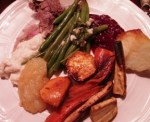
From top left clockwise:  the goose, then green bean, cranberry sauce, roast potato, roast parsnips, roast carrots, roast sweet potato, apple sauce and bread sauce.

It sounds bloody grand and it was. A local Big Issue vendor ate nothing on Christmas day, he told me today.

Juliette, eldest niece, cooked all of vegetables including her own concoction, green beans with olive oil, lemon juice, garlic, mint and a little sugar.

I made the tiramisu. None of my books had a recipe but luckily I found Tiramisu Heaven.

Mine did not look like Tiramisu Heaven pic above.

Mine looked splodgy – see below.

Yet it was delicious, if both bread-puddingy and way-creamy. I used less sugar than recipe (3oz instead of 4oz/ 1/2 cup) and brioche instead of ladyfingers. Lots of strong coffee.

I made the tiramisu late-at-night and last-minute. After carefully separating eggs, I made fatal mistake and did to egg whites what should have been done to yolks.

My mum does not use eggs at all. How sensible is that? Just 8oz mascarpone +brandy +  coffee-soaked ladyfingers, sprinkling each creamy-layer with cocoa powder, and topping with rest of coffee-soaked cake.

Geraldine provided an extra treat: mince pies with homemade pastry.

She homemade the mincemeat too: you assemble the fruit and suet, and warm. “Dead simple,” says mincemeat-demystifier, Delia Smith.

This feast was manageable thanks to six of us cooking. I made my dish in advance while others cooked on Christmas day. So division of labour was not equal.

How did you manage Christmas?

Reblog this post [with Zemanta]

Jamie Oliver – good food in 15 minutes?


Ah, I like Jamie Oliver. I have interviewed him, and I do think he is the Real Thing.

So Jamie has won the 2010 TED prize. Of course it is a bit annoying when high-earning celebrities win $100,000 prizes – I can think of equally worthy but cash-starved causes.

On the other hand, the TED prize is prestigious, international and sends a powerful message:  healthy food for children matters.

Jamie says: “Good food can be made in 15 minutes.”

I like the principle but my mind has gone blank.

Thinks: omelette / ciabatta…? (But I don’t like wheat or too many eggs).

I am currently enamoured of casseroles:

Cooked brown rice or pearl barley in a casserole with (tinned/homecooked) haricot beans, sliced raw onions and cut-up-small raw squash. Add fiery seasoning such as chilli, and/or mango chutney (or any other chutney lingering, neglected, at back of fridge) and cook in the oven with lid on, gas mark 5 for 40 minutes.

That’s dead-quick and no last-minute cooking-stress before eating.

But 15 minutes, it ain’t.

What good food would you cook in 15 minutes?

Copenhagen 2009 – green book signing

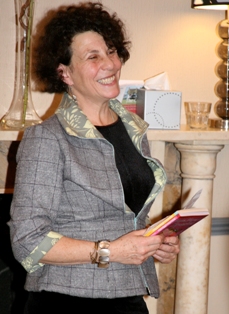
Book signing last Tuesday. Said a few words, quoting my mate Robin, quoting his mate, Tony Juniper:

Whatever happens at Copenhagen, it’s people’s cultural change that’s crucial.”

Cultural change: such as the way we eat food.

So blessed in Bristol with independent shops and local organic farmers.

We made food bought from Scoopaway, La Ruca, Saxon’s Farm at Bristol Farmers’ Market and Better Food organic supermarket.

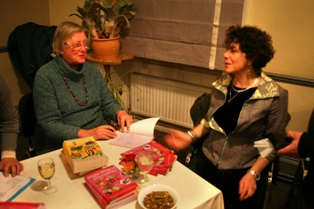
The recipes are written by co-writer Patricia Harbottle who came to sign books.

I copied Pat’s choice of recipes from the book, which Pat had cooked for the Dorset launch.

Spicy pumpkin seeds roasted and crunchy in egg white masala.

Pea, leeks and courgette fritatta.

Hey, I now know the secret of making fritatta, thanks to Patricia’s recipe.

You finish cooking omelette and vegetables by placing under the grill.

 (Thank you, Lynne, for loan of fritatta pan that goes on the stove AND under a grill – otherwise leave your frying pan’s plastic handle sticking out away from the heat.).

And we also baked Courgette cake.

For 100 people. I repeat: a hundred.

Patricia was a top London caterer before she retired to Dorset. She helped me “scale up”.

I have decided not to be a caterer when I grow up as I had low-level fear of food poisoning and had to taste everything and not die first.

I am indebted to Ros and Charlotte for patient and relentless weighing, mixing, chopping, stirring and spreading. Not to mention style counsel.

And Chris Johnstone, author of Find Your Power, for inspired dulcimer-playing.

The best bit of the book signing was when people in the audience

spontaneously suggested ways to help Make More of Squash, and Make More of Beans & Peas go far and wide.

As well as giving nutritional info, the Make More of Vegetables series show you how to grow from seed and cook from scratch

– profound ways to create a healthy, vibrant, low-carbon, resource-saving green world

…because it’s no good waiting for our business-as-usual politicians to do so.

Stop press: I checked with Tony Juniper if it was OK to quote him. He replied:

Thanks Elisabeth. Of course I am delighted for you to quote these words. The only thing I might add is to flag up the 10:10 campaign, which seems like a logical reaction to what just happened in Denmark. I was there – it was truly shocking.”

Anjum’s Gujarati lamb curry

My children are carnivores so when they (now grown-up) visit, meat is a treat.

Cheaply produced meat means people can eat it every day as a cheap takeaway.

But eating meat daily is neither good for the health of the animals, consumers or planet.

Some people need to eat meat, while others argue our soils need  manure for soil-strength.

We just don’t need to be mass-producing meat on an industrial scale.

So it’s about trying to get a balance. There’s a spontaneous revival of the traditional way of eating:  have a feast of (well-reared) meat once a week and live on the leftovers.

Join the Feastarians, Weekend Carnivore or Paul McCartney on a Meat-free Monday.

Which leads me to this delicious lamb curry.

Quadrille Books had offered – on Twitter – a free copy of Anjum’s New Indian.

Canny New Media marketing device, eh? I like – and copied it for my own books!

So I contacted Quadrille on Twitter and the big beautiful hardback copy signed-by-Anjum arrived by post.

Its subtitle is Indian Food Made Easy.

Sadly, not easy enough for me. The ingredients list looked too long. The pages too big and glossy.

I felt daunted.

For simplified Indian dishes, I rate Quick Indian Cooking.

However after months of free-book-on-Twitter-guilt, I finally tackled a recipe.

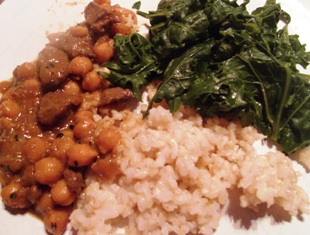
Gujarati lamb and dumpling stew – it was bloody delicious.

But I did simplify it. I left out the dumplings for a start.

Note: I substituted raw ginger for horseradish because Middle Child cannot stand ginger and takes it Very Personally if I cook with it.

Horseradish works incredibly well. Grate it raw, cover with white wine vinegar and it keeps in a jar in the fridge for 3-4 weeks.

Here’s my version: 

Ask the butcher for lamb for stewing – or mutton. Mutton is cheaper because it is  a grown-up animal. Stewing will soften the tough older meat of mutton.

Unlike pigs and poultry, it is harder to farm sheep intensively – sheep continue to roam freely and eat grass. So if you are going to eat non-organic meat, lamb is your best bet.  

I bought about 400g of organic lamb (about £4) which fed 4. I cut up the pieces quite small.

Then I browned the lamb pieces in a pan to seal the taste, then removed them.

Add a teaspoon of mustard seeds and when they pop, add the sliced onions and fry until brown.

My gratitude to Anjum grew – I don’t know what to do with mustard seeds and now I was using them like a pro.

Meanwhile, in a blender (I used the grinder attachment), make a paste of 20g of ginger – or raw grated horseradish – and 5 large peeled garlic.

This paste is a great discovery. I use it for spicy vegetarian dishes too.

Add the paste to the onions until it gently colours, about 3 minutes. Add salt to taste (I omitted the 1 tsp. of sugar), 1 Tbs of ground coriander and 1 Tbs of ground cumin; 1/2 tsp of turmeric and 1/2 tsp of chilli powder. Cook for 20 seconds.

Add about 100 ml water (I omitted the 3 pureed tomatoes) and cook gently until completely reduced, then fry the paste for 5 mins until the oil comes out.

These instructions were brill as I tend to overcook spices and not get the ratio of water-to-spices right (too watery or too dry). This worked! Thanks, Anjum.

I added a quarter of a block of coconut, not the recipe’s can of coconut milk. I also forgot the 1-2 tsp of lemon juice. I didn’t measure the water but Anjum said 200ml (for 600g of lamb).

I forgot the sweet potato but that would have been a wonderful addition.

I chose this recipe because of the chickpeas. I can’t eat a lot of meat – although I do love its rich gravy flavours – so I was happy to have meat-bits with my beloved chickpeas.

I had already soaked 200g of the raw chickpeas overnight and cooked them for an hour (or, as Anjum says, use a can).

I served it with organic curly kale and brown rice.

And it went down a treat with the carnivores.

Beetroot soup and a good deed gone wrong

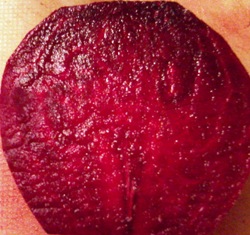
Last night’s cut raw organic beetroot.

Its insides look so mysterious.

I was making beetroot soup (again). Simplifying it.

Cut up two large peeled/scrubbed organic beetroot and place in a large pan with two peeled onions, sliced. Cover with water and bring to the boil, then simmer with a lid for 30 minutes.

I blend with an electric hand blender, my favourite kitchen power tool.

Mine was £20 second-hand, or try Freecycle for a free one, or Just for the love of it for swops.

While blending the beets (bought from Better Food), I travelled back in time:

– to fifteen years ago, and I was trying to be helpful in someone else’s kitchen.

I was in charge of the chocolate mousse.

I poured it into the mixer and pressed the button to mix.

Mayem. Chocolate mousse on every kitchen surface in spattering distance.

I had forgotten to out the lid on the mixer.

So now I practice conscious blending.

Schadenfreude means the pleasure you get from someone’s else’s pain.

I wonder if there is a word to describe the ouch you feel when you end up

causing even more ouch to the very person you are trying to help?

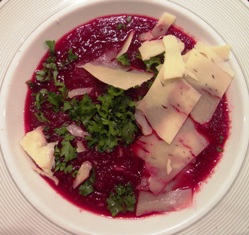
Served with home-grown parsley, plant from St Werburgh’s City Farm, and Yeo Valley organic cheddar shavings.

GM – the more we hear, the less we like

“Waiter, will you serve me a dish of genetically modified food?”

I don’t see anyone clamouring to eat it.

Genetic modification. Such a mild-sounding term. A bit of modifying here, a bit there – what could be wrong with that?

A lot. Genetic modification is a radical departure from traditional plant breeding.

Genetic modification is about taking a gene from one species and placing it in the gene pool of another species.

And why, pray? To help feed the world, as the GM companies would have us believe?

Um, no. Commercially developed GM crops have been ‘modified’ to survive being sprayed by the GM companies’ pesticides.

GM makes spraying intensive farms easier – just spray the field and what is left standing is your genetically modified plant.

The GM companies claim that their new technology cuts down on pesticide use.

A recent report published in the US has found that growing GM plants is actually increasing pesticide use.

Meanwhile here in old Blighty, the UK’s venerable scientific institution, the Royal Society, wants to invest millions of our taxpayers’ money into researching GM.

Stop this madness! We need to be spending our money on researching systems that DO work, such as organic farming, to find out how to make them even better.

Money invested in low-tech research is pitiful compared to money sunk in magic-bullet technologies – set to make corporations even richer than they are because – here’s the rub, so listen carefully:

Once a corporation genetically modifies a seed, the corporation can patent it. It owns the seed. 

And if that GM seed should land accidentally in a farmer’s field (and seeds do travel, borne by bees, or wind) then the farmer has to pay the GM corporation a licensing fee – viz the terrible case foisted on the 70-year-old farmer, Percy Schmeiser, in Saskatchewan, in Canada. And, according to the Soil Association, hundreds like him…

This week we heard the Food Standards Agency wants another go at persuading the British public that GM is OK.

The Food Standards Agency. That’s the same outfit that published a  flawed report in August stating  the benefits of organic food are “insignificant”. As I thrive on fresh organic food, this  incensed me. My post on the FSA’s report got the most comments ever.

So anyway, as I was saying, the Food Standards Agency (FSA) wants another go at brainwashing the British public.

The FSA is calling it a “dialogue project”.

The way we use words, eh. Obviously ‘dialogue’ was deemed innacurate – suggesting a two-way give-and-receive exchange of views. Which it is not. It’s a project. A dialogue project.

So a steering group of academics has been assembled so consumers “can be helped to make informed choices about the food they eat.”

Only two out of the 11 members of the steering group are known to be critical of GM technology, according to the Telegraph.

In fact one of the members, Professor Bryan Wynne, signed a letter to the paper saying (I paraphrase) the dialogue project was a waste of money anyway.

I like the sound of Prof Wynne.

I remember the government-led public debate on GM, called GM Nation.

The more debaters heard about GM, the more anti-GM feeling grew: “soaring to 90%” said Geoffrey Lean in this week’s Telegraph. Back in 2003 he reported how “Many regarded the debate as “window dressing used to cover secret decisions to go ahead with GM crop development”.”

The more we hear, the less we like.

Evelyn Rose’s Luscious Lemon Cake

Luscious lemon cake

We had a bit of a crisis and it was all-hands-on-deck, as friends and family came on board to support my youngest daughter, Maude.

Yael and Maude made this cake as part of Maude’s rehab.

I provided the recipe from my 30-year-old copy of The Complete International Jewish Cookbook by the late and wonderful Evelyn Rose.

It’s a great cake to make. You mix everything together in one bowl and once baked, you prick holes in it then pour-in a homemade lemon syrup for tangy-taste heaven.

I used to bake this cake a lot for our West Country Childbirth Group cake stall in the 1980s until I overdosed, vowing I would never bake another fundraising cake again.

We were aiming to improve maternity services. In 1982 we invited the water-birth obstetrician, Michel Odent, to give a talk and over 1,000 turned up. This demonstrated parents’ wishes for a gentle birth and led, eventually, to the UK’s first birthing room in the Royal United Hospital, Bath.

So maybe all that cake baking was worth it.

Put in one bowl: 100g softened butter + 150g caster sugar + 150g self-raising flour + 4 Tbs milk + grated rind of one lemon + two large organic eggs.

I substituted the self-raising flour for plain and used an extra egg instead, on one occasion  – it worked well.

Line the bottom of an oiled loaf tin or 15cm square tin with oiled/greased greasproof paper. Evelyn Rose says this extra insulation from the greaseproof paper is important. So heed the cooking maven (Yiddish for expert).

Put the oven on Gas 4/350F/180C to heat up.

Beat all the ingredients in the bowl with a wooden spoon or electric beater, then turn the smooth mixture into the well-oiled baking tin.

Bake for 45 minutes.

Watch the animated movie, Flushed Away, while waiting, as Yael and Maude did.

Take the cake out of the oven and let it cool, still in its tin.

Now make the lemony syrup. Heat the 75g icing sugar with the juice of 2 large lemons (about 4 Tbs) until it gets all-syrupy.

Prick the cake’s surface with a fork then gently pour the syrup over it.

Once the cake is cold, turn out and dust with caster sugar. Share with friends.

Thank you, Yaelski.

Make more of vegetables

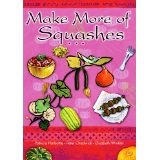
MAKING MORE OF SQUASHES MAKING MORE OF BEANS & PEAS

Two books I have co-authored launch this Saturday at The Udder Farm Shop.

Make More of Squash and Make More of Beans and Peas are the first two in a new series, Make More of Vegetables, published by Hothivebooks.

Fresh vegetables are the basis of real food, bringing vitality, health and taste.

Vegetables are good for us so how can we make more of them?

These two books will show you how.

First, the recipes cook the veg from scratch.

Queen of Italian cookery writer, (Nigella’s mentor) Anna del Conte, says of the recipes by local food enthusiast and recipe creator, Patricia Harbottle:

“The recipes in these books are a joy to read and an even bigger joy to eat.

I was particularly captivated by the section of one-pot dishes, which I love to cook –  the end result is delicious in its balance of flavours and perfect in its balance of nutrients.

Pat is a cook after my own heart!”

As well as cooking from scratch, the books show you how to grow from seed.

Correct me if I am wrong but few gardening books are aimed at the inadequate gardener, such as yours truly.

So when I teamed up with organic horticulturalist, Peter Chadwick, I made sure I asked all the right questions. Example: “What is a ‘module’?”

Peter answered ever-so-patiently, even my inner child could understand.

So if you work with children or have never grown a bean or squash from seed – try these books.

Ditto if you want to enjoy eating more veg.

Available at Amazon. 

Love and vegetable blessings, Elisabeth

PS I cooked Squash Mousse for pudding and it was delicious.

What are they doing to our bees?

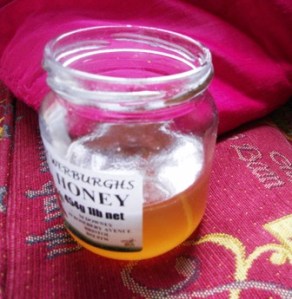
Honey from local allotment bees

This pot of honey comes from bees in a hive on our nearby allotments.

I have never tasted honey like it.

It starts off honey-ish and sweet and ends with interesting tastes, almost floral.

Bees – like most of us – do not like pesticide-sprays that spoil their food. So they thrive in a chemical-free environment, such as organic farms.

As the largest British survey found, there is more wildlife on organic farms.

Yet this common-sense evidence is being ignored.

As you probably know, the honey bee is under threat from Colony Collapse Disorder, a mysterious disease which leaves hives deserted. Have the bees gone off to die? No one knows.

A lot of our food sources depend on insect/bee pollination so we mess with honey bees at our peril.

Research indicates that the industrial farming of bees is bad for bees: large-scale transportation of hives, pesticide-spraying and, possibly, genetic modification – at least in the US where GM plants are commercially-grown – is damaging the health of bees.

Now to make matters worse, I now hear, thanks to the Ecologist, that the very company, Syngenta, that manufactures the bee-killing pesticide is also breeding bees.

For some reason, this reminds me of pharmaceutical giant Astra Zeneca,which makes the breast cancer drug tamoxifen, ALSO produces pesticides, including organochlorine acetochlor, implicated in breast cancer. Astra Zeneca is a keen sponsor of Breast Cancer Awareness Month.

Can you get your head round this? Answers in the comments box gratefully received.

Beetroot and carrot soup

Beetroot and carrot soup

When I say I am a food writer, people assume I am a gourmet foodie, a superior being who will look down my refined nose at their offerings.

Nothing could be further from the truth.

The reality is I am an everyday, sloppy, how-quickly-can-I-eat-well cook.

My concerns lie not with how food looks, or how unusual or exotic its ingredients are but rather how healthy are they and how they were grown.

I want to demystify cooking not put it on an pedestal.

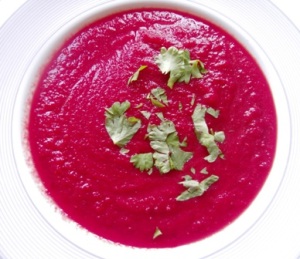
So this soup could indeed be my ‘signature’ dish. It’s comfort food made with locally and organically-grown vegetables, it took me about half-an-hour to make, is healthy and tasty.

I cut an onion and sweated their slices in olive oil in a medium-size saucepan with a lid on. I washed but did not peel the 2 large beetroots, ditto the 5-6 carrots. I chopped carrots and beetroot in inch-bites because the smaller you cut ’em, the quicker they cook.

I added the chopped veg to the softening onions, and added 3-4 mugfuls of water (one mugful=1/2 pint), and simmered it for 20 minutes, with the lid on.

I did not add salt. Both beetroot and carrot are so sweet, what other taste is needed?

I did add black pepper. And I whizzed it with my £20 handheld electric blender because I am a bit of a baby and like eating mushy-comfort food.

Escoffier, I ain’t.

So have no fear, past and future dinner hosts!

Reblog this post [with Zemanta]