Last meal at the No Tesco squat?

Stephan rang me from the No Tesco in Stokes Croft squat.

I had just taken a picture of this Tesco bag blowing randomly on a branch in a car park in Portishead.

Stephan said tonight’s Sunday communal meal may be its last.

Last Tuesday, a repossession order was granted to Tescos plc – the ‘conscious squatters’ lost their court appeal to keep the site for the community.

I call them ‘conscious squatters’ because they look after the old Jesters comedy venue site with its bar and stage and share it consciously, hence the squat’s screening of Food Inc, last night’s Cosmic Cabaret and its regular Sunday night communal meal.

They have been occupying the premises ever since we locals heard Tesco has a planning application on the site. Even though there are 6 Tescos within a mile [see comment below] and 31 in Bristol.

I would much rather have this cosy communal space the squatters have created than another soulless supermarket.

Yet any minute now, eviction papers could be served. The squatters then have 48 hours to leave.

Here is Stephan’s Project Flowers at the squat. Note the framed flower drawings.

“Flowers represent positivity,” Stephan explains. “In a way we are all like flowers.”

He created the project so everyone could take part in it.

Food is like that – something we can all take part in.

Tonight the squat served the most amazing vegan meal for over 50 people in return for donations only.
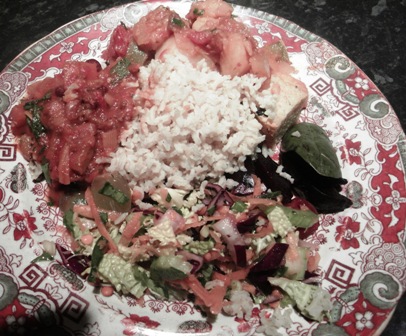
My plate of varied inventive coleslaw (raw cabbage, slivers of kiwi, finely cut celery, herbs, seeds, and cardamon), vegan chilli stew, potato curry, beetroot and spinach leaves and a mound of brown rice. Followed by homemade fruit crumble and dairy-free custard.

The funny thing tonight turned out to be networking-central. I caught up with five different lots of friends from different parts of my life (including dance, work, family and food).

The No Tesco in Stokes Croft squat is creating community.

It is budding, at the beginning of its spring growth, fertile with plans including a food coop to make local healthy food affordable for all.

It would be no joke if the squatters in the old Jesters comedy club were evicted.

Food Inc at No Tesco squat

Last night the squatters screened Food Inc (my pic above) at the No Tesco in Stokes Croft squat on Cheltenham Road in Bristol.

The comfortable friendly squat is on the same premises Tesco wants for its 32nd supermarket in Bristol – as opposed to to the real food, whole food, local food market we locals want.

The perfect setting to see Food Inc, the documentary by US investigative journalist, Eric Schlosser, author of Fast Food Nation.

The US farmer in the picture above, sitting on his horse surrounded by cattle in verdant nature, is an illusion.

“If people knew the truth about their food, they wouldn’t eat it,” says Eric Schlosser.

So the truth is hidden.

“If there were glass walls on mega-processing facilities, we’d have a different food system in this country,” says the farmer from the local organic Polyface Farm.

Farmers who speak publicly about what goes on behind the huge industrial shed-doors get their contracts terminated.

Debt is not restricted to poor farmers in the developing world. US farmers are forced to take out loans they can’t repay to meet the company’s demand for the latest  ‘upgrade’.

Chickens are bred to grow fat faster. Their bones and internal organs cannot keep up with their fattened breasts. Chickens too ill to walk are processed as food.

Eric Schlosser says the industrial food system is based on the fast-food one: train workers (usually illegal immigrants) to do one mindless task, over and over again.

Neither the animals or workers’ comfort is of concern because they are temporary commodities, cheap to replace.

The self-policing food industry is close to US governments, whether Republican or Democrat. Those on the boards of farm chemical companies turn up as high-ranking officials in the FDA (US Food and Drug administration).

Most of our food is controlled by four megasized multi-nationals, from seed to supermarket.

Companies now legally own any seed they genetically modify.

Monsanto sues farmers for violation of their patents, and has a hotline for farmers to report on each other for doing what they have done for centuries: save seed.

These companies are so powerful, they can afford battalions of lawyers to fight farmers.

They lobby governments to skew the system so the poor end up paying more for fresh broccoli than ground-up beef treated with ammonia to kill bacteria such as e-coli rife in the manure-drenched animal factories.

We need to change the policies which make the bad calories cheaper than the good ones.

After the film, the squatters served parsnip and ginger soup, with potatoes and onion. It was delicious, satisfying my desire for wholesomeness and taste.

Here is my cup of deliciousness posed against a No Tesco campaign postcard which thousands have signed.

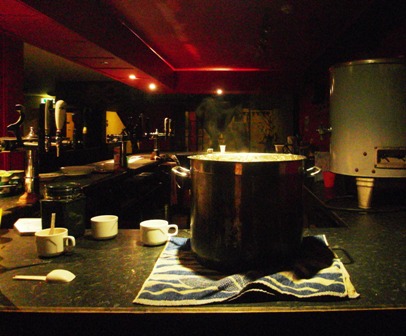
Here is the steaming soup saucepan sitting on a tea-towel on the bar of the Jesters, the ex-comedy club, which Tesco wants to demolish and replace with a soulless supermarket.

On my way home, I passed a plastic Tesco bag lying discarded on the streets.

Says it all, doesn’t it?

Please sign the petition asking Bristol City Council for a proper consultation.

And, hot-off-the-press: I am standing for the Green Party in Bishopston.

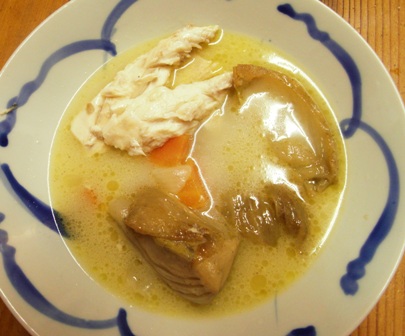
Fay’s fish soup

My mum Fay made this fish soup last Friday.

She bought the wild sea bass in Tachbrook street market, London, from Pat, the only fishmonger she trusts.

“If he packs up, I’ll pack up,” says my mum.

Here’s Fay’s riff on an Evelyn Rose recipe. Two medium-sized fish serves five.

Sweat sliced onion and carrots in butter. Once softened, add the two whole sea bass – or any pieces of fish – and turn over in the fat. Cover with water and add a bay leaf. Simmer until fish is cooked (flakes easily, about 15 minutes) with the lid on.

Cook the whole fish, gutted but with head intact – this will add flavour. Take off the head at the end. Skin and fillet before serving.

Add a dollop of cream fraiche or sour cream, braised fennel and rice with aromatic saffron.

The No Tesco in Stokes Croft campaign (note Saturday’s celebratory demonstration) has been on my mind (and blog) this week, along with the brave squatters who have now occupied the site that used to be a comedy club and which  Tesco wants to turn into a soulless supermarket.

On Wednesday I had the privilege of visiting the peaceful protestors in the occupied premises. They are doing a grand job and I am grateful for their action.

Funnily enough, my mum had a Tesco story last Friday.

“Jack Cohen, the founder of Tesco, had a barrow outside my grandmother’s shop in Morgan Street market in the East End. My family used to look down on him because he was just a barrow boy and they were shop-owners.”

Taking advantage of the property slump, Tesco is intent on buying up land.

Tesco wants control of every purchase from food to movies.

I can’t help wishing Jack stayed a barrow boy.

Stop Tesco banner in peaceful protest

Note  Tesco’s blue hoardings, put up on Saturday, and – I might add – taking up a large part of the pavement. Cheek!

So very grateful for the handpainted banner now draped on the building (see pic above) proclaiming: “Stop Tesco! Every little hurts”.

Here is my report on Monday’s meeting in Stokes Croft, Bristol, where we heard about Tesco’s plan to build a soulless supermarket on premises which used to be a comedy club – Tesco’s, you must be joking!

It is believed the premises are occupied by some brave individuals concerned about this supermarket takeover.

Good for them, I say.

Supermarket food is not cheap because the cost to our health is so high.

What would you prefer in the place of a purveyor of industrial food?

All creative and positive ideas welcome.

No Tesco in Stokes Croft

Last night’s meeting 

About 200 gather in Stokes Croft, Bristol to discuss the shock-news of Tesco opening a soulless supermarket in the area.

Not so fast, o supermarket giant – the local people of Stokes Croft want a say.

Local communities need local shops, not another soulless chain that swallows resources.

The intended site is a comedy club – they must be joking, as the campaign headline on Facebook says.

The area Tesco has chosen to site its 32nd supermarket in Bristol is Stokes Croft near St Paul’s.

The home territory of The People’s Republic of Stokes Croft which trials new ideas and celebrates creativity.

The very opposite of Tescopolis.

Supermarkets kill local business. The small shopkeeper does not survive.

The tragedy is Stokes Croft is an increasingly happening place.

Take Canteen, which serves seasonal and local food at affordable prices, hosts great music nights and is designed by award-winning architect, George Ferguson, above newly-reclaimed office space at Hamilton House run by Co-Exist.

Tesco’s planning application to change the use “from stand-up comedy venue to shop” was done under another name last November.

The minimum of public consultation took place – no responses were received – so no one knew until last week that Bristol County Council had given Tesco permission to set up shop.

Not even St Paul’s Unlimited, the body set up by Bristol City Council “to provide an open, accountable, community-led organisation to advocate and lobby for the community of St Paul’s”.

There is still time to stop the supermarket which by the way already has a Metro Express five minutes from the proposed site.

According to Rachael Marmite of the Planning Club (she knows her stuff …and how to explain it in plain English), the Bristol City City Council planning officer said:

“An inordinate amount of (responses) could rescind change of use.”

So lots of responses are planned, including surveying local traders and neighbours, petitions, lobbying councillors and a pledge bank.

Find out the latest at the No to Tesco in Stokes Croft campaign website.

And get general campaign material and advice from Tescopoly.

The people of Stokes Croft want a meaningful consultation.

Being a creative community, expect some street theatre along the way.

“If we all make an effort, it will be easier to achieve,” says co-organiser, Claire, at the first meeting last night.

“Every little helps,” added someone else in the audience, to laughter.

My night in Bristol’s rebel restaurant

Ra-ta-ta-tat on the big red door.

Entry into the wood panelled hall of Quay House.

Once Bristol’s customs house, now disused offices, the Quay House is squatted on behalf of Cloak and Dinner, Bristol’s rebel restaurant.

Seems criminal that such a place lies empty.

Good on the squatters, for invoking Section 6 and making such creative use of it.

For four nights, Quay house is host to what the Guardian calls the hottest ticket in town.

I pass the candlelit lounge where guests will be served gin and tonic.

Up another flight, past the red-curtained dining area, also wood panelled and candle-lit, where the diners will be served a four-course meal with vegan and vegetarian options.

Up the next flight to the brightly lit kitchen milling with volunteer helpers, which reduces to a core team of about seven, myself included.

An anarchist kitchen is the opposite of a  Gordon Ramsay one.

Amidst cries of “Table 7 just finished their starters” and “four vegetarian mains”, the kitchen is calm.

No one is throwing their weight around or shouting.

Anarchists believe – as do I – that human nature is basically cooperative.

And cooperate we did.

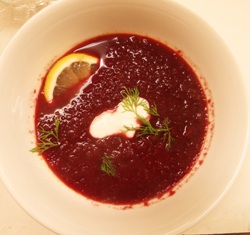
“Best borscht soup I’ve ever tasted,”  says a customer at the end of the night, the dreadlocked waiter reports.

Eve had made a soffrito of celery, onions, leeks – added grated beetroot and water to simmer. Blended when cooked. With Cabernet Sauvignon vinegar, grated lemon zest and sugar to taste. Indeed the best.

For starters: pillows of filo pastry filled with mashed pumpkin, carrots, wilted rocket and walnuts, served with Caerphilly cut from a truckle of cheese.

Steam rising on bean stew served on a cabbage leaf on top of potato mash flavoured with mustard seeds.

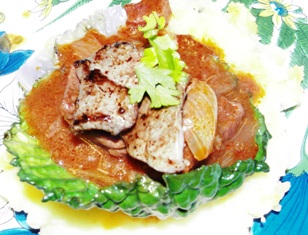
The venison comes from Fair Game in Nailsea. The young farmer shot the deer, skinned and butchered it last week. Chef Christopher cooked it with sloe gin and the bones until aromatically tender. “The venison was superb,” says another guest who visits the kitchen to praise.

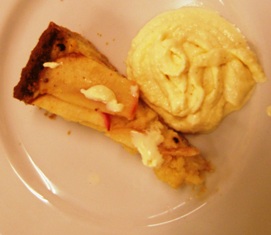
Canterbury pie about to be plated. The recipe for sweetened pastry comes courtesy of Irish chef, Richard Corrigan, while apple puree topped with thin apple slices is from classic cook, Mary Berry. The vanilla ice-cream is homemade, by Eve.

The vegan option at the open window.

I make the pies, following Sarah’s  instructions, based on the available ingredients. No scales, just guess work. My sort of cooking.

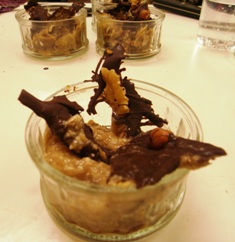
Crush biscuits in a bag, mix with melted Pure organic marge (just enough to moisten crumbs). Press into a plate. Mash bananas with ground almonds and cinnamon. Drizzle melted dark chocolate, add hazel and walnuts and drizzle more chocolate. That’s it.

The banana mixture was too slurpy to cut cleanly so it became a concoction in a ramekin with chocolate and nut lattice broken to sit on top.

The washer upper working with grace all evening, backbone of the operation.

Darren, Saturday’s chef, sweeping the floor in readiness for his shift the next night.
His day job, The Kensington Arms, lent the linen for the rebel restaurant.

“Some people like vegging out in front of the TV. But something like this brings people together,” he says.

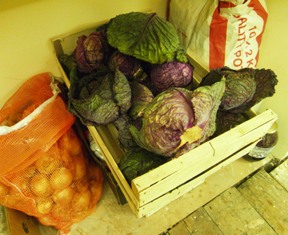
Cabbage in crates. Darren considers how to use them for his chef-shift.


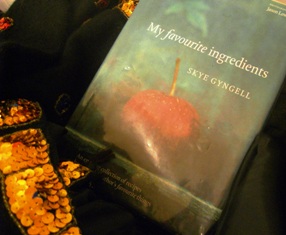
Skye Gyngell’s cookery book, My favourite ingredients, amongst the coats.


Art by Libby in the lounge where gin and tonic is served as the punters arrive.

Happy customers.

“Most restaurants have no soul,” says a guest. He and his girlfriend heard about the rebel restaurant through Facebook. The 50+ covers a night got booked up as soon as word got out.

Each chef has £75 a night to conjure with, money made from a previous project, topped up with food donations from local food businesses.

People paid what they could afford. Last night we made £800 – to go towards the next project.

Everyone gives their time freely. I end the night with a heart full of love.

Bristol’s rebel restaurant

Here I am posing outside the premises for tonight’s rebel restaurant.

Here’s what the Guardian thought after dining there on Wednesday.

The anarchist collective has squatted this fine historic building (shocking it lies normally empty, eh?) and, working for free, has turned it into a mysterious restaurant.

The idea is to create an autonomous space – free space unmediated by landlords or employers.

It’s also about eating locally and seasonally – for donations of what you can afford.

Too late to dine, I am afraid – the 50 covers for each of the four nights of the restaurant’s ephemeral existence were booked a week ago, as soon as word got out.

The tables are laid, Cloak and Dinner‘s chefs and waiting staff with maitre d’ are at the ready.

I am crewing tonight for the chef and her team.

To report back!

Food 2030 – spin not substance


Venue magazine asked me for my view on Food 2030 for its Feb 3 issue. That got me thinking:

The government’s food strategy for the next 20 years sounded like good news.

“Britain must grow more sustainable food,” went the Guardian headline as farming minister, Hilary Benn, launched Food 2030 at the Oxford Farming Conference.

Hilary was using all the right words: climate change, food security, homegrown food.

Hilary even included this rallying call:

“People power can help bring about a revolution in the way food is produced and sold.”

That sentence could have come straight from the planet-friendly Soil Association. Hold on a minute. I think it did. I remember writing something similar when I was editor of the organic charity’s magazine, Living Earth.

So, has the government finally got the green message?

Look, I hate to be cynical but there is an election coming up.

The fact is – and you might as well know sooner than later – New Labour (and Conservatives when in power) are as wedded to the dominant global food system as ever.

Food 2030 pretends to be open-minded about GM but I am not convinced.

According to Hilary Benn’s performance at the Soil Association 2008 conference, the minister does not inspire confidence.

(Watch out for Hilary at the Soil Association conference in February).

So Hilary tries to reassure us that the government is on the case because it is spending £90m over the next five years “to fund innovative technological research and development” with the Biotechnology and Biological Sciences Research Council.

Sounds like quick-fix technology to me – good for corporate finances but not for us mere mortals.

You can bet that not-much of that £90m will go on researching already-existing healthy farming models such as organic farming or permaculture.

Food 2030 pretends to be looking for solutions but instead dumps the burden on consumers and farmers.

(Reminds me of that ghastly government advert on climate change where the little kid sees a picture of a puppy dying in the rising tide. O, so kids must feel guilty while the government carries on with business-as-usual? No, minister, that is not what I would call positive action against climate change).

Back to Food 2030 and Hilary’s big push against food waste. Yes, we waste food but hold on a minute. Why focus on what we citizens keep rotting in our fridge when supermarkets throw away far more food than we do?

And as for telling farmers to produce more local food when – hello? – council farms are being sold off.

Benn’s only vaguely substantial idea was to be more honest about labelling meat’s country of origin.

But then that was a Tory idea anyway.

So, sorry – not impressed.

Are you?

_______________________________________________________________

Stop press (added 03.05.2010): The Soil Association has produced a report investigating the big fat lie that the UK needs to double food production by 2050.

Making marmalade


Marmalade lovers, if you have only ever eaten shop-bought marmalade, you MUST try making homemade marmalade at least once in your life.

Last Sunday at 7.30pm, I committed myself to an evening of marmalade making so I could enjoy real marmalade on toast (above).

Ingredients and cost

4lbs (1.80kg) Seville oranges

I bought 1.975g  of organic Seville oranges for £5.89 at Better Food organic supermarket

4lbs (1.80kg) granulated sugar

I bought the non-organic kind at Scoopaway – 1.990g white sugar @ 1.29kg = £2.57

Sugar

Sugar is cheap compared to the fruit because it is so heavily subsidised. As a commodity, its future gets gambled on and prices look set to rise.

Would much prefer organic vegetables to be subsidised, rather than sugar.

I weighed out 4 lbs (1.8kg) granulated sugar into a pan, now warming in a low oven.

Warming the sugar makes it easier to melt into the fruit.

Softening oranges

I scrubbed the oranges and removed the stalks on each one.

They are now in a preserving pan with 4 pints of boiling water.

I have found a baking tray to cover the pan. The pan hisses.

Katie Stewart says it takes 1.5 hours to soften the oranges.

Katie (whom I once met when she won a Guild of Food Writers Lifetime Achievement Award) says 3lbs of fruit, 6lbs of sugar and 5 pints of water. In my bid for less sugar, I have experimented over the years and now use equal sugar to fruit.

Christabel who works at Better Food suggested adding orange blossom water for extra orange zing.

Haiti

Very aware of Haiti. Grateful for my life where I can calmly make marmalade. A fellow food blogger, Sabrina Ghayour is organising a Food Lovers fundraiser for Haiti. Please support this event with donations and helping promote it.

Pectin

9.30pm. I have cut the softened oranges in half and scooped out pith and pips with a teaspoon. Pith and pips (repeat-very-fast) are boiling for 10 minutes in 1 extra pint of water to extract the pectin. Pectin is crucial for helping the jam to set.

After 10 minutes of vigorous boiling, I strain the pith and pips. This takes ages as I can only get a small amount in my small strainer. The pectin-filled water goes into the preserving pan with the cut-up peel and the warmed sugar. I add the juice of two lemons.  And its flesh for good luck.

If you don’t have a preserving pan, use your biggest pan or divide amounts into two pans. You need to boil sugar-fruit-water super-vigorously for 15-30 minutes without worrying about it boiling over the sides.

Making up for lost water

The lid on the softening oranges was makeshift and inadequate, and I am paying the price: I lost precious pints in steam. I ended up (after adding strained pith-and-pips water) with 1.5pts in total. I have boldly added an extra 2pts making it up water total to 3.5 pints.

PS A few days later: And it worked! Marmalade as delicious ever.

Boiling fast to set

10.30pm. I have added the sugar to the cut-up peel and water

For some reason Jeanette Winterson is in my head. I am thinking about her organic shop in East London and wondering if she is as driven to write now she has her shop. But perhaps she arrived in my mind because Oranges Are Not The Only Fruit.

11.20pm. The marmalade has been fast-boiling for 20 minutes.

I draw it off the heat to test for a set because if you over-boil, it can lose its setting point. Who says cooking is boring? It is full of drama.

Earlier I put two plates in the freezer. I will now drip some hot jam on its cold surface and wait a few minutes. If the cooling jam crinkles when I push it with my finger – then success, it has set.

Then finally – after the second lot of 15 mins of fast boiling, that tell-tale crinkling. Joy.

The marmalade cooled while I set up a Facebook page for Foodlovers Fundraiser for Haiti, a small thing that I could do to help this cause.

12.45am. And here are my 8 pots of marmalade.

It was a palaver but it was worth it.

What do you think?

Butternut squash and spinach lasagne

Snowed-in.  Good excuse to make Butternut and spinach lasagne.

Christmas has had me confused: am I vegan or carnivore?  This light vegetably vegetarian dish is a compromise.

And..it does NOT require a white sauce!

As I had been planning to make the dish for a week, I had the main ingredients:

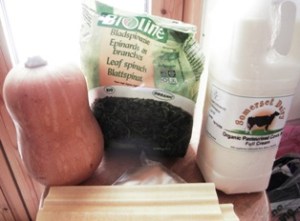
In my pic, lined up for their photoshoot, from left to right:

1 organic butternut squash, 1 packet of frozen organic spinach, 1 organic milk and 3 sheets of lasagne pasta. You need mozzarella for topping.

I got the recipe from a free promotional recipe booklet from Olive Magazine two years ago (when I had advised Hardeep Singh Kholi on going organic).

Here is the beautiful butternut squash cut in half.

I used the whole squash for the recipe and produced just over the 500g required.

I cut the squash into manageable pieces with a small sharp knife, peeled the skin using a potato peeler and scooped out the seeds.

Love the way the butternut squash is so orange.

You fry 1 onion in a large frying pan then add the 500g cut-up squash. I cut-them up smaller when I realised they had to fry.

The recipe said fry until tender and slightly brown round edges but I put the lid on – answered a few emails – and in 15 minutes it had gone very soft indeed, but not brown.

Then add 100 mls of milk (or plant milk, vegan-me).

The BEST things about this recipe are:

  • no need for a white sauce
  • 500g of squash and 150g of (frozen) spinach makes it LIGHT and vegetably.

So you cook the 3 lasagne sheets in boiling water for 3 minutes then drain.

Then layer: one sheet of pasta, followed by half of the cooked squash and half the warmed spinach.

Another sheet of lasagne pasta, then rest of squash and spinach.

Finish with the third lasagne sheet and tear a 125g ball of mozzarella over it.

(I used Buffalo Mozzarella from Laverstoke Farm, the organic farm ‘university’ owned and run by ex-racing car driver, Jody Scheckter. 20% off in Better Food organic supermarket just before New Year).

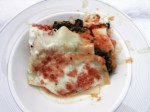
Put the dish under a heated grill until it bubbles and browns.

I photographed it against the snow.

No food-stylist, I! Look at the food splashes…not very stylish.

But definitely delicious.

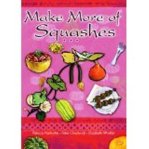
For more squash recipes, including recipes for carnivores and vegetarians, nutritional information and how to grow squash from seed, see the book I co-authored, Make More of Squash. Aad on the right of this post offers 20% discount…

Interested in reviewing a copy? Email me at elisabeth.winkler   AT yahoo.co.uk