Category Archives: vegan

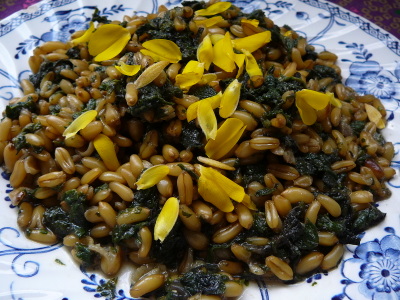
Kamut risotto with nettles and gorse flowers

Kamut wih nettles and gorse flowers

This dish is a bit like an Oscar-award winning ceremony so bear with me while I thank a few people.

Firstly Elena Renier for inspiring me to use nettle tops in a risotto. Secondly Chloë for telling me on a walk over the cliff path at Cockington in north Devon that gorse flowers are both edible – and nature’s cure for depression.

I have always loved the spiky gorse bushes’ bright yellow flowers but when I found out I could eat them – and have a mood-change into the bargain – I was ecstatic! (Or was it the gorse petals I was munching en route?).

So, back in the kitchen, I fried a sliced onion and added a mug of kamut grain (instead of rice) to the hot olive oil. Then I poured in two mugs of water, added a pinch of rock salt and let it all simmer for 30 minutes.

I washed the nettle tops that Mike had kindly helped me pick (another Oscar thank you to him) and snipped the plentiful dark green leaves (six ounces in weight) with scissors so they fitted in the pan. They took about ten minutes to wilt and add their wonderful creamy spinach-y taste.

I love nettles! I cannot believe that eight days ago I was a nettle-picking virgin. My first use in nettle soup is here.

It’s Be Nice to Nettles Week soon (14 – 25 May 2008) when we stop thinking of them as nasty weeds and realise how wonderful they are.

I know nettles sting if you forget your gloves or do not use the proper ‘folding’ procedure but I do not care. The sting is not dangerous and may even be good for me.

The world faces a rice shortage so can I do my bit by eating kamut grain instead? I have selfish reasons too for I have come to love this bursting-with-health grain.

So, oscar-thanks to the universe for providing good things to eat.

Oh, and universe, while I am in prayerful mode, please knock sense into the powers-that-be to ensure food is shared more fairly and no one goes starving.

Thank you (she says, waving her metaphorical statuette in the air and leaving the stage).

Two soups – beetroot and pea

Two soups, pea and beetroot

This two-soup soup was unplanned, a happy result of making pea soup one day, and beetroot soup the next.

Full of fibre and nutrients, it has (unusual for me) no oil or butter. Here is how I did it, food fans.

First, the pea soup. I took 200g of dried split organic peas and covered them with twice their volume with water. Then I added an onion pierced with a few cloves (thank you, queen of vegetarian cooking, Rose Elliot).

Then I cooked it for 40 minutes with a level teaspoon of untreated rock salt. And that’s it! I did not even need to blend because the obedient peas went mushy all by themselves.

As for the beetroot soup, I peeled two of the violent purple things and cut them into cubes (be careful of staining!). Thinks: as the beetroot were organic, did I need to peel? Must experiment with unpeeled next time as do not wish to shortchange myself of extra vitamins oft found in the skin.

Then I added a handful of split red lentils to thicken the soup in an innocuous way. Water to cover (about two mugsful). Plus one level teaspoon of rock salt (Do see the comments here where medical herbalist Elena Renier and I talk salt).

Still on the subject of salt: who needs a silly stock cube? Its main taste comes from salt. So why not bypass the unecessary cube – with all its weird additives – and just add a level teaspoon of sea salt instead?

The lentils and beetroot took half-an-hour to become tender to my teeth. I gave them a helping hand with my power tool, the hand-held blender. This is one kitchen device I would not be without.

Thank you, universe, for letting me have easy access to electricity, unlike the global majority. I am sure there is enough to go round if we could share resources more equally. More fairness please!

I love hummus

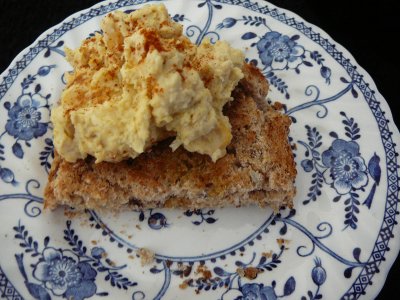
A blog of hummous on toast made with spelt on a plate

One of the best things about not being in the office this week was having time to make hummus. I ended up making several batches, each as subtly different as the last.

I kicked off with 200g dried organic chickpeas (from some supermarkets and all wholefood shops). Hard as bullets, I soaked them overnight in water and then cooked them (in the same water) for an hour until soft enough to eat. Of course, you can use tins for speed and this is a fab recipe.

(Mind you, the comments in above website were also instructive. I learnt I could use roasted sesame seeds instead of tahini. I had panicked because no exotic tahini could be found in this English seaside town. Luckily my saviour, Marshford, had a jar or two of the wondrous middle-eastern sesame seed paste.)

Using the hand-held blender, I noisily blended one clove of garlic (use more if no one objects) in the juice of one lemon, water from the cooked chickpeas (2 Tbs – that’s table not teaspoons!), olive oil (2 Tbs) and the yummy, runny, organic sesame seed paste (2 Tbs).  I added rock salt to taste (being careful not to oversalt – so easy to do), and a teaspoon each of ground cumin and coriander.

Once all the easy bits were blended, I added the fibrous chickpeas and mashed through them with my trusted electric tool.

I have written about hummus before but it is a food that bears repetition. And experimentation. When I ran out of lemon juice, I used lime and no one noticed.

Served with toast (in my case, spelt from the wondrous Common Loaf), I produced a nutrient-rich and high-fibre protein-filled snack.

The vegetarians and the world’s wise peasants know that combining pulses with grains (and subsituting, if you wish, pulses/grains for seeds) makes a protein equal to that delivered by the dear animals.

Raw oats soaking

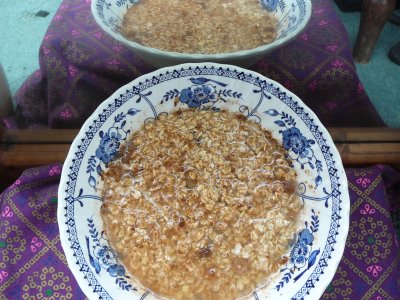
Oats with sultanas soaking in a cereal bowl in fron of a mirror


If you find it hard to eat first thing in the morning (as I often do) try this for breakfast. Cover a cupful of oats with water (preferably overnight but an hour is better than none).

Soaking in water makes oats extra-smooth and digestible because the proteins get broken down. You will hardly notice the soaked oats slide down your gullet yet they pack a nutritional punch.

Oats are full of fibre so good for a regular system. Fibre (as the name suggests) is the steady and reliable sort which also slows down the release of sugars into your bloodstream. No drama with oats. In fact they are a mood-soother. We all need loved ones like that.

To the soaking oats, I add sultanas. The water well-plumps them up. I sprinkle cinammon for its immune-boosting properties and sweet taste.

Make all the ingredients organic or biodynamic and you will be laughing all the way to the vitamin bank.

The drama of chili

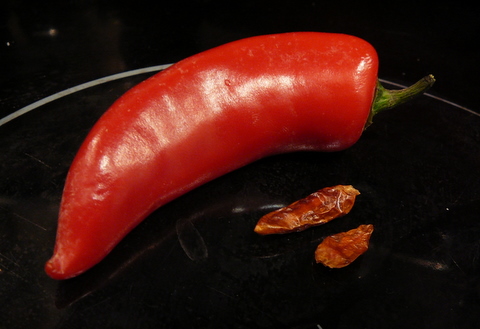
Fresh red chili looming over dried up dark red chili

The other day I blithely told you to use some chili. As if chili is easy-peasy.

Cooking with chili is always a drama. How hot will your dish be? It all depends on the behaviour of the fiery and unpredictable ones.

The big chili in the picture was fresh. I had never come across it before so I had no previous experience of its performance.

In contrast, the tiny dark red ones (see pic again) were dried, so easily available. They were my mates. Or were they?

Therein lies the drama. A half chili could make a dish. A whole one might ruin it. Friend or foe?

There’s the added uncertainty of how much food you are trying to flavour. Take dried chilis. One could be insignificant in a stew for seven.

But at least dried chilis are constant in their fashion. After a few times of using the wizened but easily-stored ones, you can control the spiciness of your dish.

How did tonight’s drama end?

The half of FRESH chili, sliced in a stir-fry (mushroom, onions and sprouted seeds) was pretty tame. Poor thing. It was a supermarket and non-organic chili so didn’t stand a chance. Bred and sprayed to look good rather than taste real.

As for the half of a DRIED chili (sliced thin), it was mighty hot in some mouthfuls of stir-fry. I tell you, those dried-up devils pack a punch.

Haricot beans and pumpkin

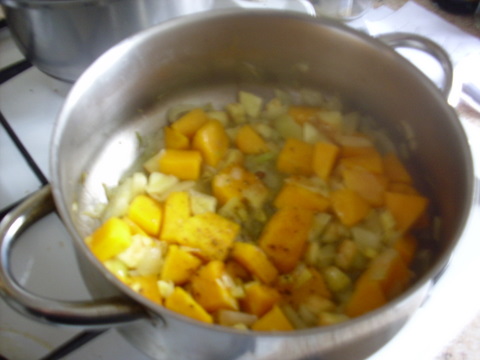
A pan on stove with beans and cut up pumpkin and sweet potato

As a cook, I’d say my forte is ‘gunge’. OK, it’s never going to win a beauty contest but the concoction is reliable and balanced. What more do you want from a lifetime companion?

I had covered the dried organic haricots beans with water, soaking them overnight. The next day, I struck a light under their pan’s bottom and let the beans simmer away in bubbling hot water for a good hour and a half.

I fried a whole onion (sliced) in olive oil and added a dried chili, finely sliced. Wait. Chili is important. I did not discover it until mid-life. If it passed me by, could it have passed you by too? If so, I beg you to experiment with the fiery creature. Let me know how you get on.

I then attacked the half of a butternut pumpkin loitering in a forgotten corner of the fridge and after peeling and de-seeding it, then cutting it in cubes, I hurled it into the frying onions. After that, I felt calmer. After adding more olive oil, I let it slowly braise with the onions (with Neil Basilo’s tips for unctuousness ringing in my ears), stirring it occasionally to stop the mixture sticking.

Typically, I then lost my focus and did something else. Not good for a dish. It feels neglected and doesn’t give its all. Realising the pumpkin had gone too soft, I quickly peeled, cubed and boiled a sweet potato in another pan. This flirtation with another veg produced fresh bright orangeness (although I felt a bit disloyal to the overcooked pumpkin). Then I assembled them all with the drained beans (see above).

When the time came to serve, I heated it all up again extremely hot with brown rice from the night before (always blast cooked-again food with bug-obliterating heat).

Having morphed into a kind of risotto and topped with some fresh organic leaves, the dish didn’t look half bad (see below) and tasted even better.

Voilà – a classic gunge. Everyday fare. Might not get a fanfare. But treats you fair.

Rice with pumkins and beans in a bowl topped with green leaves