Category Archives: vegan

Homemade hummus

cast-assembled

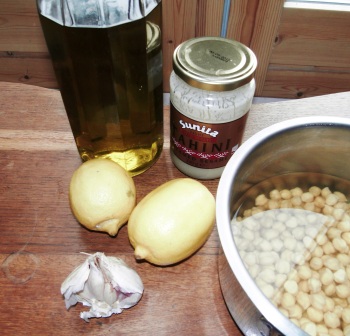
The cast is assembled. The starring ingredients (pictured) in a classic production of hummus are: olive oil, a jar of tahini,  lemons and garlic, and chickpeas soaking in a pan of water.

Thanks to kineseology, I was recently diagnosed as lactose-intolerant. Ah ha! The missing piece of the jigsaw – no wonder I prefer vegan food.

I am sad to ban eating cheese, butter and cream but not when I realise those yummy darlings make my gut sore because I lack the digestive enzymes to process them. Apparently most non-Europeans (including Mediterreanean/Eastern European types like myself) are lactose-intolerant.

This makes me ponder: our dairy-filled western diet may be dominant but is it giving the rest of the world a belly-ache?

So instead of eating cheese, I concoct homemade hummus every week. Although made from plants, hummus is a complete protein because it is combines different groups of plants, in this case, chickpeas and sesame seeds.

You can buy cooked chickpeas in a can in most shops and search out a wholefood shop or Mediterranean/Middle east delicatessen for a jar of tahini (sesame seed paste) and raw chickpeas. This recipe uses raw chickpeas.

The amounts are enough for a party dip, or eight-ten servings. I dollop it on toast, brown rice, grated carrots, lentils, fried eggs…

[Note: Chickpea upped from 100g to 150g following Ingrid Rose’s helpful comments below. So do take note when doing five times the amount, Ingrid Rose!]

150g dried organic chickpeas soaked in over twice the amount of water. Soak overnight (or speed up the process by soaking in boiling-hot water) in a pan. The chickpeas will go from shrunken to plumped-up pellets.

Bring the pan with chickpeas to the boil then simmer for an hour (on a low light with a lid) until they are soft-enough to mash.

Drain the chickpeas (hang on to the cooking water for later) and put them in a large deep bowl ready for mashing (or blending) together with:

3 Tablespoons of organic tahini or sesame seed paste. I use a dessert spoon for measuring because it will fit in the jar – give the tahini a jolly good stir before spooning out.

3 Tablespoons of olive oil

Juice of two lemons – cut in half and rotate a fork vigorously to extract the juice and pulp or use a lemon squeezer. Organic lemons can be smaller than non-organic ones and have more pips but they are more juicy.

2 fat cloves of garlic – crushed with a garlic crusher or the flat of a knife. It’s optional – not everyone loves immune-boosting garlic.

Add salt and black pepper for taste and/or crushed chilli and/or ground cumin.

A word on chickpeas. You can buy them tinned – conveniently and organically – but I prefer dried. Dry, rattly chickpeas which you soak are cheaper, tastier, less watery and have twice the nutrients than canned ones.
blending-chickpeas

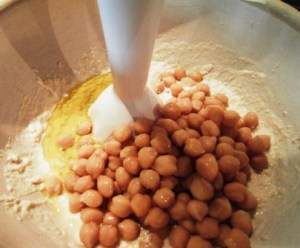
I blend half the drained chickpeas with:

garlic, lemon juice, tahini and olive oil

and whizz till smooth. It’s easier to work in small batches.

Then I add the remaining chickpeas – see picture above. If the mixture is too stiff to blend, add a teaspoonful or two of the cooking water. You are aiming for smooth and creamy not runny.

I am addicted to my electric handheld blender but a strong fork or potato masher will mash the chickpeas – just make sure the garlic is well-crushed before adding.

And here’s the mystery, every homemade hummus turns out differently.
Have you made hummus?

hummus-on-toast

Reblog this post [with Zemanta]

Beetroot soup

blended-beetroot-soup-cropped1

Sharon made this soup for me. We have known each other since we were eight, and been best friends since we were 21. She recently gave me a card. It said: “A friend is someone who likes you even though they know you”.

I have a demanding digestion that cannot tolerate tomatoes but finds root vegetables soothing. Knowing my idiosyncratic dietary needs, my pal made me a Winkler-friendly beetroot soup.

Nothing beats the beet. Its colour is dramatic but it’s not all for show. Those vivid reds deliver nutritional punch, a detoxifying antioxidant called betacyanin, according to nutritionist Natalie Savona.

I love this recipe because it uses the whole beetroot so no waste. An electric blender gives the soup its smooth texture. Wear an apron when preparing and cooking beetroot as it can stain.

Sharon found the recipe in her beloved Moro cookbook. Here’s a lazier version:

You need two bunches (750g) of organic beetroot, 1 large onion, 1 potato, oil, cumin, fresh parsley and a tasty vinegar such as red wine or balsamic.

1. Cook sliced onion in 4 tablespoons of olive oil for 10 gentle minutes in a large pan

2. Add 2 rounded teaspoons of cumin (or more – 2 did not make it taste cumin-y, or grind some fresh)

3. Stir cumin and onions for a minute till the cumin releases its aroma

4. To the onion potion add beetroot – 750g previously peeled and diced quite small

5. Also one peeled and diced potato to thicken the soup (hey, do we really need to peel pots? I am gonna experiment without). Note: the smaller the diced cubes the less time they take to cook

5. Add 1.25 litre of water and simmer for 15 minutes or until veg is easy-to-munch

6. Blend soup, return to the pan with 2 tablespoons of red wine vinegar (or balsamic?) and season to taste

7. Add fresh parsley (or coriander I say) to each bowl of soup.

Do you like this sort of soup?

Vegan noodle pie

vegan-noodle-pie

I dedicate this post to fellow blogger, Meg Wolff, who recovered from cancer thanks to a macrobiotic diet and Donna, a woman who befriended me at a Devon train station, who – it turns out – also cured her cancer after following a macrobiotic diet for ten months.

When Donna first approached me at the brightly-lit station on a dark wintry rainy evening last week, saying: “Hi, I am Donna,” I thought she had mistaken me for someone she knew.

Or maybe we had met…in another dimension?! (I love these stories so bear with me, you rationalists).

Donna asked me: “Are you interested in shamanism?”. “Always” I answered because I love real-life mystery.

To which she replied: “You have good medicine around you.” And I was thrilled.

Donna gave me her card and we are now in email contact – that’s how I know about Donna’s macrobiotic diet, and Axminster’s Awareness Centre, and her parents, the original ‘organic kids’, now 89 and 91. So listen up, you young things, eat your organic greens to get some healthy longevity inside you!

This is all the encouragement I need to eat more organic grains and vegetables, keeping animal-food to a minimum…

Donna and my other dedicatee, Meg Wolff, share many beliefs including the magic of writing things down.

Go visit Meg Wolff’s inspiring blog and I won’t even mind if you don’t come back.

Ah, you are back. OK, so Meg sent a newsletter which included a recipe for vegan lasagna. As a mama, I made lasagna but never considered how to veganise it – until this moment!

So I played around with Meg’s original recipe and here is mine – all ingredients from my local organic shop, the Better Food Company.

I peeled and chopped a big slice of pumpkin, putting the chopped-up pieces gently oiled, in a roasting pan to sizzle away in a medium-hot oven for 40 minutes.

For oil, I used Clearspring organic sunflower seed oil (first cold pressing for a naturally-nutty taste), a new discovery thanks to speaking coach, John Dawson.

While the pumpkin pieces were doing their thing in the oven, I made a vegan white sauce with organic soya milk, sunflower margarine and Dove’s rye flour, adding sliced fennel and mushroom, and tamari sauce, for interest and taste.

Then I drained and mashed 450g of tofu with gently-fried slices of onions and some sprinkling of smoked paprika.

I dunked 50g of gluten-free buckwheat noodles in a pan of boiling water until they softened – about five minutes.

Then I assembled my layers into an oiled-casserole dish, starting with the drained noodles covered with half the fennel and mushroom sauce, followed by the mashed-up tofu and the roasted pumpkin pieces, followed by the rest of the sauce – and baked it for 20 minutes.

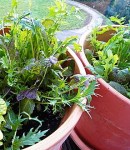
I served it with fresh mustard leaves which grow on my balcony in salad pots from Cleeve nursery bought at the Organic Food Festival in Bristol last September – an easy way to have fresh leaves (see pic below)!

It was comfort food-supreme with the baked noodles reminiscent of lokshen pudding from the alter heim.

Happy Obama week!

salad-growing-on-a-balcony

Reblog this post [with Zemanta]

Meeting Gordon Brown

Last week I left my cosy brown rice world (centre) for that of Gordon Brown’s (right pic). An invite from the prime minister was hard to resist. I was not alone. A hundred other members of the British Society of Magazine Editors turned up at number 10 Downing Street for the reception.

The prime minister’s short talk featured self-deprecating anecdotes.

I’d heard him tell some before at a previous reception also organised by the society.

April 2007. After his talk, Gordon Brown, then-chancellor, went on a fifteen-minute steered-mingle round the packed reception room. I introduced myself.

“Elisabeth Winkler from the Soil Association. We were disappointed you did not include agriculture in your green budget.”

I explained how organic farming reduces farming’s carbon footprint because it bans the use of oil-guzzling artificial fertiliser.

He changed the subject by commenting on the growth of farmers’ markets. I furnished him with a figure: farmers’ markets now number over 500. He nodded, echoing the stat.

The trick in these conversations is not to wait for Gordon to give encouraging nods and smiles. You have to deliver your message regardless.

Fast forward to last week – I failed to listen to my own advice. I only got to press his flesh and give my name and rank.

I really wanted to say: if you want an easy win, Gordon, forget GM. It’s uneconomical for farmers and unpopular with the British public.

But I fell under his spell and let him pass.  Listen, I can’t be superwoman all the time.

In his talk, Gordon Brown’s only mention of the current financial crisis was to tell us to blame the Treasury if we did not like the wine (joke). Despite the prime minister’s unwillingness to engage in the topic – and William Green, editor of Time Europe, tried hard enough – the credit crunch cropped up in every other conversation I had.

Several editors asked me if the recession would affect organic farming’s future.

I said organic farming sales had not faltered in the last recession; indeed Green & Black’s organic chocolate launched during that dire time.

And another thing, I continued, food prices are linked to oil. The price of organic food has the potential to become lower than non-organic food because organic farming uses less energy than non-organic farming.

Then I skedaddled down the road to Central Hall, Westminster, where the Soil Association’s new president, Monty Don, was giving the charity’s annual lecture in memory of its 1946 founder, Lady Eve Balfour.

Lady Eve was a cool cat who believed in caring for Mother Earth. She set about proving organic farming is better for the soil than agrichemicals. Food should be eaten as close to its source as possible, she said. Way to go.

Monty Don encouraged us to become organic vegetable gardeners. You can’t get more local than that.

Afterwards, in the Soil Association reception (organic wine, this time) several growers expressed concern that Monty’s message undervalues their skills. It’s the opposite for me: trying (failing) to grow veg has made me value the farmers more than ever.

Monty Don has reservations about the word organic, calling it “an albatross”. He is good with words (I headhunted him for Living Earth, the Soil Association magazine). Later I found myself at the bar with Monty and his wife Sarah. I said: “It’s not the word that’s the problem but the bad press associated with it. Like feminism,” I added (as a feminist).

Monty said the word ‘organic’ can make people feel guilty.

Is organic a good or bad word?

Reblog this post [with Zemanta]

GM? No way, no thanks

First, an advert for healthy eating brought to you by Earthmother productions. Worried about your health? Eat organic and for colour! Nature has kindly colour-coordinated its plant nutrients so you can mix-and-match. Step forward orange carotenoids for vitamin A production and purple and deeply-green antioxidants for cell-restoration.

If the veg is organic you get more antioxidants for your money. Here’s why: if you spray a plant with pesticides (which is how most western food is grown), then its ability to produce antioxidants is decreased. Antioxidants are the fighting army that protect a plant from pests and there are more in organic food because the organic plant gets to keep its antioxidant army. Fade on ad.

And the UK government wants to re-open the GM debate! Crikey, as if we don’t have enough to contend with just trying to grow a few unsprayed organic veg.

GM crops are modified in a lab to tolerate a herbicide (weed killer) or produce an insecticide (insect killer). Farmers have to buy the GM seed and the proprietary pesticide (umbrella term for herbicide, insecticide and fungicide).

If GM seeds or pollen arrive accidentally on a field, GM companies can sue farmers for patent-infringement. California voted to protect farmers against such lawsuits in August. It’s more fair if the polluter-company pays for GM contamination, as the Welsh Assembly government proposes – and not the hapless farmer.

The pro-GM marketing spin says GM can feed the world – how selfish of me to stop a technology that saves the hungry! But it’s a lie. There are no GM crops designed to help the poor. The current GM crops are engineered for insect and weed-spraying – not to improve yields, vitamin A, drought-prevention or any of the other mythical scenarios dreamed up by well-meaning but misguided press officers.

The (so-called) environment minister, Phil Woolas, said people like me have a year to prove GM is unsafe.

A body of evidence is growing; the ill-health effects on animals is well-documented. But the fact is the science has not been done. Commercial planting of GM especially in the US has pushed ahead regardless.  Listen, there has only been one trial published worldwide on humans eating GM food. And that showed worrying results.

I think we need more science on the health effects of GM.

And, Woolas – it’s not up to me to provide it.

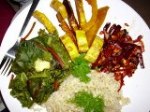
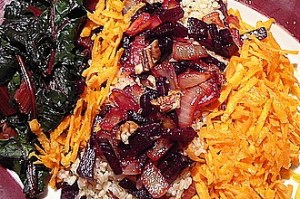
On a gentler note: the ingredients for supper came from Better Food organic supermarket, which also grew the organic veg 12 miles away. The chard was steamed, the carrots grated and the beetroot, cut very small, was – new discovery – pan-fried in olive oil for 20 minutes with sliced onion. Served on a bed of brown rice; 1 mug of rice to 2 mugs of water, simmered for 30 minutes – enough for two, and a rice salad the next day.

Andy’s vegan curry and a coincidence

Andy\'s veg vegan curry

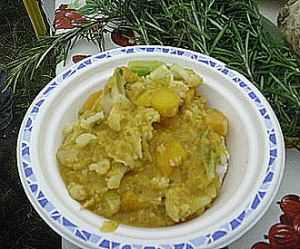
When you are partying in a field, a warming bowl of aromatic vegan veg curry on a bed of rice is most reassuring. The field had been transformed overnight into a human encampment with dance tents, music and smoking fires. And a kitchen under canvas to which I gravitated.

Andy was catering. He had borrowed pots, hired gas rings and an urn, and was cooking at a trestle table. I have a gypsy fantasy of being a festival cook but it’s bloody hard work.

Anyway, we chat about food and he mentions a friend studying at the Slow Food university called Henry.

“Henry who?” I ask, thinking of Henry Hoffman

“Henry Hoffman,” says Andy.

This is the one and the same Henry who commented about my pics from Italy saying, quite rightly, my header pic needs serious attention.

The sages say there is no such thing as a coincidence. Here I am in a Somerset field meeting someone who was schoolboy pal and is fellow foodie with the unknown stranger-person who commented on my blog.

If I am to extract a deeper meaning, I would say I need a new header pic asap. And possibly help from Henry Hoffman himself.

Tofu smoothie offering

Tofu smoothie

I lay on my bed, as heavy as a stone. How to eat when your energy deserts you? Gazing up at my lampshade reminded me of the yellow-themed photo competition in aid of Bri, the young food blogger who has breast cancer.

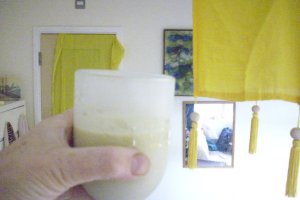
Here is my offering. A tofu smoothie in a recycled glass held up against my yellow lampshade (with yellow scarf draped over the door).

Tofu is a miracle food because it’s protein-rich but incredibly light and easy-to-digest. Made from bean curd, it’s a great invalid food because meat and dairy can be a bit hardcore when you are feeling weak.

Even chewing can be hardcore. So I blended everything and all you have to do is sip this creamy smoothie, gently.

I whizzed up 225g tofu, 2 tablespoons of ground almonds (or same amounts of peanut butter/almond butter), one sliced banana, 300 mls (half pint) rice milk and a teaspoon of cinnamon (and the same of turmeric for yellow-colour and its fabulous health properties).

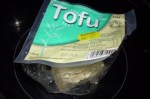
Below, I pictured the half-empty tofu packet as well as a Tibetan mandala puja ceremony I went to at the Pierian centre today. The monk had spent the last week (it was Refugee week) making a mandala from rainbow-coloured sand but today he dismantled it, prayerfully.

We followed him to Bristol’s river Frome where he cast the sand grains into the water, a reminder of both life’s impermanence and the eternal and reviving now.

Tofu in a bagTibetan mandala puja ceremonyMandala puja ceremony

Red lentil soup

My friend Sheila said, “come over,” and I said, “shall I bring something to eat?” With only an hour and a half to spare and no time to shop, soup made with split red lentils was the only answer.

Without much ado, I soaked 125g red lentils for half an hour in about 4 mugfuls of water. The little dried red things (a storecupboard-must!) absorbed some water and softened – then I applied the heat. As I brought the pan to the boil, I chopped one onion and chucked it in.

You can see the uncooked onion pieces and some lentils floating on the surface as the soup begins to boil (above).

The strange naked beast in the picture is a peeled turmeric root from Marshford organics. I have never seen turmeric’s root root before, only its powder. It is closely related to ginger, but unlike that root, turmeric stained my hand yellow as I sliced it.

I also added sliced organic carrots that had overstayed their welcome at the bottom of my fridge and quarter of a dried chilli, not enough to bite.

Once the soup had come to the boil, I simmered it for half an hour until it was a soup-y mush. To make sure of its mushiness, I gave it a quick whizz with my handheld electric blender.

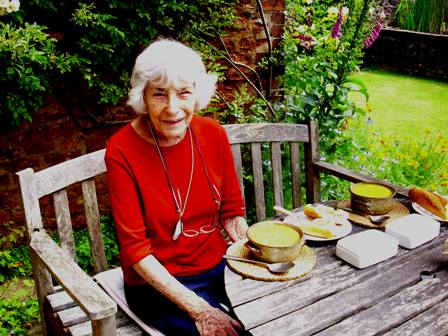
I got the soup safely to Sheila’s and we ate in the garden (see below).

I first met Sheila when, pregnant, I wandered into the Birth Centre circa 1977 to find out more about natural childbirth. On impulse, Sheila offered me a job wo-manning the Birth Centre ‘phone. She was a signpost in my life, putting me on track for the start of my new career as an ante-natal teacher and writer.

Sheila is a natural pioneer. Ahead of her time, Sheila brought the French obstetrician, Frederick (birth without violence) Leboyer to the UK, and changed our views of birth forever.

I see parallels between real food and natural birth; both aim to understand and work with nature rather then supplant it with risky and often unnecessary intervention.

yellow flower in Sheila\'s gardenSheila in gardenLentil soup

Tamarind and green tea noodles

Green tea noodles and tamarind stir fry

Cooking is like dancing – to keep it fresh you need to learn new steps.

Thanks to Mallika’s Quick Indian Cooking, I have added curry leaves and tamarind to my repertoire.

I had to improvise with the other ingredients.

Tonight was cold and misty so instead of eating grated organic carrots as a salad, I fried them in olive oil. In this bold mood, I also fried organic alfafa sprouts, the first time ever.

At the carrot stage, I also fried ten dried curry leaves, which wilted aromatically – not scary at all. Then mustard seeds and a teaspoon of tamarind paste.

I could not resist adding a quarter of a tin of coconut milk and snippets of dried chilli for spicy creaminess.

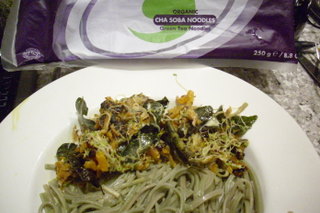
I finished off a packet of organic cha sob green tea noodles that had been lurking in my store cupboard – they only took three minutes to cook.

It was a quick supper to make and delightful to eat, while the tamarind emparted a tart lemony-lusciousness – my new exciting dance step, definitely.

Brown rice, chives – and chewing

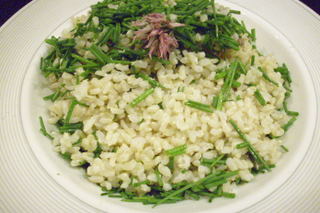
Brown rice and chives

When all else fails nothing beats a bowl of brown rice. It is a soothing superfood. With its husk still intact, brown rice brings strength – more vitamins and fibre than its denuded sister, white rice.

My brown rice is organic – what’s the point of eating a superfood if sprayed with chemicals?

I added chopped chives (and its mauve flower), olive oil and a tiny smattering of Atlantic salt to the cooked rice.

Organic brown rice a store cupboard-must because it’s nutritious, economical and sits there Buddha-like till needed.

It requires little attention while cooking. One mug of rice does for two, generously. Add to a pan with twice the amount of water (2 mugs of water for one of brown rice) and bring to the boil. Simmer for 30-40 minutes with the lid on. Brown rice is soft and chewy when cooked.

The macrobiotics swear by brown rice and so do I. It’s so yang, it relaxes the digestion and detoxifies.

If you really want to be macrobiotic, you stay in the moment while eating it. Spiritual warriors aim for 50 chews a mouthful to calm their mind and their digestion.

I can manage about four mouthfuls of conscious chewing before my natural impatience takes over.

How many chews do you give a mouthful?