Category Archives: vegan

My night in Bristol’s rebel restaurant

Ra-ta-ta-tat on the big red door.

Entry into the wood panelled hall of Quay House.

Once Bristol’s customs house, now disused offices, the Quay House is squatted on behalf of Cloak and Dinner, Bristol’s rebel restaurant.

Seems criminal that such a place lies empty.

Good on the squatters, for invoking Section 6 and making such creative use of it.

For four nights, Quay house is host to what the Guardian calls the hottest ticket in town.

I pass the candlelit lounge where guests will be served gin and tonic.

Up another flight, past the red-curtained dining area, also wood panelled and candle-lit, where the diners will be served a four-course meal with vegan and vegetarian options.

Up the next flight to the brightly lit kitchen milling with volunteer helpers, which reduces to a core team of about seven, myself included.

An anarchist kitchen is the opposite of a  Gordon Ramsay one.

Amidst cries of “Table 7 just finished their starters” and “four vegetarian mains”, the kitchen is calm.

No one is throwing their weight around or shouting.

Anarchists believe – as do I – that human nature is basically cooperative.

And cooperate we did.

“Best borscht soup I’ve ever tasted,”  says a customer at the end of the night, the dreadlocked waiter reports.

Eve had made a soffrito of celery, onions, leeks – added grated beetroot and water to simmer. Blended when cooked. With Cabernet Sauvignon vinegar, grated lemon zest and sugar to taste. Indeed the best.

For starters: pillows of filo pastry filled with mashed pumpkin, carrots, wilted rocket and walnuts, served with Caerphilly cut from a truckle of cheese.

Steam rising on bean stew served on a cabbage leaf on top of potato mash flavoured with mustard seeds.

The venison comes from Fair Game in Nailsea. The young farmer shot the deer, skinned and butchered it last week. Chef Christopher cooked it with sloe gin and the bones until aromatically tender. “The venison was superb,” says another guest who visits the kitchen to praise.

Canterbury pie about to be plated. The recipe for sweetened pastry comes courtesy of Irish chef, Richard Corrigan, while apple puree topped with thin apple slices is from classic cook, Mary Berry. The vanilla ice-cream is homemade, by Eve.

The vegan option at the open window.

I make the pies, following Sarah’s  instructions, based on the available ingredients. No scales, just guess work. My sort of cooking.

Crush biscuits in a bag, mix with melted Pure organic marge (just enough to moisten crumbs). Press into a plate. Mash bananas with ground almonds and cinnamon. Drizzle melted dark chocolate, add hazel and walnuts and drizzle more chocolate. That’s it.
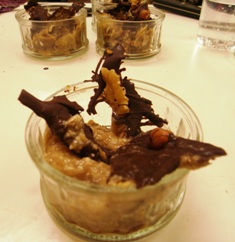
The banana mixture was too slurpy to cut cleanly so it became a concoction in a ramekin with chocolate and nut lattice broken to sit on top.

The washer upper working with grace all evening, backbone of the operation.

Darren, Saturday’s chef, sweeping the floor in readiness for his shift the next night.
His day job, The Kensington Arms, lent the linen for the rebel restaurant.

“Some people like vegging out in front of the TV. But something like this brings people together,” he says.
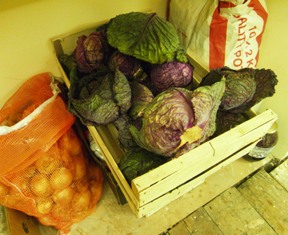
Cabbage in crates. Darren considers how to use them for his chef-shift.
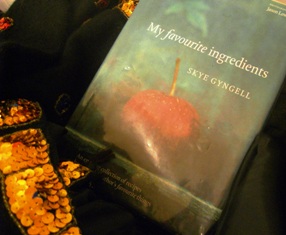

Skye Gyngell’s cookery book, My favourite ingredients, amongst the coats.


Art by Libby in the lounge where gin and tonic is served as the punters arrive.

Happy customers.

“Most restaurants have no soul,” says a guest. He and his girlfriend heard about the rebel restaurant through Facebook. The 50+ covers a night got booked up as soon as word got out.

Each chef has £75 a night to conjure with, money made from a previous project, topped up with food donations from local food businesses.

People paid what they could afford. Last night we made £800 – to go towards the next project.

Everyone gives their time freely. I end the night with a heart full of love.

Making marmalade


Marmalade lovers, if you have only ever eaten shop-bought marmalade, you MUST try making homemade marmalade at least once in your life.

Last Sunday at 7.30pm, I committed myself to an evening of marmalade making so I could enjoy real marmalade on toast (above).

Ingredients and cost

4lbs (1.80kg) Seville oranges

I bought 1.975g  of organic Seville oranges for £5.89 at Better Food organic supermarket

4lbs (1.80kg) granulated sugar

I bought the non-organic kind at Scoopaway – 1.990g white sugar @ 1.29kg = £2.57

Sugar

Sugar is cheap compared to the fruit because it is so heavily subsidised. As a commodity, its future gets gambled on and prices look set to rise.

Would much prefer organic vegetables to be subsidised, rather than sugar.

I weighed out 4 lbs (1.8kg) granulated sugar into a pan, now warming in a low oven.

Warming the sugar makes it easier to melt into the fruit.

Softening oranges

I scrubbed the oranges and removed the stalks on each one.

They are now in a preserving pan with 4 pints of boiling water.

I have found a baking tray to cover the pan. The pan hisses.

Katie Stewart says it takes 1.5 hours to soften the oranges.

Katie (whom I once met when she won a Guild of Food Writers Lifetime Achievement Award) says 3lbs of fruit, 6lbs of sugar and 5 pints of water. In my bid for less sugar, I have experimented over the years and now use equal sugar to fruit.

Christabel who works at Better Food suggested adding orange blossom water for extra orange zing.

Haiti

Very aware of Haiti. Grateful for my life where I can calmly make marmalade. A fellow food blogger, Sabrina Ghayour is organising a Food Lovers fundraiser for Haiti. Please support this event with donations and helping promote it.

Pectin

9.30pm. I have cut the softened oranges in half and scooped out pith and pips with a teaspoon. Pith and pips (repeat-very-fast) are boiling for 10 minutes in 1 extra pint of water to extract the pectin. Pectin is crucial for helping the jam to set.

After 10 minutes of vigorous boiling, I strain the pith and pips. This takes ages as I can only get a small amount in my small strainer. The pectin-filled water goes into the preserving pan with the cut-up peel and the warmed sugar. I add the juice of two lemons.  And its flesh for good luck.

If you don’t have a preserving pan, use your biggest pan or divide amounts into two pans. You need to boil sugar-fruit-water super-vigorously for 15-30 minutes without worrying about it boiling over the sides.

Making up for lost water

The lid on the softening oranges was makeshift and inadequate, and I am paying the price: I lost precious pints in steam. I ended up (after adding strained pith-and-pips water) with 1.5pts in total. I have boldly added an extra 2pts making it up water total to 3.5 pints.

PS A few days later: And it worked! Marmalade as delicious ever.

Boiling fast to set

10.30pm. I have added the sugar to the cut-up peel and water

For some reason Jeanette Winterson is in my head. I am thinking about her organic shop in East London and wondering if she is as driven to write now she has her shop. But perhaps she arrived in my mind because Oranges Are Not The Only Fruit.

11.20pm. The marmalade has been fast-boiling for 20 minutes.

I draw it off the heat to test for a set because if you over-boil, it can lose its setting point. Who says cooking is boring? It is full of drama.

Earlier I put two plates in the freezer. I will now drip some hot jam on its cold surface and wait a few minutes. If the cooling jam crinkles when I push it with my finger – then success, it has set.

Then finally – after the second lot of 15 mins of fast boiling, that tell-tale crinkling. Joy.

The marmalade cooled while I set up a Facebook page for Foodlovers Fundraiser for Haiti, a small thing that I could do to help this cause.

12.45am. And here are my 8 pots of marmalade.

It was a palaver but it was worth it.

What do you think?

Beetroot and carrot soup

Beetroot and carrot soup

When I say I am a food writer, people assume I am a gourmet foodie, a superior being who will look down my refined nose at their offerings.

Nothing could be further from the truth.

The reality is I am an everyday, sloppy, how-quickly-can-I-eat-well cook.

My concerns lie not with how food looks, or how unusual or exotic its ingredients are but rather how healthy are they and how they were grown.

I want to demystify cooking not put it on an pedestal.

So this soup could indeed be my ‘signature’ dish. It’s comfort food made with locally and organically-grown vegetables, it took me about half-an-hour to make, is healthy and tasty.

I cut an onion and sweated their slices in olive oil in a medium-size saucepan with a lid on. I washed but did not peel the 2 large beetroots, ditto the 5-6 carrots. I chopped carrots and beetroot in inch-bites because the smaller you cut ’em, the quicker they cook.

I added the chopped veg to the softening onions, and added 3-4 mugfuls of water (one mugful=1/2 pint), and simmered it for 20 minutes, with the lid on.

I did not add salt. Both beetroot and carrot are so sweet, what other taste is needed?

I did add black pepper. And I whizzed it with my £20 handheld electric blender because I am a bit of a baby and like eating mushy-comfort food.

Escoffier, I ain’t.

So have no fear, past and future dinner hosts!

Reblog this post [with Zemanta]

Hemp porridge and membrillo

Amaru hemp porridge with membrillo

Above pic represents synchronicity and sustainability  – and a comforting, tasty and easy-peasy way to get top nutrition. Just add water…

I also dolloped on membrillo – recipe below. It’s nice with something a bit sweet such as sultanas.

Synchronicity: I went to Shambala and got so turned on by hemp porridge, it became the subject of my last post.

Two weeks later, I am at The Organic Food Festival – the after-festival party to be precise at Berwick Lodge, Christopher Wicks’ new fab place – when I find myself talking to what turns out to be:

Rebekah Shaman, founder and director of Amaru Hemp.

Oooooh, I like Rebekah. Right from the start, she plunges me into different worlds with her words for instance about her time as The Shaman’s Last Apprentice in the Amazon.

She also gives me the lowdown on the nutritional powers of hemp:

  • 19% protein (meat is 30%)
  • easily absorbed globular protein (must find out what globular means)
  • every known omega, with omega 3 and 6 ideally balanced
  • every known amino acid
  • every known essential fatty acid.

One conversation leads to another and soon we realise we were linked in a myriad of different ways, culturally, socially etc.

I am taking this seriously (in an excited way): Amaru organic Hempower and me may have some work to do together in the future. Watch this space.

As for The Organic Food Festival 2009 – wow. Hot brilliant sunshine, old friends, new friends, people trading in a wholesome, future-proof, sustainable ventures – no wonder the atmosphere was elated and connections were buzzing.

I was on The Source stall with my darling editor, Dr Rachel Fleming. We shared it with the renewable energy specialists, Kaieteur, and organic soap makers, Flo and Us, both from Sidmouth.

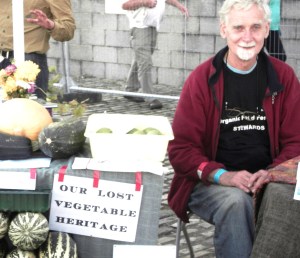
Also sharing our marquee was James Bond (yes, that is his name) of the Avon Organic Group – his organic damsons were a talking/ tasting point for the crowds.

James Bond, Avon Organic Group at The Source stall

James gave me some beautiful quince, and this week I made membrillo for the first time, with a recipe from the Avon Organic Group. Here it is (+ my comments).

1. Quarter quince, leaving core, skin, pips intact. Add just enough water for quince to float. Simmer 1 hour or more, or until it reduces to a smooth pulp.

2. Sieve to remove pips and skin.

I am afraid I got fed up of unsatisfactory sieving (and it was midnight when I started). So I blended the whole lot, skin, pips and all. As a result it did not have that pale pink translucency of traditional membrillo – but it packed more of a nutritional punch and tasted richer and denser. (And was less fiddly).

Making membrillo 1

3. Add sugar to equal weight of sieved pulp, or at least 3/4 of weight.

Not being a sugar-freak, I used 1lb 6oz rapadura sugar to 1lb 12oz of fruit. Apologies for imperial measures – this often happens when I cook.

4. Simmer for 1-2 hours or until it has reduced to a thick pulp and darkened considerably. Stir to avoid sticking.

I stirred non-stop for 1 hour, getting spattered with boiling jam when I stopped. Wear an apron!

Making membrillo 2

5. Pour into greased or non-stick baking pan to a depth of 1-1.5 inches.

6. Bake in a low oven (140c) for about 1 hour.

7. It should set to a firm paste. Cool and cut into bite-sized squares.

Mine set to a kind of thick jam.

And it goes really well with hemp porridge.

Stop press: Amaru co-director Carlo Dawson agrees to take Brixton Transition Town pound.

HemPower pic 448 X 336

Reblog this post [with Zemanta]

Hemp porridge knowledge

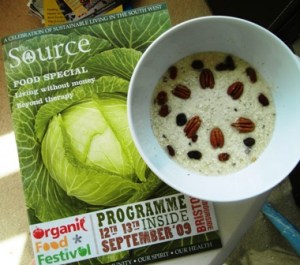
Hemp porridge and The Source (small)

I went to Shambala festival and got turned on by hemp. Every morning I would emerge from my tent to tramp across a field for hemp porridge breakfast.

Its creator, Eddie Callen, told me how he makes it: mixes it 50/50 with oats, by grinding 1/4 of the oats with all the hemp seeds, from Yorkshire Hemp. Once emulsified with the seed oil, the rest of the oats grind-in easily. Then water, hot or cold, to make the porridge, and a host of sprinkles: nuts, goji berries, agave syrup, cranberries, for taste and nutrition.

(I used pecan nuts and sultanas for my hemp breakfast back-home, see pic above).

A fount of hemp-knowledge, Eddie told me how hemp can grow abundantly in the UK without pesticides and fertilisers.

Hemp plants are so productive too: omega 3-rich seeds, and textiles, rope and paper. More sustainable than paper from trees – and cheaper.

We want hemp! ‘Tis the the earth’s most sustainable material.

Although hemp belongs to the same plant family as cannabis it has NONE of its mind-altering properties. It got a bad rap all the same and got outlawed in the 1930s but now it’s legal to grow although most UK hemp ends up as animal bedding.

Hemp-evangelist Eddie Callen was cheffing for the Community Medical Herbalists.

I had gone to see one, John E. Smith, for some remedies and it was he had told me about Eddie’s hemp-prowess.

Festivals are like that – it’s green networking city. I bumped into colleagues, past and present, as well as the legendary Simon Fairlie, editor of The Land. Its summer issue focuses on the  enclosures of Britain’s commons – historical events I have long been fascinated by as I see the roots of our present-day ills in the past.

People’s right to grow food or forage was taken away by force or legal stealth from approx from 1300s to end-18th century. Just as indigeneous people are deprived of their land today.

O I am in the mood for digression. Last night I saw Winstanley, an amazing film. Set in 1647, shot in black and white, British weather featured strongly, with only a camp fire and thatched tents to protect the Diggers from the incessant dripping rain. (As a recent camper, I identified).

Gerrard Winstanley wrote: the earth was “a Common Treasury for all”. He tried to reclaim the top of a hill in Surrey with his fellow Diggers but was beaten by the establishment.

I read about Gerrard (am on first name-terms as he is new hero) in the Land and talking about magazines, note my pic above and the latest issue of The Source.

I am SO proud to be writing for The Source, the southwest’s great green magazine.

In this issue, The Source reviews the new Transition book, Local Food, and asks:

What will we eat when the oil runs out?

The answer is green, local, organic, healthy food…and hey – this means the freshest tastes too. Talk about win-win-win-win solutions.

The Source also carries the programme for The Organic Food Festival, taking place THIS weekend in Bristol.

Organic is farming for a green future.

I am with the Shambala witches on this one.

Da witches have no Plan B (2)

Kitchen fairy at Lost Horizons

backstage at Lost Horizons with yogurt

I went to Buddhafield festival and became a kitchen fairy.

I was sitting in a Bedouin tent, as one does, listening to Martha Tilston on stage at Lost Horizons, the legendary travelling café and wood-burning (mostly naked) sauna.

I heard a cry above the music:

“Can someone stir the milk? In exchange for a chai.

Can someone stir the milk?”

“I can stir the milk,” I said.

In the field kitchen, backstage at Lost Horizons, a wooden spoon in hand, I stirred a cauldron of milk coming to the boil.

A dramatic creature with blonde curls, tight trousers and a rocker’s face appeared.

“Turn it off when it comes to the boil. Do you know when it’s cool enough to add the yogurt?” he asked.

“You say Hare krishna hare krishna krishna krishna hare hare hare rama hare rama rama rama hare hare,” he said at such speed and with such authentic inflections that I did not recognise it.

He turned out to be the legendary and talented artiste, Prana, from the Bindoo Babas.

But I got the gist, and the yogurt got made ready to set

albeit with Nyam myo renge kyo a chant I do remember.

I also did loads of washing up.

The combination of working outdoors as the rain bounced off the canvas and being part of a crew gave me unusual washing-up energy.

My reward was a bowl of spicy hearty aduki bean soup with mostly organic ingredients cooked by Richard, the chef.

Richard, Lost Horizons kitchen chef

“Aduki and mung beans are the only ones that don’t need soaking,” he said.

I noticed a chalkboard sign calling for kitchen fairies.

I arranged to come back the next day.

Reblog this post [with Zemanta]

Turnip tops and haricot beans

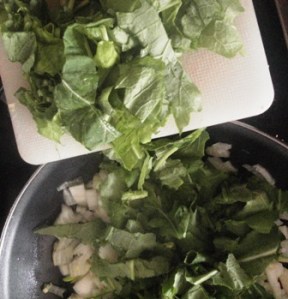
Cut-up turnip tops and into the pan they go

After a lively exchange on Facebook about how to cook turnip tops, I set to con brio.

I also consulted Jane Grigson‘s The Vegetable Book and, as always, she came up trumps with Broccoletti di rape. They eat turnip tops in Italia, you know, and appreciate their health-giving qualities.

Then I winklerfied all the information and this is what happened:

I started the whole process by frying onions because once I have done that – I am committed.

I washed the fresh turnip tops bought the day before at Bristol Farmers’ market from the wonderfully abundant organic Wrington Greens stall.

Leaves so young and fresh, I had no need to remove their stalks – just gathered them on a board and chopped them once or twice.

Then tipped them into the gently frying onions (see pic above) and stirred it all a bit.

But what to add? It’s amazing what is in the fridge. I found haricot beans, cooked at the weekend, perfectly edible and ready to go.

And of course the ubiquitous brown rice, cooked the night before.

Several grinds of black pepper, a smattering of nutmeg, a crunch or two of rock salt, a splatter of soya sauce, and about 5-10 minutes later, the dish was ready to eat.

Voilà , a plate of mean greens and beans…

turnip-greens-with-fried-onions-and-haricot-beans

Vegan nettle pesto and brown rice

nettle-pesto

Nettles came to the rescue today when the cupboard was bare.

Abundantly springing up on our path. Luckily we had Mike’s gloves.

We pinched off fresh tips and dropped them into a foraged plastic bag.

At home I planned to make pesto, having seen a recipe last week.

But vegan as I now eschew dairy for the sake of my delicate gut.

The following came under the force of my hand-held blender:

3 shallots fried in a tablespoon of olive oil

40z nettles drained after plunging in boiling water to de-sting

bit of cinnamon bark

handful of raw sunflower seeds

balsamic vinegar

olive oil

and salt.

I whizzed, obtaining a seriously delicious green sauce.

Served with brown rice (leftover from last night and stir-fried with shallots and ginger) and some freshly soaked and simmered-for-one-hour-till-soft haricots beans.

Ray Mears, author of Wild Food, says Bosnians sold nettles to eat during the war.

But don’t wait for disaster to discover their nutritious qualities.

This is the spirit of  Transition: prepare for climate change by leading a green life now.

Oh dear. I am such a dilettante. How can I transition without my electric blender?

Not to mention the balsamic vinegar

What would you miss/embrace in a low-carbon world?

Reblog this post [with Zemanta]

Nettle soup is the one to make

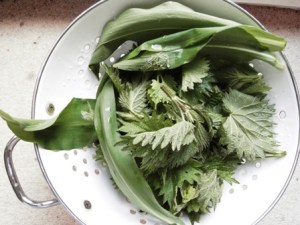
nettles-and-wild-garlic-rinsed-in-colander

Sometimes an idea takes years to come to fruition. It has distinct stages such as scoffing, curiosity, acceptance then habit.

Take nettles. I used to think eating them was weird. But over the years the idea started to intrigue.

Last spring in Westward Ho! Chloë showed me a patch of nettles, and how to pick then with gloves, the freshest top leaves according to another blogger. Nettles were no longer alien as I cooked them in pasta and soup and found them delicious.

Perhaps precisely because nettles are wild and have not been cultivated or hybridised, they taste extra-vibrant and are highly-nutritious.

This spring, in Bristol, I saw nettles growing and thought “soup”. Then on Friday I overheard Leona, the owner of St Werburgh’s City Cafe talking about: “nettles and wild garlic soup.”

The next day Mike and I found ourselves on a magical walk beside the river Avon  in a mysterious part of the city. An abundance of nettles and wild garlic grew.

conham-on-the-river-avon

I picked up a discarded Tesco plastic bag (litter bugs have their place in the universe), sniffed it, found it clean and after borrowing a glove, started pinching off the fresh greens and filling the bag.

The next morning, I weighed the nettles and the wild garlic: 4 ounces.It didn’t seem enough – but it was.

I cut up a fat onion and gently fried it in 2 tablespoons of olive oil in a saucepan. I let it stew for an hour with the lid on, so the onion was soft and a bit caramelised. I was experimenting but you could fry the onion for much less time (like 10 minutes or so).

I added 900 mls of water. To thicken the soup I added 1 ounce of raw oats.

Then I snipped in the washed nettles and wild garlic, and let it simmer for about five minutes and turned off the saucepan. The soup carried on cooking with the lid on.

And it was delicious.

Can you get food more real than nettle soup?

nettle-and-wild-garlic-and-onion-and-oat-soup

Proud to fly the Food Renegade flag, I contribute this blog on local and sustainable Nettle Soup to Fight Back Fridays to help overturn the domination of industrialised food!

foodrenegadefist_150

Reblog this post [with Zemanta]

Vegetable soup

vegetable-soup

I made a raid on the fridge last night and seized my suspects. The remains of that celery cowering in the corner? Into the pan you go. That inch of courgette, those flabby carrots? Their fate was sealed. Even the large but softening beetroot was fair game.

I started by frying onions in 2-3 tablespoons of olive oil. I find if I start by frying, it commits me to cooking and I have to carry on.

But one was not enough. This soup had four onions, peeled and chopped. An onion-craving due I believe to the weather turning – after the spring sun, back to British chill. I swear these temperature changes play havoc with the immune system and thus my body was pleading for sustenance.

Who would have thought that the miserable occupants of my fridge plus the onions could help? But they did.

I amused myself by cutting the vegetables as thinly as possible, inspired by browsing through a copy of a recipe book by Boy George and his macrobiotic cook in the Luscious Organic shop in London last Friday.

I peeled everything because although the veg were organic and thus pesticide-free, they looked in need of a beauty peel.

Cooking is so dramatic. Look at the mess I made with the peelings. But aren’t they beautiful? Some naturally interlaced with each other too…

peelings-resized

I was entranced by my vegetable peelings but life is tough and into the compost bin they went.

Meanwhile the mound of veg in my pan (with lid) was stewing away. I gave them a stir every now and then.

Then I added water – about 500 mls – and left the concoction to slowly simmer with the lid on.

I could have added salt to flavour but I had a brain wave. Due to an enduring macrobiotic flirtation, I had some miso in the fridge (it keeps for ages).

Miso is a friend, providing flavour, health and richness just from fermented plants such as soya beans or brown rice or barley.

I squeezed about two tablespoons of the miso into a cup, added some hot water and mixed it to a thin paste, which I added to the soup.

For garnish, I added a handful of nettles I had picked on our walk yesterday, and served the soup with fresh organic bread. It had taken a pleasant half-an-hour to produce from virtually nothing and it was delicious.

I swear I heard my immune system whisper “thank you”.

Reblog this post [with Zemanta]