
Category Archives: sustainable

Vegan nettle pesto and brown rice

nettle-pesto

Nettles came to the rescue today when the cupboard was bare.

Abundantly springing up on our path. Luckily we had Mike’s gloves.

We pinched off fresh tips and dropped them into a foraged plastic bag.

At home I planned to make pesto, having seen a recipe last week.

But vegan as I now eschew dairy for the sake of my delicate gut.

The following came under the force of my hand-held blender:

3 shallots fried in a tablespoon of olive oil

40z nettles drained after plunging in boiling water to de-sting

bit of cinnamon bark

handful of raw sunflower seeds

balsamic vinegar

olive oil

and salt.

I whizzed, obtaining a seriously delicious green sauce.

Served with brown rice (leftover from last night and stir-fried with shallots and ginger) and some freshly soaked and simmered-for-one-hour-till-soft haricots beans.

Ray Mears, author of Wild Food, says Bosnians sold nettles to eat during the war.

But don’t wait for disaster to discover their nutritious qualities.

This is the spirit of  Transition: prepare for climate change by leading a green life now.

Oh dear. I am such a dilettante. How can I transition without my electric blender?

Not to mention the balsamic vinegar

What would you miss/embrace in a low-carbon world?

Reblog this post [with Zemanta]

Nettle soup is the one to make

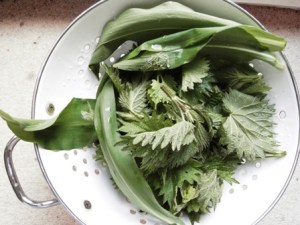
nettles-and-wild-garlic-rinsed-in-colander

Sometimes an idea takes years to come to fruition. It has distinct stages such as scoffing, curiosity, acceptance then habit.

Take nettles. I used to think eating them was weird. But over the years the idea started to intrigue.

Last spring in Westward Ho! Chloë showed me a patch of nettles, and how to pick then with gloves, the freshest top leaves according to another blogger. Nettles were no longer alien as I cooked them in pasta and soup and found them delicious.

Perhaps precisely because nettles are wild and have not been cultivated or hybridised, they taste extra-vibrant and are highly-nutritious.

This spring, in Bristol, I saw nettles growing and thought “soup”. Then on Friday I overheard Leona, the owner of St Werburgh’s City Cafe talking about: “nettles and wild garlic soup.”

The next day Mike and I found ourselves on a magical walk beside the river Avon  in a mysterious part of the city. An abundance of nettles and wild garlic grew.

conham-on-the-river-avon

I picked up a discarded Tesco plastic bag (litter bugs have their place in the universe), sniffed it, found it clean and after borrowing a glove, started pinching off the fresh greens and filling the bag.

The next morning, I weighed the nettles and the wild garlic: 4 ounces.It didn’t seem enough – but it was.

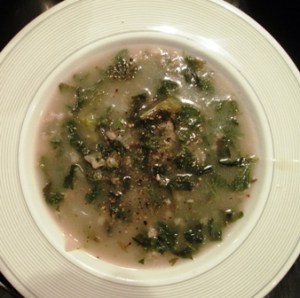
I cut up a fat onion and gently fried it in 2 tablespoons of olive oil in a saucepan. I let it stew for an hour with the lid on, so the onion was soft and a bit caramelised. I was experimenting but you could fry the onion for much less time (like 10 minutes or so).

I added 900 mls of water. To thicken the soup I added 1 ounce of raw oats.

Then I snipped in the washed nettles and wild garlic, and let it simmer for about five minutes and turned off the saucepan. The soup carried on cooking with the lid on.

And it was delicious.

Can you get food more real than nettle soup?

nettle-and-wild-garlic-and-onion-and-oat-soup

Proud to fly the Food Renegade flag, I contribute this blog on local and sustainable Nettle Soup to Fight Back Fridays to help overturn the domination of industrialised food!

foodrenegadefist_150

Reblog this post [with Zemanta]

Fast fish dish

ling-and-sprouting-broccoli

This fish dish had to be fast as it was 11pm at night and we were all tired.

I sliced several shallots thinly and fried them gently in olive oil, with the heat turned right down and the lid on. Using a lid is my new habit; it retains heat so ups a dish’s eco-credits,  as well as moisture and flavour. Win/win/win…

Still in my macrobiotic-mood, I slivered an inch of peeled raw healthy ginger in with the onions. Then I placed the fresh fish fillets on its bed of onions and back went the lid.

I figure the fish cooks by a combination of steam and heat from the aromatic stewing onions. If you can add some scientific know-how, please do!

I had bought the fillets of ling that morning from David Felce, one of two fab fishmongers at Bristol Farmers’ market. Although from the endangered cod family, the ling is line-caught, a method that does not net a ton of other fish at the same time, (then discarded wastefully).

Ling is not considered glamorous but please ignore this illusionary hierarchy of fish. Seasonal and fresh, its flesh is firm, white and flavoursome.

Meanwhile I steamed my beloved purple sprouting broccoli from Radford Mill organic farm shop, having sliced its woody stems into smaller tubes so they would be soft enough to eat.

Purple sprouting broccoli is in season from January to May when other UK-grown greens are sparse, according to my much-recommended Riverford Farm Cook Book.

I had some miso paste left over (a tablespoon of miso blended with water) and added it to the pan with about 50mls of water, for extra flavour.

We served it with organic spelt bread bought at the Common Loaf stall – who make their bread with love and the best raw ingredients-ever – also from the farmers’ market.

And voila, after 20 minutes, the dish was ready. Fast-enough for you?

P.S. The next day I had the pleasure of meeting and having lunch with a fellow blogger, Helen, from Haddock in the Kitchen. Helen was over from France visiting her lovely daughter Holly.

We ate freshly-cooked food at Zazu’s Kitchen – heartily recommended.

We chose frittatta (omelette and potatoes and herbs) and salads (including my adored lentils). I pictured my lunch with Helen’s kind gift, a pot of honey, or miel, comme on dit en français.

The honey was made by a friend of Helen’s in France.  Oooooh I absolutely love real honey.

zazzus-2409

Reblog this post [with Zemanta]

Vegetable soup

vegetable-soup

I made a raid on the fridge last night and seized my suspects. The remains of that celery cowering in the corner? Into the pan you go. That inch of courgette, those flabby carrots? Their fate was sealed. Even the large but softening beetroot was fair game.

I started by frying onions in 2-3 tablespoons of olive oil. I find if I start by frying, it commits me to cooking and I have to carry on.

But one was not enough. This soup had four onions, peeled and chopped. An onion-craving due I believe to the weather turning – after the spring sun, back to British chill. I swear these temperature changes play havoc with the immune system and thus my body was pleading for sustenance.

Who would have thought that the miserable occupants of my fridge plus the onions could help? But they did.

I amused myself by cutting the vegetables as thinly as possible, inspired by browsing through a copy of a recipe book by Boy George and his macrobiotic cook in the Luscious Organic shop in London last Friday.

I peeled everything because although the veg were organic and thus pesticide-free, they looked in need of a beauty peel.

Cooking is so dramatic. Look at the mess I made with the peelings. But aren’t they beautiful? Some naturally interlaced with each other too…

peelings-resized

I was entranced by my vegetable peelings but life is tough and into the compost bin they went.

Meanwhile the mound of veg in my pan (with lid) was stewing away. I gave them a stir every now and then.

Then I added water – about 500 mls – and left the concoction to slowly simmer with the lid on.

I could have added salt to flavour but I had a brain wave. Due to an enduring macrobiotic flirtation, I had some miso in the fridge (it keeps for ages).

Miso is a friend, providing flavour, health and richness just from fermented plants such as soya beans or brown rice or barley.

I squeezed about two tablespoons of the miso into a cup, added some hot water and mixed it to a thin paste, which I added to the soup.

For garnish, I added a handful of nettles I had picked on our walk yesterday, and served the soup with fresh organic bread. It had taken a pleasant half-an-hour to produce from virtually nothing and it was delicious.

I swear I heard my immune system whisper “thank you”.

Reblog this post [with Zemanta]

Brown rice is nice

rice-with-mike

I have ten minutes to write this blog starting from now (8.15pm).

Wow, it usually takes me two hours including uploading pics, checking links etc.

My first link goes to Haddock in the Kitchen for a novel use of my ten-minute rule

– why not use it to complete a blog?

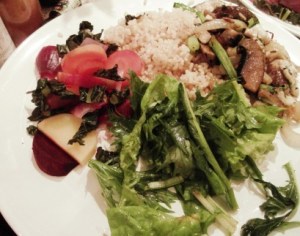
Mike and I have  been eating brown rice with every meal since March 1st (I have been counting) and it is beautiful, truly a superfood.

Above, brown rice came with organic local greens, from Radford Mill Farm.

(and mushroom) served with a salad of grated organic carrots

with olive oil and balsamic vinegar.

Below, brown rice with fresh organic veg including steamed beetroot and parsnip.

To my right, a new addition to the blog: my first ad.

What do you think about ads on a blog?

more-brown-rice

Reblog this post [with Zemanta]

Homemade yogurt

homemade-yogurt-310109

I made this yogurt. If I can do it, so can you (I am not known for my technical expertise). It tastes wonderfully-different from anything I can buy in a plastic pot. And ’tis joy-supreme not to be adding to the plastic-pot recycling mountain in my hallway.

I stopped making yogurt after being diagnosed as lactose-intolerant last autumn, but I missed all those zillions of friendly bacteria in my gut. I know I could have made it with soya milk, which I do love (in tea and on oats) but somehow could not bring myself to embrace in yogurt.

So I figured I would experiment with my lactose-intolerant boundaries. For surely my fellow lactose-intolerant eastern-european/middle-eastern ancestors ate yogurt? As a fermented food, yogurt is pre-digested so must be easier to tolerate. Is there a nutritionist in the house? What do you think?

Anyway, on a gut level (so to speak) all I know is my intestines smile when yogurt comes its way, saying hi in a welcoming way. Unlike with milk, which feels too viscous and hard work for my sensitive insides.

Now let me introduce you to my friend, the yogurt-maker. This fairly low-tech device that costs about £20 to buy and pennies to run has enabled me to become yogurt-literate.

yogurt-with-yogurt-maker

You can’t see from my pic but the plastic yogurt-maker has a plug. That’s how it works: switch it on and the yogurt-maker keeps the warmed-milk-that-will-be-yogurt at an even temperature.

Hugh Fearnly-Whittingstall says a wide-mouthed warmed thermos flask does the trick and ditto, a towel to wrap it up in and a radiator – but it’s the nifty yogurt-maker for me.

I say low-tech because it does not switch itself off after the regulatory eight-hours. So it does take planning. I have to ask myself before starting: will I be here in eight-hours to turn off the device?

Here are the ingredients you need to make longevity-boosting yogurt:

1.5 pints (850 mls) of organic milk

2 teaspoons of of natural, bio-live, organic yogurt (or from your last yogurt batch)

You have to boil the milk until it bubbles to get rid of bad bacteria and then let it cool down to blood-temperature i.e. I stick a clean finger into the cooled-down milk  and it feels pleasant and warm – not scalding-hot or, at the other extreme, brrrrr on the chilly side.

I found this operation the most taxing because after the novelty of testing too-hot milk wore off, I then forgot all about the cooling milk and by the time I remembered, it was stone-cold again. So my top tip is: try to keep conscious of time as the milk cools.

Once the boiled milk has cooled to blood-temperature, I put it in the yogurt-maker (that I’ve switched on five minutes beforehand to warm up). Then I stir in two teaspoons of yogurt, which always seems too measly to do the job but that’s all it takes to start the fermentation process. Amazing.

I find yogurt very acceptable first thing in the morning because it is non-demanding and soothing. And I add freshly-ground health-giving spices, such as cinammon, cardammon and cloves for extra zing.

Now for my yogurt-award acceptance speech. Thank you, Martin Smith, ex-propriétaire of  Danescombe Valley Hotel, who demystified yogurt-making; my Indian food guru, Mallika, who has inspired me to use freshly-ground spices from scratch; Maninas, for adding cinammon bark and whole cloves to my repertoire. And finally thanks to Beccy and Hannah at the Spark for explaining how to use the grinder-attachment on my blender…

Who would you thank in your oscar-award speech?

Reblog this post [with Zemanta]

Meeting Gordon Brown

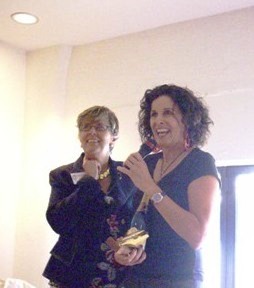
Last week I left my cosy brown rice world (centre) for that of Gordon Brown’s (right pic). An invite from the prime minister was hard to resist. I was not alone. A hundred other members of the British Society of Magazine Editors turned up at number 10 Downing Street for the reception.

The prime minister’s short talk featured self-deprecating anecdotes.

I’d heard him tell some before at a previous reception also organised by the society.

April 2007. After his talk, Gordon Brown, then-chancellor, went on a fifteen-minute steered-mingle round the packed reception room. I introduced myself.

“Elisabeth Winkler from the Soil Association. We were disappointed you did not include agriculture in your green budget.”

I explained how organic farming reduces farming’s carbon footprint because it bans the use of oil-guzzling artificial fertiliser.

He changed the subject by commenting on the growth of farmers’ markets. I furnished him with a figure: farmers’ markets now number over 500. He nodded, echoing the stat.

The trick in these conversations is not to wait for Gordon to give encouraging nods and smiles. You have to deliver your message regardless.

Fast forward to last week – I failed to listen to my own advice. I only got to press his flesh and give my name and rank.

I really wanted to say: if you want an easy win, Gordon, forget GM. It’s uneconomical for farmers and unpopular with the British public.

But I fell under his spell and let him pass.  Listen, I can’t be superwoman all the time.

In his talk, Gordon Brown’s only mention of the current financial crisis was to tell us to blame the Treasury if we did not like the wine (joke). Despite the prime minister’s unwillingness to engage in the topic – and William Green, editor of Time Europe, tried hard enough – the credit crunch cropped up in every other conversation I had.

Several editors asked me if the recession would affect organic farming’s future.

I said organic farming sales had not faltered in the last recession; indeed Green & Black’s organic chocolate launched during that dire time.

And another thing, I continued, food prices are linked to oil. The price of organic food has the potential to become lower than non-organic food because organic farming uses less energy than non-organic farming.

Then I skedaddled down the road to Central Hall, Westminster, where the Soil Association’s new president, Monty Don, was giving the charity’s annual lecture in memory of its 1946 founder, Lady Eve Balfour.

Lady Eve was a cool cat who believed in caring for Mother Earth. She set about proving organic farming is better for the soil than agrichemicals. Food should be eaten as close to its source as possible, she said. Way to go.

Monty Don encouraged us to become organic vegetable gardeners. You can’t get more local than that.

Afterwards, in the Soil Association reception (organic wine, this time) several growers expressed concern that Monty’s message undervalues their skills. It’s the opposite for me: trying (failing) to grow veg has made me value the farmers more than ever.

Monty Don has reservations about the word organic, calling it “an albatross”. He is good with words (I headhunted him for Living Earth, the Soil Association magazine). Later I found myself at the bar with Monty and his wife Sarah. I said: “It’s not the word that’s the problem but the bad press associated with it. Like feminism,” I added (as a feminist).

Monty said the word ‘organic’ can make people feel guilty.

Is organic a good or bad word?

Reblog this post [with Zemanta]

Roast organic chicken from Sheepdrove farm, half price!

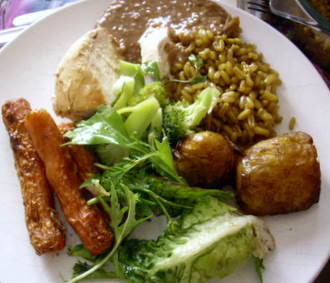
organic Sunday lunch with roast chicken from Sheepdrove

A Merrier World inspired this blog, to raise awareness for chickens. Poor things. Prisoners on a factory-production line, they have turned into commodities. An organic chicken seems expensive in comparison because it gets to lead an ordinary life.

A cheap chicken is cheap because it does not lead a normal existence. Bred to quickly gain weight, it is sometimes too heavy to walk, and, kept indoors in a noisy shed with 40,000 other birds, it is denied its natural behaviour such as feeling the sun on its back, perching or stretching its wings.

“Poor people must have cheap healthy protein,” say the chicken-factory defenders. Hello? Cheap chicken is not exactly healthy – it is full of fat, antibiotics and is a food-poisoning risk, which is why it must be cooked so carefully. A false economy, if I’ve ever heard one.

Here are ways to eat organic chicken on a budget. Buy a whole chicken and serve it as a once-a-week treat. Use its carcass for soup and leftovers for future meals. Serve it with a plateful of other goodies as I did yesterday (see the above pic with its Better Food organic salad leaves, carrots and potatoes, kamut grain and non-organic broccoli) so a little goes a long way.

My chicken came from the Sheepdrove organic farm butcher shop in Bristol, belonging to Sheepdrove organic farm in Berkshire. Master butcher, Graham Symes, picked one out for me. “See its beautiful heart shape?” he said. “That’s the way a chicken should look with the breast falling over the legs (see pic below).”

Instead of £18 for 2.6 kilos, it was half-price because of a current surplus. You can get your half-price beauties here. Hurry while stocks last!

Sheepdrove organic farm is owned and run by the kind and visionary Peter and Juliet Kindersley. Peter has put his publishing profits to a good cause, developing top animal welfare systems. My favourite Sheepdrove fact: their chickens peck at healing herbs to self-medicate. Chickens are clever creatures when allowed to be their natural chicken-selves.

The Kindersleys have recently developed a terrific new safe way of feather-plucking on its on-farm abattoir. Usually the feathers are loosened by dunking the dead birds in a bacteria-infested hot bath. The new Sheepdrove method of steaming could dramatically reduce the number of bacteria for non-organic and organic poultry alike.

Our chicken was delicious. “It tastes like chicken should taste,” said my sister who is a regular Sheepdrove shopper.

Here’s how to roast a (preferably happy) chicken: allow 20 minutes of cooking time for every pound/500 grammes – and then 20 minutes extra. I smeared the breast and legs with olive oil, rubbed in paprika and salt, and slithered slices of garlic under the skin. I simmered the giblets in wine and water for stock, and made gravy with this and the cooking pan’s juices, thickened with my new discovery: an ounce of rolled oats.

A tip for the absent-minded cook: do not put a chicken – in a plastic bag – in the oven to get to room temperature, then forget it’s there and switch the oven on. Getting melted plastic off a hot oven is no fun. Trust me.

Sheepdrove organic chicken

Guild of Food Writers awards 2008

Guild of Food Writers awardsJill Dupliex accepting her awardKatie Stewart and Elisabeth WinklerKatie Stewart and HughCookbook

The Guild of Food Writers’s annual awards party is a glittering must-go, this year held at Tamesa in the Oxo tower on the South Bank of the Thames. I was a judge of one of the awards but, shhhh, that’s all I can say about it.

Sustainability was a strong theme, from sponsors, the Alaska Seafood marketing institute and Bonterra organic wines, to the winners.

Listen, I rate the Observer’s ethical eco-hero, Hugh Fearnley-Whittingstall for his animal welfare work. But he endeared himself further by making sure (see pic 1) that his fellow author, Nick Fisher, shared the award for The River Cottage fish book. (If you click on that link, read the Amazon review by Henrietta Green of Food Lovers Britain.)

I loved Jill Dupleix‘s wise words on accepting (pic 2) the Miriam Polunin prize for Work on healthy eating. She said: “I look forward to the time when there isn’t a special category for healthy eating and all food writing is healthy.” Yeah, sister, bring it on!

The sustainability theme continued with Sarah Raven’s Garden Cookbook, which addressed food miles and provenance.

It’s always nice when you agree with the judges. Hattie Ellis won for Planet Chicken. It is a beautifully-written easy-read on a hard subject: how we treat intensively-reared chickens.

Then Bill Buckley announced that the winner (taratara) of the Lifetime achievement award was…Katie Stewart. I took this award personally (again) – The Times calendar cookbook with its seasonal recipes has been a favourite for decades. (See my beat-up food-stained version in pic 5).

An awards ceremony is such an emotional event, I was starving by the end. My hunt for food took me to a quiet part of the room where Katie stood with friends. I am afraid I could not resist asking to be photographed with her (pic 3). She said the Times cookbook was her daughter-in-law’s favourite too because people nowadays want the classics, like toad in the hole.

Then Hugh approached – clearly another Stewart devotee. (I must admit Katie looks happier with Hugh than with me but hey, that’s show biz).

Prue Leith OBE presented the awards. She explained how she gave up cooking to campaign. A champion of real food in schools, she is a woman after my own heart.

This became more evident later. There was a queue for the ladies’ and on Prue’s advice, I used the (empty) gents’ while she stood guard. I liked that – the way she encouraged an unconventional route to get results.

Spinach soup thickened with couscous

Spinach soup

I would be useless in a post-peak oil world. What would I do without my electric blender?

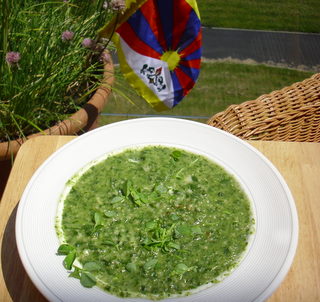
My teeth are troubling me so I made this spinach soup soothing with the help of the handheld machine. Its on-grid whirls fashioned the soup into a luxury item.

Here’s how I got there. The washed organic spinach leaves, stalks and all, went in a large pan. Spinach cooks in the water it is washed in (no need to add more) but do put a lid on to retain that moisture.

Once the spinach was cooked soft and waterless (drain to make sure), I added butter and immune-boosting garlic to frazzle in the meltedness.

But how to thicken it? I could have used flour but what is life without risk? So for the first time I sprinkled a smattering of couscous (I used organic kamut) to thicken a soup. I let it cook for a while then added a mugful of water, slowly, stirring all the time.

Reader, it worked. The couscous made it creamy.

Encouraged, I snipped in organic sprouted snow peas as a garnish.

The organic produce came from Bristol’s organic supermarket, Better Food, which is well-pleased, I imagine, with Sunday’s announcement as a finalist in the Observer Ethical Awards 2008.

Fluttering in the background is the Tibetan flag. Apparently it is illegal to fly in its home country, so it’s getting a workout on my balcony.