Category Archives: sustainable

Coed Hills magic and more hemp

Wind turbine Coed Hills ++

What is it about living outdoors that feels so good?

Last weekend I was camping on a Welsh hill outside Cardiff.

End of September autumn solstice and time for a mini-festival at Coed Hills, the off-the-grid 20-strong arts community.

A fine excuse to live outdoors in a festive atmosphere with 200 other people with similar interests: music, healing, eco-education, meditation and other forms of consciousness-raising and eating delicious healthy mostly organic vegetarian food.
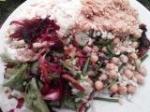
Coed meal after sauna

I went to some great talks including from BBC5.tv, saw The Age of Stupid, and gave two writing workshops myself, sitting in a yurt with talented students.

And followed the art trail in the 100-acre woods.

Indian summer autumn light but unseasonable climate-change warmth.

Being close to nature seems to open my heart. It hurts to take stock of our wasteful world.

But here at Coed Hills, people are living the dream, putting planet-saving sustainable ideas into action.

I loved the compost loos where poo is not flushed away to join our water supply but will go to feed the soil, and the willow reed beds that clean the site’s waste water.

Inspiringly, the site runs on sustainable energy including the wind turbine (see pic above) that presides over us.

Festivals are green networking cities – if not synchroni-cities.

Or just good timing.

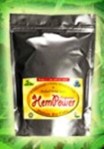
Before leaving, I don my hat as hemp ambassadress and present a packet of Amaru Hempower porridge to the Coed community.

Richard, the cook from Lost Horizons, and Coed communard, says I must meet Derek.

Soon – in festival-chaos style – I am sitting next to Derek Bielby, hemp consultant, on a deckchair in front of an open fire between the wooden sauna and a teepee.

Hemp keeps crossing my path, first at Shambala and then at The Organic Food Festival.

Incredibly nutritious, hemp is also perfectly suited to the UK climate.

Fast-growing , it is ready for harvest after 100-days of growth – and good for the land.

Hemp is super-sustainable – growing hemp for paper gives four times the yield than trees, Derek told me.

It also has many uses including for eco-building, paper and textiles.

As Derek showed me:
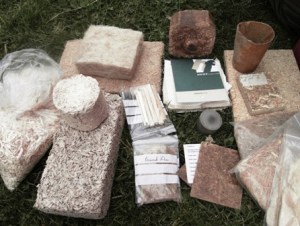
The many uses of hemp

1. In the plastic bag on the left: the woody chips, or hurd.

2.The thing that looks like a round goat’s cheese? That, and the fibrous block it sits on, is hempcrete.

Forget the C02 criminal of the building world – use hempcrete instead.

3. Above are squares of hemp felt, a natural fibre. No more toxic fibres when you insulate a roof.

4. Next to the hemp felt, a ‘log’ of hemp waste for burning – this could be used to power the on-farm hemp-processing machine, or primary processor. Talk about sustainable.

5. ‘Woodchip’ made from hemp with a garden pot made of hemp. Plus boards of resin, also made from hemp. And swatches of hemp fabric.

I did not want to leave the magical world of Coed (pronounced coid, Welsh for wood ) where you live outdoors, treading the ground unmediated by cement,  and lit at night by fires and candlelight.

But I did.

Reblog this post [with Zemanta]

Hemp porridge and membrillo

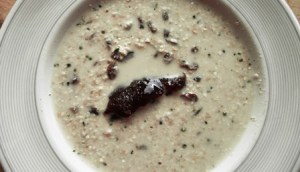
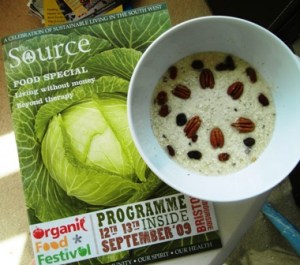
Amaru hemp porridge with membrillo

Above pic represents synchronicity and sustainability  – and a comforting, tasty and easy-peasy way to get top nutrition. Just add water…

I also dolloped on membrillo – recipe below. It’s nice with something a bit sweet such as sultanas.

Synchronicity: I went to Shambala and got so turned on by hemp porridge, it became the subject of my last post.

Two weeks later, I am at The Organic Food Festival – the after-festival party to be precise at Berwick Lodge, Christopher Wicks’ new fab place – when I find myself talking to what turns out to be:

Rebekah Shaman, founder and director of Amaru Hemp.

Oooooh, I like Rebekah. Right from the start, she plunges me into different worlds with her words for instance about her time as The Shaman’s Last Apprentice in the Amazon.

She also gives me the lowdown on the nutritional powers of hemp:

  • 19% protein (meat is 30%)
  • easily absorbed globular protein (must find out what globular means)
  • every known omega, with omega 3 and 6 ideally balanced
  • every known amino acid
  • every known essential fatty acid.

One conversation leads to another and soon we realise we were linked in a myriad of different ways, culturally, socially etc.

I am taking this seriously (in an excited way): Amaru organic Hempower and me may have some work to do together in the future. Watch this space.

As for The Organic Food Festival 2009 – wow. Hot brilliant sunshine, old friends, new friends, people trading in a wholesome, future-proof, sustainable ventures – no wonder the atmosphere was elated and connections were buzzing.

I was on The Source stall with my darling editor, Dr Rachel Fleming. We shared it with the renewable energy specialists, Kaieteur, and organic soap makers, Flo and Us, both from Sidmouth.

Also sharing our marquee was James Bond (yes, that is his name) of the Avon Organic Group – his organic damsons were a talking/ tasting point for the crowds.

James Bond, Avon Organic Group at The Source stall

James gave me some beautiful quince, and this week I made membrillo for the first time, with a recipe from the Avon Organic Group. Here it is (+ my comments).

1. Quarter quince, leaving core, skin, pips intact. Add just enough water for quince to float. Simmer 1 hour or more, or until it reduces to a smooth pulp.

2. Sieve to remove pips and skin.

I am afraid I got fed up of unsatisfactory sieving (and it was midnight when I started). So I blended the whole lot, skin, pips and all. As a result it did not have that pale pink translucency of traditional membrillo – but it packed more of a nutritional punch and tasted richer and denser. (And was less fiddly).

Making membrillo 1

3. Add sugar to equal weight of sieved pulp, or at least 3/4 of weight.

Not being a sugar-freak, I used 1lb 6oz rapadura sugar to 1lb 12oz of fruit. Apologies for imperial measures – this often happens when I cook.

4. Simmer for 1-2 hours or until it has reduced to a thick pulp and darkened considerably. Stir to avoid sticking.

I stirred non-stop for 1 hour, getting spattered with boiling jam when I stopped. Wear an apron!

Making membrillo 2

5. Pour into greased or non-stick baking pan to a depth of 1-1.5 inches.

6. Bake in a low oven (140c) for about 1 hour.

7. It should set to a firm paste. Cool and cut into bite-sized squares.

Mine set to a kind of thick jam.

And it goes really well with hemp porridge.

Stop press: Amaru co-director Carlo Dawson agrees to take Brixton Transition Town pound.

HemPower pic 448 X 336

Reblog this post [with Zemanta]

Hemp porridge knowledge

Hemp porridge and The Source (small)

I went to Shambala festival and got turned on by hemp. Every morning I would emerge from my tent to tramp across a field for hemp porridge breakfast.

Its creator, Eddie Callen, told me how he makes it: mixes it 50/50 with oats, by grinding 1/4 of the oats with all the hemp seeds, from Yorkshire Hemp. Once emulsified with the seed oil, the rest of the oats grind-in easily. Then water, hot or cold, to make the porridge, and a host of sprinkles: nuts, goji berries, agave syrup, cranberries, for taste and nutrition.

(I used pecan nuts and sultanas for my hemp breakfast back-home, see pic above).

A fount of hemp-knowledge, Eddie told me how hemp can grow abundantly in the UK without pesticides and fertilisers.

Hemp plants are so productive too: omega 3-rich seeds, and textiles, rope and paper. More sustainable than paper from trees – and cheaper.

We want hemp! ‘Tis the the earth’s most sustainable material.

Although hemp belongs to the same plant family as cannabis it has NONE of its mind-altering properties. It got a bad rap all the same and got outlawed in the 1930s but now it’s legal to grow although most UK hemp ends up as animal bedding.

Hemp-evangelist Eddie Callen was cheffing for the Community Medical Herbalists.

I had gone to see one, John E. Smith, for some remedies and it was he had told me about Eddie’s hemp-prowess.

Festivals are like that – it’s green networking city. I bumped into colleagues, past and present, as well as the legendary Simon Fairlie, editor of The Land. Its summer issue focuses on the  enclosures of Britain’s commons – historical events I have long been fascinated by as I see the roots of our present-day ills in the past.

People’s right to grow food or forage was taken away by force or legal stealth from approx from 1300s to end-18th century. Just as indigeneous people are deprived of their land today.

O I am in the mood for digression. Last night I saw Winstanley, an amazing film. Set in 1647, shot in black and white, British weather featured strongly, with only a camp fire and thatched tents to protect the Diggers from the incessant dripping rain. (As a recent camper, I identified).

Gerrard Winstanley wrote: the earth was “a Common Treasury for all”. He tried to reclaim the top of a hill in Surrey with his fellow Diggers but was beaten by the establishment.

I read about Gerrard (am on first name-terms as he is new hero) in the Land and talking about magazines, note my pic above and the latest issue of The Source.

I am SO proud to be writing for The Source, the southwest’s great green magazine.

In this issue, The Source reviews the new Transition book, Local Food, and asks:

What will we eat when the oil runs out?

The answer is green, local, organic, healthy food…and hey – this means the freshest tastes too. Talk about win-win-win-win solutions.

The Source also carries the programme for The Organic Food Festival, taking place THIS weekend in Bristol.

Organic is farming for a green future.

I am with the Shambala witches on this one.

Da witches have no Plan B (2)

GM feeds world? Don’t fall for spin

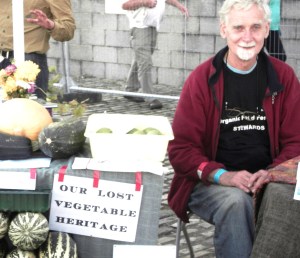
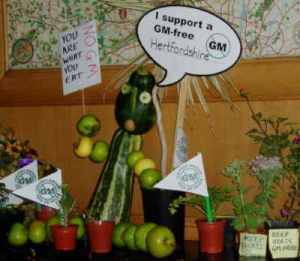
marrowman

Did you see yesterday’s print supplement to the Guardian?

Titled Agriculture, produced by the Lyonsdown media group, it was basically a huge advert for intensive farming.

Including promoting the use of GM crops in Africa.

Warning!  Spin-alert!

Don’t fall for the propaganda even if (especially if!) it comes with an ever-so-liberal paper such as the Guardian.

It is blatantly calculated to appeal to caring Guardian-reader types.

What makes me so cross is the way Africa is used in the sales talk.

Let us get one thing straight.

There is NO GM crop being grown commercially that improves yield. The only ones being grown are designed to make intensive farming tidier.

Currently, GM plants are engineered to be resistent to pesticide-spraying.  This means when a farm sprays the field, the GM crops won’t die.

How this is supposed to help a farmer in Africa?

All it does is increase dependency on agrichemical companies. The farmers have to buy the GM seed (which cannot be saved) AND the pesticides to go with it AND the licence to use it all.

One of the authors is Professor Derek Burke known as the godfather of biotech.

He writes how organic farmers are a “wealthy lobby group” preventing GM progress.

– see pic above for evidence of  “wealthy lobby group”.

So, according to the professor, a section representing 2% 0f the UK food industry, and made up of mainly small family farms, is the only thing holding back GM world domination?

No mention of the European public which does not want GM.

No mention of the African farmers who do not want GM.

And strangely, no mention of the marketing budget of  agrichemical corporations such as Monsanto and Bayer which are aggressively pushing their risky, unproven GM technology.

I wonder what the marketing-spend is on a supplement such as the one in the Guardian?

I can’t imagine a GM company is short of a bob or two for its PR war.

Good intentions at Buddhafield

Bahji seller, Buddhafield

Buddhafield Festival boasted fast food: the best onion bhajis I have ever tasted.

Nutritious – made with gram (chick pea) flour, spices of fennel, ajwain and mustard seed, and – here is the miracle – ungreasy. Generous and sustaining, only £1.

The maker was Fish, another fascinating character; makes shamanic drums from deer skin.

Here was another fast food staple from the cafe near the Dance Tent.

Soup with momo dumpling

Stuffed with chunks of fresh vegetables including sweet potato and leeks, with olives for taste and butter beans for protein, and for an extra £1 a beautiful delicate stuffed Tibetan dumpling called a momo, bringing this princely dish to £5.

There was a fire outside the cafe. On the Friday night, I had a good chat with a lovely young woman from Sheffield.

The next night we bumped into each other again. One thing led to another until she said:

She said: “You remind me of someone  know – you have similar energy….Moira”

What? My mate from Somerset who moved to Wales.

Then it all fell into place. Her parents had come to my ante natal classes over 20 years ago. “Omigod!” I said, “I knew you as a baby!” and I could remember her baby dark eyebrows and eyes there in her young woman’s face.

I take issue with that old saying: “The path to Hell is paved with good intentions”

The organisers of Buddhafield set good intentions for the festival. And much good manifested, I am sure, as a result.

Setting an intention can guide you like a compass.

On day one of the festival, a kind stranger lent us his spare sleeping bag.

When we could not find him to return it, I randomly asked his ex-tent’s neighbour:

“You don’t need a sleeping bag, do you?”

“I have not got one! Thank you!” he said.

May that sleeping bag go on to give night-warmth to whomsoever shall needeth it.

Kitchen fairy at Lost Horizons

backstage at Lost Horizons with yogurt

I went to Buddhafield festival and became a kitchen fairy.

I was sitting in a Bedouin tent, as one does, listening to Martha Tilston on stage at Lost Horizons, the legendary travelling café and wood-burning (mostly naked) sauna.

I heard a cry above the music:

“Can someone stir the milk? In exchange for a chai.

Can someone stir the milk?”

“I can stir the milk,” I said.

In the field kitchen, backstage at Lost Horizons, a wooden spoon in hand, I stirred a cauldron of milk coming to the boil.

A dramatic creature with blonde curls, tight trousers and a rocker’s face appeared.

“Turn it off when it comes to the boil. Do you know when it’s cool enough to add the yogurt?” he asked.

“You say Hare krishna hare krishna krishna krishna hare hare hare rama hare rama rama rama hare hare,” he said at such speed and with such authentic inflections that I did not recognise it.

He turned out to be the legendary and talented artiste, Prana, from the Bindoo Babas.

But I got the gist, and the yogurt got made ready to set

albeit with Nyam myo renge kyo a chant I do remember.

I also did loads of washing up.

The combination of working outdoors as the rain bounced off the canvas and being part of a crew gave me unusual washing-up energy.

My reward was a bowl of spicy hearty aduki bean soup with mostly organic ingredients cooked by Richard, the chef.

Richard, Lost Horizons kitchen chef

“Aduki and mung beans are the only ones that don’t need soaking,” he said.

I noticed a chalkboard sign calling for kitchen fairies.

I arranged to come back the next day.

Reblog this post [with Zemanta]

Harvest supper with Grofun

Grofun - 12.7.09

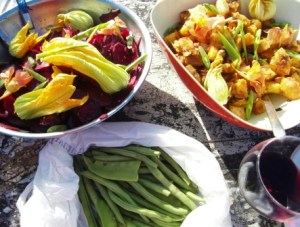
Sunday 6pm. Everything in the picture was grown on our community allotment: the beetroot, turned into slivered (use a potato peeler) salad, and the spiced Mumbai potatoes, both decorated with courgette flowers, and the green beans in their bag – all on the table in the evening sun, waiting to be eaten.

We have GROFUN, Growing Real Organic Food in Urban Neighbourhoods, to thank for this miracle.

Nadia Hillman, GROFUN’s 33 year-old Bristol-based founder, was on BBC’s Gardening World at Easter helping Birmingham set up a similar scheme.

Is your garden overgrown? Would you like help getting it fit to grow organic vegetables?

GROFUN volunteers pitch in and in return for their impressive labour they get reciprocal gardening-help either in their own garden or at the community allotment in St Werburgh’s, Bristol.

We are learning how to grow. And everyone involved gets invited to the harvest meals.

“The best thing for me is the connecting of people” says Nadia.

We sat around the fire into the evening. Mel played a haunting song on the guitar.

It sounds a moment of peace. And it was.

The Organic Food Festival 2009

Lido couscous cropped again

We met last night to discuss the Organic Food Festival 12-13 September 2009 in association with the Soil Association.

First my starter (above) which made me think: my favourite dishes are mush-tastic. I eat lots of grains and pulses, and, let’s face it, they blob.

Please don’t reject my love because of their apparent lack of finesse.

Nourishing, healthy and economical, grains and pulses lend themselves to many tastes.

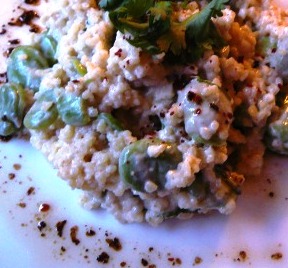
I ate the above starter (£6.50) last night at the Lido (saved and restored to its Victorian-swimming-baths-original thanks to a community campaign).

Couscous with yogurt, fresh broad beans and coriander – delicious, soothing.

Even when eating out I am drawn to mushy grains.

But why be ashamed? Eating for substance is the organic way.

“We are about inner quality, not outer appearance – that is our hallmark.”

So said Patrick Holden, Soil Association director, recently quoted in the Independent apropos the abolition of those wonky EU-rules on wonky veg.

Which brings us back to the Organic Food Festival.

Last night’s dinner was the inauguration of two things:

1) I was in my new role as food editor of The Source.

2) The Source is helping produce the programme for the Organic Food Festival 2009. And that’s what we doing, round a table at the Lido.

Every September, Bristol Harbourside transforms into Europe’s largest organic market place. The Soil Association organic festival used to be free but became so popular it got rammed so, there has been a charge. This year £1 of the £5 entry fee goes to the Soil Association.

My message?

Join us!

The Organic Food Festival in Bristol Harbourside on 12 – 13 September 2009

Taste the future

Organic is more than a product

– it is our sustainable future.

Six salad party food

Plate of party food

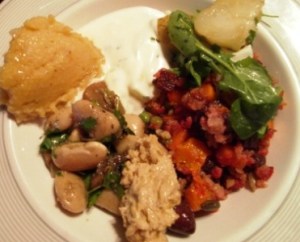
Party food chez Winkler. I was too excited to eat, so took small portions. This one went down a treat despite hostess-nerves: the wild rice salad with oven-roasted morsels of beetroot, pumpkin and carrots, and crunchy oven-roasted pumpkin and sunflower seeds. My off-the-cuff invention, it’s made the grade for next time.

The six vegetarian salads (see unposed picture above) were easy-on-the-purse and high-on-health:

1. Wild rice salad with pumpkin, beetroot and carrot – followed clockwise in the picture by…

2. Ingrid Rose’s hummus (using her 5 x amounts hummus recipe) – her birthday present to me!

3. Butter bean, mushroom and coriander salad with lemon juice

– a perennial winner thanks to Rose Elliot’s The Bean Book

4. Red split lentils with chilli. Simple dhal – light with bite.

5. Organic wholemilk yogurt with diced cucumber, black pepper and mint

6. Classic potato salad – boil halved-and-quartered (if possible NEW) potatoes until soft enough to fall from a a sharp knife when speared.

The party was on Saturday. I aimed to be prepared and avoid last-minute superstress.

Most of the shopping was done midweek.

Thursday I emptied the packet of butter beans (500g) into a large pan and covered the hard ones with water. Overnight they swelled. Some say throw away the rinsing water to reduce farting – what do you think?

Friday I cooked the swelled-up beans in enough water to cover them and boiled them for 1 HOUR, then drained. I defrosted the frozen wild rice I had cooked earlier that week (with chilli). Texture mushy but taste good.

The drained butter beans mingle eventually – with onions fried in olive oil plus 5 teaspoons of cumin sizzling for seconds. Into the spicy mix go sliced mushrooms, lots of them. You may need to add more olive oil to prevent sticking. Once the mushrooms are cooked but not soggy, then you add the drained butter beans.

I  roasted the root vegetables a day-ahead too

– seasonal local beetroots and carrots and (imported) pumpkin roasted for only 20 minutes because they were cut-up so small, and the seeds – they take minutes.

Saturday Boiled potatoes for potato salad and slouched them with olive oil, rock salt and garlic while still warm.

Peeled and diced 3 English cucumbers + mint + 3 large pots of organic yogurt, emptied into a bowl.

Assembled the wild rice salad and cooked roasted root veg and seeds.

Assembled the butter beans + mushrooms + cumin with lemon juice and fresh local organic coriander.

Wow. This was the first time I have been so prepared.

I had even sorted out the serving dishes in advance.

All the more time to party.

Me and my birthday cake Me and Richie

Reblog this post [with Zemanta]

Turnip tops and haricot beans

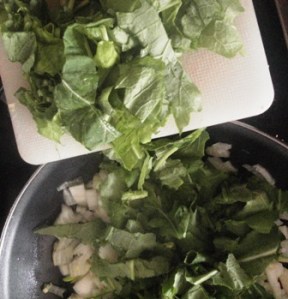
Cut-up turnip tops and into the pan they go

After a lively exchange on Facebook about how to cook turnip tops, I set to con brio.

I also consulted Jane Grigson‘s The Vegetable Book and, as always, she came up trumps with Broccoletti di rape. They eat turnip tops in Italia, you know, and appreciate their health-giving qualities.

Then I winklerfied all the information and this is what happened:

I started the whole process by frying onions because once I have done that – I am committed.

I washed the fresh turnip tops bought the day before at Bristol Farmers’ market from the wonderfully abundant organic Wrington Greens stall.

Leaves so young and fresh, I had no need to remove their stalks – just gathered them on a board and chopped them once or twice.

Then tipped them into the gently frying onions (see pic above) and stirred it all a bit.

But what to add? It’s amazing what is in the fridge. I found haricot beans, cooked at the weekend, perfectly edible and ready to go.

And of course the ubiquitous brown rice, cooked the night before.

Several grinds of black pepper, a smattering of nutmeg, a crunch or two of rock salt, a splatter of soya sauce, and about 5-10 minutes later, the dish was ready to eat.

Voilà , a plate of mean greens and beans…

turnip-greens-with-fried-onions-and-haricot-beans