Category Archives: sustainable

Speedy spelt loaf recipe – not speedy roads

I am still on real bread, the topic of my last post.

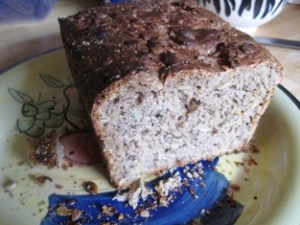
Julia made the loaf in the picture above from a recipe in the Telegraph.

Apart from bread, Julia Guest, filmmaker extraordinaire, also made A Letter to the Prime Minister.

The documentary follows the British peace activist, Jo Wilding, in Iraq before and during the 2003 invasion.

Talking about films, I was round at Julia’s on Sunday to watch Life In The Fast Lane, a documentary she was involved with about the M11 road protest (1995).

The M11 sliced through three East London boroughs and tore apart communities – all for the sake of saving motorists three minutes of time.

The M11 road protest along with similar ones at Twyford and Newbury did not stop the roads being built.

However the cost of evictions – both financially and morally – eventually halted the then-mania for road-building.

This report by the Campaign to Protect Rural England (CPRE) shows new roads are not evaluated. And grandiose claims for reducing traffic appear not to have been realised. For instance, according to Countryside Voice, the CPRE magazine (summer 2006), the Newbury town centre peak-hour traffic flows are almost back to pre-bypass levels. And, “the actual damage to protected landscapes is even worse than expected.” [added 2012]

So while we were watching Life In The Fast Lane, we ate Julia’s homemade squash-from-her-allotment soup with the amazing bread. It was delicious – tasty and healthy.

I was blown away by Life In The Fast Lane:

– the local residents who helped patrol the squat including the 93-year-old resident made a squatter in her own childhood home

– the anguished cries of schoolschildren as the 250-year old chestnut tree was torn down by a digger (reminiscent of a scene from Avatar) and despite the protestors’ beautiful tree-top home

– the spectacular London rooftop shots of squatters who locked-on themselves to chimney pots with concrete and handcuffs to stop being evicted.

It was a real insider’s view of a mega-squat resisting the onslaught of so-called progress.

The M11 movie put me in mind of the eviction of the Tesco squatters.

Julia writes: “I make this with fresh yeast from the Better Food Company and less flour. Let it rise for just over an hour in the tin, then bake it.. but no kneading at all. I use a mix of any seeds I fancy…and the quantities vary. I also add a little olive oil to stop it sticking – as well as coating the tin in oil and then a coat of small seeds. Baking only takes about 30 minutes.”

Check out Julia’s inspiration, a spelt recipe by Xanthe Clay in the Telegraph using dried yeast and requiring no kneading or proving, and an earlier one by Rose Prince that ditto is fast.

For further inspiration visit Real Bread campaigner and master baker, Andrew Whitley, and author of much-recommended Bread Matters.

And for my real-life experience of Julia’s recipe see my blog on Easy-to-make spelt loaf – it works!

Surely a quick-to-make loaf is a better use of speed than an unnecessary road?

GM potato? I prefer blight-resistant beauties

I love the look of these potatoes and their healthy interesting purpleness.

They have just had their own launch in London at the sustainable London restaurant, Konstam.

Bred by the Sarvari Trust, these Sárpo potatoes are

  • blight-resistant thus reducing pesticides
  • high-yield
  • deep-rooting
  • have weed-smothering foliage
  • low-carbon footprint
  • and can be stored unrefrigerated.

Vegetable heroes, they are on the front-line of battle against the Genetic Modification industry.

Modification? Too mild a word! Manipulation would be better.

You may have heard. In March 2010, the European Union rode roughshod over the people’s wishes and approved the first GM crop in 12 years.

BASF’s GM Amflora potato carries a controversial antibiotic resistant gene which could enter the food chain.

The EU-funded pro-GM GMO Safety website says of the GM Amflora potato.

“In this potato the composition of the starch has been altered so that it is better suited for certain industrial purposes.”

Lovely. A GM industrial potato.

Crikey. It’s enough to make me want to join anti-Europe UKIP. (Only joking).

Luckily, there is an alternative.

The Avaaz petition aims to get 1 million signatures in order to officially request the European Commission to put a moratorium on the introduction of GM crops into Europe and set up an independent, ethical, scientific body to research the impact of GM crops and determine regulation.

The funding of GM science is driven by multinational agribusiness. GM is a money spinner perfectly suited to control-freaks because once a plant is genetically modified, it can be patented.

Monsanto sues farmers in North America for having unlicensed GM seeds – even if the GM seeds arrive on their fields (as seeds do) by wind, animal or insect.

Some scientists get excited about GM, genuinely believing the technology has the possibility of helping the world.

But GM science is out-of-date, based on the belief that Genes are King.

You can’t take a genetic characteristic from one organism, put it another and tra-la-la, create a GM plant in our best interests.

The Human Genome Project proved life is far more complex than that. We disturb the gene sequence at our peril.

Scientists,  if you want to explore the frontiers of life, there is plenty of mystery in the life we already have.

Defra has to decide whether to license two GM potato trials in England.

Come on Defra! Instead of putting my taxpayer money into unproven, disaster-in-the-making technology – why not put the research money into the beautiful blight-resistant purple potato?

What do you think?

Peaceful protestors await Tesco eviction

I am in awe of the No Tesco squatters.

They are putting their safety and freedom on the line, taking non-violent direct action to keep the old Jesters building as a community centre.

It’s a lovely space with its wooden bars and stage and has become a hub of homemade entertainment and education since the squatters moved in.

In time, it could become a food coop selling affordable healthy food.

Instead Tesco wants to turn it into another soulless supermarket selling mass-produced food – even though there are five Tescos within walking distance.

The idea of another Tesco is unpopular.

Many (numbers tbc) have signed the e-petition at Bristol City Council.

3,500 have signed postcards complaining to Bristol City Council about the lack of consultation over the building’s change of use from ‘comedy club’ to ‘shop’.

Supermarkets are bad for local business and communities.

Supermarkets ‘will kill corner shops by 2015’ according to the Times.

Local shops create neighbourliness – and local profit.

Spend money with your local shopkeeper (instead of a supermarket) and the money doubles in value to the community because it is re-spent locally.

Planning laws are toothless – they cannot protect its own.

So the squatters moved into the beautiful old building Tesco wants.

Sadly, on the 2 March they lost their court case to keep it for the community.

The peaceful squatters want to save the building.

Inspired by Gandhi, they practice passive resistance, or Satyagraha.

My photo

The poles on the roof (see my pic above) are an urban version of climbing up a tree and refusing to leave in order to stop it being cut down.

It’s called manufactured vulnerability.

If Tesco wants to repossess the building, then the police and bailiffs acting on court orders will have to evict the squatters by force.

A terrible situation for all involved.

The squatters remind me of the suffragettes who chained themselves to railings.

Sometimes people take brave and desperate action to improve the quality of life for future generations.

Tesco could choose to hand the building back to the community.

What a graceful PR coup for Tesco that would be!

What do you think?

Last meal at the No Tesco squat?

Stephan rang me from the No Tesco in Stokes Croft squat.

I had just taken a picture of this Tesco bag blowing randomly on a branch in a car park in Portishead.

Stephan said tonight’s Sunday communal meal may be its last.

Last Tuesday, a repossession order was granted to Tescos plc – the ‘conscious squatters’ lost their court appeal to keep the site for the community.

I call them ‘conscious squatters’ because they look after the old Jesters comedy venue site with its bar and stage and share it consciously, hence the squat’s screening of Food Inc, last night’s Cosmic Cabaret and its regular Sunday night communal meal.

They have been occupying the premises ever since we locals heard Tesco has a planning application on the site. Even though there are 6 Tescos within a mile [see comment below] and 31 in Bristol.

I would much rather have this cosy communal space the squatters have created than another soulless supermarket.

Yet any minute now, eviction papers could be served. The squatters then have 48 hours to leave.

Here is Stephan’s Project Flowers at the squat. Note the framed flower drawings.

“Flowers represent positivity,” Stephan explains. “In a way we are all like flowers.”

He created the project so everyone could take part in it.

Food is like that – something we can all take part in.

Tonight the squat served the most amazing vegan meal for over 50 people in return for donations only.

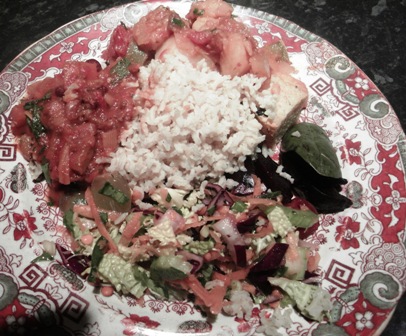
My plate of varied inventive coleslaw (raw cabbage, slivers of kiwi, finely cut celery, herbs, seeds, and cardamon), vegan chilli stew, potato curry, beetroot and spinach leaves and a mound of brown rice. Followed by homemade fruit crumble and dairy-free custard.

The funny thing tonight turned out to be networking-central. I caught up with five different lots of friends from different parts of my life (including dance, work, family and food).

The No Tesco in Stokes Croft squat is creating community.

It is budding, at the beginning of its spring growth, fertile with plans including a food coop to make local healthy food affordable for all.

It would be no joke if the squatters in the old Jesters comedy club were evicted.

Stop Tesco banner in peaceful protest

Note  Tesco’s blue hoardings, put up on Saturday, and – I might add – taking up a large part of the pavement. Cheek!

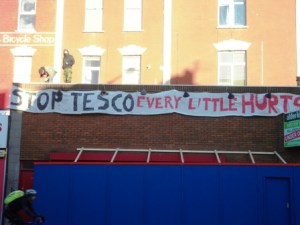
So very grateful for the handpainted banner now draped on the building (see pic above) proclaiming: “Stop Tesco! Every little hurts”.

Here is my report on Monday’s meeting in Stokes Croft, Bristol, where we heard about Tesco’s plan to build a soulless supermarket on premises which used to be a comedy club – Tesco’s, you must be joking!

It is believed the premises are occupied by some brave individuals concerned about this supermarket takeover.

Good for them, I say.

Supermarket food is not cheap because the cost to our health is so high.

What would you prefer in the place of a purveyor of industrial food?

All creative and positive ideas welcome.

My night in Bristol’s rebel restaurant

Ra-ta-ta-tat on the big red door.

Entry into the wood panelled hall of Quay House.

Once Bristol’s customs house, now disused offices, the Quay House is squatted on behalf of Cloak and Dinner, Bristol’s rebel restaurant.

Seems criminal that such a place lies empty.

Good on the squatters, for invoking Section 6 and making such creative use of it.

For four nights, Quay house is host to what the Guardian calls the hottest ticket in town.

I pass the candlelit lounge where guests will be served gin and tonic.

Up another flight, past the red-curtained dining area, also wood panelled and candle-lit, where the diners will be served a four-course meal with vegan and vegetarian options.

Up the next flight to the brightly lit kitchen milling with volunteer helpers, which reduces to a core team of about seven, myself included.

An anarchist kitchen is the opposite of a  Gordon Ramsay one.

Amidst cries of “Table 7 just finished their starters” and “four vegetarian mains”, the kitchen is calm.

No one is throwing their weight around or shouting.

Anarchists believe – as do I – that human nature is basically cooperative.

And cooperate we did.

“Best borscht soup I’ve ever tasted,”  says a customer at the end of the night, the dreadlocked waiter reports.

Eve had made a soffrito of celery, onions, leeks – added grated beetroot and water to simmer. Blended when cooked. With Cabernet Sauvignon vinegar, grated lemon zest and sugar to taste. Indeed the best.

For starters: pillows of filo pastry filled with mashed pumpkin, carrots, wilted rocket and walnuts, served with Caerphilly cut from a truckle of cheese.

Steam rising on bean stew served on a cabbage leaf on top of potato mash flavoured with mustard seeds.

The venison comes from Fair Game in Nailsea. The young farmer shot the deer, skinned and butchered it last week. Chef Christopher cooked it with sloe gin and the bones until aromatically tender. “The venison was superb,” says another guest who visits the kitchen to praise.

Canterbury pie about to be plated. The recipe for sweetened pastry comes courtesy of Irish chef, Richard Corrigan, while apple puree topped with thin apple slices is from classic cook, Mary Berry. The vanilla ice-cream is homemade, by Eve.

The vegan option at the open window.

I make the pies, following Sarah’s  instructions, based on the available ingredients. No scales, just guess work. My sort of cooking.

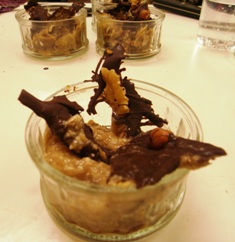
Crush biscuits in a bag, mix with melted Pure organic marge (just enough to moisten crumbs). Press into a plate. Mash bananas with ground almonds and cinnamon. Drizzle melted dark chocolate, add hazel and walnuts and drizzle more chocolate. That’s it.

The banana mixture was too slurpy to cut cleanly so it became a concoction in a ramekin with chocolate and nut lattice broken to sit on top.

The washer upper working with grace all evening, backbone of the operation.

Darren, Saturday’s chef, sweeping the floor in readiness for his shift the next night.
His day job, The Kensington Arms, lent the linen for the rebel restaurant.

“Some people like vegging out in front of the TV. But something like this brings people together,” he says.

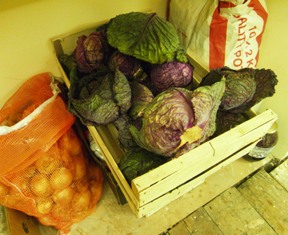
Cabbage in crates. Darren considers how to use them for his chef-shift.


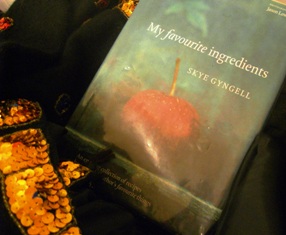
Skye Gyngell’s cookery book, My favourite ingredients, amongst the coats.


Art by Libby in the lounge where gin and tonic is served as the punters arrive.

Happy customers.

“Most restaurants have no soul,” says a guest. He and his girlfriend heard about the rebel restaurant through Facebook. The 50+ covers a night got booked up as soon as word got out.

Each chef has £75 a night to conjure with, money made from a previous project, topped up with food donations from local food businesses.

People paid what they could afford. Last night we made £800 – to go towards the next project.

Everyone gives their time freely. I end the night with a heart full of love.

Bristol’s rebel restaurant

Here I am posing outside the premises for tonight’s rebel restaurant.

Here’s what the Guardian thought after dining there on Wednesday.

The anarchist collective has squatted this fine historic building (shocking it lies normally empty, eh?) and, working for free, has turned it into a mysterious restaurant.

The idea is to create an autonomous space – free space unmediated by landlords or employers.

It’s also about eating locally and seasonally – for donations of what you can afford.

Too late to dine, I am afraid – the 50 covers for each of the four nights of the restaurant’s ephemeral existence were booked a week ago, as soon as word got out.

The tables are laid, Cloak and Dinner‘s chefs and waiting staff with maitre d’ are at the ready.

I am crewing tonight for the chef and her team.

To report back!

Beetroot soup and a good deed gone wrong

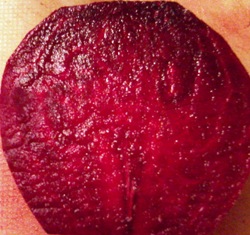
Last night’s cut raw organic beetroot.

Its insides look so mysterious.

I was making beetroot soup (again). Simplifying it.

Cut up two large peeled/scrubbed organic beetroot and place in a large pan with two peeled onions, sliced. Cover with water and bring to the boil, then simmer with a lid for 30 minutes.

I blend with an electric hand blender, my favourite kitchen power tool.

Mine was £20 second-hand, or try Freecycle for a free one, or Just for the love of it for swops.

While blending the beets (bought from Better Food), I travelled back in time:

– to fifteen years ago, and I was trying to be helpful in someone else’s kitchen.

I was in charge of the chocolate mousse.

I poured it into the mixer and pressed the button to mix.

Mayem. Chocolate mousse on every kitchen surface in spattering distance.

I had forgotten to out the lid on the mixer.

So now I practice conscious blending.

Schadenfreude means the pleasure you get from someone’s else’s pain.

I wonder if there is a word to describe the ouch you feel when you end up

causing even more ouch to the very person you are trying to help?

Served with home-grown parsley, plant from St Werburgh’s City Farm, and Yeo Valley organic cheddar shavings.

GM – the more we hear, the less we like

“Waiter, will you serve me a dish of genetically modified food?”

I don’t see anyone clamouring to eat it.

Genetic modification. Such a mild-sounding term. A bit of modifying here, a bit there – what could be wrong with that?

A lot. Genetic modification is a radical departure from traditional plant breeding.

Genetic modification is about taking a gene from one species and placing it in the gene pool of another species.

And why, pray? To help feed the world, as the GM companies would have us believe?

Um, no. Commercially developed GM crops have been ‘modified’ to survive being sprayed by the GM companies’ pesticides.

GM makes spraying intensive farms easier – just spray the field and what is left standing is your genetically modified plant.

The GM companies claim that their new technology cuts down on pesticide use.

A recent report published in the US has found that growing GM plants is actually increasing pesticide use.

Meanwhile here in old Blighty, the UK’s venerable scientific institution, the Royal Society, wants to invest millions of our taxpayers’ money into researching GM.

Stop this madness! We need to be spending our money on researching systems that DO work, such as organic farming, to find out how to make them even better.

Money invested in low-tech research is pitiful compared to money sunk in magic-bullet technologies – set to make corporations even richer than they are because – here’s the rub, so listen carefully:

Once a corporation genetically modifies a seed, the corporation can patent it. It owns the seed. 

And if that GM seed should land accidentally in a farmer’s field (and seeds do travel, borne by bees, or wind) then the farmer has to pay the GM corporation a licensing fee – viz the terrible case foisted on the 70-year-old farmer, Percy Schmeiser, in Saskatchewan, in Canada. And, according to the Soil Association, hundreds like him…

This week we heard the Food Standards Agency wants another go at persuading the British public that GM is OK.

The Food Standards Agency. That’s the same outfit that published a  flawed report in August stating  the benefits of organic food are “insignificant”. As I thrive on fresh organic food, this  incensed me. My post on the FSA’s report got the most comments ever.

So anyway, as I was saying, the Food Standards Agency (FSA) wants another go at brainwashing the British public.

The FSA is calling it a “dialogue project”.

The way we use words, eh. Obviously ‘dialogue’ was deemed innacurate – suggesting a two-way give-and-receive exchange of views. Which it is not. It’s a project. A dialogue project.

So a steering group of academics has been assembled so consumers “can be helped to make informed choices about the food they eat.”

Only two out of the 11 members of the steering group are known to be critical of GM technology, according to the Telegraph.

In fact one of the members, Professor Bryan Wynne, signed a letter to the paper saying (I paraphrase) the dialogue project was a waste of money anyway.

I like the sound of Prof Wynne.

I remember the government-led public debate on GM, called GM Nation.

The more debaters heard about GM, the more anti-GM feeling grew: “soaring to 90%” said Geoffrey Lean in this week’s Telegraph. Back in 2003 he reported how “Many regarded the debate as “window dressing used to cover secret decisions to go ahead with GM crop development”.”

The more we hear, the less we like.

Time to transition – now

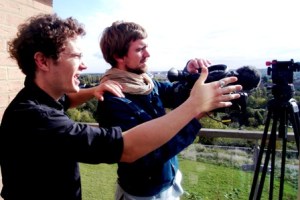
French film crew for Transition film

Last Sunday, the doorbell rung. Turned out to be a French camera crew wanting to film the allotments from our flats. I was the only one in our block who had answered the buzzer.

“Entrez,” I said. It was a random meeting but I recognised fellow media-types.

When the director came into my flat, I noticed he had a copy of The Spark under his arm.

“Tiens, voila,” I said, and introduced myself as its guest editor for the summer 2009 issue.

I gave him a copy of The Source, explaining I was now its food editor. (Never one to hold back on networking opportunities, moi. Even on Sunday morning).

He laughed. “I have just been reading that.”

He said he had really liked our features on local food:

Rachel Fleming’s take on UK food security policy and my review of Local Food, the great new practical action book by Tamzin Pinkerton and Transition co-founder Rob Hopkins.

Guess what? It turned out Nils Aguilar, the director, and his cameraman, Jérôme Polidor, were filming a movie on Transition. People in France are asking: how shall we eat when the oil runs out? Industrial food production relies on oil-based chemical fertilisers and long-distance transport.

The film is to introduce la belle France to Transition, the vibrant international green movement.  Transition encourages practical grassroot local solutions NOW – rather than waiting for the proverbial sh*t to hit fan – and works with existing green groups to achieve it.

Fortuitously, I had just seen the movie In Transition, premiered by Sustainable Redland. I liked it because it shows an amazing range of sustainable projects for food, transport etc which are already up-and-running.

The director agreed: good to be positive.

I had seen The Age of Stupid the previous Sunday at Coed Hills festival in Wales. The human stories were heart-breaking but seemed to link more in my mind to the destruction caused by oil wars and pollution rather than climate change. I can connect them in my head but not in my heart.  (Al Gore’s An Inconvenient Truth woke many up but made me go to sleep – all those graphs).

Is it because – despite my green beliefs – I am in denial too?

What I am trying to say is my meagre grasp of the science does not affect my drive to save the planet.

It is common sense to save our precious non-renewable resources and reduce CO2 emissions to stop the ice caps melting – to search for another way of living.

To paraphrase a comment on George Monbiot’s post about climate change denial:

If you believe in climate change, you end up living in a just and caring world. If you don’t believe in climate change, it’s business as usual: exploitation, pollution, disease and oil wars.

Or as climate change campaigner George Marshall says: the facts are not enough to effect change. You need belief too.

Stop press: I just read a comment on the Transition blog from a woman in Wales whose spring is running dry for the first time in over a hundred years.

Climate change is not an intellectual debate.

Wake up. We need to wake up.