Category Archives: sustainable

Kedgeree

I ask Nadia over. Our plan: to make a video of cooking kedgeree, then scoff it convivially.

We assemble the ingredients, position Nadia at the cooker and I film the three-minute video on my iPhone without a script.

I like it fast and real, like my food.

According to Wikipedia, kedgeree ‘consists of cooked, flaked fish (sometimes smoked haddock), boiled rice, parsley, hard-boiled eggs, curry powder, butter or cream and occasionally sultanas’.

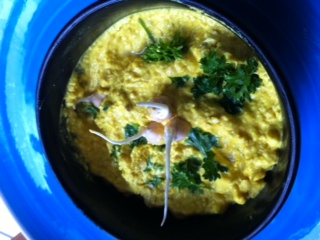
We use Organico Nerone (black) rice, into which, once cooked, we stir 1 tsp curry powder, quartered organic hard-boiled eggs, chopped dates, Fish4Ever peppered mackerel then lemon juice + chopped parsley.

We concoct curry powder with ground spices. Recipe for future ref: 4 tsp coriander + 2 tsp turmeric + 2 tsp chilli + 1 tsp ginger + 1 tsp mustard seed + 2 tsp cinnamon + 8 single cloves. We only use 1 tsp of this mix in the kedgeree. Would be wrong to overpower the rest of the ingredients…

No sultanas but miraculously I have dates, softening in water. We decide 8 cut-up small ones are fine. No butter because the fish is canned in plenty of organic sunflower oil. (I hope this encourages you to experiment when cooking).

Before Nadia arrives, I hard-boil eggs.  Note to self: try 3 next time.

I boil the rice.

250 g Organico Nerone rice simmers for 40 mins in 800 ml water. A whole grain, cook black rice as if brown rice: 1 cup of rice for 2 of water.

Listen, sometimes cooking is guess-work. Jamie Oliver uses 170g of long-grain rice for his kedgeree recipe but give no quantities of water. Water has to cover the rice generously because rice swells.

Amounts-wise, I’m a bit hit-and-miss. (Gad, how I hate reading posts like this when desperately seeking a recipe. Sorry). How do you cook your rice?

STOP PRESS: After saying on Twitter that I could not find a classic kedgeree recipe online, chef James McIntosh blogged this one! Fresh!

I was dying to try Organico Nerone rice. Known as ‘forbidden rice’, it did not disappoint. Dramatically black, the cooked grains are fragrant, dense and vibrant.

A speciality grain, it is grown only in parts of the Po valley. Charles Redfern, Organico’s founder and MD, is rightly proud of his artisan suppliers – Organico Nerone rice is cultivated and packed by the Picco family, growing it since 1878.

Organico Nerone rice recently won two stars in the 2012 Great Taste Awards. “Two stars = faultless” according to the Great Taste Awards.

Declaring interests, Organico and its sister company Fish4Ever are clients. I only promote what is Winkle-tastic real food. And I did the video just-for-the-love-of-it.

Fish4Ever, the world’s first sustainable canned fish brand, is store-cupboard convenience with a conscience. In organic world, everything is connected. Fish4Ever’s eco-practices include supporting local day boats, artisan fishing and local canning, and 100% organic land ingredients. The result? Quality fish. It’s a virtuous circle.

Here’s me eating it. Yup, I overcooked the rice a bit. And still, utterly delicious.
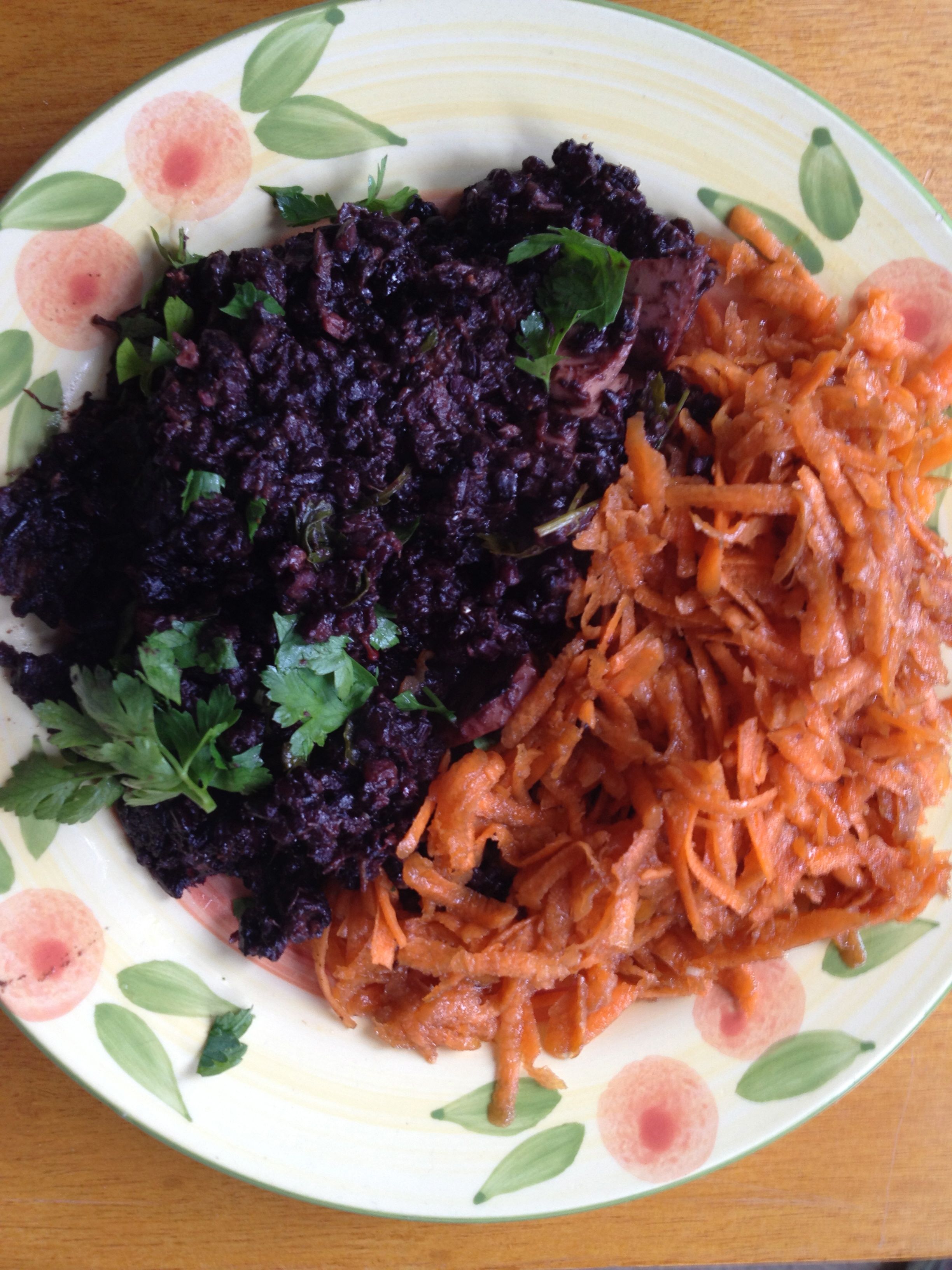
Black rice kedgeree served with grated carrots

And here it is, served the next day.
Marine Ecocide trial sets legal precedent

Ecocide is the destruction of nature, and the Ecocide Act seeks to bring those responsible for this destruction to account.

Drafted by barrister and campaigner, Polly Higgins, the Ecocide Act is not law. Not yet.

Writing post-Rio, Polly Higgins says the Ecocide Act is “a fully-worked piece of legislation which is ready to be implemented. All we need do is mobilise people to say that this must happen.”

In this spirit, the Bristol Law School organised the Marine Ecocide Trial in the presence of Polly Higgins (seated in pic below).

It was cool to meet Polly Higgins – we chatted (as one does!) about vested interests lobbying politicians. Polly Higgins said, worryingly, political lobbying is regulated by voluntary guidelines only, and only since last year.

Now to declare my vested interests: Charles Redfern, the MD and founder of Fish4Ever, the world’s first sustainable canned fish brand, is one of my clients. I only promote causes and companies I believe in. My involvement in the Marine Ecocide Trial was passionate and, mostly, voluntary (as is writing this blog).

The Marine Ecocide trial took place on the first floor of Bordeaux Quay restaurant on 15 June 2012 during Bristol’s Big Green week.

Real barristers cross-examined expert witnesses in front of judge and jury as if the Ecocide Act were law.

Although not a “real” trial, the Marine Ecocide trial is nonetheless of huge relevance to future trials. As Bristol Law School principal lecturer in law and organiser, Benjamin Pontin, says:

“Documentation and arguments used at this trial will be used as legal precedents in future ecocide trials.”

The Bristol Law School is soon to launch a website dedicated to the Marine Ecocide Trial – watch this space.

The previous Ecocide trial at the Supreme Court – which found Tar Sands bosses guilty of ecocide – had actors as expert witnesses. In contrast, the Marine Ecocide trial used real expert witnesses.

In the Bristol trial, the UK Secretary of State for the Environment, Caroline Spelman, was charged for implementing policies that “are causing damage to and destruction of UK fishing ecosystems…”

The government pleaded not guilty and did not appear. Instead Graham Watson the Liberal Democrat Member of the European Parliament  appeared as a defence witness. So did Jeremy Percy, the chief executive of the Under Tens Fishermen’s Association.

The defence focused on showing that Caroline Spelman was not in control of UK fisheries policy, because it was devolved nations and the EU also being responsible.

The Walrus and the Carpenter

The words of Lewis Carroll’s poem, about the Walrus gobbling up the oysters, came to mind as I listened to the so-called concerns of the defence:

‘”I weep for you,” the Walrus said. “I deeply sympathise”.

With sobs and tears, he sorted out those of the largest size, holding his pocket handkerchief before his streaming eyes. “”

Marine Ecocide prosecution

Jonathon Porritt appeared as an expert witness for the prosecution, swearing his oath on Gaia. He talked about the “systematic abuse of science” for political ends.

He also said that fish stocks don’t necessarily replenish once overfishing has been halted. In other words, overfishing can lead to extinction.

Another expert witness, was marine lawyer, Tom Appleby. When questioned by the prosecution about whether the UK government can legally hand out fish quotas, he said: “I do not believe Defra has this power to give out property rights.”

Dr Jean-Luc Solandt from the Marine Conservation Society gave the history of UK fishing and a factual but searing account of the damage done to the sea bed by scallop dredgers and beam trawlers.

Charles Redfern, MD and founder of Fish4Ever, the world’s first sustainable canned fish brand, was an expert witness for the prosecution.

He said that consumer awareness of the plight of the fish was a double-edged sword because now people care more about sustainability, it is possible for unauthenticated sustainability claims to be made.

Think how many times you see “Dolphin-friendly” on canned fish. Charles Redfern says you might as well label chocolate as “dolphin-friendly”; that is how meaningless the term is.

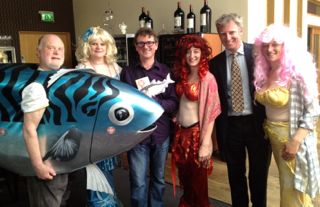
Time to present the Fish4Ever mermaids pretending to be sworn in


Imilia Lucas

Jane Victoria Powell

with costumes made by

fellow mermaid, Melanie Small.

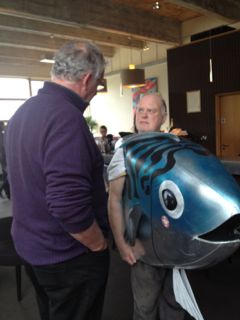
Here is the Greenpeace fish talking to fisherman, Jeremy Percy – please check out Greenpeace’s new campaign to be Be a Fisherman’s Friend.

(Yes, fishers do seem to be mostly male.).

Results of Marine Ecocide Trial

In response to the jury’s failure to deliver an unanimous verdict in the time available, the judge acquitted the Secretary of State and ordered the prosecution to pay court costs.

I am not MEANT to know how the jury of sixth-formers voted but I do know so I am now going to tell you.

The jury at first voted 7 to 5 in favour of finding the Secretary of State Caroline Spellman guilty of ecocide.

The jury went away to try to reach an unanimous verdict. It returned a verdict even closer to a guilty charge, voting 8 to 4 in favour of finding the Secretary of State guilty.

However, the jury could not deliberate further because, unlike a real trial, we only had a day, and the day was ending.

So the defence jumped in and asked for the Secretary of State to be acquitted and costs to be awarded to the prosecution, and, wrongly – in my biased pro-fish opinion – the judge agreed.

As I could not be a mermaid that day, here is a picture of me

on Bias Lane (in Devon). Apologies for the diversion.

Whatever the outcome of the trial, it raises awareness of the Eradicating Ecocide campaign to make ecocide an international crime.

As Polly Higgins wrote recently:

“Big ideas always start out in the margins before they spread into the mainstream. Earth law and in particular the law of Ecocide is just that – a big idea worth spreading.”

Worst Olympic sponsor?

The Olympics loom. Once again I am out of step with the nation. I feel like Scrooge at Christmas.

I salute sports people, their dedication and prowess. But the nobility of their art is undermined by their patrons.

Greenwash Gold is inviting votes for the worst sponsor.

I am cross about Olympics’ sponsors  of fast-foods such as Coca Cola or McDonald’s which contribute to obesity.

However, my vote for worst sponsor must go to the Dow Chemical Company.

Its website looks green and pleasant.

Dow Chemical with Monsanto produced Agent Orange, a deadly herbicide used in the Vietnam war. Agent Orange caused severe deformations in children, according to the Vietnam Red Cross.

Dow Chemical owns the Union Carbide company responsible for the 1984 Bhopal tragedy. A terrible explosion of the US multinational’s pesticide factory one night in an Indian city resulted in painful deaths, poisoned water, chronic illness.

The survivors are still fighting for justice.

Meredith Alexander, a commissioner on the sustainability watchdog of the London 2012 Games, resigned over Dow Chemical’s sponsorship.

She explains in her words why, adding:

“I would like to see Dow take responsibility for the Bhopal tragedy.. .This would be a true Olympic legacy.

Look, the London 2012 Olympics have inspired groovy things such as sourcing sustainable wood and sustainable fish. I am not saying it is all bad.

However, just as Christmas is monetised, so are the Olympics.

Rooted in mythology, the Olympics were intended to develop spirituality. O, to revive this noble intention!

Which sponsor gets your worst vote?

Thank you Criminal Chalklist for ‘100 metre Dash’ image above. I think it might have inspired this post. 

London, 17 May: Symphony of the Soil UK premiere

I am a soil lover.

Some see soil as dirty.

What does that say about our relationship with the world?

Love soil – our lives depend on it.

I am proud to be promoting the Symphony of the Soil UK film premiere on 17 May 2012.

With specially-composed music from a Hollywood great, and original animation, Symphony of the Soil is a multi-media film. Read its roll-call of expert interviewees soil scientists, farmers and campaigners including Dr Vandana Shiva.

Organico, the Mediterranean organic food company, is sponsoring the invitation-only premiere. Do Like Organico on Facebook for the chance to win tickets to this exclusive event.

Director and filmmaker, Deborah Koons Garcia (above) will be  talking about Symphony of the Soil with the Soil Association’s Helen Browning OBE and organic farmer.

In 2006, I organised the London premiere of Deborah Koons Garcia’s film documentary The Future of Food. It examined the corporate domination of our food system, sounding the alarm on GM patents, and exposed revolving-door politics between biotetch executives and the US administration.

The Future of Food helped spearhead the US real food movement, currently calling for GM labelling in California.

Deborah Koons Garcia says  that Symphony of the Soil is a positive film because we can all do something, such as make compost or support organic farms.

“I am making a positive film, science presented in an artistic manner [so] that people will fall in love with [soil] and become part of the soil community – because we are anyway. We rise up from it and we go back to it. So we’re part of it and when we are responsible members of the soil community, we give back to it, it gives back to us. …

“When people see this film they’ll actually become even more committed to a positive relationship with soil.”

As I am writing this blog, I hear BBC radio news announce: “Half of Britain is in drought.”

I shout to the radio: “Go organic!”

Organic soils retain more water than non-organic soils, according to long-term research.

If we put back what we take out, the soil can nurture us.

“We don’t grow plants. We grow healthy soil – and the soil grows the plants,” says a grower in the film.

Symphony of the Soil illuminates the complex dynamic relationship between soil life plants – “a dialogue of nutrients.”

It is all common sense. You have to put back what you take out otherwise soil becomes barren.

So why not listen to our common sense?

Follow the money.

Dr Hans Herren co-chaired the IASSTD 400-strong scientific review of agriculture which found that what the world needs now is small-scale ecological farming.

Interviewed in the Symphony of the Soil, Herren says of organic farming:

“…but it does not fill the pockets of the few. It only feeds the consumer and the farmer.”

Symphony of the Soil is a beautiful and moving film – shows how clever and intricate and subtle nature is.

But it will also made me angry and sad because there is so much needless destruction of this natural precious resource.

What is Tesco Real Food?

Tesco Real Food is the name of of Tesco’s recipe magazine and website, Tesco.com/realfood.

Launched by Tesco PLC in 2011,  the magazine is given away free by Tesco six times a year as a marketing promotion (see pic above).

Tesco sells real food in the sense it is tangible, not imaginary. But Tesco food is not what this Real Food Lover calls real food.

I have had this definition on my Real Food Lover blog since 2008.

“What do I mean by real food? As close to nature as it can get. I want mine grown organically – without chemicals and with respect, as close to my home as possible. And wholefoody and unprocessed too, please.”

Others have a similar definition.

The Real Food Festival says: “Real Food is all about great tasting, sustainably and ethically produced food.”

Real Foods, based in Edinburgh, has, for the last 30 years, sold: “healthy, natural, organic (real) food to the nation at affordable prices.”

In a blog post responding to Tesco’s recent use of the term “real food”, Real Foods writes: “… ‘real food’ is food from which the body can extract the maximum amount of nutrition with the minimum amount of waste; food in its most natural state with the best bits still left in rather than foods that have been processed so that the goodness has been removed and replaced by chemicals which, if not actually harmful, are nutritionally ’empty’.”

Like the efficient retailer it is, Tesco has done its consumer market research and understands the nation’s need for nourishment. The result is its Real Food marketing initiative. Will it help people eat real food?

The magazine promises 32 “seasonal” recipes on the front cover.

Out of Tesco’s three “Season’s Best” recipes, one features mangoes from Peru. Mangoes are not grown in this country. They can never be seasonal for the UK.

Ten out of the 32 “seasonal” recipes were puddings with no fresh produce at all. Some were for Valentine’s day, Pancake day and Mother’s day. Are these annual celebrations what Tesco means by “seasonal”?

If so, Tesco has misunderstood the importance of seasonal for real food lovers.

Eating seasonally is about enjoying freshly-harvested produce. The fresher and more seasonal the produce is, the more nutrients it has and the better it tastes. That is one of the (many) reasons why local is important because it means the food is fresher when you eat it.

Tesco Real Food magazine’s current issue invites readers to Love Local and check out online its “wide variety of food from local producers around the UK”.

I checked out Tesco.com/local with my Bristol postcode and was directed to the Gloucestershire region. I was offered only eight products, four of which were beer. Yes, all good local produce, including Pieminister pies and cold-pressed rape seed oil.

But eight products do not a local-food-supply-chain make.

Like most supermarkets, Tesco sources globally not locally.

This article on apples gives us a clue.

According to the Telegraph, at the height of the UK apple-growing season in 2010, Tesco sourced only ten per cent of apples from Britain. The rest were imported. However its billboard ads promised ten different British varieties (subject to availability).

I get the feeling Tesco likes using words such as real and seasonal and local and organic because they sound good. But does Tesco subscribe to the principles and practices that underpin these words?

Tesco Real Food magazine’s current issue has an advertising feature for Tesco Organic. It says organic produce is grown “with reduced reliance on fertilisers”.

This is incorrect. Let me explain. Natural fertilisers – such as composted green and animal manures, and nitrogen-rich crops – are crucial to organic farming. This is how the soil is nourished.

On the other hand, chemical fertilisers are banned in organic farming because they strip the soil of life and cause environmental damage including water pollution.

Tesco’s Organic range is truly organic, and I am not questioning that [added after publication for clarification]. But does Tesco understand organic farming methods? Or is it using organic to make Tesco’s other products – such as intensively-farmed chickens – seem more wholesome?

Here is another example of the mismatch between Tesco Real Food and the reality of Tesco food.

As far as I know (please tell me I am wrong) Tesco still sells foods with trans fats despite a promise to ban them by 2011. Trans fats may make food last longer, but they are essentially candle-wax with huge health risks.

Trans fats are not real food. In fact, they are not even food.

Tesco’s Real Food magazine is glossy, handbag-size and beautifully-presented. In thick bold type, it emphasises words such as “nutritious” and “soul-warming”.

Is Tesco Real Food  the marketing version of trans fats, a cheap filler that tricks us into thinking we’ve been nourished?

Real food producers can tell you exactly what is in their food: how and when and where it was grown, reared, produced and processed – how the land was fertilised, and the farm animals cared for.

Why is Tesco spending its marketing millions pretending to be real?


Sheepdrove organic goose

There is no getting away from it. Eating meat means taking a life.

I understand the horror vegetarians feel. I love vegan cuisine.

But I am a meat eater. Maybe once a week. I can feel the nutritional value it brings to my body.

If I were a hunter – I imagine – I would kill the animal, and lie down and cry because I had killed it. (I saw this on TV once). Then eat it. Hopefully with reverence.

But I could be romanticising.

The fact is I cannot square killing for food.

At least I can make sure the animal was well looked-after while alive.

Which is why I choose organic meat.

On Christmas day, we cooked and ate a goose from Sheepdrove Organic Farm.

Declaration of interest: I work with Sheepdrove Organic Farm. But – you know me – I can only work with a cause or company I believe in.

Check out Sheepdrove Organic Farm. Lots of great info on its website: including the importance of grass-fed creatures and Eating less meat? Eat better meat!

Sheepdrove Organic Farm’s head butcher, Nick Rapps, is passionate about showing people how to eat organic meat in a budget.

For instance, buy cheaper organic cuts (not pre-cut packages) from an actual butcher who can provide the unusual cheaper cuts. Cheaper cuts need slower cooking.

Nick Rapps’s The Organic Butcher’s Blog at Food Magazine is a treasure trove of tips. Here’s Nick on the organic Christmas turkey on a budget.

My sister, Geraldine, cooked our Christmas goose.

Listen-up. True to our ancestors, she is a real food lover.

My sister said: “How did I cook the goose? It was good, wasn’t it? And simple to cook. I rubbed salt and pepper and fresh grated ginger on the skin. Then scrunched wet greaseproof paper, smoothed it out and covered the goose. The formula is 20 minutes per pound on a low heat roughly 150/Gas Mark 2/300  and 20 minutes over. Our goose took about 5 hours. Regularly,  pour fat off the roasting pan (and keep it later for roasting veg) otherwise the goose fat will overfill the pan. Most importantly, let it “rest” a good half-an-hour after taking it out the oven.”

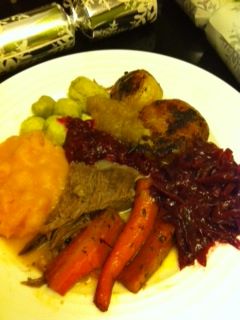
We served the Sheepdrove goose with an array of colourful vegetables, cooked by other members of the family so not one person did all the work.

Red cabbage and apples, squash and coconut, cranberry sauce, roast potatoes, Brussels sprouts, gravy.

PS I lost my ‘phone over Christmas. However – curiously – on the day I lost my ‘phone, I sent a picture of our Christmas meal (above) to myself. Which was lucky as I had not backed up my images since November so the Christmas meal pic would have been lost. Funny, eh?

Sprouts and raw hummus

I was told yesterday that today is the last day of the Mayan calendar.

That means the end of 28,000 years of hierarchy and oppression.

Yippee!

And I have finally found a spouting system that works.

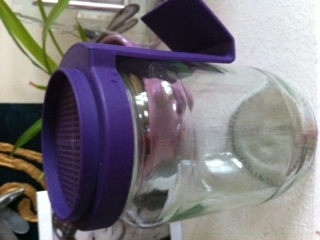
I bought this jar with its plastic perforated lid from Harvest, part of Essential Trading Worker Co-op.

DIY types can make their own. Or use old tights or muslin as the lovely Alys Fowler suggests.

Or buy one like mine (after years of experimentation, I can vouch that This One Works), and get loads of sprouting info from Living Food of St Ives.

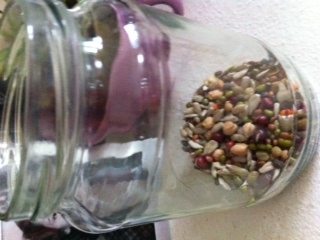
First you put the dry (organic) seeds in the jar.

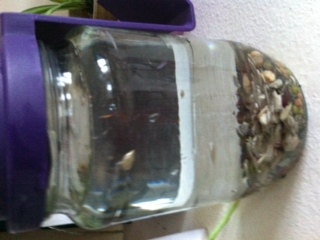
Add water and leave them overnight to bring them to life.

After that first long soak, you wash the seeds daily (or twice, thrice).

The seeds like being clean and wet (not soaked or drowned).

So after filling the jar with water, swill the seeds around then drain away the water (hence the natty perforated lid which makes life so much easier).

And how is this for a virtuous circle? I drain the water on the indoor plants so they get a regular watering.

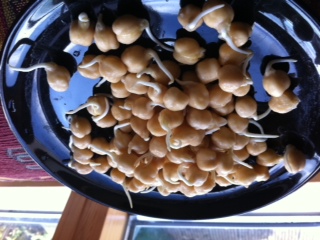
After a few days, I have produced living things.

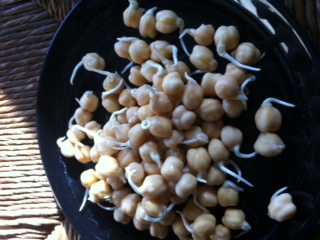
Here are some sprouting chickpeas, looking positively Lawrentian.

(DH Lawrence being one of my fave authors because he describes life on its different levels: soul, mundane etc and because: “Lawrence believed that industrialised Western culture was dehumanising…”).

So now I am going sprout-mad. Sprouts in stews. On toast with cream cheese.

Whizzed with Organico Artichoke Spread for instant hummus.

Hold on a minute. Did I say hummus?

I ask myself: WHY make hummus with cooked chickpeas when you can use extra-bursting-with-vitality FRESH sprouting raw chickpeas?

So, I substitute the cooked chickpeas for my Lawrentian darlings, add some turmeric and crushed coriander seeds (must sprout THEM one day) and of course lemon juice, olive oil, tahini, raw garlic, as in my usual recipe for hummus .

And it was delicious.

Fish4Ever challenges big brands

As a journalist and food campaigner, I help Fish4Ever with its communications. I cannot work for a cause or company I don’t believe in.

So, I have the privilege of asking nosy questions and learning about the politics of fish.

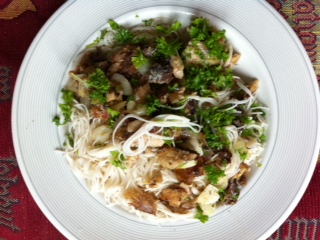
Lunch: a fried-medley of Fish4Ever sardine fillets (Steenberg’s Organic online £1.60) on a bed of organic rice vermicelli.

Medly: I fry sliced shallots/onions, garlic and chilli in the organic oil in which the fish are canned – Fish4Ever uses 100% organic land ingredients.

I add the sardine fillets, mashing them (was that respectful?). I snip-in fresh parsley .

Fish4Ever canned fish is in a class of its own, fished traditionally (70% MSC-certified, the rest artisan) and quickly-conserved for freshness.

I am a real food lover and here’s why: you do good – it tastes good.

Why is it important to look after the fish?

Fishing technology is too effective. Desired species are being hunted to extinction.

Its hunting methods are indiscriminate, killing turtles, sea birds, dolphins.

There are too many factory boats and not enough fish. Regulations to control catches are insufficient and often ignored. Out at sea, where no one is looking, rules can be flouted. Poor countries suffer from foreign piracy on an industrial scale.

Hugh’s Fish Fight on Channel 4 earlier this month focused on changing the fishing methods of the big tuna brands and own-label supermarkets.

The food corporations’ proposed changes are far better than nothing.

However, although the big brands may well promise a “pole and line” range, their primary business remains likely unchanged.

Each Fish4Ever can has a story – including the smallest tuna fishing boats in the world.

This is not an eco-add-on. Fish4Ever’s raison d’être is care of land, sea and people.

That’s what I call an ethical company.

Meditation pot-luck lunch with Claude AnShin

“Bring cushion, blanket and vegetarian food to share,” were the instructions for yesterday’s meditation workshop at the Pierian Centre.

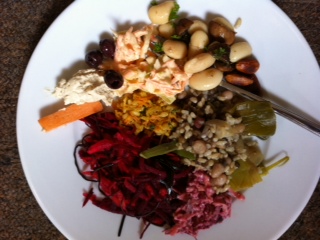
I have never known a pot luck not to work: my plate was filled with favourite foods such as raw beetroot and seaweed, butter bean salad, rice and lentil salad, raw carrot and hummus…

We practiced eating meditation. We ate in silence, aiming to chew each mouthful consciously, with 50 chews.

Eating silently and slowly in company was strangely relaxing.

I had helped promote this event with Saint Stephen’s and the Pierian Centre so it made sense to go.

But I had dreaded it. What? A whole day of meditation? I felt trapped.

Instead the day was rich and intense.

The workshop was led by Claude AnShin Thomas supported by KenShin.

(“How do I address you?” I had asked KenShin. “Ken – like Ken and Barbie – and shin as in leg,” she answered.)

Claude AnShin Thomas was a Vietnam veteran with post-traumatic stress – like many in the military or caught in war.

His spiritual practice helped him cope with flashbacks and emotional pain.

Meditation does not make horrifying experiences go away.

But being conscious, or awake, paradoxically makes trauma easier to cope with.

You learn to sit with discomforting feelings rather than self-medicate or distract yourself to push them away.

Claude AnShin Thomas is funny, straightforward, down-to-earth, profound and deeply touching.

A mendicant monk, he is homeless, goes wherever he can make a difference, and lives on donations.

He works for peace with the Zaltho Foundation by being as conscious as possible. “Everyone has their Vietnam,” he says.

I have marched for peace but peace activists can work for peace by healing the war inside, too.

I am reading his book, At Hell’s GateBeautifully written, so worth reading.

He’s not a new-age guru making money from spirituality, but a man with a troubled past who found his spiritual practice bought him peace, and who has dedicated his life to sharing this to help others.

And this real-ness transmits, I swear.

Organic Food Awards 2011

This year I was a Soil Association Organic Food Awards judge, judging cheese (wonderful taste memories, quality outstanding).

So I was invited to the actual awards last Wednesday.

They were held this year at the launch of the 12-day Start festival to celebrate sustainable living.

And at Clarence House gardens, open to the public for the first time.

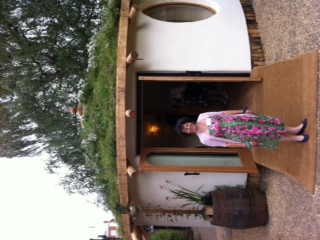
So I made an effort, bought a reclaimed frock for £25 at Dutty’s in Bristol, caught the coach (National Express not golden) to Victoria, and walked to the Mall.


Me (in sister’s shoes) in front of earth house with grass roof and circular windows.

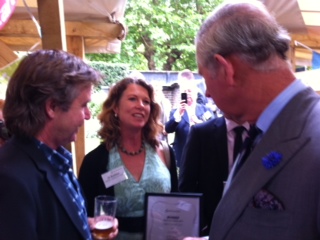
My first royal photo of Higher Hacknell Farm Organic Food Award winners, Jo and her husband Tim Budden, receiving rightful organic congratulations from HRH Prince Charles.

I had a touching royal moment myself exchanging greetings – I feel Prince Charles (and Soil Association patron) is an earth ally, and uses his position well. I award him the Winkler Seal of Approval.

It was an uplifting evening, meeting old friends and new, especially enlivening because it was held outdoors. Outdoors on a summer evening = good!

Here is a pic from the Bee keeping stall with Daylesford foundation

And a pic of the organic veg garden at Clarence House (could the bare earth do with more plants growing, permaculture-style?).

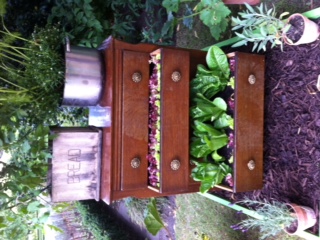
Here is a chest of drawers imaginatively filled with plants from Garden Organic

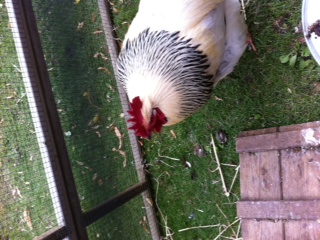
And an organic chicken

Pic of the Organic Food Awards certificates awaiting collection by their winners.

At the end of the evening, on my way to Green Park station, I saw the ubiquitous discarded Tesco plastic bag.

Funny. Because my day had begun by taking a Guardian photographer round Stokes Croft in Bristol for a feature by John Harris in next weekend’s Weekend Guardian on UK-wide campaigns against Tescos.

What does it mean?

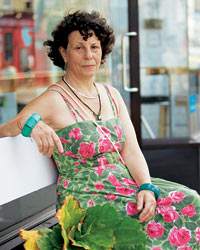
PS Here is the pic that Guardian photographer, Jon Tonks, took of me outside Cafe Kino in my Dutty royal get-up.