Category Archives: recipe

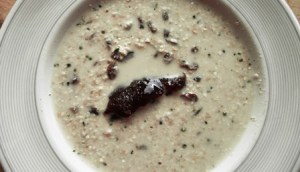
Beetroot and carrot soup

Beetroot and carrot soup

When I say I am a food writer, people assume I am a gourmet foodie, a superior being who will look down my refined nose at their offerings.

Nothing could be further from the truth.

The reality is I am an everyday, sloppy, how-quickly-can-I-eat-well cook.

My concerns lie not with how food looks, or how unusual or exotic its ingredients are but rather how healthy are they and how they were grown.

I want to demystify cooking not put it on an pedestal.

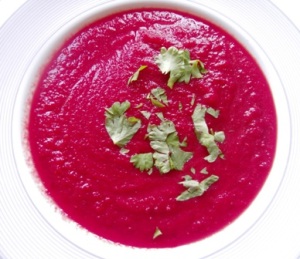
So this soup could indeed be my ‘signature’ dish. It’s comfort food made with locally and organically-grown vegetables, it took me about half-an-hour to make, is healthy and tasty.

I cut an onion and sweated their slices in olive oil in a medium-size saucepan with a lid on. I washed but did not peel the 2 large beetroots, ditto the 5-6 carrots. I chopped carrots and beetroot in inch-bites because the smaller you cut ’em, the quicker they cook.

I added the chopped veg to the softening onions, and added 3-4 mugfuls of water (one mugful=1/2 pint), and simmered it for 20 minutes, with the lid on.

I did not add salt. Both beetroot and carrot are so sweet, what other taste is needed?

I did add black pepper. And I whizzed it with my £20 handheld electric blender because I am a bit of a baby and like eating mushy-comfort food.

Escoffier, I ain’t.

So have no fear, past and future dinner hosts!

Reblog this post [with Zemanta]

Hemp porridge and membrillo

Amaru hemp porridge with membrillo

Above pic represents synchronicity and sustainability  – and a comforting, tasty and easy-peasy way to get top nutrition. Just add water…

I also dolloped on membrillo – recipe below. It’s nice with something a bit sweet such as sultanas.

Synchronicity: I went to Shambala and got so turned on by hemp porridge, it became the subject of my last post.

Two weeks later, I am at The Organic Food Festival – the after-festival party to be precise at Berwick Lodge, Christopher Wicks’ new fab place – when I find myself talking to what turns out to be:

Rebekah Shaman, founder and director of Amaru Hemp.

Oooooh, I like Rebekah. Right from the start, she plunges me into different worlds with her words for instance about her time as The Shaman’s Last Apprentice in the Amazon.

She also gives me the lowdown on the nutritional powers of hemp:

  • 19% protein (meat is 30%)
  • easily absorbed globular protein (must find out what globular means)
  • every known omega, with omega 3 and 6 ideally balanced
  • every known amino acid
  • every known essential fatty acid.

One conversation leads to another and soon we realise we were linked in a myriad of different ways, culturally, socially etc.

I am taking this seriously (in an excited way): Amaru organic Hempower and me may have some work to do together in the future. Watch this space.

As for The Organic Food Festival 2009 – wow. Hot brilliant sunshine, old friends, new friends, people trading in a wholesome, future-proof, sustainable ventures – no wonder the atmosphere was elated and connections were buzzing.

I was on The Source stall with my darling editor, Dr Rachel Fleming. We shared it with the renewable energy specialists, Kaieteur, and organic soap makers, Flo and Us, both from Sidmouth.

Also sharing our marquee was James Bond (yes, that is his name) of the Avon Organic Group – his organic damsons were a talking/ tasting point for the crowds.

James Bond, Avon Organic Group at The Source stall

James gave me some beautiful quince, and this week I made membrillo for the first time, with a recipe from the Avon Organic Group. Here it is (+ my comments).

1. Quarter quince, leaving core, skin, pips intact. Add just enough water for quince to float. Simmer 1 hour or more, or until it reduces to a smooth pulp.

2. Sieve to remove pips and skin.

I am afraid I got fed up of unsatisfactory sieving (and it was midnight when I started). So I blended the whole lot, skin, pips and all. As a result it did not have that pale pink translucency of traditional membrillo – but it packed more of a nutritional punch and tasted richer and denser. (And was less fiddly).

Making membrillo 1

3. Add sugar to equal weight of sieved pulp, or at least 3/4 of weight.

Not being a sugar-freak, I used 1lb 6oz rapadura sugar to 1lb 12oz of fruit. Apologies for imperial measures – this often happens when I cook.

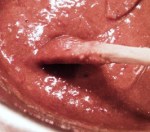
4. Simmer for 1-2 hours or until it has reduced to a thick pulp and darkened considerably. Stir to avoid sticking.

I stirred non-stop for 1 hour, getting spattered with boiling jam when I stopped. Wear an apron!

Making membrillo 2

5. Pour into greased or non-stick baking pan to a depth of 1-1.5 inches.

6. Bake in a low oven (140c) for about 1 hour.

7. It should set to a firm paste. Cool and cut into bite-sized squares.

Mine set to a kind of thick jam.

And it goes really well with hemp porridge.

Stop press: Amaru co-director Carlo Dawson agrees to take Brixton Transition Town pound.

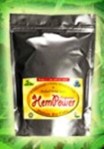
HemPower pic 448 X 336

Reblog this post [with Zemanta]

My mother’s tongue

My mother' tongue

My mother heaved the 2-pound tongue onto the serving dish and I offered to skin it.

I eat mainly vegetarian food but I skinned that tongue like a pro, feeling elemental and respectful like a hunter.

My mother foraged for it in Waitrose. The label bore two marks: UK and EU.

My mother went to the customer service desk to check its provenance.

“Cured in Bedford,” said the assistant, “so it must be British.”

“But where did the animal come from?” said my mother.

He checked with the buyer who sent word the animal was UK-bred.

“So why the EU label? It’s still a mystery,” said Ingrid Rose when my mother told us the story as we ate.

My mother said she used to pickle tongue with saltpetre. Now it’s hard to find.

Pickling salt beef and tongue are traditional ways to preserve meat. No refrigeration in the shtetl.

My mother’s tongue – a childhood memory.

My mother talked about the cooking of the 2lb tongue (for £8, 8 servings).

She disagreed with the label’s instructions: to throw away the water after bringing the tongue to the boil seemed a terrible waste, she said.

She and Evelyn Rose are of one mind: wash the tongue well in cold water – there is no need for waste.

Cooking salted/pickled/cured tongue: water to cover + garlic + 1 onion skinned and cut in half + peppercorns + bay leaves. Simmer and cover for 2 hours and 30 minutes. Then drain and skin.

The potato pie: mashed potatoes + 1 tablespoon of goose fat (“My mother used chicken fat,” says my mother) + 2 eggs + salt and pepper plus my mother’s latest addition: chives.

Back to the meat.

What do you want to preserve?

Reblog this post [with Zemanta]

Six salad party food

Plate of party food

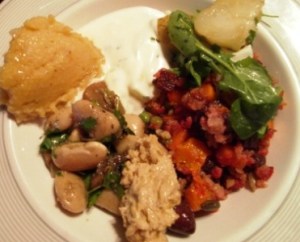
Party food chez Winkler. I was too excited to eat, so took small portions. This one went down a treat despite hostess-nerves: the wild rice salad with oven-roasted morsels of beetroot, pumpkin and carrots, and crunchy oven-roasted pumpkin and sunflower seeds. My off-the-cuff invention, it’s made the grade for next time.

The six vegetarian salads (see unposed picture above) were easy-on-the-purse and high-on-health:

1. Wild rice salad with pumpkin, beetroot and carrot – followed clockwise in the picture by…

2. Ingrid Rose’s hummus (using her 5 x amounts hummus recipe) – her birthday present to me!

3. Butter bean, mushroom and coriander salad with lemon juice

– a perennial winner thanks to Rose Elliot’s The Bean Book

4. Red split lentils with chilli. Simple dhal – light with bite.

5. Organic wholemilk yogurt with diced cucumber, black pepper and mint

6. Classic potato salad – boil halved-and-quartered (if possible NEW) potatoes until soft enough to fall from a a sharp knife when speared.

The party was on Saturday. I aimed to be prepared and avoid last-minute superstress.

Most of the shopping was done midweek.

Thursday I emptied the packet of butter beans (500g) into a large pan and covered the hard ones with water. Overnight they swelled. Some say throw away the rinsing water to reduce farting – what do you think?

Friday I cooked the swelled-up beans in enough water to cover them and boiled them for 1 HOUR, then drained. I defrosted the frozen wild rice I had cooked earlier that week (with chilli). Texture mushy but taste good.

The drained butter beans mingle eventually – with onions fried in olive oil plus 5 teaspoons of cumin sizzling for seconds. Into the spicy mix go sliced mushrooms, lots of them. You may need to add more olive oil to prevent sticking. Once the mushrooms are cooked but not soggy, then you add the drained butter beans.

I  roasted the root vegetables a day-ahead too

– seasonal local beetroots and carrots and (imported) pumpkin roasted for only 20 minutes because they were cut-up so small, and the seeds – they take minutes.

Saturday Boiled potatoes for potato salad and slouched them with olive oil, rock salt and garlic while still warm.

Peeled and diced 3 English cucumbers + mint + 3 large pots of organic yogurt, emptied into a bowl.

Assembled the wild rice salad and cooked roasted root veg and seeds.

Assembled the butter beans + mushrooms + cumin with lemon juice and fresh local organic coriander.

Wow. This was the first time I have been so prepared.

I had even sorted out the serving dishes in advance.

All the more time to party.

Me and my birthday cake Me and Richie

Reblog this post [with Zemanta]

Tofu with coconut

Tofu Rendang

Quite often strange and wonderful foods are packaged with no explanations on how to eat them.

Take aduki beans. Gillian McKeith recommended them on British TV. The nation listened and duly bought them.

But what to do with those aduki beans? I bet you money some are still sitting in the back of people’s cupboards…

The more unusual the food, the more the food makers assume you know what to do with them.

This explains why I was so happy to receive a booklet (in this case free with this Sunday’s the Observer) on interesting ways to cook tofu.

I love the bland, digestible high-protein bean curd. But apart from stir-frying, I never quite know how to eat it.

The booklet from award-winning organic tofu makers, Cauldron, takes its inspiration from Asia where tofu is traditionally used and you are not seen as a weirdo for eating it.

Here’s my Winklerified version of its Rendang paste:

Toast 3 tablespoons of dessicated coconut in a dry, hot frying pan.

Make a paste: Blend (or whizz or pound) the toasted coconut with one cut raw onion, 1 mild fresh chilli, a chunk of raw ginger peeled and chopped, and a teaspoon of turmeric. No liquid needed.

Heat 1 tablespoon of oil in a heavy frying pan and gently fry the paste, stirring until the aroma is released.

Add 250 mls (a bit more than half a can) of coconut milk with 125 mls of water.

Blend a teaspoon of tamarind paste with a tablespoon of water, and add that along with 1 stick of cinnamon (see it floating on left of picture) and 4 star anise (I have had star anise in my cupboard for ages not knowing what to do with it…).

Bring the mixture to the boil, then reduce the heat and simmer for 5 minutes. Add the drained tofu pieces and cook gently for another 10 minutes. Stir in greens chopped in strips, such as fresh coriander or spinach or pak choi.

Serve as I did with brown rice and cubes of roasted sweet potato.

I am not known for my presentation skills when it comes to food. By the time I have cooked, I am in no mood for artistry. Hence the joy of eating out.

One of my fave local eating places is a gastropub on Bristol’s Gloucester Road Robin Hood’s Retreat.

The food is locally sourced and heavenly flavoured. I believe the chef is a master.

I had asparagus from the Wye Valley with a Scotch egg with the egg still warm and runny; pea puree and sea trout on a bed of lentils. Dinner for two with 1 glass of wine and two courses, came to about £50.

And all, as you can see, beautifully presented.

Robin Hood Retreat - asparagus from Wye Valley, scotch egg Robin Hood Retreat - pea puree, lentils (not pot) and sea trout

Reblog this post [with Zemanta]

Nettle soup is the one to make

nettles-and-wild-garlic-rinsed-in-colander

Sometimes an idea takes years to come to fruition. It has distinct stages such as scoffing, curiosity, acceptance then habit.

Take nettles. I used to think eating them was weird. But over the years the idea started to intrigue.

Last spring in Westward Ho! Chloë showed me a patch of nettles, and how to pick then with gloves, the freshest top leaves according to another blogger. Nettles were no longer alien as I cooked them in pasta and soup and found them delicious.

Perhaps precisely because nettles are wild and have not been cultivated or hybridised, they taste extra-vibrant and are highly-nutritious.

This spring, in Bristol, I saw nettles growing and thought “soup”. Then on Friday I overheard Leona, the owner of St Werburgh’s City Cafe talking about: “nettles and wild garlic soup.”

The next day Mike and I found ourselves on a magical walk beside the river Avon  in a mysterious part of the city. An abundance of nettles and wild garlic grew.

conham-on-the-river-avon

I picked up a discarded Tesco plastic bag (litter bugs have their place in the universe), sniffed it, found it clean and after borrowing a glove, started pinching off the fresh greens and filling the bag.

The next morning, I weighed the nettles and the wild garlic: 4 ounces.It didn’t seem enough – but it was.

I cut up a fat onion and gently fried it in 2 tablespoons of olive oil in a saucepan. I let it stew for an hour with the lid on, so the onion was soft and a bit caramelised. I was experimenting but you could fry the onion for much less time (like 10 minutes or so).

I added 900 mls of water. To thicken the soup I added 1 ounce of raw oats.

Then I snipped in the washed nettles and wild garlic, and let it simmer for about five minutes and turned off the saucepan. The soup carried on cooking with the lid on.

And it was delicious.

Can you get food more real than nettle soup?

nettle-and-wild-garlic-and-onion-and-oat-soup

Proud to fly the Food Renegade flag, I contribute this blog on local and sustainable Nettle Soup to Fight Back Fridays to help overturn the domination of industrialised food!

foodrenegadefist_150

Reblog this post [with Zemanta]

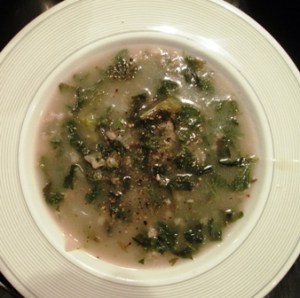
Vegetable soup

vegetable-soup

I made a raid on the fridge last night and seized my suspects. The remains of that celery cowering in the corner? Into the pan you go. That inch of courgette, those flabby carrots? Their fate was sealed. Even the large but softening beetroot was fair game.

I started by frying onions in 2-3 tablespoons of olive oil. I find if I start by frying, it commits me to cooking and I have to carry on.

But one was not enough. This soup had four onions, peeled and chopped. An onion-craving due I believe to the weather turning – after the spring sun, back to British chill. I swear these temperature changes play havoc with the immune system and thus my body was pleading for sustenance.

Who would have thought that the miserable occupants of my fridge plus the onions could help? But they did.

I amused myself by cutting the vegetables as thinly as possible, inspired by browsing through a copy of a recipe book by Boy George and his macrobiotic cook in the Luscious Organic shop in London last Friday.

I peeled everything because although the veg were organic and thus pesticide-free, they looked in need of a beauty peel.

Cooking is so dramatic. Look at the mess I made with the peelings. But aren’t they beautiful? Some naturally interlaced with each other too…

peelings-resized

I was entranced by my vegetable peelings but life is tough and into the compost bin they went.

Meanwhile the mound of veg in my pan (with lid) was stewing away. I gave them a stir every now and then.

Then I added water – about 500 mls – and left the concoction to slowly simmer with the lid on.

I could have added salt to flavour but I had a brain wave. Due to an enduring macrobiotic flirtation, I had some miso in the fridge (it keeps for ages).

Miso is a friend, providing flavour, health and richness just from fermented plants such as soya beans or brown rice or barley.

I squeezed about two tablespoons of the miso into a cup, added some hot water and mixed it to a thin paste, which I added to the soup.

For garnish, I added a handful of nettles I had picked on our walk yesterday, and served the soup with fresh organic bread. It had taken a pleasant half-an-hour to produce from virtually nothing and it was delicious.

I swear I heard my immune system whisper “thank you”.

Reblog this post [with Zemanta]

Homemade yogurt

homemade-yogurt-310109

I made this yogurt. If I can do it, so can you (I am not known for my technical expertise). It tastes wonderfully-different from anything I can buy in a plastic pot. And ’tis joy-supreme not to be adding to the plastic-pot recycling mountain in my hallway.

I stopped making yogurt after being diagnosed as lactose-intolerant last autumn, but I missed all those zillions of friendly bacteria in my gut. I know I could have made it with soya milk, which I do love (in tea and on oats) but somehow could not bring myself to embrace in yogurt.

So I figured I would experiment with my lactose-intolerant boundaries. For surely my fellow lactose-intolerant eastern-european/middle-eastern ancestors ate yogurt? As a fermented food, yogurt is pre-digested so must be easier to tolerate. Is there a nutritionist in the house? What do you think?

Anyway, on a gut level (so to speak) all I know is my intestines smile when yogurt comes its way, saying hi in a welcoming way. Unlike with milk, which feels too viscous and hard work for my sensitive insides.

Now let me introduce you to my friend, the yogurt-maker. This fairly low-tech device that costs about £20 to buy and pennies to run has enabled me to become yogurt-literate.

yogurt-with-yogurt-maker

You can’t see from my pic but the plastic yogurt-maker has a plug. That’s how it works: switch it on and the yogurt-maker keeps the warmed-milk-that-will-be-yogurt at an even temperature.

Hugh Fearnly-Whittingstall says a wide-mouthed warmed thermos flask does the trick and ditto, a towel to wrap it up in and a radiator – but it’s the nifty yogurt-maker for me.

I say low-tech because it does not switch itself off after the regulatory eight-hours. So it does take planning. I have to ask myself before starting: will I be here in eight-hours to turn off the device?

Here are the ingredients you need to make longevity-boosting yogurt:

1.5 pints (850 mls) of organic milk

2 teaspoons of of natural, bio-live, organic yogurt (or from your last yogurt batch)

You have to boil the milk until it bubbles to get rid of bad bacteria and then let it cool down to blood-temperature i.e. I stick a clean finger into the cooled-down milk  and it feels pleasant and warm – not scalding-hot or, at the other extreme, brrrrr on the chilly side.

I found this operation the most taxing because after the novelty of testing too-hot milk wore off, I then forgot all about the cooling milk and by the time I remembered, it was stone-cold again. So my top tip is: try to keep conscious of time as the milk cools.

Once the boiled milk has cooled to blood-temperature, I put it in the yogurt-maker (that I’ve switched on five minutes beforehand to warm up). Then I stir in two teaspoons of yogurt, which always seems too measly to do the job but that’s all it takes to start the fermentation process. Amazing.

I find yogurt very acceptable first thing in the morning because it is non-demanding and soothing. And I add freshly-ground health-giving spices, such as cinammon, cardammon and cloves for extra zing.

Now for my yogurt-award acceptance speech. Thank you, Martin Smith, ex-propriétaire of  Danescombe Valley Hotel, who demystified yogurt-making; my Indian food guru, Mallika, who has inspired me to use freshly-ground spices from scratch; Maninas, for adding cinammon bark and whole cloves to my repertoire. And finally thanks to Beccy and Hannah at the Spark for explaining how to use the grinder-attachment on my blender…

Who would you thank in your oscar-award speech?

Reblog this post [with Zemanta]

Making organic mince pies

making-organic-mince-pies

We were thinking of ways to promote the benefits of joining our workplace union when someone mentioned mince pies. I knew I had to make some.

I have been a proud member of the National Union of Journalists all my working life and now I am a member of Unite too. Unions and feminism come under similar fire. ie  propaganda from a status-quo establishment paints both as uncool and combative. Hello! Just as feminism makes for a more balanced relationship between the sexes (do you really want to be your husband’s chattel?), so the union supports management to create a better workplace.

My mother makes her puff-pastry from scratch and, natch, me too. Talk about propaganda!  It’s a family sin to buy the ready-made stuff. I consult my handwritten cookery notebook, begun in 1971 when I was a 17-year-old aspiring counter-culture hippy, and find her instructions.

For home-made puff pastry use equal amounts of butter to flour. (Yup, I know I am lactose-intolerant but I could not face cooking mince pies with marge).

1 pound (500g) of butter to a pound (500g) of self-raising flour makes about 30 mince pies with little hats, plus a 300g jar of organic mincemeat (sorry I did not make that from scratch but the Village Bakery organic mincemeat is soooo good and not too sweet and you could always add orange peel or cranberries to jazz it up).

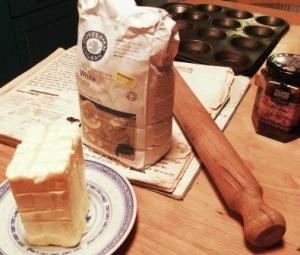
I used Dove’s organic white self-raising flour and unsalted organic butter.

Make sure the butter hard and cold from the fridge. (If too soft, your pastry will be too crumbly).

Cut the block of butter lengthways and then sideways, until you end up with little cubes to toss in the flour.

Add scant lemon juice and/or water to the mixture to start uniting (how symbolic! Our workplace union is Unite) the flour and the fat. It is tempting to add enough water to blend the two but don’t or it will turn to goo. Add liquid parsimoniously, teaspoon by teaspoon.

And do not crumble the fat into the flour with eager fingers or you will end up with too buttery-shortcrust pastry. The true blend comes from the butter gradually pressing into the flour – the oven’s heat will ‘unite’ (symbolic union!) the rest.

Now – turn out the unwieldy mass on to a floured board and press down a few times with a rolling pin.

Believe me, it will look a mess. Cooking IS a mess. I always go through this stage of despair: “Oh this will never come together, I am a failure (etc)….”

Which is how I felt at this stage.

mince-pie-dough

But all was not lost! The trick with puff pastry is in the folding then rolling. You assemble your uncohesive mass of pastry into a rough oblong shape. Then fold over the top third, and fold the bottom third over that. Turn this ‘envelope’ to the right and then give it a firm press with your rolling pin (or improvise with a bottle).

Repeat this fold-turn-and-roll action 3-4 times until finally your dough looks more shapely, and the flour and butter has come together in fairly homogenised layers. But don’t over-roll.

Wrap in greaseproof paper and let it rest in the fridge for an hour. Or less, if, like me, you lack patience.

My handwritten instructions from my 17-year-old self say: “Roll out not very thick.”  What the hell does this mean, I ask her?

Basically, the dough will never be paper-thin because it is too buttery so will stick to the board and you do not want to use too much flour to stop it sticking. So, well, roll it out “not very thick”.

Cut with a pastry cutter or use jar lids instead: a bigger one for the bottom case and a slightly smaller one for its little hat.

It all sounds so orderly on the page, doesn’t it? Here is a picture of mincepie mayhem. (I was staying at my sister’s last week because I lent my flat to our Canarian family who came to see the new baby, Tayda – but that is another story!).

mince-pie-mayhem

Grease not the baking tin as the pastry is sufficiently buttery. Fill each case with a teaspoon of mincemeat mixture. When ’tis time to cover with its hat, dab the rims of both bottom and top pastry cases with an ice-cube to make them ever-so-slightly damp and and press with a fork to unite both top and bottom (more symbolic union!).

Heat your oven to very hot about Gas Mark 8 / 45o F / 230 C

Place a tray of your uncooked darlings for approx 10-15 minutes in the oven. Put a timer on and do not get distracted – easy to burn!

Listen, some were over-crumbly (the butter was not hard enough) so I texted my friend-colleague at 1am to say: buy extra from Joe’s Bakery.

But they tasted OK, even the over-crumbly ones, as this note from my niece attests.

mince-pie-note

As for the union, we had a happy half-an-hour the next day at work what with the mince pies and brandy butter and making two new members, and goodwill galore.

Reblog this post [with Zemanta]

Homemade hummus

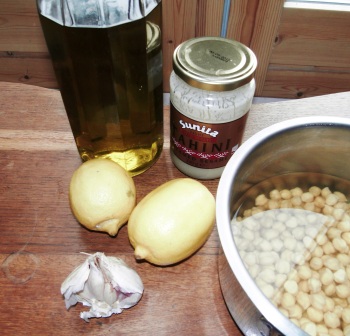
cast-assembled

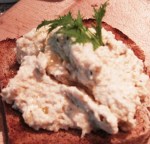
The cast is assembled. The starring ingredients (pictured) in a classic production of hummus are: olive oil, a jar of tahini,  lemons and garlic, and chickpeas soaking in a pan of water.

Thanks to kineseology, I was recently diagnosed as lactose-intolerant. Ah ha! The missing piece of the jigsaw – no wonder I prefer vegan food.

I am sad to ban eating cheese, butter and cream but not when I realise those yummy darlings make my gut sore because I lack the digestive enzymes to process them. Apparently most non-Europeans (including Mediterreanean/Eastern European types like myself) are lactose-intolerant.

This makes me ponder: our dairy-filled western diet may be dominant but is it giving the rest of the world a belly-ache?

So instead of eating cheese, I concoct homemade hummus every week. Although made from plants, hummus is a complete protein because it is combines different groups of plants, in this case, chickpeas and sesame seeds.

You can buy cooked chickpeas in a can in most shops and search out a wholefood shop or Mediterranean/Middle east delicatessen for a jar of tahini (sesame seed paste) and raw chickpeas. This recipe uses raw chickpeas.

The amounts are enough for a party dip, or eight-ten servings. I dollop it on toast, brown rice, grated carrots, lentils, fried eggs…

[Note: Chickpea upped from 100g to 150g following Ingrid Rose’s helpful comments below. So do take note when doing five times the amount, Ingrid Rose!]

150g dried organic chickpeas soaked in over twice the amount of water. Soak overnight (or speed up the process by soaking in boiling-hot water) in a pan. The chickpeas will go from shrunken to plumped-up pellets.

Bring the pan with chickpeas to the boil then simmer for an hour (on a low light with a lid) until they are soft-enough to mash.

Drain the chickpeas (hang on to the cooking water for later) and put them in a large deep bowl ready for mashing (or blending) together with:

3 Tablespoons of organic tahini or sesame seed paste. I use a dessert spoon for measuring because it will fit in the jar – give the tahini a jolly good stir before spooning out.

3 Tablespoons of olive oil

Juice of two lemons – cut in half and rotate a fork vigorously to extract the juice and pulp or use a lemon squeezer. Organic lemons can be smaller than non-organic ones and have more pips but they are more juicy.

2 fat cloves of garlic – crushed with a garlic crusher or the flat of a knife. It’s optional – not everyone loves immune-boosting garlic.

Add salt and black pepper for taste and/or crushed chilli and/or ground cumin.

A word on chickpeas. You can buy them tinned – conveniently and organically – but I prefer dried. Dry, rattly chickpeas which you soak are cheaper, tastier, less watery and have twice the nutrients than canned ones.

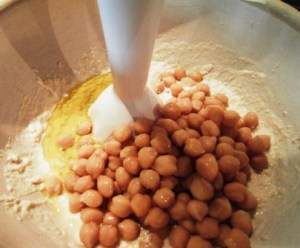
blending-chickpeas

I blend half the drained chickpeas with:

garlic, lemon juice, tahini and olive oil

and whizz till smooth. It’s easier to work in small batches.

Then I add the remaining chickpeas – see picture above. If the mixture is too stiff to blend, add a teaspoonful or two of the cooking water. You are aiming for smooth and creamy not runny.

I am addicted to my electric handheld blender but a strong fork or potato masher will mash the chickpeas – just make sure the garlic is well-crushed before adding.

And here’s the mystery, every homemade hummus turns out differently.

Have you made hummus?

hummus-on-toast

Reblog this post [with Zemanta]