Category Archives: recipe idea

Red lentil soup

My friend Sheila said, “come over,” and I said, “shall I bring something to eat?” With only an hour and a half to spare and no time to shop, soup made with split red lentils was the only answer.

Without much ado, I soaked 125g red lentils for half an hour in about 4 mugfuls of water. The little dried red things (a storecupboard-must!) absorbed some water and softened – then I applied the heat. As I brought the pan to the boil, I chopped one onion and chucked it in.

You can see the uncooked onion pieces and some lentils floating on the surface as the soup begins to boil (above).

The strange naked beast in the picture is a peeled turmeric root from Marshford organics. I have never seen turmeric’s root root before, only its powder. It is closely related to ginger, but unlike that root, turmeric stained my hand yellow as I sliced it.

I also added sliced organic carrots that had overstayed their welcome at the bottom of my fridge and quarter of a dried chilli, not enough to bite.

Once the soup had come to the boil, I simmered it for half an hour until it was a soup-y mush. To make sure of its mushiness, I gave it a quick whizz with my handheld electric blender.

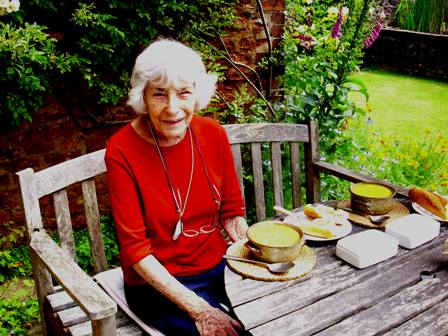
I got the soup safely to Sheila’s and we ate in the garden (see below).

I first met Sheila when, pregnant, I wandered into the Birth Centre circa 1977 to find out more about natural childbirth. On impulse, Sheila offered me a job wo-manning the Birth Centre ‘phone. She was a signpost in my life, putting me on track for the start of my new career as an ante-natal teacher and writer.

Sheila is a natural pioneer. Ahead of her time, Sheila brought the French obstetrician, Frederick (birth without violence) Leboyer to the UK, and changed our views of birth forever.

I see parallels between real food and natural birth; both aim to understand and work with nature rather then supplant it with risky and often unnecessary intervention.

yellow flower in Sheila\'s gardenSheila in gardenLentil soup

Spinach soup thickened with couscous

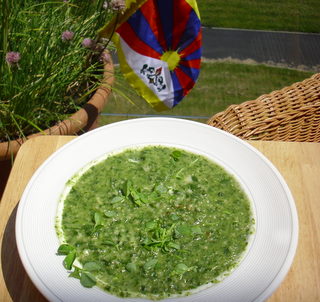
Spinach soup

I would be useless in a post-peak oil world. What would I do without my electric blender?

My teeth are troubling me so I made this spinach soup soothing with the help of the handheld machine. Its on-grid whirls fashioned the soup into a luxury item.

Here’s how I got there. The washed organic spinach leaves, stalks and all, went in a large pan. Spinach cooks in the water it is washed in (no need to add more) but do put a lid on to retain that moisture.

Once the spinach was cooked soft and waterless (drain to make sure), I added butter and immune-boosting garlic to frazzle in the meltedness.

But how to thicken it? I could have used flour but what is life without risk? So for the first time I sprinkled a smattering of couscous (I used organic kamut) to thicken a soup. I let it cook for a while then added a mugful of water, slowly, stirring all the time.

Reader, it worked. The couscous made it creamy.

Encouraged, I snipped in organic sprouted snow peas as a garnish.

The organic produce came from Bristol’s organic supermarket, Better Food, which is well-pleased, I imagine, with Sunday’s announcement as a finalist in the Observer Ethical Awards 2008.

Fluttering in the background is the Tibetan flag. Apparently it is illegal to fly in its home country, so it’s getting a workout on my balcony.

Tamarind and green tea noodles

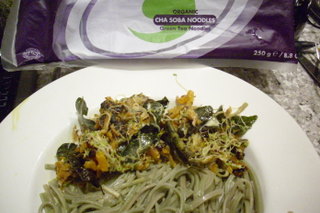
Green tea noodles and tamarind stir fry

Cooking is like dancing – to keep it fresh you need to learn new steps.

Thanks to Mallika’s Quick Indian Cooking, I have added curry leaves and tamarind to my repertoire.

I had to improvise with the other ingredients.

Tonight was cold and misty so instead of eating grated organic carrots as a salad, I fried them in olive oil. In this bold mood, I also fried organic alfafa sprouts, the first time ever.

At the carrot stage, I also fried ten dried curry leaves, which wilted aromatically – not scary at all. Then mustard seeds and a teaspoon of tamarind paste.

I could not resist adding a quarter of a tin of coconut milk and snippets of dried chilli for spicy creaminess.

I finished off a packet of organic cha sob green tea noodles that had been lurking in my store cupboard – they only took three minutes to cook.

It was a quick supper to make and delightful to eat, while the tamarind emparted a tart lemony-lusciousness – my new exciting dance step, definitely.

Brown rice, chives – and chewing

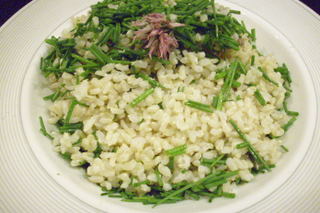
Brown rice and chives

When all else fails nothing beats a bowl of brown rice. It is a soothing superfood. With its husk still intact, brown rice brings strength – more vitamins and fibre than its denuded sister, white rice.

My brown rice is organic – what’s the point of eating a superfood if sprayed with chemicals?

I added chopped chives (and its mauve flower), olive oil and a tiny smattering of Atlantic salt to the cooked rice.

Organic brown rice a store cupboard-must because it’s nutritious, economical and sits there Buddha-like till needed.

It requires little attention while cooking. One mug of rice does for two, generously. Add to a pan with twice the amount of water (2 mugs of water for one of brown rice) and bring to the boil. Simmer for 30-40 minutes with the lid on. Brown rice is soft and chewy when cooked.

The macrobiotics swear by brown rice and so do I. It’s so yang, it relaxes the digestion and detoxifies.

If you really want to be macrobiotic, you stay in the moment while eating it. Spiritual warriors aim for 50 chews a mouthful to calm their mind and their digestion.

I can manage about four mouthfuls of conscious chewing before my natural impatience takes over.

How many chews do you give a mouthful?

Fay’s pavlova and the Real food festival

Fay\'s pavlova

Fay’s pavlova is legendary. How does she get the meringue so light on the inside yet crispy on the outside?

Piled high with strawberries (out-of-season but hey, only g-d is perfect), imbedded in whipped organic double cream, the delectable concoction is hard to resist.

Fay and I both rely on the late Evelyn Rose’s recipe for a perfect pavlova. It’s worth buying her book just for that, although (I promise), you will find a ton of other indispensable recipes there too.

Whip four egg whites to stiff peaks, then fold in double the amounts of caster sugar (that makes eight ounces. Sorry, I am so unmetric when it comes to cooking although I am trying, I really am). Fay uses half of white caster sugar and the other half golden caster sugar.

The secret Evelyn Rose ingredient is one teaspoon of vinegar (plus one teaspoon of vanilla). The vinegar seems to ensure that crispy outside and unsticky inside although I am not sure how it works scientifically.

Then spread the mixture on a greased baking sheet and bake in a low oven for two hours.

Being such a purist, my mum (for that is who Fay is) is no freezer-cook but she does (to my surprise) freeze egg whites.

I want to take my mum to the Real food festival on Thursday 24 April as she so appreciates fine raw ingredients.

“You can’t make a silk purse out of a sow’s ear,” she says. You have to buy the best (be it organic, free-range, fresh, seasonal, local and/or artisan) to make a good meal, she says.

If the ingredients are good, no need for complicated recipes (as her mother said before her).

Ingredients, ingredients, ingredients. The only three words you need to know when it comes to cooking.

Real food festival – what a buzz

Fay\'s borscht

As you can imagine, as soon as I got wind of the Real food festival, I knew I had to go.

Opening this Thursday 24 April at 10 am in Earl’s Court, this is London’s foodie festival of the year.

With about 500 small producers under one roof, including Blur musician and cheese maker Alex James, it must be one of the the biggest farmers’ market in the world.

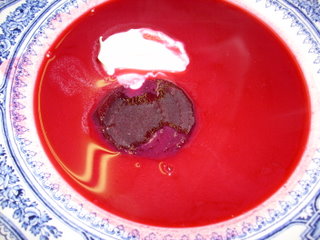
(Thus meriting a picture of my esteemed mother’s borscht. She strains the cooked beetroots, adds lemon juice to the liquid and beats in an egg. See pic from Saturday lunchtime, above.)

The Real food festival ends at 6 pm on Sunday 27 April. Here’s how to get tickets.

There’s a real buzz going on in the food world about this festival. Everyone I speak to is on their way.

I will be going on Thursday. My first stop, Nichola Fletcher’s stall (P648).

Nichola is a deer farmer from Auchtermuchty, Scotland. I just read on her website how the deer in her care are slaughtered. Sentient beings, they die instantly with no stress – it is awesome.

Deer are well-real because they have not been so intensively-farmed or bred (unlike those poor chickens).

Nichola is also an award-winning author. I know Nichola from the Guild of Food Writers. Fellow members, we have ‘met’ online.

I am looking forward to meeting Nichola in real (my favourite word again!) life.

And tasting her compassionately-killed venison.

Black bream roasted

Black bream before baking

Look at this fine fish, called black bream. What an intelligent look in its eye.

Non-flesh eaters may want to stop reading now.

Mike cut slits in the fish’s sides, right down to the bone. I then inserted dried thyme and fresh parley into the slits and its gutted cavity.

I placed it on an oiled baking sheet in a cold oven then whacked up the heat to its max. About 10-15 minutes later, it was sizzling and I turned it over to roast the other side for a few minutes.

We ate it with organically-grown potatoes from Marshford.

For some unfathomable reason, black bream is not considered trendy.

Yet black bream has a firm white sweet flesh comparable to its more expensive cousin, sea bass (but a fraction of the price).

“How much did it cost?” asked Mike, as we dined like kings in the back garden.

“Pennies,” I said.

I had bought it at the Beach House Wet Fish at Widemouth Bay for something like two pounds sterling (and it fed three of us).

I sing the shop’s praises here.

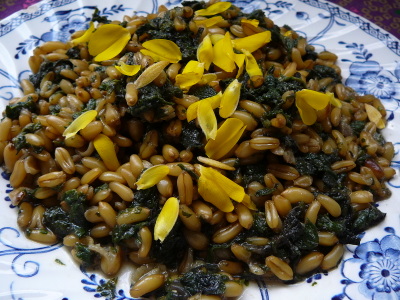
Kamut risotto with nettles and gorse flowers

Kamut wih nettles and gorse flowers

This dish is a bit like an Oscar-award winning ceremony so bear with me while I thank a few people.

Firstly Elena Renier for inspiring me to use nettle tops in a risotto. Secondly Chloë for telling me on a walk over the cliff path at Cockington in north Devon that gorse flowers are both edible – and nature’s cure for depression.

I have always loved the spiky gorse bushes’ bright yellow flowers but when I found out I could eat them – and have a mood-change into the bargain – I was ecstatic! (Or was it the gorse petals I was munching en route?).

So, back in the kitchen, I fried a sliced onion and added a mug of kamut grain (instead of rice) to the hot olive oil. Then I poured in two mugs of water, added a pinch of rock salt and let it all simmer for 30 minutes.

I washed the nettle tops that Mike had kindly helped me pick (another Oscar thank you to him) and snipped the plentiful dark green leaves (six ounces in weight) with scissors so they fitted in the pan. They took about ten minutes to wilt and add their wonderful creamy spinach-y taste.

I love nettles! I cannot believe that eight days ago I was a nettle-picking virgin. My first use in nettle soup is here.

It’s Be Nice to Nettles Week soon (14 – 25 May 2008) when we stop thinking of them as nasty weeds and realise how wonderful they are.

I know nettles sting if you forget your gloves or do not use the proper ‘folding’ procedure but I do not care. The sting is not dangerous and may even be good for me.

The world faces a rice shortage so can I do my bit by eating kamut grain instead? I have selfish reasons too for I have come to love this bursting-with-health grain.

So, oscar-thanks to the universe for providing good things to eat.

Oh, and universe, while I am in prayerful mode, please knock sense into the powers-that-be to ensure food is shared more fairly and no one goes starving.

Thank you (she says, waving her metaphorical statuette in the air and leaving the stage).

Fish from Widemouth Bay

Fish soup with fish from Widemouth Bay

On Sunday I crossed counties from Devon to Cornwall. My mission: to buy fish. On a Sunday.

As I drove westward, on my right was the grey/green Atlantic ocean. But I knew its proximity did not guarantee I could buy fish landed from its waters.

We have lost the art of buying fresh fish caught locally. Most fish nowadays is sold in supermarkets. Much comes from far away and has probably been frozen.

This is the tragedy of (so-called) developed countries. The only thing which has developed is mass industrialisation. Thus fishmongers are in danger of becoming an extinct species, swallowed up in the jaws of the supermarket.

But not in Widemouth Bay. Perched above its windswept beach is Beach House Wet Fish , probably one of the best wet fish shops around. And it’s open on a Sunday (until 5.30pm).

The lovely fish lady was apologetic the local boats were not out yet this year. So, my fish came from Looe, a bit further down the coast.

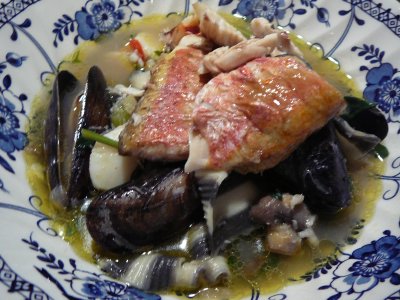
All the fish and shellfish in the bowl (pic above) was bought at Widemouth Bay: the scallops, the mussels, the little red mullets perched atop (which I roasted quickly in a hot oven and added with the fried scallops right at the end of the mussels cooking in the water flavoured with a fillet of ling, fried onion and fennel, and fresh parsley and tarragon).

Here is more detail on an earlier fish soup.

The black and white bits in the above pic are actually pasta, farfalle zebra, coloured with black squid juice (the packet has not been opened for a year but this soup was the right occasion).

I am only sorry I had to drive to get there and back (one hour and a half in total) because I consider cars to be cold mean death machines that are bad for the planet as well as my soul.

Two soups – beetroot and pea

Two soups, pea and beetroot

This two-soup soup was unplanned, a happy result of making pea soup one day, and beetroot soup the next.

Full of fibre and nutrients, it has (unusual for me) no oil or butter. Here is how I did it, food fans.

First, the pea soup. I took 200g of dried split organic peas and covered them with twice their volume with water. Then I added an onion pierced with a few cloves (thank you, queen of vegetarian cooking, Rose Elliot).

Then I cooked it for 40 minutes with a level teaspoon of untreated rock salt. And that’s it! I did not even need to blend because the obedient peas went mushy all by themselves.

As for the beetroot soup, I peeled two of the violent purple things and cut them into cubes (be careful of staining!). Thinks: as the beetroot were organic, did I need to peel? Must experiment with unpeeled next time as do not wish to shortchange myself of extra vitamins oft found in the skin.

Then I added a handful of split red lentils to thicken the soup in an innocuous way. Water to cover (about two mugsful). Plus one level teaspoon of rock salt (Do see the comments here where medical herbalist Elena Renier and I talk salt).

Still on the subject of salt: who needs a silly stock cube? Its main taste comes from salt. So why not bypass the unecessary cube – with all its weird additives – and just add a level teaspoon of sea salt instead?

The lentils and beetroot took half-an-hour to become tender to my teeth. I gave them a helping hand with my power tool, the hand-held blender. This is one kitchen device I would not be without.

Thank you, universe, for letting me have easy access to electricity, unlike the global majority. I am sure there is enough to go round if we could share resources more equally. More fairness please!