Category Archives: recipe idea

Last meal at the No Tesco squat?

Stephan rang me from the No Tesco in Stokes Croft squat.

I had just taken a picture of this Tesco bag blowing randomly on a branch in a car park in Portishead.

Stephan said tonight’s Sunday communal meal may be its last.

Last Tuesday, a repossession order was granted to Tescos plc – the ‘conscious squatters’ lost their court appeal to keep the site for the community.

I call them ‘conscious squatters’ because they look after the old Jesters comedy venue site with its bar and stage and share it consciously, hence the squat’s screening of Food Inc, last night’s Cosmic Cabaret and its regular Sunday night communal meal.

They have been occupying the premises ever since we locals heard Tesco has a planning application on the site. Even though there are 6 Tescos within a mile [see comment below] and 31 in Bristol.

I would much rather have this cosy communal space the squatters have created than another soulless supermarket.

Yet any minute now, eviction papers could be served. The squatters then have 48 hours to leave.

Here is Stephan’s Project Flowers at the squat. Note the framed flower drawings.

“Flowers represent positivity,” Stephan explains. “In a way we are all like flowers.”

He created the project so everyone could take part in it.

Food is like that – something we can all take part in.

Tonight the squat served the most amazing vegan meal for over 50 people in return for donations only.
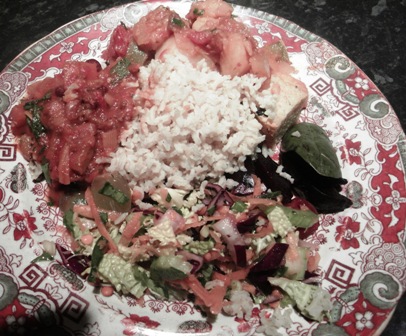
My plate of varied inventive coleslaw (raw cabbage, slivers of kiwi, finely cut celery, herbs, seeds, and cardamon), vegan chilli stew, potato curry, beetroot and spinach leaves and a mound of brown rice. Followed by homemade fruit crumble and dairy-free custard.

The funny thing tonight turned out to be networking-central. I caught up with five different lots of friends from different parts of my life (including dance, work, family and food).

The No Tesco in Stokes Croft squat is creating community.

It is budding, at the beginning of its spring growth, fertile with plans including a food coop to make local healthy food affordable for all.

It would be no joke if the squatters in the old Jesters comedy club were evicted.
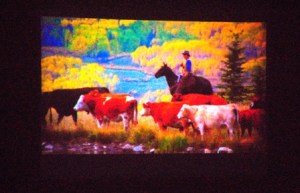
Food Inc at No Tesco squat

Last night the squatters screened Food Inc (my pic above) at the No Tesco in Stokes Croft squat on Cheltenham Road in Bristol.

The comfortable friendly squat is on the same premises Tesco wants for its 32nd supermarket in Bristol – as opposed to to the real food, whole food, local food market we locals want.

The perfect setting to see Food Inc, the documentary by US investigative journalist, Eric Schlosser, author of Fast Food Nation.

The US farmer in the picture above, sitting on his horse surrounded by cattle in verdant nature, is an illusion.

“If people knew the truth about their food, they wouldn’t eat it,” says Eric Schlosser.

So the truth is hidden.

“If there were glass walls on mega-processing facilities, we’d have a different food system in this country,” says the farmer from the local organic Polyface Farm.

Farmers who speak publicly about what goes on behind the huge industrial shed-doors get their contracts terminated.

Debt is not restricted to poor farmers in the developing world. US farmers are forced to take out loans they can’t repay to meet the company’s demand for the latest  ‘upgrade’.

Chickens are bred to grow fat faster. Their bones and internal organs cannot keep up with their fattened breasts. Chickens too ill to walk are processed as food.

Eric Schlosser says the industrial food system is based on the fast-food one: train workers (usually illegal immigrants) to do one mindless task, over and over again.

Neither the animals or workers’ comfort is of concern because they are temporary commodities, cheap to replace.

The self-policing food industry is close to US governments, whether Republican or Democrat. Those on the boards of farm chemical companies turn up as high-ranking officials in the FDA (US Food and Drug administration).

Most of our food is controlled by four megasized multi-nationals, from seed to supermarket.

Companies now legally own any seed they genetically modify.

Monsanto sues farmers for violation of their patents, and has a hotline for farmers to report on each other for doing what they have done for centuries: save seed.

These companies are so powerful, they can afford battalions of lawyers to fight farmers.

They lobby governments to skew the system so the poor end up paying more for fresh broccoli than ground-up beef treated with ammonia to kill bacteria such as e-coli rife in the manure-drenched animal factories.

We need to change the policies which make the bad calories cheaper than the good ones.

After the film, the squatters served parsnip and ginger soup, with potatoes and onion. It was delicious, satisfying my desire for wholesomeness and taste.

Here is my cup of deliciousness posed against a No Tesco campaign postcard which thousands have signed.

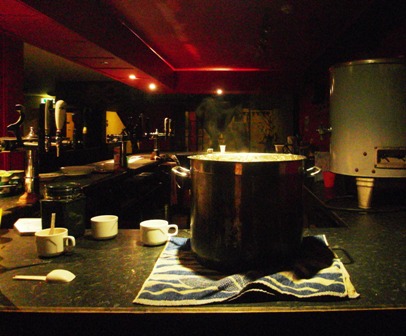
Here is the steaming soup saucepan sitting on a tea-towel on the bar of the Jesters, the ex-comedy club, which Tesco wants to demolish and replace with a soulless supermarket.

On my way home, I passed a plastic Tesco bag lying discarded on the streets.

Says it all, doesn’t it?

Please sign the petition asking Bristol City Council for a proper consultation.

And, hot-off-the-press: I am standing for the Green Party in Bishopston.

Christmas 2009 – how was yours?

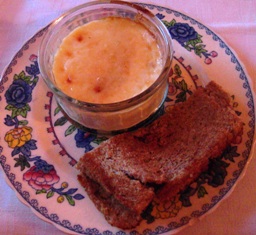
Christmas lunch. First course: parmesan custard with anchovy toast, recipe from Café Anglais, executed by my niece, Charlotte.

There was a time when my mother, Fay, good Jewish mother that she is, would insist on cooking every morsel of Christmas fare.

Finally we managed to persuade her we were old enough to take over.

Now we share the cooking.

My sister, Geraldine, cooked the goose reared by wise animal welfare expert, Sheepdrove Organic Farm, which has a shop in Bristol.

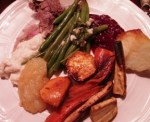
From top left clockwise:  the goose, then green bean, cranberry sauce, roast potato, roast parsnips, roast carrots, roast sweet potato, apple sauce and bread sauce.

It sounds bloody grand and it was. A local Big Issue vendor ate nothing on Christmas day, he told me today.

Juliette, eldest niece, cooked all of vegetables including her own concoction, green beans with olive oil, lemon juice, garlic, mint and a little sugar.

I made the tiramisu. None of my books had a recipe but luckily I found Tiramisu Heaven.

Mine did not look like Tiramisu Heaven pic above.

Mine looked splodgy – see below.

Yet it was delicious, if both bread-puddingy and way-creamy. I used less sugar than recipe (3oz instead of 4oz/ 1/2 cup) and brioche instead of ladyfingers. Lots of strong coffee.

I made the tiramisu late-at-night and last-minute. After carefully separating eggs, I made fatal mistake and did to egg whites what should have been done to yolks.

My mum does not use eggs at all. How sensible is that? Just 8oz mascarpone +brandy +  coffee-soaked ladyfingers, sprinkling each creamy-layer with cocoa powder, and topping with rest of coffee-soaked cake.

Geraldine provided an extra treat: mince pies with homemade pastry.

She homemade the mincemeat too: you assemble the fruit and suet, and warm. “Dead simple,” says mincemeat-demystifier, Delia Smith.

This feast was manageable thanks to six of us cooking. I made my dish in advance while others cooked on Christmas day. So division of labour was not equal.

How did you manage Christmas?

Reblog this post [with Zemanta]

Jamie Oliver – good food in 15 minutes?


Ah, I like Jamie Oliver. I have interviewed him, and I do think he is the Real Thing.

So Jamie has won the 2010 TED prize. Of course it is a bit annoying when high-earning celebrities win $100,000 prizes – I can think of equally worthy but cash-starved causes.

On the other hand, the TED prize is prestigious, international and sends a powerful message:  healthy food for children matters.

Jamie says: “Good food can be made in 15 minutes.”

I like the principle but my mind has gone blank.

Thinks: omelette / ciabatta…? (But I don’t like wheat or too many eggs).

I am currently enamoured of casseroles:

Cooked brown rice or pearl barley in a casserole with (tinned/homecooked) haricot beans, sliced raw onions and cut-up-small raw squash. Add fiery seasoning such as chilli, and/or mango chutney (or any other chutney lingering, neglected, at back of fridge) and cook in the oven with lid on, gas mark 5 for 40 minutes.

That’s dead-quick and no last-minute cooking-stress before eating.

But 15 minutes, it ain’t.

What good food would you cook in 15 minutes?

Copenhagen 2009 – green book signing

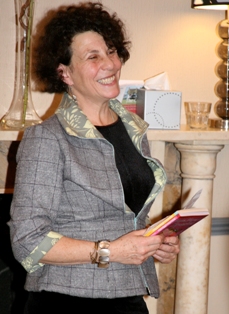
Book signing last Tuesday. Said a few words, quoting my mate Robin, quoting his mate, Tony Juniper:

Whatever happens at Copenhagen, it’s people’s cultural change that’s crucial.”

Cultural change: such as the way we eat food.

So blessed in Bristol with independent shops and local organic farmers.

We made food bought from Scoopaway, La Ruca, Saxon’s Farm at Bristol Farmers’ Market and Better Food organic supermarket.

The recipes are written by co-writer Patricia Harbottle who came to sign books.

I copied Pat’s choice of recipes from the book, which Pat had cooked for the Dorset launch.

Spicy pumpkin seeds roasted and crunchy in egg white masala.

Pea, leeks and courgette fritatta.

Hey, I now know the secret of making fritatta, thanks to Patricia’s recipe.

You finish cooking omelette and vegetables by placing under the grill.

 (Thank you, Lynne, for loan of fritatta pan that goes on the stove AND under a grill – otherwise leave your frying pan’s plastic handle sticking out away from the heat.).

And we also baked Courgette cake.

For 100 people. I repeat: a hundred.

Patricia was a top London caterer before she retired to Dorset. She helped me “scale up”.

I have decided not to be a caterer when I grow up as I had low-level fear of food poisoning and had to taste everything and not die first.

I am indebted to Ros and Charlotte for patient and relentless weighing, mixing, chopping, stirring and spreading. Not to mention style counsel.

And Chris Johnstone, author of Find Your Power, for inspired dulcimer-playing.

The best bit of the book signing was when people in the audience

spontaneously suggested ways to help Make More of Squash, and Make More of Beans & Peas go far and wide.

As well as giving nutritional info, the Make More of Vegetables series show you how to grow from seed and cook from scratch

– profound ways to create a healthy, vibrant, low-carbon, resource-saving green world

…because it’s no good waiting for our business-as-usual politicians to do so.

Stop press: I checked with Tony Juniper if it was OK to quote him. He replied:

Thanks Elisabeth. Of course I am delighted for you to quote these words. The only thing I might add is to flag up the 10:10 campaign, which seems like a logical reaction to what just happened in Denmark. I was there – it was truly shocking.”

Anjum’s Gujarati lamb curry

My children are carnivores so when they (now grown-up) visit, meat is a treat.

Cheaply produced meat means people can eat it every day as a cheap takeaway.

But eating meat daily is neither good for the health of the animals, consumers or planet.

Some people need to eat meat, while others argue our soils need  manure for soil-strength.

We just don’t need to be mass-producing meat on an industrial scale.

So it’s about trying to get a balance. There’s a spontaneous revival of the traditional way of eating:  have a feast of (well-reared) meat once a week and live on the leftovers.

Join the Feastarians, Weekend Carnivore or Paul McCartney on a Meat-free Monday.

Which leads me to this delicious lamb curry.

Quadrille Books had offered – on Twitter – a free copy of Anjum’s New Indian.

Canny New Media marketing device, eh? I like – and copied it for my own books!

So I contacted Quadrille on Twitter and the big beautiful hardback copy signed-by-Anjum arrived by post.

Its subtitle is Indian Food Made Easy.

Sadly, not easy enough for me. The ingredients list looked too long. The pages too big and glossy.

I felt daunted.

For simplified Indian dishes, I rate Quick Indian Cooking.

However after months of free-book-on-Twitter-guilt, I finally tackled a recipe.

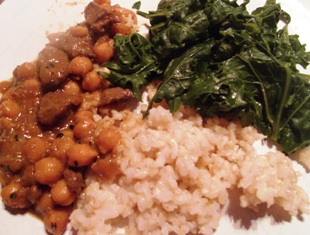
Gujarati lamb and dumpling stew – it was bloody delicious.

But I did simplify it. I left out the dumplings for a start.

Note: I substituted raw ginger for horseradish because Middle Child cannot stand ginger and takes it Very Personally if I cook with it.

Horseradish works incredibly well. Grate it raw, cover with white wine vinegar and it keeps in a jar in the fridge for 3-4 weeks.

Here’s my version: 

Ask the butcher for lamb for stewing – or mutton. Mutton is cheaper because it is  a grown-up animal. Stewing will soften the tough older meat of mutton.

Unlike pigs and poultry, it is harder to farm sheep intensively – sheep continue to roam freely and eat grass. So if you are going to eat non-organic meat, lamb is your best bet.  

I bought about 400g of organic lamb (about £4) which fed 4. I cut up the pieces quite small.

Then I browned the lamb pieces in a pan to seal the taste, then removed them.

Add a teaspoon of mustard seeds and when they pop, add the sliced onions and fry until brown.

My gratitude to Anjum grew – I don’t know what to do with mustard seeds and now I was using them like a pro.

Meanwhile, in a blender (I used the grinder attachment), make a paste of 20g of ginger – or raw grated horseradish – and 5 large peeled garlic.

This paste is a great discovery. I use it for spicy vegetarian dishes too.

Add the paste to the onions until it gently colours, about 3 minutes. Add salt to taste (I omitted the 1 tsp. of sugar), 1 Tbs of ground coriander and 1 Tbs of ground cumin; 1/2 tsp of turmeric and 1/2 tsp of chilli powder. Cook for 20 seconds.

Add about 100 ml water (I omitted the 3 pureed tomatoes) and cook gently until completely reduced, then fry the paste for 5 mins until the oil comes out.

These instructions were brill as I tend to overcook spices and not get the ratio of water-to-spices right (too watery or too dry). This worked! Thanks, Anjum.

I added a quarter of a block of coconut, not the recipe’s can of coconut milk. I also forgot the 1-2 tsp of lemon juice. I didn’t measure the water but Anjum said 200ml (for 600g of lamb).

I forgot the sweet potato but that would have been a wonderful addition.

I chose this recipe because of the chickpeas. I can’t eat a lot of meat – although I do love its rich gravy flavours – so I was happy to have meat-bits with my beloved chickpeas.

I had already soaked 200g of the raw chickpeas overnight and cooked them for an hour (or, as Anjum says, use a can).

I served it with organic curly kale and brown rice.

And it went down a treat with the carnivores.

Beetroot soup and a good deed gone wrong

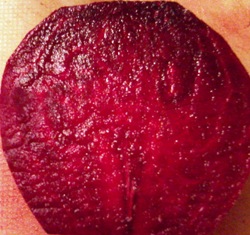
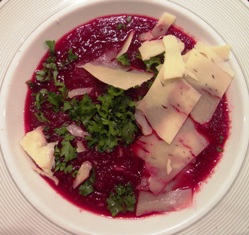
Last night’s cut raw organic beetroot.

Its insides look so mysterious.

I was making beetroot soup (again). Simplifying it.

Cut up two large peeled/scrubbed organic beetroot and place in a large pan with two peeled onions, sliced. Cover with water and bring to the boil, then simmer with a lid for 30 minutes.

I blend with an electric hand blender, my favourite kitchen power tool.

Mine was £20 second-hand, or try Freecycle for a free one, or Just for the love of it for swops.

While blending the beets (bought from Better Food), I travelled back in time:

– to fifteen years ago, and I was trying to be helpful in someone else’s kitchen.

I was in charge of the chocolate mousse.

I poured it into the mixer and pressed the button to mix.

Mayem. Chocolate mousse on every kitchen surface in spattering distance.

I had forgotten to out the lid on the mixer.

So now I practice conscious blending.

Schadenfreude means the pleasure you get from someone’s else’s pain.

I wonder if there is a word to describe the ouch you feel when you end up

causing even more ouch to the very person you are trying to help?

Served with home-grown parsley, plant from St Werburgh’s City Farm, and Yeo Valley organic cheddar shavings.

Beetroot and carrot soup

Beetroot and carrot soup

When I say I am a food writer, people assume I am a gourmet foodie, a superior being who will look down my refined nose at their offerings.

Nothing could be further from the truth.

The reality is I am an everyday, sloppy, how-quickly-can-I-eat-well cook.

My concerns lie not with how food looks, or how unusual or exotic its ingredients are but rather how healthy are they and how they were grown.

I want to demystify cooking not put it on an pedestal.

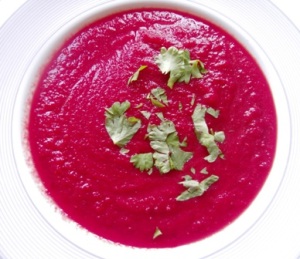
So this soup could indeed be my ‘signature’ dish. It’s comfort food made with locally and organically-grown vegetables, it took me about half-an-hour to make, is healthy and tasty.

I cut an onion and sweated their slices in olive oil in a medium-size saucepan with a lid on. I washed but did not peel the 2 large beetroots, ditto the 5-6 carrots. I chopped carrots and beetroot in inch-bites because the smaller you cut ’em, the quicker they cook.

I added the chopped veg to the softening onions, and added 3-4 mugfuls of water (one mugful=1/2 pint), and simmered it for 20 minutes, with the lid on.

I did not add salt. Both beetroot and carrot are so sweet, what other taste is needed?

I did add black pepper. And I whizzed it with my £20 handheld electric blender because I am a bit of a baby and like eating mushy-comfort food.

Escoffier, I ain’t.

So have no fear, past and future dinner hosts!

Reblog this post [with Zemanta]

Coed Hills magic and more hemp

Wind turbine Coed Hills ++

What is it about living outdoors that feels so good?

Last weekend I was camping on a Welsh hill outside Cardiff.

End of September autumn solstice and time for a mini-festival at Coed Hills, the off-the-grid 20-strong arts community.

A fine excuse to live outdoors in a festive atmosphere with 200 other people with similar interests: music, healing, eco-education, meditation and other forms of consciousness-raising and eating delicious healthy mostly organic vegetarian food.

Coed meal after sauna

I went to some great talks including from BBC5.tv, saw The Age of Stupid, and gave two writing workshops myself, sitting in a yurt with talented students.

And followed the art trail in the 100-acre woods.

Indian summer autumn light but unseasonable climate-change warmth.

Being close to nature seems to open my heart. It hurts to take stock of our wasteful world.

But here at Coed Hills, people are living the dream, putting planet-saving sustainable ideas into action.

I loved the compost loos where poo is not flushed away to join our water supply but will go to feed the soil, and the willow reed beds that clean the site’s waste water.

Inspiringly, the site runs on sustainable energy including the wind turbine (see pic above) that presides over us.

Festivals are green networking cities – if not synchroni-cities.

Or just good timing.

Before leaving, I don my hat as hemp ambassadress and present a packet of Amaru Hempower porridge to the Coed community.

Richard, the cook from Lost Horizons, and Coed communard, says I must meet Derek.

Soon – in festival-chaos style – I am sitting next to Derek Bielby, hemp consultant, on a deckchair in front of an open fire between the wooden sauna and a teepee.

Hemp keeps crossing my path, first at Shambala and then at The Organic Food Festival.

Incredibly nutritious, hemp is also perfectly suited to the UK climate.

Fast-growing , it is ready for harvest after 100-days of growth – and good for the land.

Hemp is super-sustainable – growing hemp for paper gives four times the yield than trees, Derek told me.

It also has many uses including for eco-building, paper and textiles.

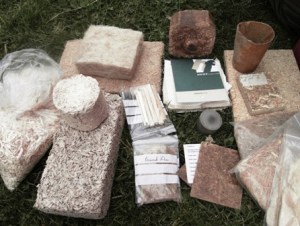
As Derek showed me:

The many uses of hemp

1. In the plastic bag on the left: the woody chips, or hurd.

2.The thing that looks like a round goat’s cheese? That, and the fibrous block it sits on, is hempcrete.

Forget the C02 criminal of the building world – use hempcrete instead.

3. Above are squares of hemp felt, a natural fibre. No more toxic fibres when you insulate a roof.

4. Next to the hemp felt, a ‘log’ of hemp waste for burning – this could be used to power the on-farm hemp-processing machine, or primary processor. Talk about sustainable.

5. ‘Woodchip’ made from hemp with a garden pot made of hemp. Plus boards of resin, also made from hemp. And swatches of hemp fabric.

I did not want to leave the magical world of Coed (pronounced coid, Welsh for wood ) where you live outdoors, treading the ground unmediated by cement,  and lit at night by fires and candlelight.

But I did.

Reblog this post [with Zemanta]

Hemp porridge knowledge

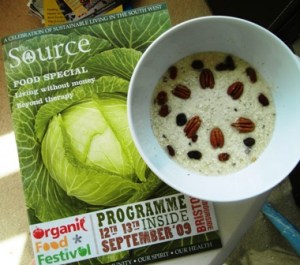
Hemp porridge and The Source (small)

I went to Shambala festival and got turned on by hemp. Every morning I would emerge from my tent to tramp across a field for hemp porridge breakfast.

Its creator, Eddie Callen, told me how he makes it: mixes it 50/50 with oats, by grinding 1/4 of the oats with all the hemp seeds, from Yorkshire Hemp. Once emulsified with the seed oil, the rest of the oats grind-in easily. Then water, hot or cold, to make the porridge, and a host of sprinkles: nuts, goji berries, agave syrup, cranberries, for taste and nutrition.

(I used pecan nuts and sultanas for my hemp breakfast back-home, see pic above).

A fount of hemp-knowledge, Eddie told me how hemp can grow abundantly in the UK without pesticides and fertilisers.

Hemp plants are so productive too: omega 3-rich seeds, and textiles, rope and paper. More sustainable than paper from trees – and cheaper.

We want hemp! ‘Tis the the earth’s most sustainable material.

Although hemp belongs to the same plant family as cannabis it has NONE of its mind-altering properties. It got a bad rap all the same and got outlawed in the 1930s but now it’s legal to grow although most UK hemp ends up as animal bedding.

Hemp-evangelist Eddie Callen was cheffing for the Community Medical Herbalists.

I had gone to see one, John E. Smith, for some remedies and it was he had told me about Eddie’s hemp-prowess.

Festivals are like that – it’s green networking city. I bumped into colleagues, past and present, as well as the legendary Simon Fairlie, editor of The Land. Its summer issue focuses on the  enclosures of Britain’s commons – historical events I have long been fascinated by as I see the roots of our present-day ills in the past.

People’s right to grow food or forage was taken away by force or legal stealth from approx from 1300s to end-18th century. Just as indigeneous people are deprived of their land today.

O I am in the mood for digression. Last night I saw Winstanley, an amazing film. Set in 1647, shot in black and white, British weather featured strongly, with only a camp fire and thatched tents to protect the Diggers from the incessant dripping rain. (As a recent camper, I identified).

Gerrard Winstanley wrote: the earth was “a Common Treasury for all”. He tried to reclaim the top of a hill in Surrey with his fellow Diggers but was beaten by the establishment.

I read about Gerrard (am on first name-terms as he is new hero) in the Land and talking about magazines, note my pic above and the latest issue of The Source.

I am SO proud to be writing for The Source, the southwest’s great green magazine.

In this issue, The Source reviews the new Transition book, Local Food, and asks:

What will we eat when the oil runs out?

The answer is green, local, organic, healthy food…and hey – this means the freshest tastes too. Talk about win-win-win-win solutions.

The Source also carries the programme for The Organic Food Festival, taking place THIS weekend in Bristol.

Organic is farming for a green future.

I am with the Shambala witches on this one.

Da witches have no Plan B (2)