Category Archives: rant

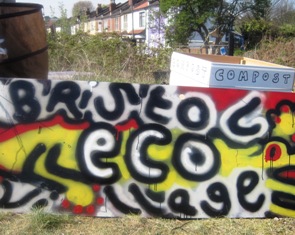
Bristol eco-village

Welcome to Bristol eco-village.

Welcome.

The squatters moved in on Saturday and already three acres of desolate wasteland in inner-city Bristol have been transformed.

What is dead has been brought back to life.

The beans are planted in the soil – on lined raised beds as the land used to be a scrapyard and may be contaminated by toxins.

The squatters are conducting soil tests.

If contamination is found, the squatters plan some soil restoration, such as feeding with compost tea and planting with nitrate-fixing plants (such as beans).

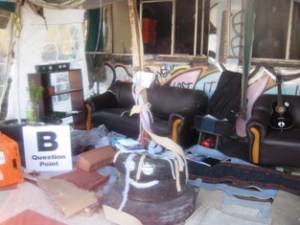
Here is their reception area where visitors can get more info.

It looks like something out of Mad Max or a similar post-apocalyptic movie – and that’s the point.

Rather than be victims of a future likely eco-disaster, some people would rather prepare positively in the present.

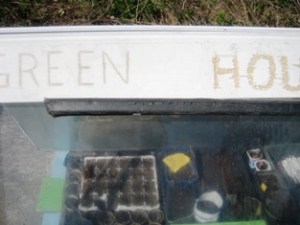
Here is a makeshift green house.

On Tuesday the squatters must got to court.

Why?

Must the land be repossessed by the owners so it may lie unused for another twenty years?

Or can it be restored to life as the squatters are doing, growing vegetables and rebuilding soil fertility?

“We come in peace they said

To dig and sow

We come to work the lands in common

And to make the waste ground grow

This earth divided

We will make whole

So it will be

A common treasury for all

We work, we eat together

We need no swords

We will not bow to the masters

Or pay rent to the lords.

Still we are free

Though we are poor

You Diggers all stand up for glory

Stand up now!”

Speedy spelt loaf recipe – not speedy roads

I am still on real bread, the topic of my last post.

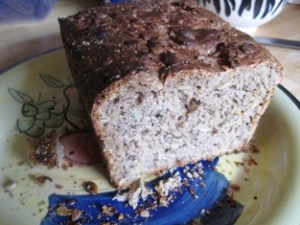
Julia made the loaf in the picture above from a recipe in the Telegraph.

Apart from bread, Julia Guest, filmmaker extraordinaire, also made A Letter to the Prime Minister.

The documentary follows the British peace activist, Jo Wilding, in Iraq before and during the 2003 invasion.

Talking about films, I was round at Julia’s on Sunday to watch Life In The Fast Lane, a documentary she was involved with about the M11 road protest (1995).

The M11 sliced through three East London boroughs and tore apart communities – all for the sake of saving motorists three minutes of time.

The M11 road protest along with similar ones at Twyford and Newbury did not stop the roads being built.

However the cost of evictions – both financially and morally – eventually halted the then-mania for road-building.

This report by the Campaign to Protect Rural England (CPRE) shows new roads are not evaluated. And grandiose claims for reducing traffic appear not to have been realised. For instance, according to Countryside Voice, the CPRE magazine (summer 2006), the Newbury town centre peak-hour traffic flows are almost back to pre-bypass levels. And, “the actual damage to protected landscapes is even worse than expected.” [added 2012]

So while we were watching Life In The Fast Lane, we ate Julia’s homemade squash-from-her-allotment soup with the amazing bread. It was delicious – tasty and healthy.

I was blown away by Life In The Fast Lane:

– the local residents who helped patrol the squat including the 93-year-old resident made a squatter in her own childhood home

– the anguished cries of schoolschildren as the 250-year old chestnut tree was torn down by a digger (reminiscent of a scene from Avatar) and despite the protestors’ beautiful tree-top home

– the spectacular London rooftop shots of squatters who locked-on themselves to chimney pots with concrete and handcuffs to stop being evicted.

It was a real insider’s view of a mega-squat resisting the onslaught of so-called progress.

The M11 movie put me in mind of the eviction of the Tesco squatters.

Julia writes: “I make this with fresh yeast from the Better Food Company and less flour. Let it rise for just over an hour in the tin, then bake it.. but no kneading at all. I use a mix of any seeds I fancy…and the quantities vary. I also add a little olive oil to stop it sticking – as well as coating the tin in oil and then a coat of small seeds. Baking only takes about 30 minutes.”

Check out Julia’s inspiration, a spelt recipe by Xanthe Clay in the Telegraph using dried yeast and requiring no kneading or proving, and an earlier one by Rose Prince that ditto is fast.

For further inspiration visit Real Bread campaigner and master baker, Andrew Whitley, and author of much-recommended Bread Matters.

And for my real-life experience of Julia’s recipe see my blog on Easy-to-make spelt loaf – it works!

Surely a quick-to-make loaf is a better use of speed than an unnecessary road?

Food Inc at No Tesco squat

Last night the squatters screened Food Inc (my pic above) at the No Tesco in Stokes Croft squat on Cheltenham Road in Bristol.

The comfortable friendly squat is on the same premises Tesco wants for its 32nd supermarket in Bristol – as opposed to to the real food, whole food, local food market we locals want.

The perfect setting to see Food Inc, the documentary by US investigative journalist, Eric Schlosser, author of Fast Food Nation.

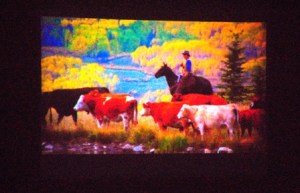
The US farmer in the picture above, sitting on his horse surrounded by cattle in verdant nature, is an illusion.

“If people knew the truth about their food, they wouldn’t eat it,” says Eric Schlosser.

So the truth is hidden.

“If there were glass walls on mega-processing facilities, we’d have a different food system in this country,” says the farmer from the local organic Polyface Farm.

Farmers who speak publicly about what goes on behind the huge industrial shed-doors get their contracts terminated.

Debt is not restricted to poor farmers in the developing world. US farmers are forced to take out loans they can’t repay to meet the company’s demand for the latest  ‘upgrade’.

Chickens are bred to grow fat faster. Their bones and internal organs cannot keep up with their fattened breasts. Chickens too ill to walk are processed as food.

Eric Schlosser says the industrial food system is based on the fast-food one: train workers (usually illegal immigrants) to do one mindless task, over and over again.

Neither the animals or workers’ comfort is of concern because they are temporary commodities, cheap to replace.

The self-policing food industry is close to US governments, whether Republican or Democrat. Those on the boards of farm chemical companies turn up as high-ranking officials in the FDA (US Food and Drug administration).

Most of our food is controlled by four megasized multi-nationals, from seed to supermarket.

Companies now legally own any seed they genetically modify.

Monsanto sues farmers for violation of their patents, and has a hotline for farmers to report on each other for doing what they have done for centuries: save seed.

These companies are so powerful, they can afford battalions of lawyers to fight farmers.

They lobby governments to skew the system so the poor end up paying more for fresh broccoli than ground-up beef treated with ammonia to kill bacteria such as e-coli rife in the manure-drenched animal factories.

We need to change the policies which make the bad calories cheaper than the good ones.

After the film, the squatters served parsnip and ginger soup, with potatoes and onion. It was delicious, satisfying my desire for wholesomeness and taste.

Here is my cup of deliciousness posed against a No Tesco campaign postcard which thousands have signed.

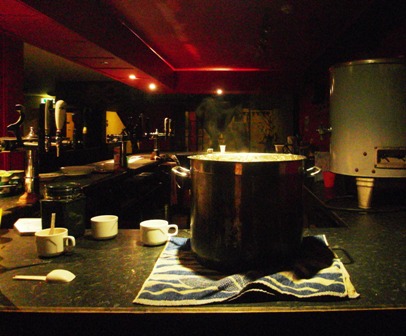
Here is the steaming soup saucepan sitting on a tea-towel on the bar of the Jesters, the ex-comedy club, which Tesco wants to demolish and replace with a soulless supermarket.

On my way home, I passed a plastic Tesco bag lying discarded on the streets.

Says it all, doesn’t it?

Please sign the petition asking Bristol City Council for a proper consultation.

And, hot-off-the-press: I am standing for the Green Party in Bishopston.

Stop Tesco banner in peaceful protest

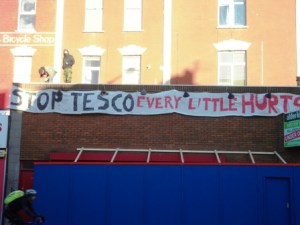
Note  Tesco’s blue hoardings, put up on Saturday, and – I might add – taking up a large part of the pavement. Cheek!

So very grateful for the handpainted banner now draped on the building (see pic above) proclaiming: “Stop Tesco! Every little hurts”.

Here is my report on Monday’s meeting in Stokes Croft, Bristol, where we heard about Tesco’s plan to build a soulless supermarket on premises which used to be a comedy club – Tesco’s, you must be joking!

It is believed the premises are occupied by some brave individuals concerned about this supermarket takeover.

Good for them, I say.

Supermarket food is not cheap because the cost to our health is so high.

What would you prefer in the place of a purveyor of industrial food?

All creative and positive ideas welcome.

Food 2030 – spin not substance


Venue magazine asked me for my view on Food 2030 for its Feb 3 issue. That got me thinking:

The government’s food strategy for the next 20 years sounded like good news.

“Britain must grow more sustainable food,” went the Guardian headline as farming minister, Hilary Benn, launched Food 2030 at the Oxford Farming Conference.

Hilary was using all the right words: climate change, food security, homegrown food.

Hilary even included this rallying call:

“People power can help bring about a revolution in the way food is produced and sold.”

That sentence could have come straight from the planet-friendly Soil Association. Hold on a minute. I think it did. I remember writing something similar when I was editor of the organic charity’s magazine, Living Earth.

So, has the government finally got the green message?

Look, I hate to be cynical but there is an election coming up.

The fact is – and you might as well know sooner than later – New Labour (and Conservatives when in power) are as wedded to the dominant global food system as ever.

Food 2030 pretends to be open-minded about GM but I am not convinced.

According to Hilary Benn’s performance at the Soil Association 2008 conference, the minister does not inspire confidence.

(Watch out for Hilary at the Soil Association conference in February).

So Hilary tries to reassure us that the government is on the case because it is spending £90m over the next five years “to fund innovative technological research and development” with the Biotechnology and Biological Sciences Research Council.

Sounds like quick-fix technology to me – good for corporate finances but not for us mere mortals.

You can bet that not-much of that £90m will go on researching already-existing healthy farming models such as organic farming or permaculture.

Food 2030 pretends to be looking for solutions but instead dumps the burden on consumers and farmers.

(Reminds me of that ghastly government advert on climate change where the little kid sees a picture of a puppy dying in the rising tide. O, so kids must feel guilty while the government carries on with business-as-usual? No, minister, that is not what I would call positive action against climate change).

Back to Food 2030 and Hilary’s big push against food waste. Yes, we waste food but hold on a minute. Why focus on what we citizens keep rotting in our fridge when supermarkets throw away far more food than we do?

And as for telling farmers to produce more local food when – hello? – council farms are being sold off.

Benn’s only vaguely substantial idea was to be more honest about labelling meat’s country of origin.

But then that was a Tory idea anyway.

So, sorry – not impressed.

Are you?

_______________________________________________________________

Stop press (added 03.05.2010): The Soil Association has produced a report investigating the big fat lie that the UK needs to double food production by 2050.

GM – the more we hear, the less we like

“Waiter, will you serve me a dish of genetically modified food?”

I don’t see anyone clamouring to eat it.

Genetic modification. Such a mild-sounding term. A bit of modifying here, a bit there – what could be wrong with that?

A lot. Genetic modification is a radical departure from traditional plant breeding.

Genetic modification is about taking a gene from one species and placing it in the gene pool of another species.

And why, pray? To help feed the world, as the GM companies would have us believe?

Um, no. Commercially developed GM crops have been ‘modified’ to survive being sprayed by the GM companies’ pesticides.

GM makes spraying intensive farms easier – just spray the field and what is left standing is your genetically modified plant.

The GM companies claim that their new technology cuts down on pesticide use.

A recent report published in the US has found that growing GM plants is actually increasing pesticide use.

Meanwhile here in old Blighty, the UK’s venerable scientific institution, the Royal Society, wants to invest millions of our taxpayers’ money into researching GM.

Stop this madness! We need to be spending our money on researching systems that DO work, such as organic farming, to find out how to make them even better.

Money invested in low-tech research is pitiful compared to money sunk in magic-bullet technologies – set to make corporations even richer than they are because – here’s the rub, so listen carefully:

Once a corporation genetically modifies a seed, the corporation can patent it. It owns the seed. 

And if that GM seed should land accidentally in a farmer’s field (and seeds do travel, borne by bees, or wind) then the farmer has to pay the GM corporation a licensing fee – viz the terrible case foisted on the 70-year-old farmer, Percy Schmeiser, in Saskatchewan, in Canada. And, according to the Soil Association, hundreds like him…

This week we heard the Food Standards Agency wants another go at persuading the British public that GM is OK.

The Food Standards Agency. That’s the same outfit that published a  flawed report in August stating  the benefits of organic food are “insignificant”. As I thrive on fresh organic food, this  incensed me. My post on the FSA’s report got the most comments ever.

So anyway, as I was saying, the Food Standards Agency (FSA) wants another go at brainwashing the British public.

The FSA is calling it a “dialogue project”.

The way we use words, eh. Obviously ‘dialogue’ was deemed innacurate – suggesting a two-way give-and-receive exchange of views. Which it is not. It’s a project. A dialogue project.

So a steering group of academics has been assembled so consumers “can be helped to make informed choices about the food they eat.”

Only two out of the 11 members of the steering group are known to be critical of GM technology, according to the Telegraph.

In fact one of the members, Professor Bryan Wynne, signed a letter to the paper saying (I paraphrase) the dialogue project was a waste of money anyway.

I like the sound of Prof Wynne.

I remember the government-led public debate on GM, called GM Nation.

The more debaters heard about GM, the more anti-GM feeling grew: “soaring to 90%” said Geoffrey Lean in this week’s Telegraph. Back in 2003 he reported how “Many regarded the debate as “window dressing used to cover secret decisions to go ahead with GM crop development”.”

The more we hear, the less we like.

Hemp porridge knowledge

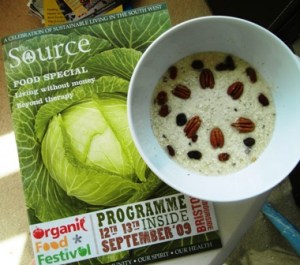
Hemp porridge and The Source (small)

I went to Shambala festival and got turned on by hemp. Every morning I would emerge from my tent to tramp across a field for hemp porridge breakfast.

Its creator, Eddie Callen, told me how he makes it: mixes it 50/50 with oats, by grinding 1/4 of the oats with all the hemp seeds, from Yorkshire Hemp. Once emulsified with the seed oil, the rest of the oats grind-in easily. Then water, hot or cold, to make the porridge, and a host of sprinkles: nuts, goji berries, agave syrup, cranberries, for taste and nutrition.

(I used pecan nuts and sultanas for my hemp breakfast back-home, see pic above).

A fount of hemp-knowledge, Eddie told me how hemp can grow abundantly in the UK without pesticides and fertilisers.

Hemp plants are so productive too: omega 3-rich seeds, and textiles, rope and paper. More sustainable than paper from trees – and cheaper.

We want hemp! ‘Tis the the earth’s most sustainable material.

Although hemp belongs to the same plant family as cannabis it has NONE of its mind-altering properties. It got a bad rap all the same and got outlawed in the 1930s but now it’s legal to grow although most UK hemp ends up as animal bedding.

Hemp-evangelist Eddie Callen was cheffing for the Community Medical Herbalists.

I had gone to see one, John E. Smith, for some remedies and it was he had told me about Eddie’s hemp-prowess.

Festivals are like that – it’s green networking city. I bumped into colleagues, past and present, as well as the legendary Simon Fairlie, editor of The Land. Its summer issue focuses on the  enclosures of Britain’s commons – historical events I have long been fascinated by as I see the roots of our present-day ills in the past.

People’s right to grow food or forage was taken away by force or legal stealth from approx from 1300s to end-18th century. Just as indigeneous people are deprived of their land today.

O I am in the mood for digression. Last night I saw Winstanley, an amazing film. Set in 1647, shot in black and white, British weather featured strongly, with only a camp fire and thatched tents to protect the Diggers from the incessant dripping rain. (As a recent camper, I identified).

Gerrard Winstanley wrote: the earth was “a Common Treasury for all”. He tried to reclaim the top of a hill in Surrey with his fellow Diggers but was beaten by the establishment.

I read about Gerrard (am on first name-terms as he is new hero) in the Land and talking about magazines, note my pic above and the latest issue of The Source.

I am SO proud to be writing for The Source, the southwest’s great green magazine.

In this issue, The Source reviews the new Transition book, Local Food, and asks:

What will we eat when the oil runs out?

The answer is green, local, organic, healthy food…and hey – this means the freshest tastes too. Talk about win-win-win-win solutions.

The Source also carries the programme for The Organic Food Festival, taking place THIS weekend in Bristol.

Organic is farming for a green future.

I am with the Shambala witches on this one.

Da witches have no Plan B (2)

GM feeds world? Don’t fall for spin

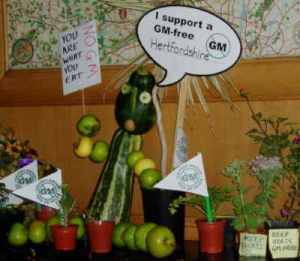
marrowman

Did you see yesterday’s print supplement to the Guardian?

Titled Agriculture, produced by the Lyonsdown media group, it was basically a huge advert for intensive farming.

Including promoting the use of GM crops in Africa.

Warning!  Spin-alert!

Don’t fall for the propaganda even if (especially if!) it comes with an ever-so-liberal paper such as the Guardian.

It is blatantly calculated to appeal to caring Guardian-reader types.

What makes me so cross is the way Africa is used in the sales talk.

Let us get one thing straight.

There is NO GM crop being grown commercially that improves yield. The only ones being grown are designed to make intensive farming tidier.

Currently, GM plants are engineered to be resistent to pesticide-spraying.  This means when a farm sprays the field, the GM crops won’t die.

How this is supposed to help a farmer in Africa?

All it does is increase dependency on agrichemical companies. The farmers have to buy the GM seed (which cannot be saved) AND the pesticides to go with it AND the licence to use it all.

One of the authors is Professor Derek Burke known as the godfather of biotech.

He writes how organic farmers are a “wealthy lobby group” preventing GM progress.

– see pic above for evidence of  “wealthy lobby group”.

So, according to the professor, a section representing 2% 0f the UK food industry, and made up of mainly small family farms, is the only thing holding back GM world domination?

No mention of the European public which does not want GM.

No mention of the African farmers who do not want GM.

And strangely, no mention of the marketing budget of  agrichemical corporations such as Monsanto and Bayer which are aggressively pushing their risky, unproven GM technology.

I wonder what the marketing-spend is on a supplement such as the one in the Guardian?

I can’t imagine a GM company is short of a bob or two for its PR war.

Slow food and fast dancing

Son Tropical

I love these guys. A nine-piece band, fresh from Havana and en route for the Barbican, London, brought to Bristol last night thanks to Bristol Slow Food.

The venue was Jesters on the Cheltenham Road. Tickets were £10 and the Cuban-style dishes, devised and prepared by Chris Wicks of Bell’s Diner were about £8.50.

Mike and I had the shrimps and avocado.

There was no mention of organic even though Cuba is the great organic inspiration. Following the collapse of the Soviet Union and no more cheap pesticides and chemical fertilisers, Cuba went organic. Many public spaces in Havana are now given over to growing organic veg. ie State-supported agriculture without fossil fuels. Don’t you love it? Just shows it can be done.

The shrimps were plump, grilled and well-tasty and the fresh pea shoots (part of the salad dressed with lemon juice) looked enchanting and tasted earthy. I have never eaten pea tendrils before – and why not? They are delicious.

The dish was the size of a generous starter but actually perfect because I needed to be light on my feet to dance.

I forgot to take a picture of my plate but I got several pictures of the band.

It was so groovy because these guys in the band were middle-aged (i.e. about my age) and older.

And they rocked.

If I wanted to nitpick about the evening, I’d say Jesters could have sold twice as many drinks with more bar staff. My sister said you needed to apply in triplicate for a Cuban cocktail – but when it came, she said: It was worth it.

They could have sold twice the food too.

But I don’t think Bristol Slow Food knew how rammed the event would get. Apparently they only confirmed Son Tropical two weeks ago. And then bookings went ballistic.

Which shows that great music and dancing may be the missing ingredient to Slow Food.

Reblog this post [with Zemanta]

Guild of Food Writers Awards 2009

IMG00083

Last night I was at the Guild of Food Writers Awards 2009 party at the Old Hall, London.

My blog was shortlisted for the New Media award, and I took my mum (see pic, above) along to give me support.

OK, my blog did not win. Tim Haward of the Guardian/ Observer Word of Mouth blog pipped both me and the lovely Helen Yuet Ling Pang of the World Foodie Guide to the (blog) post.

However, the judges said nice things about Real Food Lover such as: “Quirky”, “informative” and “Winkler’s writing rules should be required reading for aspiring writers online or in print”, and ditto in The Guardian.

One of the judges, Rupert Parker, gave me some good advice, saying I should update more often. Like daily. Will give it a go. Viz.

Emma Sturgess and Diane Hendry were also winners and that meant a lot to me because I had voted for them when I was on two previous judging panels.

Being a participant – rather than an observer – took the event to another level. I was high.

And snapped away.

IMG00084

Here is the lovely Jane Baxter and Guy Watson happy with their award (and not knowing they are about to receive another). I love their Riverford Farm Cook Book – and I have mentioned it a few times here at this blog.

Jane said there was no danger of this going to her head. “As I was coming up the steps of the Old Hall, I got a call from my six-year-old: ‘Mum, where is my bicycle pump?”

IMG00092

Here is Mark Hix who is not only a winner but thouroughly helpful. When I told him my niece was a fan, he said: “Can she cook?” and said she could contact him (yippee).

IMG00095

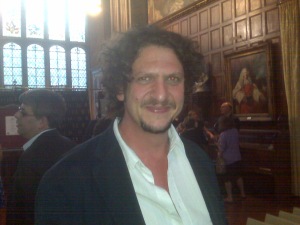
Here is Jay Rayner who was warm and funny. And below is Heston Blumenthal.

IMG00093

As my mum said: “You were up there with the big boys.”

In fact Heston was dead impressed by my mum. She was talking about her parents (circa 1930s) who used to analyse every dish at every meal – an enduring family trait. Heston admired my mum’s energy and told her:

“I want what you’ve got.”

O it was fun. And being shortlisted is a goddamn-fine accolade. Nichola Fletcher told me her publishers put it on her book cover.

So in the words of the song: “They can’t take that away from me.”

Oh no – they can’t take that away from meeeeeeee.