Category Archives: producers

Quick lettuce soup

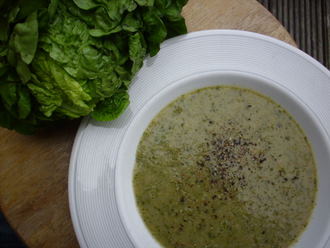
Lettuce soup

It was buy one, get one free at the organic supermarket in Bristol.

The Better Food assistant pointed out the bargain gem lettuces, fresh from the company’s Walled Garden.

I thought: oat-thickened lettuce soup. The perfect opportunity to share the quickest healthy-soup recipe I know. You basically boil water with butter, add oats to thicken and then the lettuce which takes seconds to cook.

Boil 1 pint of water with 1 ounce (30g) of butter. Add 1 ounce of rolled oats. Bring the water, butter and oats to the boil. Simmer for five minutes to cook the oats. Add a lettuce, chopped. Season with lots of black pepper but a little salt. Turn off the heat after several minutes as lettuce cooks quickly. And will carry on cooking in the water.

I think blending this soup makes it more unctious. I blended mine (see pic).

I came across it the other day. My mother was cooking it when I got back from the Guild of Food Writers Awards. Appropriately, the recipe came from the pen of one of our best food writers, the late Jane Grigson (mother of Sophie).

I love Jane Grigson’s Vegetable Book, which has recipes for every veg from artichoke to yam. My mum made hers with spinach, but the Grigson original is Irish Nettle Pottage.

I have had this book since 1980 so why, oh why, did I not think to delve in, in my nettle-soup phase?

On the subject of mistakes, I broke one glass within ten minutes of leaving the charity shop with five (for a fiver). When I photographed the damage, it had beauty (see below).

I feel a moral coming on.

Mistakes are like jewels in the crown because we can learn from them.
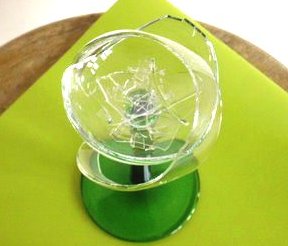
Broken wine glass

St Werburgh’s City Farm Café, Bristol

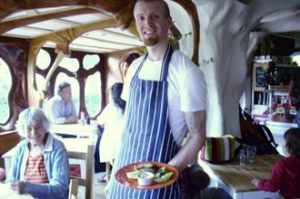
Paul Burton, chef, at St Werburgh\'s city farm cafe

Lucky me. To get to this Observer ethical award-winning café from my home, all I have do is walk ten minutes through the allotments.

Here is chef, Paul Burton, holding my lunch – the aioli is homemade, with fennel from the next-door city farm and smoked mackerel from Cornwall. Paul used to work at Café Maitreya (another Bristol award-winning eaterie) and now he is a business partner in St Werburgh’s city farm café.

Note its hippy-trippy Hobbit-like décor, courtesy of artisan builders, Bristol Gnomes.

I wish I had a photo of the café’s owner, Leona Williamson, because she too has an ethereal quality – but like all fairies, she has power too.

When cooking in the Local Food Hero competition, she came up with a new concoction, with one hour to spare.

She made goat and beetroot sausage with a three-root mash (celeriac, potato and Jerusalem artichoke), and wowed the judges, Jay Rayner, Xanthe Clay and Gary Rhodes. The goat came from the city farm.

So impressed was Jay that he put her forward for the Observer‘s ethical awards.

It was Leona’s idea to use the animals on the city farm for food.

I totally approve.

Far better to be a conscious meat-eater that respects the animals than not give a thought to how they fared when alive.

These darling creatures currently living on the city farm may well end up in one of Leona’s famous goat stews. Reader, is this OK with you?

Bristol\'s St Werburgh\'s city farm goats

Judges Bakery – real bread

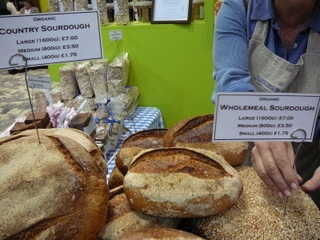
Judges bread stall

I had a glamorous moment at the Real food festival when I bought bread at the same time as Trudi Styler. She has an organic farm and had just taken part in the festival panel with Zac Goldsmith, of the Ecologist, who also chanced by.

So there I was checking out Craig’s organic bread at Judges stall and suddenly I was surrounded by celebrities.

I’ll do the goss then get on to the bread.

Judges is owned by Craig Sams and Josephine Fairley. Their relationship gave birth to Green & Black’s chocolate – it’s a great story, soon published.

Before marrying Josephine (a top editor), Craig made healthy eating accessible. You could buy wholefood peanut butter in the supermarket in the 1980s thanks to his company, Whole Earth.

My gratitude goes back to 1968. I was a teenage Londoner who went to Seed, Craig and his brother‘s macrobiotic restaurant in a Paddington basement.

Later, (and living communally) I could buy brown rice from their organic and wholefood shop, Ceres, in Notting Hill Gate.

Later again (now with a child in 1978), I would buy the most delicious health-giving bread ever from the Sams’ bakery.

That brings me to the present. The Sams’ bread today is just as bread should be. Real, substantial, and tempting.

No wonder it has flavour and texture. Judges’ organic loaves rise slowly overnight before being baked.

(Most commercial bread is whipped into a frenzy with air and additives).

Slow dough breads are easier on the digestion too. During the slow rising, enzymes have a chance to start breaking the bread down.

The pic below is of two Judges’ loaves from the Real food festival at my friend’s breakfast table.

It reminds me how at home I felt there. (We go back to the 1970s too.)

Bread

Fay’s pavlova and the Real food festival

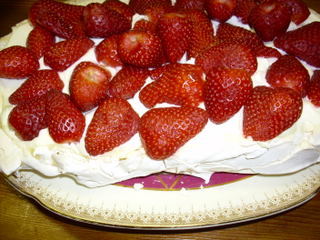
Fay\'s pavlova

Fay’s pavlova is legendary. How does she get the meringue so light on the inside yet crispy on the outside?

Piled high with strawberries (out-of-season but hey, only g-d is perfect), imbedded in whipped organic double cream, the delectable concoction is hard to resist.

Fay and I both rely on the late Evelyn Rose’s recipe for a perfect pavlova. It’s worth buying her book just for that, although (I promise), you will find a ton of other indispensable recipes there too.

Whip four egg whites to stiff peaks, then fold in double the amounts of caster sugar (that makes eight ounces. Sorry, I am so unmetric when it comes to cooking although I am trying, I really am). Fay uses half of white caster sugar and the other half golden caster sugar.

The secret Evelyn Rose ingredient is one teaspoon of vinegar (plus one teaspoon of vanilla). The vinegar seems to ensure that crispy outside and unsticky inside although I am not sure how it works scientifically.

Then spread the mixture on a greased baking sheet and bake in a low oven for two hours.

Being such a purist, my mum (for that is who Fay is) is no freezer-cook but she does (to my surprise) freeze egg whites.

I want to take my mum to the Real food festival on Thursday 24 April as she so appreciates fine raw ingredients.

“You can’t make a silk purse out of a sow’s ear,” she says. You have to buy the best (be it organic, free-range, fresh, seasonal, local and/or artisan) to make a good meal, she says.

If the ingredients are good, no need for complicated recipes (as her mother said before her).

Ingredients, ingredients, ingredients. The only three words you need to know when it comes to cooking.

Real food festival – what a buzz

Fay\'s borscht

As you can imagine, as soon as I got wind of the Real food festival, I knew I had to go.

Opening this Thursday 24 April at 10 am in Earl’s Court, this is London’s foodie festival of the year.

With about 500 small producers under one roof, including Blur musician and cheese maker Alex James, it must be one of the the biggest farmers’ market in the world.

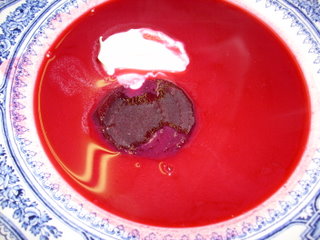
(Thus meriting a picture of my esteemed mother’s borscht. She strains the cooked beetroots, adds lemon juice to the liquid and beats in an egg. See pic from Saturday lunchtime, above.)

The Real food festival ends at 6 pm on Sunday 27 April. Here’s how to get tickets.

There’s a real buzz going on in the food world about this festival. Everyone I speak to is on their way.

I will be going on Thursday. My first stop, Nichola Fletcher’s stall (P648).

Nichola is a deer farmer from Auchtermuchty, Scotland. I just read on her website how the deer in her care are slaughtered. Sentient beings, they die instantly with no stress – it is awesome.

Deer are well-real because they have not been so intensively-farmed or bred (unlike those poor chickens).

Nichola is also an award-winning author. I know Nichola from the Guild of Food Writers. Fellow members, we have ‘met’ online.

I am looking forward to meeting Nichola in real (my favourite word again!) life.

And tasting her compassionately-killed venison.

Soil Association on Facebook for dandelions

Dandelion

The new me is eating bits of nature in the raw. Last week I was on nettles and gorse. Now it’s dandelion.

I taste its sweet petals. Mnnn. I am a dandelion fan.

What a bright-looking flower. Dandelions are medicinal. If you can’t get to pick it, try this organic herb tea.

Dandelions are also a good sign real food is growing organically. There are more wild flowers on organic farms than soil deadened by farm chemicals.

God bless the Soil Association – it fights off threats to dandelions.

Protecting dandelions from toxic chemicals is good news for organic food, keeping it real and more nutritious.

I love a good ban. The Soil Association’s pioneering standards (and here) say no to weed-killing chemicals and GM technology. Thus the dandelion lives free.

It’s exciting to help nature (that’s farm animals too. And human ones).

So do connect with the Soil Association on Facebook and join like-minded fans.

Together we can build a healthy, tasty, real food-loving future.

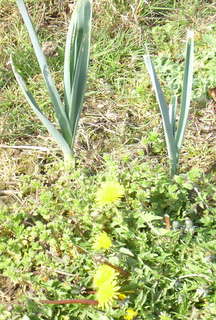
PS Check out those cute dandelions growing in the same fields as my local organic veg. Good sign, eh?

Dandelions at Marshford

Fish from Widemouth Bay

Fish soup with fish from Widemouth Bay

On Sunday I crossed counties from Devon to Cornwall. My mission: to buy fish. On a Sunday.

As I drove westward, on my right was the grey/green Atlantic ocean. But I knew its proximity did not guarantee I could buy fish landed from its waters.

We have lost the art of buying fresh fish caught locally. Most fish nowadays is sold in supermarkets. Much comes from far away and has probably been frozen.

This is the tragedy of (so-called) developed countries. The only thing which has developed is mass industrialisation. Thus fishmongers are in danger of becoming an extinct species, swallowed up in the jaws of the supermarket.

But not in Widemouth Bay. Perched above its windswept beach is Beach House Wet Fish , probably one of the best wet fish shops around. And it’s open on a Sunday (until 5.30pm).

The lovely fish lady was apologetic the local boats were not out yet this year. So, my fish came from Looe, a bit further down the coast.

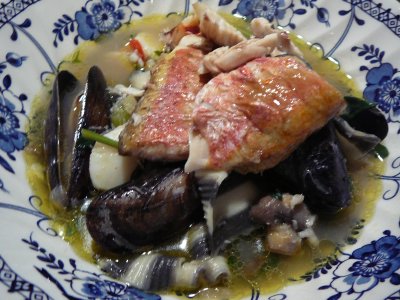
All the fish and shellfish in the bowl (pic above) was bought at Widemouth Bay: the scallops, the mussels, the little red mullets perched atop (which I roasted quickly in a hot oven and added with the fried scallops right at the end of the mussels cooking in the water flavoured with a fillet of ling, fried onion and fennel, and fresh parsley and tarragon).

Here is more detail on an earlier fish soup.

The black and white bits in the above pic are actually pasta, farfalle zebra, coloured with black squid juice (the packet has not been opened for a year but this soup was the right occasion).

I am only sorry I had to drive to get there and back (one hour and a half in total) because I consider cars to be cold mean death machines that are bad for the planet as well as my soul.

Two soups – beetroot and pea

Two soups, pea and beetroot

This two-soup soup was unplanned, a happy result of making pea soup one day, and beetroot soup the next.

Full of fibre and nutrients, it has (unusual for me) no oil or butter. Here is how I did it, food fans.

First, the pea soup. I took 200g of dried split organic peas and covered them with twice their volume with water. Then I added an onion pierced with a few cloves (thank you, queen of vegetarian cooking, Rose Elliot).

Then I cooked it for 40 minutes with a level teaspoon of untreated rock salt. And that’s it! I did not even need to blend because the obedient peas went mushy all by themselves.

As for the beetroot soup, I peeled two of the violent purple things and cut them into cubes (be careful of staining!). Thinks: as the beetroot were organic, did I need to peel? Must experiment with unpeeled next time as do not wish to shortchange myself of extra vitamins oft found in the skin.

Then I added a handful of split red lentils to thicken the soup in an innocuous way. Water to cover (about two mugsful). Plus one level teaspoon of rock salt (Do see the comments here where medical herbalist Elena Renier and I talk salt).

Still on the subject of salt: who needs a silly stock cube? Its main taste comes from salt. So why not bypass the unecessary cube – with all its weird additives – and just add a level teaspoon of sea salt instead?

The lentils and beetroot took half-an-hour to become tender to my teeth. I gave them a helping hand with my power tool, the hand-held blender. This is one kitchen device I would not be without.

Thank you, universe, for letting me have easy access to electricity, unlike the global majority. I am sure there is enough to go round if we could share resources more equally. More fairness please!

Birthday lunch at Bordeaux Quay

Bowl of fish soup, elegant and simple

My mother’s birthday so we booked a table at Bordeaux Quay. Downstairs is the buzzy brasserie for everyday (good honest dishes), but on this special occasion, we swept upstairs in a lordly way to the restaurant, overlooking Bristol’s waterfront.

We ate so well, and relaxed too. I started with Salade Paysanne, a tumble of leaves with tempting pieces of chicken and duck livers and crispy bacon (perhaps I do eat pork, after all). I ceased eating chicken livers in the 1980s when I realised most were polluted by toxins. Today was different because I could trust the meat came from happy and naturally-fed poultry.

Bordeaux Quay is not merely nodding at sustainable sourcing – its chef proprietor Barny Haughton is the real thing. He has been cooking with organic ingredients (first at Rocinantes, which then morphed into Quartier Vert) for over twenty years – and not even telling his diners because organic was considered too hippy at the time…

You can hear my interview with Barny here where I got to quiz him about his provenance. Barny’s family are organic dudes too, what with his brother, Phil (Better Food) and Liz (The Folk House). Yes, we are well served in Bristol thanks to the Haughtons – god bless their parents for producing such sustainably-minded offspring.

Like Barny, I received my food education at my mother’s knee for which I am eternally grateful.

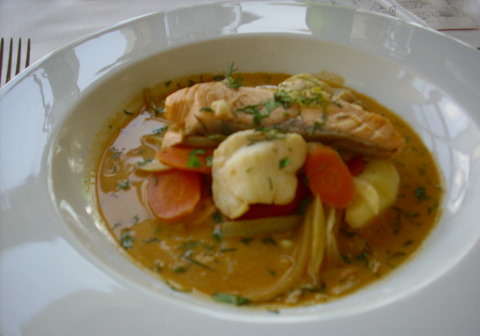
Next I had cotriade (see pic), a fish stew from Brittany. The (organic) salmon and (line-caught) cod were steamed separately, and added to this dream of a cream crab sauce with sliced earthy carrots and aromatic tarragon and fennel.

My mother – who is the empress of Real Food Lovers – said the meal restored her faith in humankind. Look, when it comes to food, it is no mean feat to please my mother. I hope Barny realises this.

“It’s such a relief to know the ingredients are well-sourced,” I said.

“And you can tell,” said my sister, Geraldine. “It’s all so naturally flavoursome – not just a big plate of nothing.”

Geraldine had masterfully chosen the most marvellous wine, the 2004 Riesling, les Princes Abbés, from Domaines Schlumberger, that even had my daughter Maude raving about its “delicate” flavour.

My mother spoke of her grandmother (another foodie) who left her village, Slonim, in Bellarusse (a hop and a skip from Vilnius) in Czarist Russia, for the east end of London.

“You said she was a revolutionary?” I asked hopefully.

“Nonsense,” said my mum (pic below). “She became very observant and spiritual as she got older but, well, as a girl, she was an atheist and went to secret socialist meetings in Russia.”

“Ha,” I said triumphantly. “And you wonder how we all turned out Bolshie.”

The blog author’s mama at 80-ish, with red hair and stylish floppy hat

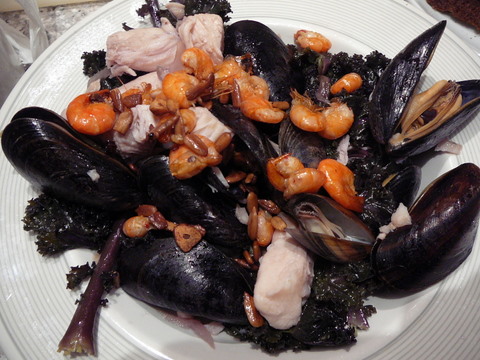
Fish soup with mussels and chilli prawns

Fish soup in a bowl with mussels sticking out and tiny prawns

I am an ungrateful girlfriend. Here was Mike slaving at the stove and here was me finding fault: the kale was too big, and (listen to this bitterness) he never praised my cooking as much as he did his own.

He was raving about this dish (above) and I was jealous. He reassured me that a) he saw it as ‘our’ dish (especially as I had sourced the ingredients) and b) he was particularly chuffed because in the past this would have taken him all day to cook, what with making a fish stock from the bones.

And we (I feel I can say ‘we’ now) had rustled it up in half-an-hour.

Let me recap. One onion fried in olive oil, plus half a mug of water. Added snippets of smoked haddock for salty taste, and monkfish cheeks, in chunks. Then the purple kale.

I was detailed to remove the shells from the shrimps (but not obsessively – I was amazed by what Mike said I could leave on, and the remaining shells cooked up well-crispy). I fried the little creatures in a pan (see below) with sliced dried chili and two sliced cloves of garlic in olive oil.

I reflected how cooking makes the raw and free fall under our dominion. What power.

Mike added the scrubbed mussels (shells tightly closed) to the fish soup and kale.

Nigel Slater, who inspired this dish, says the mussels add more flavour at this point than the rest of the fish put together. I agree.

The shrimps fried with chili and garlic added another layer of gutsiness with the shells’ crispy crunchiness adding a spicy ‘wow’ to the final bowl (See top pic – the broth must have lingered at the bottom of the bowl because not visible in pic but most definitely there).

To Mike, Nigel, the mussels, shrimps, haddock and monkfish, a big thank you for one of the tastiest finger-slurping fish soup experiences of my existence.

Shrimps frying in pan