Category Archives: producers

Organic premium – who profits?

Why do we need organic food?

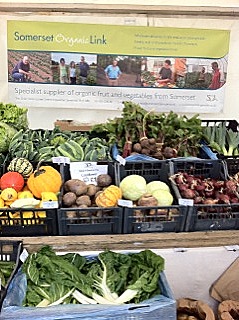
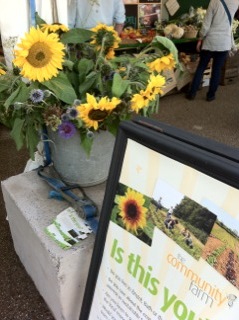
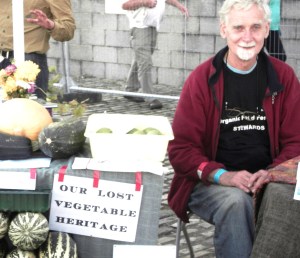
(As in the picture above of the beautiful stall from Somerset Organic Link, the farmers’ cooperative, at the Organic Food Festival last September).

What kind of topsy-turvy world do we live in that organic food has to be ring-fenced by regulations? Organic food should be the norm. It is food grown with chemicals that is the aberration!

NON-organic food should have to jump through all the hoops to be certified. Those that use the farm chemicals and potentially-harmful food additives should be paying extra in time and money to be regulated.

And people should pay more for the privilege: if industrial food factories had to pay for the damage they do – for instance polluting rivers and encouraging obesity – non-organic food would be very expensive indeed.

Instead it is organic food that attracts a “premium” (i.e. costs more).

Sometimes I wonder: Why? Who profits?

I include this letter from a farmer in the latest issue of Organic Farming which indicates that the profiteer is the supermarket.

“…If the Soil Association is serious [about challenging the public’s perception that organic is too expensive] it might do well to investigate the ongoing disparity between the supermarket shelf ‘premium’ and the ‘premium’ paid to farmers. Take lamb mince as an example: on 1 July 2010 Tesco was selling organic at £7.48/kg, compared to £5.74/kg for non-organic – that’s a difference of £1.74/kg or 23 per cent. Yet I am lucky to get a 5 per cent premium…..”

It’s annoying that eating organic often costs more (unless you are canny and take the extra effort to eat organic on a budget.)

It strikes me as grossly unfair that those of us who want to eat food – grown as nature intended – have to take more time, effort and money to do so.

What do you think?

Organic Food Festival 2010, Bristol

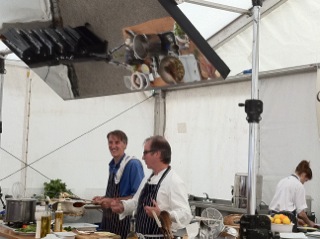
The Soil Association Organic Food Festival (see Demo kitchen above) now in its tenth year, lifts my spirits.

“79% of food we buy comes from just four shops,” says Real Food Festival’s Philip Lowery at the launch of Europe’s biggest organic food market.

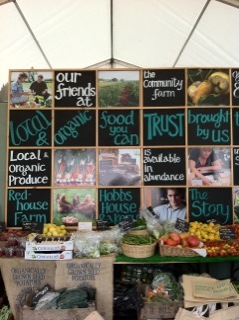
The Organic Food Festival showcases real food producers who cannot be shoehorned into the supermarket-system, with its gargantuan requirement for uniformity.

After a week objecting to a multi-billion-backed Tesco (39th store in Bristol) in Stokes Croft, this is just what I need to revive my flagging spirits.

Somerset Organic Link displays freshly-harvested vegetables grown in carbon-rich organic soil without polluting the land with nitrate fertiliser.

And a variety of pumpkins you won’t find in a supermarket.

Better Food Company (a 20 minutes walk from the proposed Tesco) has a field outside Bristol supplying the shop with much of its seasonal local organic produce.

Better Food’s Community Farm is open to all, including helping in return for a share of the harvest.

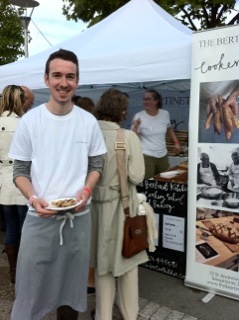
I buy a spelt loaf from the Bertinet Bakery based in Bath.

Bertinet Bakery were exhilarated having just been awarded a Soil Association Organic Food award for Baked Goods by Hugh Fearnley-Whittingstall at the awards ceremony held earlier that day in At-bristol.

The theme of this year’s Organic Fortnight is Choose Organic Everyday.

According to the latest Soil Association market report on the recession-hit 2009, 33% of organic purchases are now made by shoppers including manual and casual workers, students, pensioners and people on benefits.

In other words, recession or not, people care about healthy food, where it comes from and how it was grown.

Some organic businesses in common with many non-organic ones were hurt by the recession – overall a near 13% decline in 2009 organic sales.

But  others resisted the downward trend: organic milk sales were up 1%, organic baby food up 21%. By 2010 UK farmland that is organic rises above 5% for the first time.

Junk food high in cheap fat, sugar and additives, or chickens raised in giant sheds  never seeing natural daylight – these are the product of an industrialised and centralised food system that profits shareholders – not the consumer.

Tesco and the other three supermarkets control over three-quarters of our food. They seek market-dominance and make vast profits – Tesco’s profits increased 12% in half-year profits to £1.6bn. [October 2010 figures added after blog was posted].

Supermarkets promise cheapness but it’s an illusion.

The costs are externalised – in other words, they are picked up elsewhere: rivers polluted by farm chemicals are cleaned by taxpayers’ money; obesity from eating junk food is paid for by the NHS. Farmers are squeezed; animals farmed inhumanely.

A shopping survey in Stokes Croft – the Bristol area currently fighting off a Tesco – shows food is cheaper in the local shops than Tesco Express.

Devon-based Riverford farm’s monthly price comparisons show the organic fruit and veg in its delivery box is on average 20% cheaper than supermarkets.

Can you imagine a world where the only food you can buy comes from industrialised food systems?

(Well, that is if oil supplies remain steady because if not we will be stuffed if we are relying on only four suppliers ferrying in food from afar).

Another – local organic – world is possible.

PS Thanks to Juliet Wilson for encouraging this post.

PPS Deadline for objecting to Tesco in Stokes Croft: 14 September.

Why I object to Tesco in Stokes Croft, Bristol

On Tuesday I ate (well) in Zazu’s Kitchen in the cultural quarter of Stokes Croft.

A unique area featuring street art from vintage Banksy
to up-to-the-minute street art attracting visitors from far and wide including Italian food blogger, Jasmine.

“93% of local people say NO to Tesco in Stokes Croft,” says the fresh notice on Stokes Croft’s  creative response to street drinking, Turbo Island.

How many Tescos does a city need? There are already 38 Tescos in Bristol according to Tesco – and two within five minutes of the proposed site.

Tesco picked the wrong place to wield its corporate takeover of the high street when it set its sights on the eighteenth-century building at 138-142 Cheltenham Road in Stokes Croft.

Using an intermediary (to deflect suspicion?), it bought the lease on Jesters comedy club and applied for change-of-use to shop in November 2009.

Apparently, one Bristol City councillor said: had he known it was Tesco applying, he would not have agreed. But the application got passed, unnoticed.

Thus Tesco infiltrated the heartland of Stokes Croft, as part of its taking advantage of the recession master-plan. What a double-win for Tesco: cheapness and take-over. The more shops Tesco has, the less competition.

Local shops cannot compete against a supermarket’s marketing millions. Hello supermarket means goodbye local family businesses.

Stokes Croft happens to bring together a powerful group of people: freethinkers, food activists and artists. The area’s independent shops offer a wealth of cultural diversity and quality food – including a long-established Italian delicatessen and organic farm shop – and community.

People know each other and help each other.

The local shops have an informal agreement not to sell cheap-as-dirt super-strength alcohol – the liver-rotting stuff supermarkets sell. It will be the beginning of the end if Tesco moves in.

As Joni Mitchell sung in the Sixties: “They paved Paradise and put up a parking lot… You don’t know what you’ve got till it’s gone.”

There is still time to stop the juggernaut. All Bristolians have a right to object.

It’s true that current planning laws do not allow a Council to protect its own local shops as the Channel 4 Dispatches documentary: Tesco – the supermarket eating Britain – shows.

However the formal objection process against a shop front still gives plenty of scope for voicing concerns. Tesco front store branding promises cheapness but is a lie. Our local shops are cheaper than Tesco Express, according to a local survey.

I am helping run workshops to help people write their letters. We all need encouragement. I know I did.

The No Tesco in Stokes Croft campaignwebsite has a template letter to email to Bristol City Council. Copy and paste, then top-and-tail with a list of your concerns and your postal address.

The deadline for emailing your objection is the 14 September 2010.

I have also sent my written statement asking to speak at the planning committee on 22 September at Bristol City Council on College Green.

There will be a party on College Green from 12.30 – 2.00pm to celebrate our campaign. Whatever happens, our fight for fair planning laws has just begun.

Do you eat real bread?

I took the above picture of real bread at Wholefoods Market, London last weekend.

Daringly I took it AFTER being told by a Wholefoods Market employer that it was “not company policy” to allow photographs.

Even though I was about to blog about the store’s amazing real bread made by a genuine master baker who makes his own yeast.

Bread was on  my mind.

A few days before, a press release from the Real Bread Campaign had arrived in my email inbox.

A nine-month investigation by the Real Bread Campaign found that – despite those tempting bread-baking smells in supermarkets – only one, Marks & Spencer, produces real bread.

Real bread is made with basic ingredients such as flour, yeast and water.

Real bread does not use weird substances designed to make bread seem like real bread but are actually potentially toxic ‘processing aids’ that do not even need to be declared on the label.

I must confess.

A bit of me was like ‘so what?’.

I mean I was hardly surprised to hear supermarkets sell pretend bread.

However my inner jaded-real food campaigner was put to shame when the Real Bread Campaign’s report was published in the Daily Mail.

I was staying at my mum’s; she is a daily Daily Mail reader.

“I knew it,” she said, pacing up and down the kitchen, brandishing the paper.

“I knew that smell of baking loaves was fake,” she said.

The report vindicated her suspicion that there was no real baking going on.

Unlike at Wholefood Market which may charge inflated Kensington prices on some items (such as hummus) and not wish me to take photos but

does bake the

most

amazing

real bread.

Find real bread here and tell me:

Do you eat real bread?

My night in Bristol’s rebel restaurant

Ra-ta-ta-tat on the big red door.

Entry into the wood panelled hall of Quay House.

Once Bristol’s customs house, now disused offices, the Quay House is squatted on behalf of Cloak and Dinner, Bristol’s rebel restaurant.

Seems criminal that such a place lies empty.

Good on the squatters, for invoking Section 6 and making such creative use of it.

For four nights, Quay house is host to what the Guardian calls the hottest ticket in town.

I pass the candlelit lounge where guests will be served gin and tonic.

Up another flight, past the red-curtained dining area, also wood panelled and candle-lit, where the diners will be served a four-course meal with vegan and vegetarian options.

Up the next flight to the brightly lit kitchen milling with volunteer helpers, which reduces to a core team of about seven, myself included.

An anarchist kitchen is the opposite of a  Gordon Ramsay one.

Amidst cries of “Table 7 just finished their starters” and “four vegetarian mains”, the kitchen is calm.

No one is throwing their weight around or shouting.

Anarchists believe – as do I – that human nature is basically cooperative.

And cooperate we did.
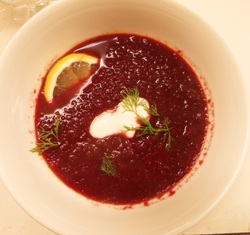
“Best borscht soup I’ve ever tasted,”  says a customer at the end of the night, the dreadlocked waiter reports.

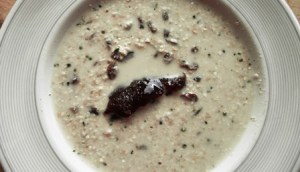
Eve had made a soffrito of celery, onions, leeks – added grated beetroot and water to simmer. Blended when cooked. With Cabernet Sauvignon vinegar, grated lemon zest and sugar to taste. Indeed the best.

For starters: pillows of filo pastry filled with mashed pumpkin, carrots, wilted rocket and walnuts, served with Caerphilly cut from a truckle of cheese.
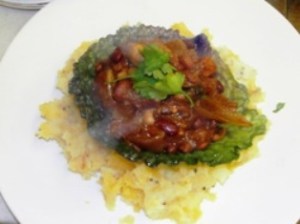
Steam rising on bean stew served on a cabbage leaf on top of potato mash flavoured with mustard seeds.

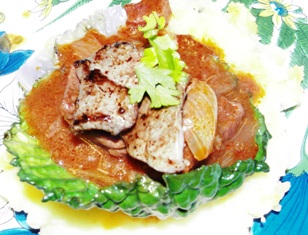
The venison comes from Fair Game in Nailsea. The young farmer shot the deer, skinned and butchered it last week. Chef Christopher cooked it with sloe gin and the bones until aromatically tender. “The venison was superb,” says another guest who visits the kitchen to praise.

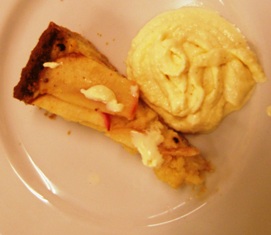
Canterbury pie about to be plated. The recipe for sweetened pastry comes courtesy of Irish chef, Richard Corrigan, while apple puree topped with thin apple slices is from classic cook, Mary Berry. The vanilla ice-cream is homemade, by Eve.

The vegan option at the open window.

I make the pies, following Sarah’s  instructions, based on the available ingredients. No scales, just guess work. My sort of cooking.

Crush biscuits in a bag, mix with melted Pure organic marge (just enough to moisten crumbs). Press into a plate. Mash bananas with ground almonds and cinnamon. Drizzle melted dark chocolate, add hazel and walnuts and drizzle more chocolate. That’s it.
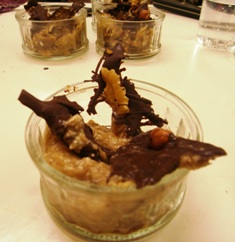
The banana mixture was too slurpy to cut cleanly so it became a concoction in a ramekin with chocolate and nut lattice broken to sit on top.

The washer upper working with grace all evening, backbone of the operation.
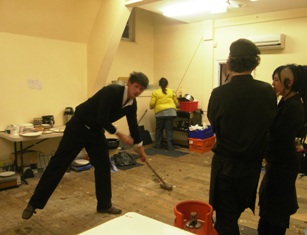
Darren, Saturday’s chef, sweeping the floor in readiness for his shift the next night.
His day job, The Kensington Arms, lent the linen for the rebel restaurant.

“Some people like vegging out in front of the TV. But something like this brings people together,” he says.
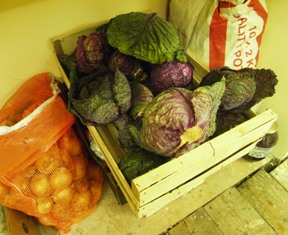
Cabbage in crates. Darren considers how to use them for his chef-shift.


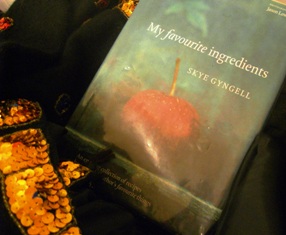
Skye Gyngell’s cookery book, My favourite ingredients, amongst the coats.


Art by Libby in the lounge where gin and tonic is served as the punters arrive.
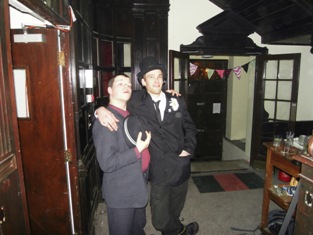
Happy customers.

“Most restaurants have no soul,” says a guest. He and his girlfriend heard about the rebel restaurant through Facebook. The 50+ covers a night got booked up as soon as word got out.

Each chef has £75 a night to conjure with, money made from a previous project, topped up with food donations from local food businesses.

People paid what they could afford. Last night we made £800 – to go towards the next project.

Everyone gives their time freely. I end the night with a heart full of love.

Butternut squash and spinach lasagne

Snowed-in.  Good excuse to make Butternut and spinach lasagne.

Christmas has had me confused: am I vegan or carnivore?  This light vegetably vegetarian dish is a compromise.

And..it does NOT require a white sauce!

As I had been planning to make the dish for a week, I had the main ingredients:

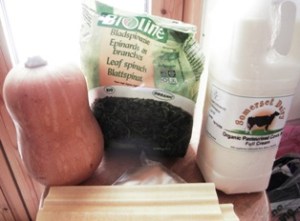
In my pic, lined up for their photoshoot, from left to right:

1 organic butternut squash, 1 packet of frozen organic spinach, 1 organic milk and 3 sheets of lasagne pasta. You need mozzarella for topping.

I got the recipe from a free promotional recipe booklet from Olive Magazine two years ago (when I had advised Hardeep Singh Kholi on going organic).

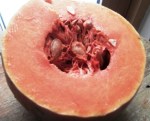
Here is the beautiful butternut squash cut in half.

I used the whole squash for the recipe and produced just over the 500g required.

I cut the squash into manageable pieces with a small sharp knife, peeled the skin using a potato peeler and scooped out the seeds.

Love the way the butternut squash is so orange.

You fry 1 onion in a large frying pan then add the 500g cut-up squash. I cut-them up smaller when I realised they had to fry.

The recipe said fry until tender and slightly brown round edges but I put the lid on – answered a few emails – and in 15 minutes it had gone very soft indeed, but not brown.

Then add 100 mls of milk (or plant milk, vegan-me).

The BEST things about this recipe are:

  • no need for a white sauce
  • 500g of squash and 150g of (frozen) spinach makes it LIGHT and vegetably.

So you cook the 3 lasagne sheets in boiling water for 3 minutes then drain.

Then layer: one sheet of pasta, followed by half of the cooked squash and half the warmed spinach.

Another sheet of lasagne pasta, then rest of squash and spinach.

Finish with the third lasagne sheet and tear a 125g ball of mozzarella over it.

(I used Buffalo Mozzarella from Laverstoke Farm, the organic farm ‘university’ owned and run by ex-racing car driver, Jody Scheckter. 20% off in Better Food organic supermarket just before New Year).

Put the dish under a heated grill until it bubbles and browns.

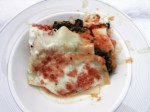
I photographed it against the snow.

No food-stylist, I! Look at the food splashes…not very stylish.

But definitely delicious.

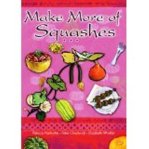
For more squash recipes, including recipes for carnivores and vegetarians, nutritional information and how to grow squash from seed, see the book I co-authored, Make More of Squash. Aad on the right of this post offers 20% discount…

Interested in reviewing a copy? Email me at elisabeth.winkler   AT yahoo.co.uk

Hemp porridge and membrillo

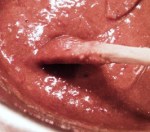
Amaru hemp porridge with membrillo

Above pic represents synchronicity and sustainability  – and a comforting, tasty and easy-peasy way to get top nutrition. Just add water…

I also dolloped on membrillo – recipe below. It’s nice with something a bit sweet such as sultanas.

Synchronicity: I went to Shambala and got so turned on by hemp porridge, it became the subject of my last post.

Two weeks later, I am at The Organic Food Festival – the after-festival party to be precise at Berwick Lodge, Christopher Wicks’ new fab place – when I find myself talking to what turns out to be:

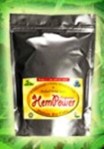
Rebekah Shaman, founder and director of Amaru Hemp.

Oooooh, I like Rebekah. Right from the start, she plunges me into different worlds with her words for instance about her time as The Shaman’s Last Apprentice in the Amazon.

She also gives me the lowdown on the nutritional powers of hemp:

  • 19% protein (meat is 30%)
  • easily absorbed globular protein (must find out what globular means)
  • every known omega, with omega 3 and 6 ideally balanced
  • every known amino acid
  • every known essential fatty acid.

One conversation leads to another and soon we realise we were linked in a myriad of different ways, culturally, socially etc.

I am taking this seriously (in an excited way): Amaru organic Hempower and me may have some work to do together in the future. Watch this space.

As for The Organic Food Festival 2009 – wow. Hot brilliant sunshine, old friends, new friends, people trading in a wholesome, future-proof, sustainable ventures – no wonder the atmosphere was elated and connections were buzzing.

I was on The Source stall with my darling editor, Dr Rachel Fleming. We shared it with the renewable energy specialists, Kaieteur, and organic soap makers, Flo and Us, both from Sidmouth.

Also sharing our marquee was James Bond (yes, that is his name) of the Avon Organic Group – his organic damsons were a talking/ tasting point for the crowds.

James Bond, Avon Organic Group at The Source stall

James gave me some beautiful quince, and this week I made membrillo for the first time, with a recipe from the Avon Organic Group. Here it is (+ my comments).

1. Quarter quince, leaving core, skin, pips intact. Add just enough water for quince to float. Simmer 1 hour or more, or until it reduces to a smooth pulp.

2. Sieve to remove pips and skin.

I am afraid I got fed up of unsatisfactory sieving (and it was midnight when I started). So I blended the whole lot, skin, pips and all. As a result it did not have that pale pink translucency of traditional membrillo – but it packed more of a nutritional punch and tasted richer and denser. (And was less fiddly).

Making membrillo 1

3. Add sugar to equal weight of sieved pulp, or at least 3/4 of weight.

Not being a sugar-freak, I used 1lb 6oz rapadura sugar to 1lb 12oz of fruit. Apologies for imperial measures – this often happens when I cook.

4. Simmer for 1-2 hours or until it has reduced to a thick pulp and darkened considerably. Stir to avoid sticking.

I stirred non-stop for 1 hour, getting spattered with boiling jam when I stopped. Wear an apron!

Making membrillo 2

5. Pour into greased or non-stick baking pan to a depth of 1-1.5 inches.

6. Bake in a low oven (140c) for about 1 hour.

7. It should set to a firm paste. Cool and cut into bite-sized squares.

Mine set to a kind of thick jam.

And it goes really well with hemp porridge.

Stop press: Amaru co-director Carlo Dawson agrees to take Brixton Transition Town pound.

HemPower pic 448 X 336

Reblog this post [with Zemanta]

Guild of Food Writers Awards 2009

IMG00083

Last night I was at the Guild of Food Writers Awards 2009 party at the Old Hall, London.

My blog was shortlisted for the New Media award, and I took my mum (see pic, above) along to give me support.

OK, my blog did not win. Tim Haward of the Guardian/ Observer Word of Mouth blog pipped both me and the lovely Helen Yuet Ling Pang of the World Foodie Guide to the (blog) post.

However, the judges said nice things about Real Food Lover such as: “Quirky”, “informative” and “Winkler’s writing rules should be required reading for aspiring writers online or in print”, and ditto in The Guardian.

One of the judges, Rupert Parker, gave me some good advice, saying I should update more often. Like daily. Will give it a go. Viz.

Emma Sturgess and Diane Hendry were also winners and that meant a lot to me because I had voted for them when I was on two previous judging panels.

Being a participant – rather than an observer – took the event to another level. I was high.

And snapped away.

IMG00084

Here is the lovely Jane Baxter and Guy Watson happy with their award (and not knowing they are about to receive another). I love their Riverford Farm Cook Book – and I have mentioned it a few times here at this blog.

Jane said there was no danger of this going to her head. “As I was coming up the steps of the Old Hall, I got a call from my six-year-old: ‘Mum, where is my bicycle pump?”

IMG00092

Here is Mark Hix who is not only a winner but thouroughly helpful. When I told him my niece was a fan, he said: “Can she cook?” and said she could contact him (yippee).

IMG00095

Here is Jay Rayner who was warm and funny. And below is Heston Blumenthal.

IMG00093

As my mum said: “You were up there with the big boys.”

In fact Heston was dead impressed by my mum. She was talking about her parents (circa 1930s) who used to analyse every dish at every meal – an enduring family trait. Heston admired my mum’s energy and told her:

“I want what you’ve got.”

O it was fun. And being shortlisted is a goddamn-fine accolade. Nichola Fletcher told me her publishers put it on her book cover.

So in the words of the song: “They can’t take that away from me.”

Oh no – they can’t take that away from meeeeeeee.

Six salad party food

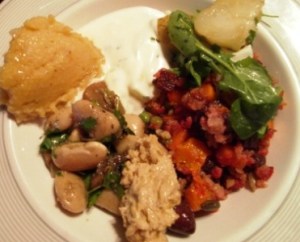
Plate of party food

Party food chez Winkler. I was too excited to eat, so took small portions. This one went down a treat despite hostess-nerves: the wild rice salad with oven-roasted morsels of beetroot, pumpkin and carrots, and crunchy oven-roasted pumpkin and sunflower seeds. My off-the-cuff invention, it’s made the grade for next time.

The six vegetarian salads (see unposed picture above) were easy-on-the-purse and high-on-health:

1. Wild rice salad with pumpkin, beetroot and carrot – followed clockwise in the picture by…

2. Ingrid Rose’s hummus (using her 5 x amounts hummus recipe) – her birthday present to me!

3. Butter bean, mushroom and coriander salad with lemon juice

– a perennial winner thanks to Rose Elliot’s The Bean Book

4. Red split lentils with chilli. Simple dhal – light with bite.

5. Organic wholemilk yogurt with diced cucumber, black pepper and mint

6. Classic potato salad – boil halved-and-quartered (if possible NEW) potatoes until soft enough to fall from a a sharp knife when speared.

The party was on Saturday. I aimed to be prepared and avoid last-minute superstress.

Most of the shopping was done midweek.

Thursday I emptied the packet of butter beans (500g) into a large pan and covered the hard ones with water. Overnight they swelled. Some say throw away the rinsing water to reduce farting – what do you think?

Friday I cooked the swelled-up beans in enough water to cover them and boiled them for 1 HOUR, then drained. I defrosted the frozen wild rice I had cooked earlier that week (with chilli). Texture mushy but taste good.

The drained butter beans mingle eventually – with onions fried in olive oil plus 5 teaspoons of cumin sizzling for seconds. Into the spicy mix go sliced mushrooms, lots of them. You may need to add more olive oil to prevent sticking. Once the mushrooms are cooked but not soggy, then you add the drained butter beans.

I  roasted the root vegetables a day-ahead too

– seasonal local beetroots and carrots and (imported) pumpkin roasted for only 20 minutes because they were cut-up so small, and the seeds – they take minutes.

Saturday Boiled potatoes for potato salad and slouched them with olive oil, rock salt and garlic while still warm.

Peeled and diced 3 English cucumbers + mint + 3 large pots of organic yogurt, emptied into a bowl.

Assembled the wild rice salad and cooked roasted root veg and seeds.

Assembled the butter beans + mushrooms + cumin with lemon juice and fresh local organic coriander.

Wow. This was the first time I have been so prepared.

I had even sorted out the serving dishes in advance.

All the more time to party.

Me and my birthday cake Me and Richie

Reblog this post [with Zemanta]

Turnip tops and haricot beans

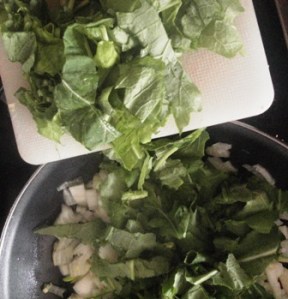
Cut-up turnip tops and into the pan they go

After a lively exchange on Facebook about how to cook turnip tops, I set to con brio.

I also consulted Jane Grigson‘s The Vegetable Book and, as always, she came up trumps with Broccoletti di rape. They eat turnip tops in Italia, you know, and appreciate their health-giving qualities.

Then I winklerfied all the information and this is what happened:

I started the whole process by frying onions because once I have done that – I am committed.

I washed the fresh turnip tops bought the day before at Bristol Farmers’ market from the wonderfully abundant organic Wrington Greens stall.

Leaves so young and fresh, I had no need to remove their stalks – just gathered them on a board and chopped them once or twice.

Then tipped them into the gently frying onions (see pic above) and stirred it all a bit.

But what to add? It’s amazing what is in the fridge. I found haricot beans, cooked at the weekend, perfectly edible and ready to go.

And of course the ubiquitous brown rice, cooked the night before.

Several grinds of black pepper, a smattering of nutmeg, a crunch or two of rock salt, a splatter of soya sauce, and about 5-10 minutes later, the dish was ready to eat.

Voilà , a plate of mean greens and beans…

turnip-greens-with-fried-onions-and-haricot-beans