
Category Archives: peak oil

Meeting Gordon Brown

Last week I left my cosy brown rice world (centre) for that of Gordon Brown’s (right pic). An invite from the prime minister was hard to resist. I was not alone. A hundred other members of the British Society of Magazine Editors turned up at number 10 Downing Street for the reception.

The prime minister’s short talk featured self-deprecating anecdotes.

I’d heard him tell some before at a previous reception also organised by the society.

April 2007. After his talk, Gordon Brown, then-chancellor, went on a fifteen-minute steered-mingle round the packed reception room. I introduced myself.

“Elisabeth Winkler from the Soil Association. We were disappointed you did not include agriculture in your green budget.”

I explained how organic farming reduces farming’s carbon footprint because it bans the use of oil-guzzling artificial fertiliser.

He changed the subject by commenting on the growth of farmers’ markets. I furnished him with a figure: farmers’ markets now number over 500. He nodded, echoing the stat.

The trick in these conversations is not to wait for Gordon to give encouraging nods and smiles. You have to deliver your message regardless.

Fast forward to last week – I failed to listen to my own advice. I only got to press his flesh and give my name and rank.

I really wanted to say: if you want an easy win, Gordon, forget GM. It’s uneconomical for farmers and unpopular with the British public.

But I fell under his spell and let him pass.  Listen, I can’t be superwoman all the time.

In his talk, Gordon Brown’s only mention of the current financial crisis was to tell us to blame the Treasury if we did not like the wine (joke). Despite the prime minister’s unwillingness to engage in the topic – and William Green, editor of Time Europe, tried hard enough – the credit crunch cropped up in every other conversation I had.

Several editors asked me if the recession would affect organic farming’s future.

I said organic farming sales had not faltered in the last recession; indeed Green & Black’s organic chocolate launched during that dire time.

And another thing, I continued, food prices are linked to oil. The price of organic food has the potential to become lower than non-organic food because organic farming uses less energy than non-organic farming.

Then I skedaddled down the road to Central Hall, Westminster, where the Soil Association’s new president, Monty Don, was giving the charity’s annual lecture in memory of its 1946 founder, Lady Eve Balfour.

Lady Eve was a cool cat who believed in caring for Mother Earth. She set about proving organic farming is better for the soil than agrichemicals. Food should be eaten as close to its source as possible, she said. Way to go.

Monty Don encouraged us to become organic vegetable gardeners. You can’t get more local than that.

Afterwards, in the Soil Association reception (organic wine, this time) several growers expressed concern that Monty’s message undervalues their skills. It’s the opposite for me: trying (failing) to grow veg has made me value the farmers more than ever.

Monty Don has reservations about the word organic, calling it “an albatross”. He is good with words (I headhunted him for Living Earth, the Soil Association magazine). Later I found myself at the bar with Monty and his wife Sarah. I said: “It’s not the word that’s the problem but the bad press associated with it. Like feminism,” I added (as a feminist).

Monty said the word ‘organic’ can make people feel guilty.

Is organic a good or bad word?

Reblog this post [with Zemanta]

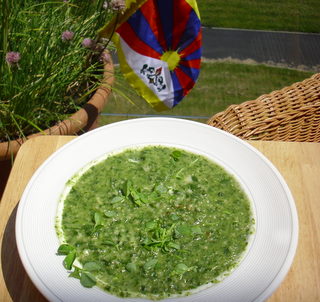
Spinach soup thickened with couscous

Spinach soup

I would be useless in a post-peak oil world. What would I do without my electric blender?

My teeth are troubling me so I made this spinach soup soothing with the help of the handheld machine. Its on-grid whirls fashioned the soup into a luxury item.

Here’s how I got there. The washed organic spinach leaves, stalks and all, went in a large pan. Spinach cooks in the water it is washed in (no need to add more) but do put a lid on to retain that moisture.

Once the spinach was cooked soft and waterless (drain to make sure), I added butter and immune-boosting garlic to frazzle in the meltedness.

But how to thicken it? I could have used flour but what is life without risk? So for the first time I sprinkled a smattering of couscous (I used organic kamut) to thicken a soup. I let it cook for a while then added a mugful of water, slowly, stirring all the time.

Reader, it worked. The couscous made it creamy.

Encouraged, I snipped in organic sprouted snow peas as a garnish.

The organic produce came from Bristol’s organic supermarket, Better Food, which is well-pleased, I imagine, with Sunday’s announcement as a finalist in the Observer Ethical Awards 2008.

Fluttering in the background is the Tibetan flag. Apparently it is illegal to fly in its home country, so it’s getting a workout on my balcony.

Food waste? Bless compost

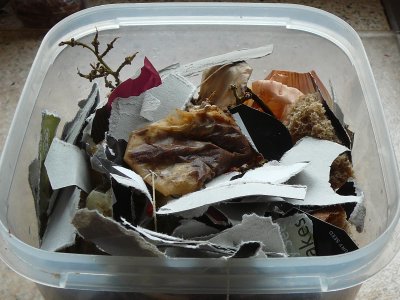
Food waste becoming compost

I admit the contents of the plastic box (above) – with its stalks, stale bread, peelings, torn-up cardboard (more later) and discarded tea bag – is not a pretty sight.

But don’t be deceived by its appearance. The present detritus of our kitchens is the future fertiliser of our food.

Sensitive souls often feel guilty about wasting food. Guys, your instinct is correct – those scraps are meant to be put to good use.

When my eco-friend Chris showed me how to compost, my life changed. Instead of throwing old food in the landfill, I became a guilt-free fertiliser queen.

Compost is a basic principle of organic farming, and hence a friend of real food. It replenishes the soil with an amazing array of nutrients – for free.

(Chemical fertiliser is not a patch on the real thing. Plus its production is oil-guzzling, polluting and greenhouse-gas causing).

You start the composting process by collecting kitchen scraps (including cooked food). Then you need to find a covered bin (preferably outdoors) where the waste can compost down in peace.

Anything which lived can be composted. The smaller it is, the quicker it breaks down so it can go from waste to ‘black-gold’ in nine months.

I added cardboard (which used to be a tree) for dryness, and tore it up, making it easier for the worms and bugs to munch it down in the garden compost bin.

What if you have no garden? Check out the Bokashi system for indoor or balcony composting (see mine below). Brave people keep wormeries in their kitchen. The waste-turned-to-crumbly-soil or fertiliser juice (yum) can be added to plant pots or a friend’s garden.

If indoor composting does not appeal, scour your vicinity – any outdoor space to be pressed into service?

What stands in your way to happy composting? Let’s break it down…

Bokashi compost bin

Fish from Widemouth Bay

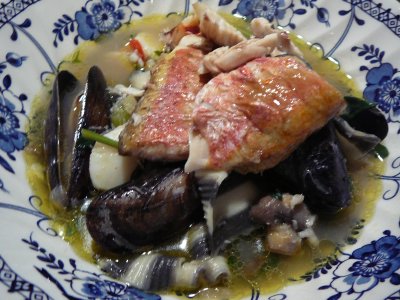
Fish soup with fish from Widemouth Bay

On Sunday I crossed counties from Devon to Cornwall. My mission: to buy fish. On a Sunday.

As I drove westward, on my right was the grey/green Atlantic ocean. But I knew its proximity did not guarantee I could buy fish landed from its waters.

We have lost the art of buying fresh fish caught locally. Most fish nowadays is sold in supermarkets. Much comes from far away and has probably been frozen.

This is the tragedy of (so-called) developed countries. The only thing which has developed is mass industrialisation. Thus fishmongers are in danger of becoming an extinct species, swallowed up in the jaws of the supermarket.

But not in Widemouth Bay. Perched above its windswept beach is Beach House Wet Fish , probably one of the best wet fish shops around. And it’s open on a Sunday (until 5.30pm).

The lovely fish lady was apologetic the local boats were not out yet this year. So, my fish came from Looe, a bit further down the coast.

All the fish and shellfish in the bowl (pic above) was bought at Widemouth Bay: the scallops, the mussels, the little red mullets perched atop (which I roasted quickly in a hot oven and added with the fried scallops right at the end of the mussels cooking in the water flavoured with a fillet of ling, fried onion and fennel, and fresh parsley and tarragon).

Here is more detail on an earlier fish soup.

The black and white bits in the above pic are actually pasta, farfalle zebra, coloured with black squid juice (the packet has not been opened for a year but this soup was the right occasion).

I am only sorry I had to drive to get there and back (one hour and a half in total) because I consider cars to be cold mean death machines that are bad for the planet as well as my soul.

The distance between two places

As we walked down the lane where the wind bends the trees west, I said to Mike:

“Travelling from Devon to Bristol doesn’t seem a long way now. A hundred miles, that’s two hours by car, and twice that by train. But what happens when the oil runs out?

It could take days to reach my family in Bristol (my girls, my sister, her girls). Let alone London (mother, father).

In my mind’s eye, I see corroded petrol pumps, and military guards at the train station preventing travel.

“It’s like a disaster movie in my head,” I said. “And the thing is, it could be true.”

“The real disaster is not enjoying what you have now,” said Mike.