Category Archives: organic

Vardo, Venice

I walk the boardwalk from Santa Monica to Venice.

The sky is overcast (yummy, just like home in England). The locals call it June gloom.

I am hungry but nothing takes my fancy.

It looks touristy and, well, not real food.

I can’t get this restaurant out of my head that I had passed earlier.

The sign had said: ethnic, vegan, vegetarian…

I don’t like retracing my steps, or leaving the ocean.

But I am glad I did.

It is rare to find somewhere where I want to eat every dish on the menu.

This is the place for me.

An oasis. Delicate flavours, vegan and vegetarian delights, raw food desserts and all ingredients organic.

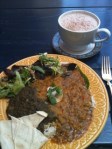
I had the aromatic gently spicy dhal and spinach curries and salad, beautifully dressed with homemade vinaigrette.

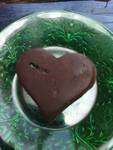
followed by this sweetheart of raw chocolate with fresh mint and coconut filling.

Vardo means gypsy in Roma.

And suited this gypsy queen down to the ground.

Food I eat in the US

Leaving Las Vegas

on the US Asia bus (tip: cheaper than Greyhound bus).

I have my bag of provisions from New Frontiers. Organic roasted cashews, plums, bananas, chocolate almonds.

I had oatmeal porridge for breakfast in the Sahara hotel and casino on the Strip.

My palatial room with en-suite was only $28 a night. I could live cheaply in Las Vegas.

The vast lobby filled with a 100 gambling machines holds no temptation.

Nor does the food.

It is plentiful alright. But nothing I want.

I am in the land of GM.

No labelling on food. No choice.

My list of food I don’t want includes:
anything with corn in it – one of the native American ‘three sisters’, it is a prime victim of genetic modification.

That cuts out a lot including, sadly, tortillas.

I don’t want to be fussy about food.

But I know too much.

I can’t unknow that cattle are pumped with grain and hormones, or shrimp is laced with antibiotics, or the gene to resist the weedkiller Roundup Ready has been inserted into the corn plant’s cells.

Plus my delicate digestion is like a canary down a mine.

I had a rice drink in my first week from a cafe. Rice sounded nice. But the next day my bowels knew it. I think it was the high-fructose corn syrup.

As the US food writer, Michael Pollan, says:

If it comes from a plant, eat it, if it was made in a plant don’t.

I am in the land of the overfed – and I am losing weight.

How ironic.

PS Just after writing this moany blog,  the bus stopped mid-desert. I eschewed McDonald’s and plumped for Chinese fast food. Joy! I rate Panda Express.

Eat organic – reduce carbon

Today I met my friend and ex-Soil Association colleague, Gundula Azeez, for lunch.

She wrote the Soil Association 2010 report, Soil carbon and organic farming.

I confess carbon used to confuse me.

As a journalist, my ignorance is my strength. If I can understand it, so can you.

Gundula kindly went back to basics for a beginner’s mind explanation.

Is carbon good or bad?

Carbon is both good and bad depending on where it is.

When it is in the soil, or locked up in oil and coal, it’s good.

When it’s in the atmosphere, it’s bad.

Carbon-in-the-air i.e. carbon dioxide is something we need to breathe OUT.

In the case of current planetary concerns, rising levels of carbon dioxide (or CO2) create rising greenhouse gases – too much of which contributes to climate change.

(Sentence rewritten following Georgie’s comment below).

Organic farming and the carbon cycle

Plants remove carbon from the atmosphere by breathing IN carbon dioxide.

That’s good.

When plants decay, the carbon is stored in the soil.

That’s good too.

Organic farmers uses this natural cycle to replenish the soil.

According to the Soil Association report, if all UK farmland were converted to organic farming, at least 3.2 million tonnes of carbon would be stored in the soil each year – the equivalent of taking nearly 1 million cars off the road

Not only that – but when carbon is stored in the soil, it does a LOT of good.

That’s because it is stored as organic matter which retains nutrients, soil structure and water.

Organic farmers create more carbon-rich organic matter through their farming practices.

They grow green manures and add compost to enrich the soil.

Soil life

Introducing soil microbes, the tiniest creatures on earth that perform vital functions to keep the soil healthy.

These soil microbes are exterminated by chemical farming practices but are actually encouraged by organic farmers.

Soil micro-organisms are essential to life on earth.

They help deliver nutrients to the growing plant.

They help it decompose when it is dead.

Thus creating more organic matter and its carbon-storage capacity.

Clods of earth

The soil actually clumps – or aggregates – around the carbon to protect it.

This delicious crumbly soil also provides a holding place for water, nutrients and air.

Which is why majority-world countries benefit from organic farming practices because they increase yield, and create water-retaining soil.

This gives developing countries more economic independence too.

They don’t have to pay the West for chemicals to feed the soil because organic farming does it naturally – by using the planet’s natural carbon cycle.

Lunch at Saint Stephen’s cafe

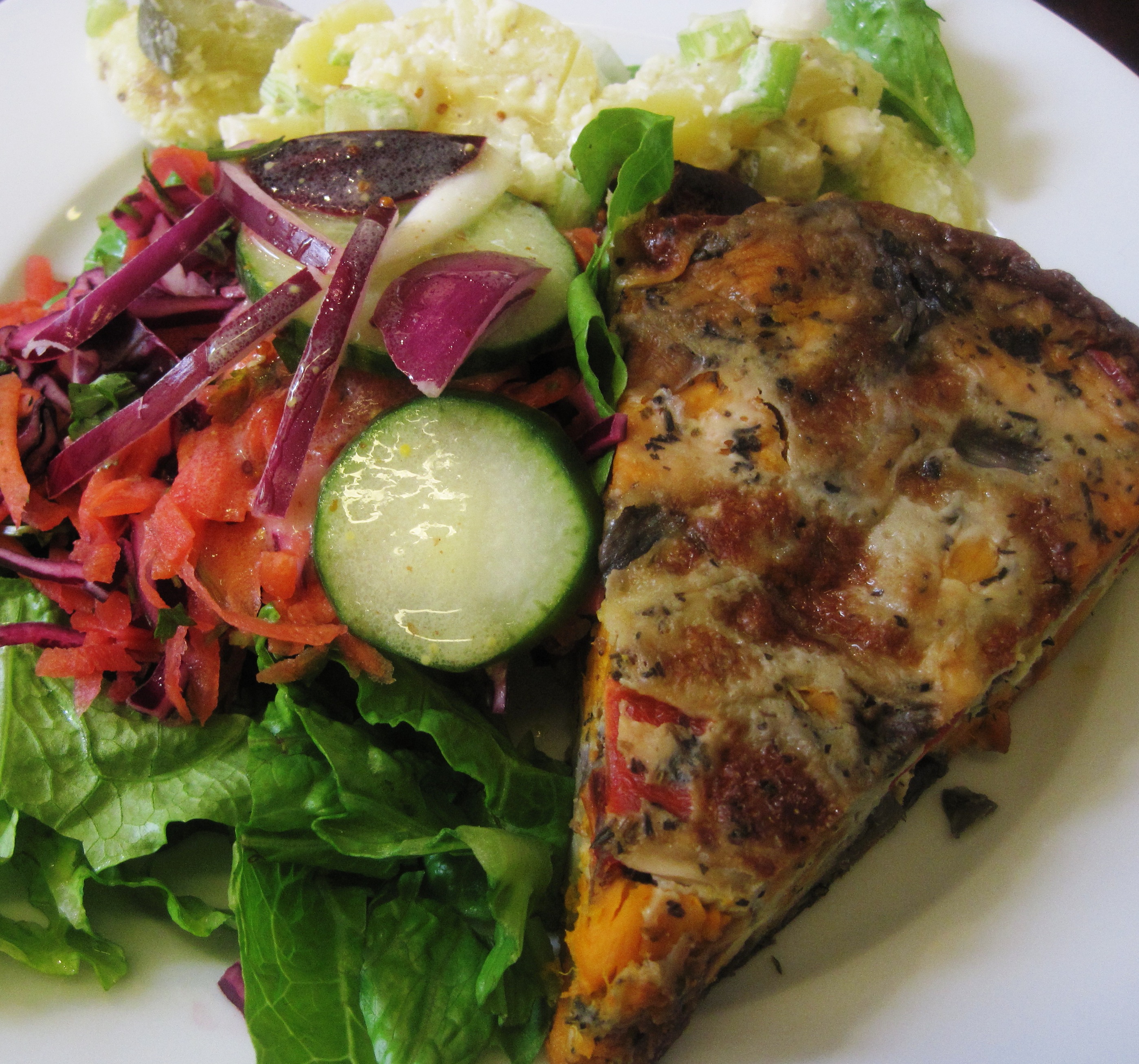
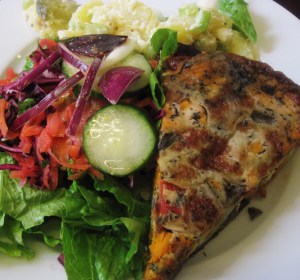
I had sweet potato frittata and salad – pictured – at Saint Stephen’s cafe.

The food is amazing – home-cooked and organic, seasonal, fair trade and local where possible.

Saint Stephen’s church cares deeply about the environment and this is reflected in its cafe food, conceived by one of Bristol’s best cooks, Edna Yeffet Summerel.

Nice to know when I eat organic food that I am enriching the soil and helping store carbon…

Easy-to-make spelt loaf

This is the most delicious bread I have baked in my life, ever – and the fastest.

Spelt bread has three great things going for it:

1. Wheat-sensitive types like myself find spelt easier-to-digest

2. Because it is spelt, you can get away with no-kneading because, as Rose Prince says in her recipe for white spelt, “Spelt, an ancient wheat grain, reacts quickly to yeast”.

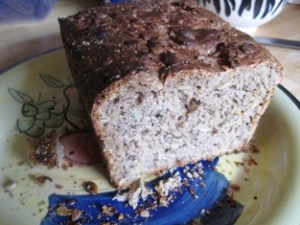
3. It tastes fantastic – the crust was seed-crunchy and the inside was moist and held together.

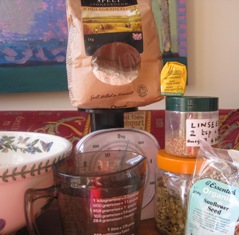
My leading characters:

Thank you to Julia for real-time baking advice, the recipe and the loaf we ate

while watching Life In The Fast Lane, about the 1990s M11 road protest.

Julia says you have to use real yeast to make it taste so good, and I did.

See Yeast ** further down for more info including using dried yeast.

Ingredients

1lb 2oz/ 500g spelt flour

½ tsp sea salt

2oz/ 50g pumpkin seeds

2oz/ 50g sunflower seeds

2oz/ 50g linseeds or sesame seeds

17floz/ 500ml warm water

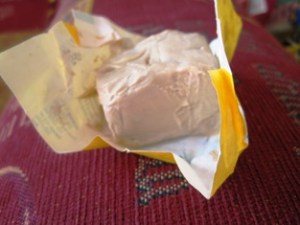
15-20g fresh yeast with 1 teaspoon of honey

a slosh of olive oil (or any oil)

Method after Julia

Add the fresh yeast and honey (1 teaspoon) to the warm water and leave it somewhere warm for 10 minutes to activate the yeast. Feel it gently fizz in your face as you peer into the jug – smells like beer brewing.

Mix the ingredients above – flour + salt + seeds + oil (and anything else such as chilli for a devilish spicyness) – in a large mixing bowl, adding the yeast/water last.

Grease two loaf tins with oil and scatter seeds to line.

Size of tins? One 2lb tin and one 1lb tin did the job for me but you can improvise.

Pour in the mixture and leave it to rise in the tins

– about 30 minutes rising-time.

If you leave it longer, dough-mixture might collapse.

Bake in an oven pre-heated to Gas Mark 6 / 200C / 400F  for 30 minutes.

Turn out and eat as soon as it cools.

(The recipe does tell you to return the loaf to oven for 5 minutes after removing it from tin but this did not seem necessary).

Yeast

It’s exciting – a living organism.

If using dried yeast see Xanthe Clay‘s recipe – which is even faster as there is no need to wait for dough-mixture to rise in the tin (although dried yeast does have additives).

How much fresh yeast to use? Rose Prince says use 7g (1/4oz) of fresh yeast for making a white spelt loaf. Julia says use about 15g.

By mistake I used 42g. Read on.

My yeast story

In my ignorance I used the entire packet of organic fresh yeast instead of a third as Julia recommended.

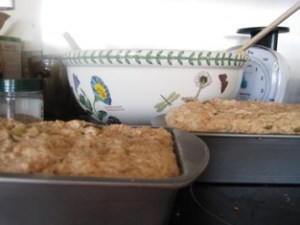
It got very dramatic as the dough-mixture rose and rose and spilled over the loaf tin.

Domestic-slut that I am

I scooped the spilled mixture and slopped it into another greased loaf tin.

And let the mixture(s) rise again.

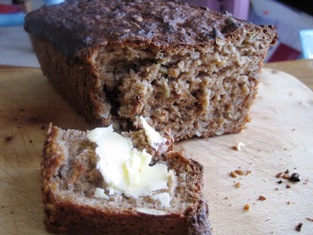
They behaved quite well this time, rising just-so – see pic below.

The bread was delicious and non-yeasty – maybe because the wholemeal spelt flour was strong enough to take the accidental extra yeast.

The moral of the tale?

You can make mistakes while cooking…

So to recap.

This spelt bread does not need kneading

making it fast to bake

Plus so damn delicious it’s also fast to partake.

Speedy spelt loaf recipe – not speedy roads

I am still on real bread, the topic of my last post.

Julia made the loaf in the picture above from a recipe in the Telegraph.

Apart from bread, Julia Guest, filmmaker extraordinaire, also made A Letter to the Prime Minister.

The documentary follows the British peace activist, Jo Wilding, in Iraq before and during the 2003 invasion.

Talking about films, I was round at Julia’s on Sunday to watch Life In The Fast Lane, a documentary she was involved with about the M11 road protest (1995).

The M11 sliced through three East London boroughs and tore apart communities – all for the sake of saving motorists three minutes of time.

The M11 road protest along with similar ones at Twyford and Newbury did not stop the roads being built.

However the cost of evictions – both financially and morally – eventually halted the then-mania for road-building.

This report by the Campaign to Protect Rural England (CPRE) shows new roads are not evaluated. And grandiose claims for reducing traffic appear not to have been realised. For instance, according to Countryside Voice, the CPRE magazine (summer 2006), the Newbury town centre peak-hour traffic flows are almost back to pre-bypass levels. And, “the actual damage to protected landscapes is even worse than expected.” [added 2012]

So while we were watching Life In The Fast Lane, we ate Julia’s homemade squash-from-her-allotment soup with the amazing bread. It was delicious – tasty and healthy.

I was blown away by Life In The Fast Lane:

– the local residents who helped patrol the squat including the 93-year-old resident made a squatter in her own childhood home

– the anguished cries of schoolschildren as the 250-year old chestnut tree was torn down by a digger (reminiscent of a scene from Avatar) and despite the protestors’ beautiful tree-top home

– the spectacular London rooftop shots of squatters who locked-on themselves to chimney pots with concrete and handcuffs to stop being evicted.

It was a real insider’s view of a mega-squat resisting the onslaught of so-called progress.

The M11 movie put me in mind of the eviction of the Tesco squatters.

Julia writes: “I make this with fresh yeast from the Better Food Company and less flour. Let it rise for just over an hour in the tin, then bake it.. but no kneading at all. I use a mix of any seeds I fancy…and the quantities vary. I also add a little olive oil to stop it sticking – as well as coating the tin in oil and then a coat of small seeds. Baking only takes about 30 minutes.”

Check out Julia’s inspiration, a spelt recipe by Xanthe Clay in the Telegraph using dried yeast and requiring no kneading or proving, and an earlier one by Rose Prince that ditto is fast.

For further inspiration visit Real Bread campaigner and master baker, Andrew Whitley, and author of much-recommended Bread Matters.

And for my real-life experience of Julia’s recipe see my blog on Easy-to-make spelt loaf – it works!

Surely a quick-to-make loaf is a better use of speed than an unnecessary road?

GM potato? I prefer blight-resistant beauties

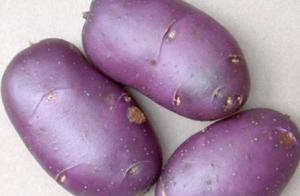
I love the look of these potatoes and their healthy interesting purpleness.

They have just had their own launch in London at the sustainable London restaurant, Konstam.

Bred by the Sarvari Trust, these Sárpo potatoes are

  • blight-resistant thus reducing pesticides
  • high-yield
  • deep-rooting
  • have weed-smothering foliage
  • low-carbon footprint
  • and can be stored unrefrigerated.

Vegetable heroes, they are on the front-line of battle against the Genetic Modification industry.

Modification? Too mild a word! Manipulation would be better.

You may have heard. In March 2010, the European Union rode roughshod over the people’s wishes and approved the first GM crop in 12 years.

BASF’s GM Amflora potato carries a controversial antibiotic resistant gene which could enter the food chain.

The EU-funded pro-GM GMO Safety website says of the GM Amflora potato.

“In this potato the composition of the starch has been altered so that it is better suited for certain industrial purposes.”

Lovely. A GM industrial potato.

Crikey. It’s enough to make me want to join anti-Europe UKIP. (Only joking).

Luckily, there is an alternative.

The Avaaz petition aims to get 1 million signatures in order to officially request the European Commission to put a moratorium on the introduction of GM crops into Europe and set up an independent, ethical, scientific body to research the impact of GM crops and determine regulation.

The funding of GM science is driven by multinational agribusiness. GM is a money spinner perfectly suited to control-freaks because once a plant is genetically modified, it can be patented.

Monsanto sues farmers in North America for having unlicensed GM seeds – even if the GM seeds arrive on their fields (as seeds do) by wind, animal or insect.

Some scientists get excited about GM, genuinely believing the technology has the possibility of helping the world.

But GM science is out-of-date, based on the belief that Genes are King.

You can’t take a genetic characteristic from one organism, put it another and tra-la-la, create a GM plant in our best interests.

The Human Genome Project proved life is far more complex than that. We disturb the gene sequence at our peril.

Scientists,  if you want to explore the frontiers of life, there is plenty of mystery in the life we already have.

Defra has to decide whether to license two GM potato trials in England.

Come on Defra! Instead of putting my taxpayer money into unproven, disaster-in-the-making technology – why not put the research money into the beautiful blight-resistant purple potato?

What do you think?

Last meal at the No Tesco squat?

Stephan rang me from the No Tesco in Stokes Croft squat.

I had just taken a picture of this Tesco bag blowing randomly on a branch in a car park in Portishead.

Stephan said tonight’s Sunday communal meal may be its last.

Last Tuesday, a repossession order was granted to Tescos plc – the ‘conscious squatters’ lost their court appeal to keep the site for the community.

I call them ‘conscious squatters’ because they look after the old Jesters comedy venue site with its bar and stage and share it consciously, hence the squat’s screening of Food Inc, last night’s Cosmic Cabaret and its regular Sunday night communal meal.

They have been occupying the premises ever since we locals heard Tesco has a planning application on the site. Even though there are 6 Tescos within a mile [see comment below] and 31 in Bristol.

I would much rather have this cosy communal space the squatters have created than another soulless supermarket.

Yet any minute now, eviction papers could be served. The squatters then have 48 hours to leave.

Here is Stephan’s Project Flowers at the squat. Note the framed flower drawings.

“Flowers represent positivity,” Stephan explains. “In a way we are all like flowers.”

He created the project so everyone could take part in it.

Food is like that – something we can all take part in.

Tonight the squat served the most amazing vegan meal for over 50 people in return for donations only.

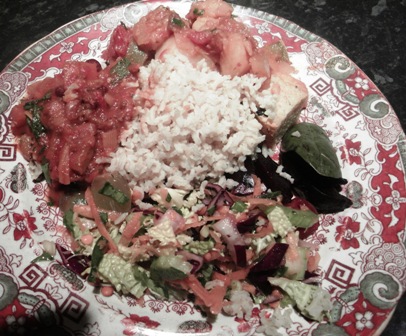
My plate of varied inventive coleslaw (raw cabbage, slivers of kiwi, finely cut celery, herbs, seeds, and cardamon), vegan chilli stew, potato curry, beetroot and spinach leaves and a mound of brown rice. Followed by homemade fruit crumble and dairy-free custard.

The funny thing tonight turned out to be networking-central. I caught up with five different lots of friends from different parts of my life (including dance, work, family and food).

The No Tesco in Stokes Croft squat is creating community.

It is budding, at the beginning of its spring growth, fertile with plans including a food coop to make local healthy food affordable for all.

It would be no joke if the squatters in the old Jesters comedy club were evicted.

Food Inc at No Tesco squat

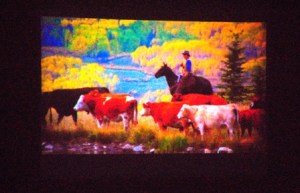
Last night the squatters screened Food Inc (my pic above) at the No Tesco in Stokes Croft squat on Cheltenham Road in Bristol.

The comfortable friendly squat is on the same premises Tesco wants for its 32nd supermarket in Bristol – as opposed to to the real food, whole food, local food market we locals want.

The perfect setting to see Food Inc, the documentary by US investigative journalist, Eric Schlosser, author of Fast Food Nation.

The US farmer in the picture above, sitting on his horse surrounded by cattle in verdant nature, is an illusion.

“If people knew the truth about their food, they wouldn’t eat it,” says Eric Schlosser.

So the truth is hidden.

“If there were glass walls on mega-processing facilities, we’d have a different food system in this country,” says the farmer from the local organic Polyface Farm.

Farmers who speak publicly about what goes on behind the huge industrial shed-doors get their contracts terminated.

Debt is not restricted to poor farmers in the developing world. US farmers are forced to take out loans they can’t repay to meet the company’s demand for the latest  ‘upgrade’.

Chickens are bred to grow fat faster. Their bones and internal organs cannot keep up with their fattened breasts. Chickens too ill to walk are processed as food.

Eric Schlosser says the industrial food system is based on the fast-food one: train workers (usually illegal immigrants) to do one mindless task, over and over again.

Neither the animals or workers’ comfort is of concern because they are temporary commodities, cheap to replace.

The self-policing food industry is close to US governments, whether Republican or Democrat. Those on the boards of farm chemical companies turn up as high-ranking officials in the FDA (US Food and Drug administration).

Most of our food is controlled by four megasized multi-nationals, from seed to supermarket.

Companies now legally own any seed they genetically modify.

Monsanto sues farmers for violation of their patents, and has a hotline for farmers to report on each other for doing what they have done for centuries: save seed.

These companies are so powerful, they can afford battalions of lawyers to fight farmers.

They lobby governments to skew the system so the poor end up paying more for fresh broccoli than ground-up beef treated with ammonia to kill bacteria such as e-coli rife in the manure-drenched animal factories.

We need to change the policies which make the bad calories cheaper than the good ones.

After the film, the squatters served parsnip and ginger soup, with potatoes and onion. It was delicious, satisfying my desire for wholesomeness and taste.

Here is my cup of deliciousness posed against a No Tesco campaign postcard which thousands have signed.

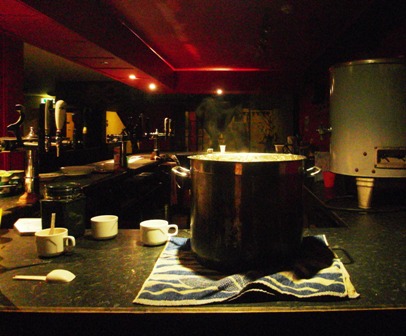
Here is the steaming soup saucepan sitting on a tea-towel on the bar of the Jesters, the ex-comedy club, which Tesco wants to demolish and replace with a soulless supermarket.

On my way home, I passed a plastic Tesco bag lying discarded on the streets.

Says it all, doesn’t it?

Please sign the petition asking Bristol City Council for a proper consultation.

And, hot-off-the-press: I am standing for the Green Party in Bishopston.

Food 2030 – spin not substance


Venue magazine asked me for my view on Food 2030 for its Feb 3 issue. That got me thinking:

The government’s food strategy for the next 20 years sounded like good news.

“Britain must grow more sustainable food,” went the Guardian headline as farming minister, Hilary Benn, launched Food 2030 at the Oxford Farming Conference.

Hilary was using all the right words: climate change, food security, homegrown food.

Hilary even included this rallying call:

“People power can help bring about a revolution in the way food is produced and sold.”

That sentence could have come straight from the planet-friendly Soil Association. Hold on a minute. I think it did. I remember writing something similar when I was editor of the organic charity’s magazine, Living Earth.

So, has the government finally got the green message?

Look, I hate to be cynical but there is an election coming up.

The fact is – and you might as well know sooner than later – New Labour (and Conservatives when in power) are as wedded to the dominant global food system as ever.

Food 2030 pretends to be open-minded about GM but I am not convinced.

According to Hilary Benn’s performance at the Soil Association 2008 conference, the minister does not inspire confidence.

(Watch out for Hilary at the Soil Association conference in February).

So Hilary tries to reassure us that the government is on the case because it is spending £90m over the next five years “to fund innovative technological research and development” with the Biotechnology and Biological Sciences Research Council.

Sounds like quick-fix technology to me – good for corporate finances but not for us mere mortals.

You can bet that not-much of that £90m will go on researching already-existing healthy farming models such as organic farming or permaculture.

Food 2030 pretends to be looking for solutions but instead dumps the burden on consumers and farmers.

(Reminds me of that ghastly government advert on climate change where the little kid sees a picture of a puppy dying in the rising tide. O, so kids must feel guilty while the government carries on with business-as-usual? No, minister, that is not what I would call positive action against climate change).

Back to Food 2030 and Hilary’s big push against food waste. Yes, we waste food but hold on a minute. Why focus on what we citizens keep rotting in our fridge when supermarkets throw away far more food than we do?

And as for telling farmers to produce more local food when – hello? – council farms are being sold off.

Benn’s only vaguely substantial idea was to be more honest about labelling meat’s country of origin.

But then that was a Tory idea anyway.

So, sorry – not impressed.

Are you?

_______________________________________________________________

Stop press (added 03.05.2010): The Soil Association has produced a report investigating the big fat lie that the UK needs to double food production by 2050.

Making marmalade


Marmalade lovers, if you have only ever eaten shop-bought marmalade, you MUST try making homemade marmalade at least once in your life.

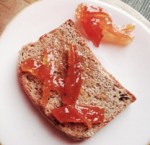
Last Sunday at 7.30pm, I committed myself to an evening of marmalade making so I could enjoy real marmalade on toast (above).

Ingredients and cost

4lbs (1.80kg) Seville oranges

I bought 1.975g  of organic Seville oranges for £5.89 at Better Food organic supermarket

4lbs (1.80kg) granulated sugar

I bought the non-organic kind at Scoopaway – 1.990g white sugar @ 1.29kg = £2.57

Sugar

Sugar is cheap compared to the fruit because it is so heavily subsidised. As a commodity, its future gets gambled on and prices look set to rise.

Would much prefer organic vegetables to be subsidised, rather than sugar.

I weighed out 4 lbs (1.8kg) granulated sugar into a pan, now warming in a low oven.

Warming the sugar makes it easier to melt into the fruit.

Softening oranges

I scrubbed the oranges and removed the stalks on each one.

They are now in a preserving pan with 4 pints of boiling water.

I have found a baking tray to cover the pan. The pan hisses.

Katie Stewart says it takes 1.5 hours to soften the oranges.

Katie (whom I once met when she won a Guild of Food Writers Lifetime Achievement Award) says 3lbs of fruit, 6lbs of sugar and 5 pints of water. In my bid for less sugar, I have experimented over the years and now use equal sugar to fruit.

Christabel who works at Better Food suggested adding orange blossom water for extra orange zing.

Haiti

Very aware of Haiti. Grateful for my life where I can calmly make marmalade. A fellow food blogger, Sabrina Ghayour is organising a Food Lovers fundraiser for Haiti. Please support this event with donations and helping promote it.

Pectin

9.30pm. I have cut the softened oranges in half and scooped out pith and pips with a teaspoon. Pith and pips (repeat-very-fast) are boiling for 10 minutes in 1 extra pint of water to extract the pectin. Pectin is crucial for helping the jam to set.

After 10 minutes of vigorous boiling, I strain the pith and pips. This takes ages as I can only get a small amount in my small strainer. The pectin-filled water goes into the preserving pan with the cut-up peel and the warmed sugar. I add the juice of two lemons.  And its flesh for good luck.

If you don’t have a preserving pan, use your biggest pan or divide amounts into two pans. You need to boil sugar-fruit-water super-vigorously for 15-30 minutes without worrying about it boiling over the sides.

Making up for lost water

The lid on the softening oranges was makeshift and inadequate, and I am paying the price: I lost precious pints in steam. I ended up (after adding strained pith-and-pips water) with 1.5pts in total. I have boldly added an extra 2pts making it up water total to 3.5 pints.

PS A few days later: And it worked! Marmalade as delicious ever.

Boiling fast to set

10.30pm. I have added the sugar to the cut-up peel and water

For some reason Jeanette Winterson is in my head. I am thinking about her organic shop in East London and wondering if she is as driven to write now she has her shop. But perhaps she arrived in my mind because Oranges Are Not The Only Fruit.

11.20pm. The marmalade has been fast-boiling for 20 minutes.

I draw it off the heat to test for a set because if you over-boil, it can lose its setting point. Who says cooking is boring? It is full of drama.

Earlier I put two plates in the freezer. I will now drip some hot jam on its cold surface and wait a few minutes. If the cooling jam crinkles when I push it with my finger – then success, it has set.

Then finally – after the second lot of 15 mins of fast boiling, that tell-tale crinkling. Joy.

The marmalade cooled while I set up a Facebook page for Foodlovers Fundraiser for Haiti, a small thing that I could do to help this cause.

12.45am. And here are my 8 pots of marmalade.

It was a palaver but it was worth it.

What do you think?