Category Archives: organic

GM? No way, no thanks

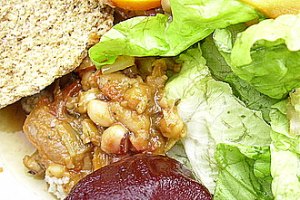
First, an advert for healthy eating brought to you by Earthmother productions. Worried about your health? Eat organic and for colour! Nature has kindly colour-coordinated its plant nutrients so you can mix-and-match. Step forward orange carotenoids for vitamin A production and purple and deeply-green antioxidants for cell-restoration.

If the veg is organic you get more antioxidants for your money. Here’s why: if you spray a plant with pesticides (which is how most western food is grown), then its ability to produce antioxidants is decreased. Antioxidants are the fighting army that protect a plant from pests and there are more in organic food because the organic plant gets to keep its antioxidant army. Fade on ad.

And the UK government wants to re-open the GM debate! Crikey, as if we don’t have enough to contend with just trying to grow a few unsprayed organic veg.

GM crops are modified in a lab to tolerate a herbicide (weed killer) or produce an insecticide (insect killer). Farmers have to buy the GM seed and the proprietary pesticide (umbrella term for herbicide, insecticide and fungicide).

If GM seeds or pollen arrive accidentally on a field, GM companies can sue farmers for patent-infringement. California voted to protect farmers against such lawsuits in August. It’s more fair if the polluter-company pays for GM contamination, as the Welsh Assembly government proposes – and not the hapless farmer.

The pro-GM marketing spin says GM can feed the world – how selfish of me to stop a technology that saves the hungry! But it’s a lie. There are no GM crops designed to help the poor. The current GM crops are engineered for insect and weed-spraying – not to improve yields, vitamin A, drought-prevention or any of the other mythical scenarios dreamed up by well-meaning but misguided press officers.

The (so-called) environment minister, Phil Woolas, said people like me have a year to prove GM is unsafe.

A body of evidence is growing; the ill-health effects on animals is well-documented. But the fact is the science has not been done. Commercial planting of GM especially in the US has pushed ahead regardless.  Listen, there has only been one trial published worldwide on humans eating GM food. And that showed worrying results.

I think we need more science on the health effects of GM.

And, Woolas – it’s not up to me to provide it.

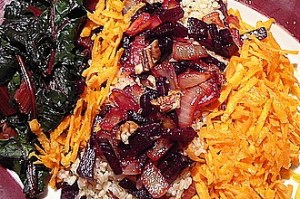
On a gentler note: the ingredients for supper came from Better Food organic supermarket, which also grew the organic veg 12 miles away. The chard was steamed, the carrots grated and the beetroot, cut very small, was – new discovery – pan-fried in olive oil for 20 minutes with sliced onion. Served on a bed of brown rice; 1 mug of rice to 2 mugs of water, simmered for 30 minutes – enough for two, and a rice salad the next day.
Baked apples

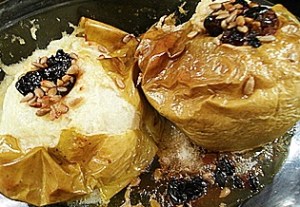
I searched my trusty cookery books but in the end only Mrs Beeton’s yielded a recipe for baked apples. I customised it, omitting sugar, and used chopped-up organic dates and prunes plus sultanas and sunflower seeds to stuff the de-cored apples. I dotted butter on top, and placed the stuffed unpeeled apples in an ovenproof dish with a thumbnail of water and baked it for an hour at Gas mark 4 (180 degrees).

They emerged from the oven, fluffed-up apple-flesh bursting from their heat-withered skin. Hmmmm, worthy contenders for a competition, methinks…

My apples were organic, natch, because I didn’t fancy the cocktail of factory-made pesticides sprayed on most apples.

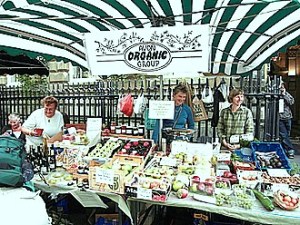
I had bought my big fat organic cooking apples at Bristol Farmers’ Market from the stall of the wondrous Avon Organic Group (below). I say wondrous because it is a voluntary group that helps maintain a local organic orchard and allotments in the city. Where would we be without such dedication?

It’s Apple day on October 21. I keep noticing the little darlings ripening on trees in the stillness of autumn.

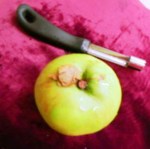
If you love baked apples, and you ever come across an apple-corer, do not hesitate. Just buy it. A corer costs a few pounds and will be your lifelong-kitchen friend even if you only use it once a year.

I value mine so much, I photographed it on a velvet cushion (see below).

PS Emboldened by Antonia’s invite (see comments), I hereby enter the humble apples into their second competition at Food Glorious Food, organised in aid of British Food Fortnight.

Bread and organic ghee

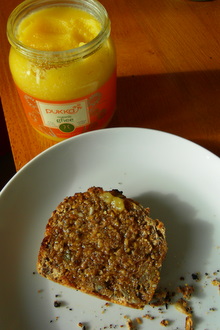
This morning’s breakfast: toast from Hobbs House Bakery and organic ghee from Pukka, both bought at the Soil Association’s Organic Food Festival this weekend.

I have wanted to buy ghee for months – it’s a healthy fat that can be used at high temperatures without burning. But I have been deterred by the ingredients list. This ghee, however, has nothing in it but clarified butter from organic milk.

I have pledged to eat unpackaged local and organic during Organic Fortnight. As this is impossible, I Ask Questions instead.

“Why is the organic ghee from Austria ?” I sternly ask Pukka’s Helena Kowalski. Turns out Pukka works with an Austrian farmer who specialises in making ghee on his small farm. Perhaps this is a new way for west country organic farmers to add value to their milk?

My breakfast toast is from Hobbs House Bakery in Bath – local points there. The Hobbs people (see their colourful stall below) were jubilant about their win at the Soil Association organic food awards on Friday. So they should be – their bread is so damn delicious, I was heartbroken when I ate my last slice an hour ago.

The whole mood of the Organic Food Festival was buzzy and warm. It’s a wonderful feeling to be involved in something which does the planet good. And is successful.

At the festival’s launch, Barny Haughton from sustainable gastro-paradise restaurant, Bordeaux Quay, said business had never been so good.

The recent food price rises are linked to the price of oil. The lynchpin of industrial farming is factory-made fertiliser, a process that relies entirely on burning oil.

In contrast organic farmers fertilise their fields naturally, courtesy of the sun, by using crop rotations, nitrogen-fixing clover and composting. As oil prices rise, organic farming becomes more profitable.

In an oil-depleted world, local organic is the future. Common sense, don’t you agree?

Shambala festival 2008

“Camping is like having a baby – you forget the pain and do it again,” said a woman at Shambala festival.

As the rain dripped, we wondered why we had left our warm dry homes to live in a field. Not even a quiet one because this was Festival Land where sounds pound night-and-day from eight different music tents. The chaos was offset by the healing area with its chimes dinging in the wind, and therapists offering massage or reiki or any manner of soothing restoration in calm tents.

I was helping the family crew welcome parents and children to the family yurt, a wondrous place of sanctuary. It was a pleasure seeing the children run free. And when dark descended, you could promenade in the anarchic carnival atmosphere.

Circus-huge tents were  themed from The Kamikaze tent and Geisha Palace to The Aloha beach with sand and pretend palm trees. My favourite was the Bollocks tent, a surreal lounge with sofas serving vodka shots and  impromptu jazz from top musicians dropping by.

There was always somewhere to have a cup of tea even at two in the morning such as Granny’s Gaff (granny looked manly and used tea-cosies).

Back at the family site, its boundaries not the usual walls but canvas, we took turns cooking the evening supper. On Sunday it was mine.

Two gas rings in a busy field kitchen and 18 adults and 12 children to feed. Mike was graceful about being my commis.

We served 500g split peas (soaked overnight and simmered for an hour) with juice squeezed from 10 fresh lemons, tahini and ground almonds; 400g of aduki beans (soaked overnight and simmered for an hour) with yogurt; mashed sweet potato; and pan-fried beetroot and carrot. I wanted to roast the beetroot and carrots but – no oven – so I experimented by cooking them for an hour in oil. They retained more sweetness than mere boiling.

We camped until the festival had truly ended. It was a privilege seeing the illusion dismantled like being backstage.

I watched the Posh Wash showers being loaded on to a truck and the mobile solar-powered cinema drive off. The circus was leaving town.

We slept the last night in an empty field where an owl hooted above the faraway sounds of the festival crew’s last party.

Celebrity to market

celebrity-to-market-this-one

I had to set an organic challenge for Hardeep Singh Kohli of Celebrity Masterchef fame: become 100% organic in two weeks. See how the comedian fared in olive, on sale now. It was a tall order because, in truth, going organic happens gradually.

I was mad-keen for Hardeep to visit a farmers’ market but he stuck to supermarkets. Farmers’ markets only set up stall once a week (or less), so I can see why they are not convenient. But the difference in quality between local organic food grown, made – or reared – within 50 miles, and the much-travelled organic food in supermarkets, is beyond compare.

Buying organic food from the person who grew it (from farmers’ markets or veg box delivery) adds a new dimension to shopping – you know where your food is from. Price-wise, buying direct is cheaper than supermarkets – no middleman to add costs.

Last Thursday at noon, catching a lift with Mike to Exeter train station, we unexpectedly passed Exeter’s farmers’ market.

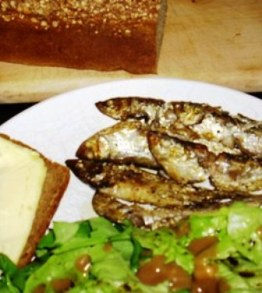
“Stop the car,” I said. I had ten minutes to gather dinner (see above). Everything was organic apart from the fish, which was wild. With only a short season, the sprats, caught in Dorset , are special. And cheap. I got six portions-worth for £5. Sprats are sustainable to fish and healthy to eat. Grill without oil – they are naturally rich in must-have omega-3.

I fried the above darlings, eating them with Rod and Ben’s salad and Emma’s homemade bread, fresh from Exeter’s Farmer’s Market.

As well as shallow-frying the fish, I slathered oil on the salad and butter on my bread – what am I like?

The next day my pal and child came round. We ate the fried sprats whole, crunchy heads and all. I was surprised a four-year old would enjoy them but he did.

This time I served them with organic mash potatoes grown at Radford Mill Farm 30 miles away, and sold at its inner-city organic farm shop luckily on my flight-path.

How do you access local organic produce? Do you find it hard like Hardeep?

Starhawk and pot luck

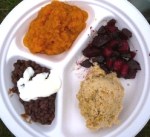
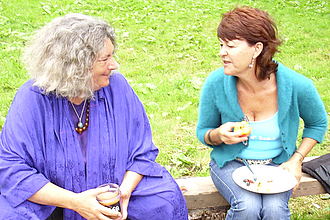
It’s not every day you meet a witch. The American pagan peace activist and writer Starhawk was giving a workshop on a nearby farm. We all bought a vegetarian offering for the shared lunch (see above).

Food brings people together and if everyone brings a dish, it’s not hard work to feed 30. The tastes may be pot luck but they miraculously get on well.

Starhawk shared with us some magical methods for keeping our spirits up while saving the world. She said, try to be in nature every day for fifteen minutes. Take time to wonder at how that leaf falls or green shoots burst out of a cracked pavement, and use your physical senses to ground you.

Radford Mill Farm was the perfect setting. We closed our eyes and heard the wind in the trees and the birds, calling. We opened them and walked barefoot on the wet grass. We felt the sun on our backs and saw the sky. I felt like a cooped-up chicken allowed to go free range.

Green activists live with the doom-reality of an impending environmental crisis but they are remarkably upbeat, probably because they are doing something to make the world a better place.

Starhawk’s talk was organised by Sarah Pugh, the Transition Bristol maven. Transition Culture is about getting self-sufficient so when supermarket shelves are empty and petrol pumps are dry, we have by this time learnt to grow our own veg (and guard our allotments from the marauding hordes?).

Our vegetables will have to be organic when oil is scarce. Non-organic farming relies on oil to make chemical fertiliser in factories. As oil prices rise, so does the cost of food. Organic farming has no need for gallons of oil. It makes its fertiliser on the farm, courtesy of the sun.

Radford Mill Farm is converting to organic and is set on making it a community affair. The official term is Community Supported Agriculture (CSA for those in the know). Originally from the US, it’s about sharing a farm’s responsibilities – and rewards. You commit in advance, with cash or in kind, and in return get a share of the harvest.

When the going gets tough, we will need our family farms more than ever. Adopt one now!

Below is a picture of Starhawk listening to Siobhan, a co-founder of Tribe of Doris, the UK’s most prestigious cultural festival. Here’s a tip for keeping cheerful: if you want to learn to dance or play music and can live under canvas for a convivial few days over the Bank Holiday weekend, then that’s the festival for you. (And don’t forget Climate Camp next week).

Buddhafield festival 2008

Healthy camping breakfast of raw oats, nuts and dried fruit

I ate the above every morning – a perfect no-cook nutrition-packed camping breakfast. From now on I will never travel without a spoon, a bowl, and bags of organic jumbo oats, dates, sunflower seeds, sultanas and pecan nuts. All dried so easy to store – just add water to bring them to life (plus a slice of apple or two).

I don’t know why people bother with expensive foreign holidays when they can go to a five-day long Buddhist festival in a Devon field. Its rigours test you, its strange culture intrigues while all around fellow festival go-ers are shaking off their everyday constraints.

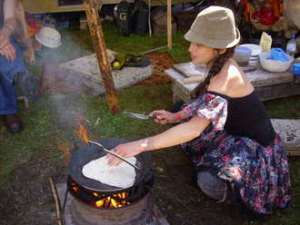
Chapatti cooking on open fire at Buddhafield festival 2008

Lots of interesting food to try such as the chapatti (above) cooked on an open fire and stuffed with homemade basil pesto and split-pea houmous (a must-try because quicker than soaking chickpeas).

And every cafe served fresh homemade chai, for me and the other two thousand people milling around in four fields.

Buddhafield cafe
Buddhafield cafe (above) was always busy, while other cafes such as the Organic Fallafel tent and the Indian Food tent did equally brisk business. As did Padma Pancakes which featured live music (including the unmissable The Wraithes who put classical poems to music).

Even the compost loos had their charms, with wooden steps as if unto a throne.

You could not do a thirtieth of what was on offer.

At night, there were live bands in every cafe, a cinema, DJs. A packed daily programme included talks on climate change, workshops in kung fu, lessons in Indian dancing, skilful flirting and sacred chanting. There were saunas in wooden huts, impromptu cabarets and Buddhist rituals with a butterfly on stilts (below).

Sainttina - butterfly on stilts at Buddhafield

And, just like the end of an exotic holiday, it was a culture-clash returning from Buddhafield to civvie street.

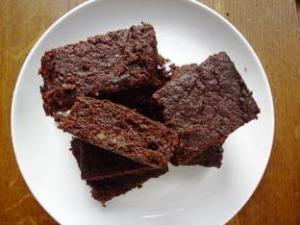
Beetroot, chocolate (and raw cocoa) brownies

Beetroot, (chocolate and raw cocoa) brownies

I read about this recipe in the riveting Riverford Farm Cook Book I have been raving about, only I have customised it somewhat.

I have never thought about beetroot in cakes until I read Riverford’s recipe and then it was an “of course” moment – beetroot cake is the new carrot cake. The beets are sweet-tasting, easy to mush when cooked and not too watery. And plentiful, seasonal and grown-locally.

I used half the sugar the recipe called for, and also omitted its cocoa powder and baking powder. This was after eating the most wonderful date-and-walnut cake at Saturday’s party, baked by the Great Cake Company. Great, indeed. Cakemaker, Chris, generously shared her secret: rice flour, loads of butter and eggs. And no raising agents. Not necessary, she said.

Instant liberation! No more raising agents – just eggs. Yippee.

Going slightly off piste, I also added soaked prunes and raw cocoa nibs.

And here, thanks to the Riverford Farm Cook Book, is how I did it.

I melted a 150g bar of Green & Black’s cooking chocolate with 200g of butter, cubed, in a bowl, over a pan of boiling water.

The recipe calls for 250g but a 150g bar seemed to do it, plus I added 150g of raw cocoa nibs which are a natural stimulant and highly nutritious. Raw cocoa stays wildly crunchy and feels terribly healthy.

I had cooked the 250g beetroot the day before and now I whizzed the peeled purple beauties (and about 12 soaked prunes) in my trusty food processor, dating circa 1980s. The recipes calls for three eggs, but I whizzed-in four eggs (organic and free range of course), one by one. Then more whizzing with 100g of rapadura sugar (instead of the recipe’s 200g caster sugar).

Then with a large spoon, I folded in 50g of rice flour (which is gluten-free) and 100g ground almonds. All ingredients were organic, naturellement.

I miraculously found a baking tin of roughly the right proportions (28x18cm), greased it with butter and lined it with foil as I had no baking parchment. And placed it in the preheated oven at Gas 4/180 degrees C. It took half-an-hour. But don’t overcook it!

Omigod, were those brownies yum. Not too sweet, with crunchy bits and mousse-like lightness.

Roast organic chicken from Sheepdrove farm, half price!

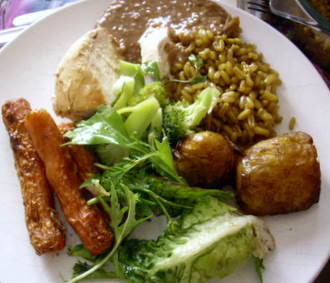
organic Sunday lunch with roast chicken from Sheepdrove

A Merrier World inspired this blog, to raise awareness for chickens. Poor things. Prisoners on a factory-production line, they have turned into commodities. An organic chicken seems expensive in comparison because it gets to lead an ordinary life.

A cheap chicken is cheap because it does not lead a normal existence. Bred to quickly gain weight, it is sometimes too heavy to walk, and, kept indoors in a noisy shed with 40,000 other birds, it is denied its natural behaviour such as feeling the sun on its back, perching or stretching its wings.

“Poor people must have cheap healthy protein,” say the chicken-factory defenders. Hello? Cheap chicken is not exactly healthy – it is full of fat, antibiotics and is a food-poisoning risk, which is why it must be cooked so carefully. A false economy, if I’ve ever heard one.

Here are ways to eat organic chicken on a budget. Buy a whole chicken and serve it as a once-a-week treat. Use its carcass for soup and leftovers for future meals. Serve it with a plateful of other goodies as I did yesterday (see the above pic with its Better Food organic salad leaves, carrots and potatoes, kamut grain and non-organic broccoli) so a little goes a long way.

My chicken came from the Sheepdrove organic farm butcher shop in Bristol, belonging to Sheepdrove organic farm in Berkshire. Master butcher, Graham Symes, picked one out for me. “See its beautiful heart shape?” he said. “That’s the way a chicken should look with the breast falling over the legs (see pic below).”

Instead of £18 for 2.6 kilos, it was half-price because of a current surplus. You can get your half-price beauties here. Hurry while stocks last!

Sheepdrove organic farm is owned and run by the kind and visionary Peter and Juliet Kindersley. Peter has put his publishing profits to a good cause, developing top animal welfare systems. My favourite Sheepdrove fact: their chickens peck at healing herbs to self-medicate. Chickens are clever creatures when allowed to be their natural chicken-selves.

The Kindersleys have recently developed a terrific new safe way of feather-plucking on its on-farm abattoir. Usually the feathers are loosened by dunking the dead birds in a bacteria-infested hot bath. The new Sheepdrove method of steaming could dramatically reduce the number of bacteria for non-organic and organic poultry alike.

Our chicken was delicious. “It tastes like chicken should taste,” said my sister who is a regular Sheepdrove shopper.

Here’s how to roast a (preferably happy) chicken: allow 20 minutes of cooking time for every pound/500 grammes – and then 20 minutes extra. I smeared the breast and legs with olive oil, rubbed in paprika and salt, and slithered slices of garlic under the skin. I simmered the giblets in wine and water for stock, and made gravy with this and the cooking pan’s juices, thickened with my new discovery: an ounce of rolled oats.

A tip for the absent-minded cook: do not put a chicken – in a plastic bag – in the oven to get to room temperature, then forget it’s there and switch the oven on. Getting melted plastic off a hot oven is no fun. Trust me.

Sheepdrove organic chicken

Quick lettuce soup

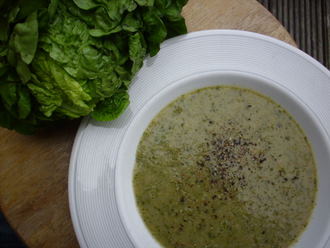
Lettuce soup

It was buy one, get one free at the organic supermarket in Bristol.

The Better Food assistant pointed out the bargain gem lettuces, fresh from the company’s Walled Garden.

I thought: oat-thickened lettuce soup. The perfect opportunity to share the quickest healthy-soup recipe I know. You basically boil water with butter, add oats to thicken and then the lettuce which takes seconds to cook.

Boil 1 pint of water with 1 ounce (30g) of butter. Add 1 ounce of rolled oats. Bring the water, butter and oats to the boil. Simmer for five minutes to cook the oats. Add a lettuce, chopped. Season with lots of black pepper but a little salt. Turn off the heat after several minutes as lettuce cooks quickly. And will carry on cooking in the water.

I think blending this soup makes it more unctious. I blended mine (see pic).

I came across it the other day. My mother was cooking it when I got back from the Guild of Food Writers Awards. Appropriately, the recipe came from the pen of one of our best food writers, the late Jane Grigson (mother of Sophie).

I love Jane Grigson’s Vegetable Book, which has recipes for every veg from artichoke to yam. My mum made hers with spinach, but the Grigson original is Irish Nettle Pottage.

I have had this book since 1980 so why, oh why, did I not think to delve in, in my nettle-soup phase?

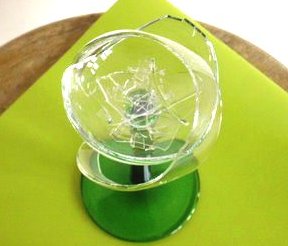
On the subject of mistakes, I broke one glass within ten minutes of leaving the charity shop with five (for a fiver). When I photographed the damage, it had beauty (see below).

I feel a moral coming on.

Mistakes are like jewels in the crown because we can learn from them.

Broken wine glass