Category Archives: organic

Lunch at The Spark

spark-lunch3

Here is lunch at The Spark, the wonderful publication I edit.

I am still at the Soil Association two-days a week as contributing editor. Now I am editor of The Spark on two more days. My inner-Gemini loves having two jobs, especially as both have ethical, sustainable values.

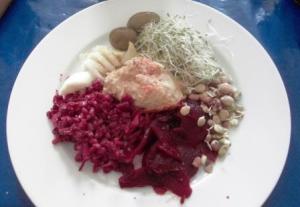
Every week, we stock the small Spark office fridge with fresh provisions from Better Food, the organic supermarket. On my plate is:

Wise healers in Ancient Greece counselled eating from a wide range of food, the origin of mezze. Lunch at The Spark fulfils this criteria for nutritional variety.

It fulfils my appetite on other levels too. Free-thinking and alternative, it’s been part of my life since publisher, John Dawson, bought out the first issue in 1993. It’s now the biggest free ethical quarterly in the southwest.

An independent publication, The Spark is a precious thing. Instead of celebrity gossip and relentless doom, it offers inquisitive editorial and practical solutions. The Spark is optimistic. It embodies the idea that it’s better to shine a light than shout at the darkness.

If I want to shine that beam at myself, The Spark can steer me to self-knowledge. I feel I can be more useful and peaceful for acknowledging my demons. As Gandhi put it:

“Be the change you want to see in the world”

The Spark is brimming with creative ways to make a difference, both inner and outer. Whether looking for a therapist or a course on permaculture, it is THE place to advertise if you want to catch 99,000 like-minded people.

The spring 2009 Spark goes out today to indie food shops and local libraries from Glastonbury to Bristol and beyond Bath.  Join The Spark on Facebook and visit The Spark website (heading for its revamp).

Back to my lunch. We have an hour to eat and clear up. Civilised with time to digest. The conversation ranges wide and is, well, sparky.

How was your lunch?

Reblog this post [with Zemanta]

Homemade yogurt

homemade-yogurt-310109

I made this yogurt. If I can do it, so can you (I am not known for my technical expertise). It tastes wonderfully-different from anything I can buy in a plastic pot. And ’tis joy-supreme not to be adding to the plastic-pot recycling mountain in my hallway.

I stopped making yogurt after being diagnosed as lactose-intolerant last autumn, but I missed all those zillions of friendly bacteria in my gut. I know I could have made it with soya milk, which I do love (in tea and on oats) but somehow could not bring myself to embrace in yogurt.

So I figured I would experiment with my lactose-intolerant boundaries. For surely my fellow lactose-intolerant eastern-european/middle-eastern ancestors ate yogurt? As a fermented food, yogurt is pre-digested so must be easier to tolerate. Is there a nutritionist in the house? What do you think?

Anyway, on a gut level (so to speak) all I know is my intestines smile when yogurt comes its way, saying hi in a welcoming way. Unlike with milk, which feels too viscous and hard work for my sensitive insides.

Now let me introduce you to my friend, the yogurt-maker. This fairly low-tech device that costs about £20 to buy and pennies to run has enabled me to become yogurt-literate.

yogurt-with-yogurt-maker

You can’t see from my pic but the plastic yogurt-maker has a plug. That’s how it works: switch it on and the yogurt-maker keeps the warmed-milk-that-will-be-yogurt at an even temperature.

Hugh Fearnly-Whittingstall says a wide-mouthed warmed thermos flask does the trick and ditto, a towel to wrap it up in and a radiator – but it’s the nifty yogurt-maker for me.

I say low-tech because it does not switch itself off after the regulatory eight-hours. So it does take planning. I have to ask myself before starting: will I be here in eight-hours to turn off the device?

Here are the ingredients you need to make longevity-boosting yogurt:

1.5 pints (850 mls) of organic milk

2 teaspoons of of natural, bio-live, organic yogurt (or from your last yogurt batch)

You have to boil the milk until it bubbles to get rid of bad bacteria and then let it cool down to blood-temperature i.e. I stick a clean finger into the cooled-down milk  and it feels pleasant and warm – not scalding-hot or, at the other extreme, brrrrr on the chilly side.

I found this operation the most taxing because after the novelty of testing too-hot milk wore off, I then forgot all about the cooling milk and by the time I remembered, it was stone-cold again. So my top tip is: try to keep conscious of time as the milk cools.

Once the boiled milk has cooled to blood-temperature, I put it in the yogurt-maker (that I’ve switched on five minutes beforehand to warm up). Then I stir in two teaspoons of yogurt, which always seems too measly to do the job but that’s all it takes to start the fermentation process. Amazing.

I find yogurt very acceptable first thing in the morning because it is non-demanding and soothing. And I add freshly-ground health-giving spices, such as cinammon, cardammon and cloves for extra zing.

Now for my yogurt-award acceptance speech. Thank you, Martin Smith, ex-propriétaire of  Danescombe Valley Hotel, who demystified yogurt-making; my Indian food guru, Mallika, who has inspired me to use freshly-ground spices from scratch; Maninas, for adding cinammon bark and whole cloves to my repertoire. And finally thanks to Beccy and Hannah at the Spark for explaining how to use the grinder-attachment on my blender…

Who would you thank in your oscar-award speech?

Reblog this post [with Zemanta]

Making organic mince pies

making-organic-mince-pies

We were thinking of ways to promote the benefits of joining our workplace union when someone mentioned mince pies. I knew I had to make some.

I have been a proud member of the National Union of Journalists all my working life and now I am a member of Unite too. Unions and feminism come under similar fire. ie  propaganda from a status-quo establishment paints both as uncool and combative. Hello! Just as feminism makes for a more balanced relationship between the sexes (do you really want to be your husband’s chattel?), so the union supports management to create a better workplace.

My mother makes her puff-pastry from scratch and, natch, me too. Talk about propaganda!  It’s a family sin to buy the ready-made stuff. I consult my handwritten cookery notebook, begun in 1971 when I was a 17-year-old aspiring counter-culture hippy, and find her instructions.

For home-made puff pastry use equal amounts of butter to flour. (Yup, I know I am lactose-intolerant but I could not face cooking mince pies with marge).

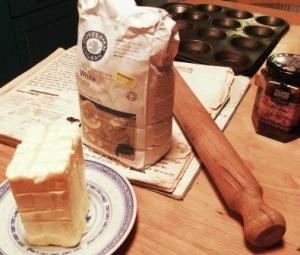
1 pound (500g) of butter to a pound (500g) of self-raising flour makes about 30 mince pies with little hats, plus a 300g jar of organic mincemeat (sorry I did not make that from scratch but the Village Bakery organic mincemeat is soooo good and not too sweet and you could always add orange peel or cranberries to jazz it up).

I used Dove’s organic white self-raising flour and unsalted organic butter.

Make sure the butter hard and cold from the fridge. (If too soft, your pastry will be too crumbly).

Cut the block of butter lengthways and then sideways, until you end up with little cubes to toss in the flour.

Add scant lemon juice and/or water to the mixture to start uniting (how symbolic! Our workplace union is Unite) the flour and the fat. It is tempting to add enough water to blend the two but don’t or it will turn to goo. Add liquid parsimoniously, teaspoon by teaspoon.

And do not crumble the fat into the flour with eager fingers or you will end up with too buttery-shortcrust pastry. The true blend comes from the butter gradually pressing into the flour – the oven’s heat will ‘unite’ (symbolic union!) the rest.

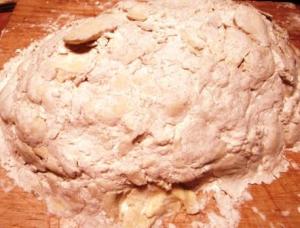
Now – turn out the unwieldy mass on to a floured board and press down a few times with a rolling pin.

Believe me, it will look a mess. Cooking IS a mess. I always go through this stage of despair: “Oh this will never come together, I am a failure (etc)….”

Which is how I felt at this stage.
mince-pie-dough

But all was not lost! The trick with puff pastry is in the folding then rolling. You assemble your uncohesive mass of pastry into a rough oblong shape. Then fold over the top third, and fold the bottom third over that. Turn this ‘envelope’ to the right and then give it a firm press with your rolling pin (or improvise with a bottle).

Repeat this fold-turn-and-roll action 3-4 times until finally your dough looks more shapely, and the flour and butter has come together in fairly homogenised layers. But don’t over-roll.

Wrap in greaseproof paper and let it rest in the fridge for an hour. Or less, if, like me, you lack patience.

My handwritten instructions from my 17-year-old self say: “Roll out not very thick.”  What the hell does this mean, I ask her?

Basically, the dough will never be paper-thin because it is too buttery so will stick to the board and you do not want to use too much flour to stop it sticking. So, well, roll it out “not very thick”.

Cut with a pastry cutter or use jar lids instead: a bigger one for the bottom case and a slightly smaller one for its little hat.

It all sounds so orderly on the page, doesn’t it? Here is a picture of mincepie mayhem. (I was staying at my sister’s last week because I lent my flat to our Canarian family who came to see the new baby, Tayda – but that is another story!).

mince-pie-mayhem

Grease not the baking tin as the pastry is sufficiently buttery. Fill each case with a teaspoon of mincemeat mixture. When ’tis time to cover with its hat, dab the rims of both bottom and top pastry cases with an ice-cube to make them ever-so-slightly damp and and press with a fork to unite both top and bottom (more symbolic union!).

Heat your oven to very hot about Gas Mark 8 / 45o F / 230 C

Place a tray of your uncooked darlings for approx 10-15 minutes in the oven. Put a timer on and do not get distracted – easy to burn!

Listen, some were over-crumbly (the butter was not hard enough) so I texted my friend-colleague at 1am to say: buy extra from Joe’s Bakery.

But they tasted OK, even the over-crumbly ones, as this note from my niece attests.

mince-pie-note

As for the union, we had a happy half-an-hour the next day at work what with the mince pies and brandy butter and making two new members, and goodwill galore.

Reblog this post [with Zemanta]

Homemade hummus

cast-assembled

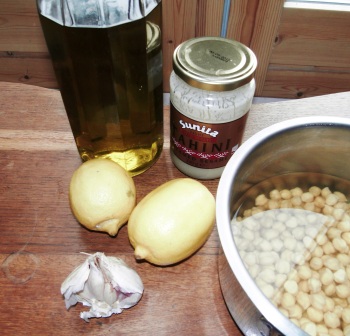
The cast is assembled. The starring ingredients (pictured) in a classic production of hummus are: olive oil, a jar of tahini,  lemons and garlic, and chickpeas soaking in a pan of water.

Thanks to kineseology, I was recently diagnosed as lactose-intolerant. Ah ha! The missing piece of the jigsaw – no wonder I prefer vegan food.

I am sad to ban eating cheese, butter and cream but not when I realise those yummy darlings make my gut sore because I lack the digestive enzymes to process them. Apparently most non-Europeans (including Mediterreanean/Eastern European types like myself) are lactose-intolerant.

This makes me ponder: our dairy-filled western diet may be dominant but is it giving the rest of the world a belly-ache?

So instead of eating cheese, I concoct homemade hummus every week. Although made from plants, hummus is a complete protein because it is combines different groups of plants, in this case, chickpeas and sesame seeds.

You can buy cooked chickpeas in a can in most shops and search out a wholefood shop or Mediterranean/Middle east delicatessen for a jar of tahini (sesame seed paste) and raw chickpeas. This recipe uses raw chickpeas.

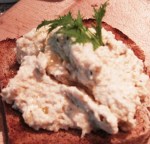
The amounts are enough for a party dip, or eight-ten servings. I dollop it on toast, brown rice, grated carrots, lentils, fried eggs…

[Note: Chickpea upped from 100g to 150g following Ingrid Rose’s helpful comments below. So do take note when doing five times the amount, Ingrid Rose!]

150g dried organic chickpeas soaked in over twice the amount of water. Soak overnight (or speed up the process by soaking in boiling-hot water) in a pan. The chickpeas will go from shrunken to plumped-up pellets.

Bring the pan with chickpeas to the boil then simmer for an hour (on a low light with a lid) until they are soft-enough to mash.

Drain the chickpeas (hang on to the cooking water for later) and put them in a large deep bowl ready for mashing (or blending) together with:

3 Tablespoons of organic tahini or sesame seed paste. I use a dessert spoon for measuring because it will fit in the jar – give the tahini a jolly good stir before spooning out.

3 Tablespoons of olive oil

Juice of two lemons – cut in half and rotate a fork vigorously to extract the juice and pulp or use a lemon squeezer. Organic lemons can be smaller than non-organic ones and have more pips but they are more juicy.

2 fat cloves of garlic – crushed with a garlic crusher or the flat of a knife. It’s optional – not everyone loves immune-boosting garlic.

Add salt and black pepper for taste and/or crushed chilli and/or ground cumin.

A word on chickpeas. You can buy them tinned – conveniently and organically – but I prefer dried. Dry, rattly chickpeas which you soak are cheaper, tastier, less watery and have twice the nutrients than canned ones.

blending-chickpeas

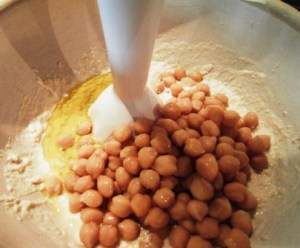
I blend half the drained chickpeas with:

garlic, lemon juice, tahini and olive oil

and whizz till smooth. It’s easier to work in small batches.

Then I add the remaining chickpeas – see picture above. If the mixture is too stiff to blend, add a teaspoonful or two of the cooking water. You are aiming for smooth and creamy not runny.

I am addicted to my electric handheld blender but a strong fork or potato masher will mash the chickpeas – just make sure the garlic is well-crushed before adding.

And here’s the mystery, every homemade hummus turns out differently.

Have you made hummus?

hummus-on-toast

Reblog this post [with Zemanta]

Firewalking in Bristol

pot-luck-by-candlelight-2

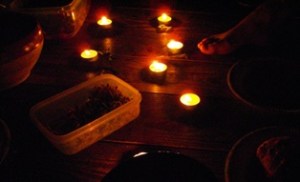
After firewalking (she says nonchalantly – of more later) we ate by candlelight (see pic) wholefood vegetarian dishes we had bought to share: tofu, sprouts and potato salads, hummus, homebaked spelt loaves and a coconut-apple dish to round off the feast.

In a forgotten farm lane in the heart of Bristol city, the Larch barn (our home for seven hours) made eco-living a reality. Powered solely by solar panels on a grey-cloudy day, the sudden departure of electricity plunged us would-be firewalkers into dramatic darkness.

The candles sent shadows flying to the wooden eaves.

The fire we had built earlier in the rare November light was burning brightly in the winter night.  Waiting.

We had prepared: voiced some fears (and did not exhaust my list). It was striking to hear others express sometimes identical anxieties – I was not alone when gripped by irrational thoughts.

Sumir, our firewalking teacher, guided our 12-strong group like a gentle young father. Firewalking four years ago in California had been the catalyst for jacking in a sensible career to follow his dream of making music.

I am slightly group-averse but something about facing this fire-filled experience broke through my usual social barriers. We stood on the cold grass in our bare feet.

Samir raked the fire so the embers glowed.

The first person crossed the red-hot dust and I followed as if caught in her eddy.

I walked, as instructed, at my normal pace. I was crunching on hot embers but it did not hurt – no minor blisters or any ill after-effects. I accepted and gave hugs to my fellow firewalkers. We crossed and recrossed the embers several times. It was exhilarating.

And of course I had to write about it.

Is it OK to boast?

Reblog this post [with Zemanta]

Beetroot soup

blended-beetroot-soup-cropped1

Sharon made this soup for me. We have known each other since we were eight, and been best friends since we were 21. She recently gave me a card. It said: “A friend is someone who likes you even though they know you”.

I have a demanding digestion that cannot tolerate tomatoes but finds root vegetables soothing. Knowing my idiosyncratic dietary needs, my pal made me a Winkler-friendly beetroot soup.

Nothing beats the beet. Its colour is dramatic but it’s not all for show. Those vivid reds deliver nutritional punch, a detoxifying antioxidant called betacyanin, according to nutritionist Natalie Savona.

I love this recipe because it uses the whole beetroot so no waste. An electric blender gives the soup its smooth texture. Wear an apron when preparing and cooking beetroot as it can stain.

Sharon found the recipe in her beloved Moro cookbook. Here’s a lazier version:

You need two bunches (750g) of organic beetroot, 1 large onion, 1 potato, oil, cumin, fresh parsley and a tasty vinegar such as red wine or balsamic.

1. Cook sliced onion in 4 tablespoons of olive oil for 10 gentle minutes in a large pan

2. Add 2 rounded teaspoons of cumin (or more – 2 did not make it taste cumin-y, or grind some fresh)

3. Stir cumin and onions for a minute till the cumin releases its aroma

4. To the onion potion add beetroot – 750g previously peeled and diced quite small

5. Also one peeled and diced potato to thicken the soup (hey, do we really need to peel pots? I am gonna experiment without). Note: the smaller the diced cubes the less time they take to cook

5. Add 1.25 litre of water and simmer for 15 minutes or until veg is easy-to-munch

6. Blend soup, return to the pan with 2 tablespoons of red wine vinegar (or balsamic?) and season to taste

7. Add fresh parsley (or coriander I say) to each bowl of soup.

Do you like this sort of soup?

Vegan noodle pie

vegan-noodle-pie

I dedicate this post to fellow blogger, Meg Wolff, who recovered from cancer thanks to a macrobiotic diet and Donna, a woman who befriended me at a Devon train station, who – it turns out – also cured her cancer after following a macrobiotic diet for ten months.

When Donna first approached me at the brightly-lit station on a dark wintry rainy evening last week, saying: “Hi, I am Donna,” I thought she had mistaken me for someone she knew.

Or maybe we had met…in another dimension?! (I love these stories so bear with me, you rationalists).

Donna asked me: “Are you interested in shamanism?”. “Always” I answered because I love real-life mystery.

To which she replied: “You have good medicine around you.” And I was thrilled.

Donna gave me her card and we are now in email contact – that’s how I know about Donna’s macrobiotic diet, and Axminster’s Awareness Centre, and her parents, the original ‘organic kids’, now 89 and 91. So listen up, you young things, eat your organic greens to get some healthy longevity inside you!

This is all the encouragement I need to eat more organic grains and vegetables, keeping animal-food to a minimum…

Donna and my other dedicatee, Meg Wolff, share many beliefs including the magic of writing things down.

Go visit Meg Wolff’s inspiring blog and I won’t even mind if you don’t come back.

Ah, you are back. OK, so Meg sent a newsletter which included a recipe for vegan lasagna. As a mama, I made lasagna but never considered how to veganise it – until this moment!

So I played around with Meg’s original recipe and here is mine – all ingredients from my local organic shop, the Better Food Company.

I peeled and chopped a big slice of pumpkin, putting the chopped-up pieces gently oiled, in a roasting pan to sizzle away in a medium-hot oven for 40 minutes.

For oil, I used Clearspring organic sunflower seed oil (first cold pressing for a naturally-nutty taste), a new discovery thanks to speaking coach, John Dawson.

While the pumpkin pieces were doing their thing in the oven, I made a vegan white sauce with organic soya milk, sunflower margarine and Dove’s rye flour, adding sliced fennel and mushroom, and tamari sauce, for interest and taste.

Then I drained and mashed 450g of tofu with gently-fried slices of onions and some sprinkling of smoked paprika.

I dunked 50g of gluten-free buckwheat noodles in a pan of boiling water until they softened – about five minutes.

Then I assembled my layers into an oiled-casserole dish, starting with the drained noodles covered with half the fennel and mushroom sauce, followed by the mashed-up tofu and the roasted pumpkin pieces, followed by the rest of the sauce – and baked it for 20 minutes.

I served it with fresh mustard leaves which grow on my balcony in salad pots from Cleeve nursery bought at the Organic Food Festival in Bristol last September – an easy way to have fresh leaves (see pic below)!

It was comfort food-supreme with the baked noodles reminiscent of lokshen pudding from the alter heim.

Happy Obama week!

salad-growing-on-a-balcony

Reblog this post [with Zemanta]

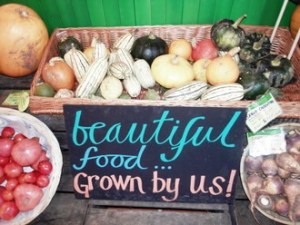
Beautiful food grown by us

The inspiration for this blog is manifold.

It owes its line-length to skinny writing

and the vegetables in the picture

to the organic Better Food Company

where I shop, happily, in Bristol.

I also want to multi-dedicate this post

to the planet’s coolest conference, Blog08

and the winner of my first blog competition.

More soon.

And please leave me a comment!

Jamie Oliver – the real thing

I once sat in a room with Jamie Oliver for two and a half hours as he gave five interviews on the trot to the Scottish media. Whether explaining his passion for organic food to a reporter, or pacing the small room in-between bouts, Jamie seemed comfortably himself.

It was 2004, and Jamie hinted his next step was to do something with school meals. I escorted him through the university building where the Soil Association was holding its annual conference (stop press: our next conference is in Bristol this coming November). As he passed the book stall, Jamie bought twenty pounds worth of books on organic farming. We shook hands and I have to report – this guy is for real. He exudes natural warmth and spontaneity.

Now he is on television teaching Rotherham how to cook. And I love him.

The TV show tonight could not have packed-in more touching scenes. Julie used to live on crisps and chocolate – now she cooks healthy fresh dinners. The miner who found food teaches fellow miners how to stir-fry. Stereotypes fall away. So-called feckless single mothers and ‘real’ men, the stuff of tabloid headlines, absorb Jamie’s lessons – eager to learn, brimming with untapped talents.

Jamie takes his inspiration from the wartime Ministry of Food – Marguerite Patten reminds Jamie “the Ministry never lectured…cooking has to be pleasurable.” Wise advice but pity we have to wait for a disaster to get people changing their behaviour.

Such as the obesity crisis that Jamie graphically illustrates when he drops by the hospital to see Julie’s scan (and the baby she might call after him). There is a hoist and equipment that costs £60,000 to help care for extremely obese people. Clinically-fat people who do not need to suffer if – as the NHS medics insist – they had learnt to cook from scratch from the start.

Jamie gets a thousand people together in one go for a mass cook-in. He is working on the theory of passing it on. If I learn a recipe and pass it on to five people then – do the maths. I marvel at the cheffy dishes he chooses for people who have never cooked before: flattening chicken breasts pressed with parma ham.  His chief ingredients are chilli, ginger and garlic to get everything tasty – top tips to pass on.

His Rotherham experiment is part of revolution, with cooks as guerilla fighters in the war against junk food.

[I changed ‘part of’ from ‘beginning of’ following Sarah Beattie‘s comment because she‘s right: there’s unseen work going on, which is precariously-funded.]

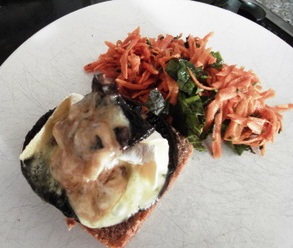
My recipe: I put flat mushrooms with slivered garlic under a grill, brushed them with olive oil top and bottom so they would not burn. When they had softened, I added a slice or two of camembert cheese that took five minutes to melt. I piled the mushrooms on wholemeal toast and served them with grated carrots and mustard leaves snipped from my potted salad plants.

I hope Jamie would be proud of me.

Reblog this post [with Zemanta]

Meeting Gordon Brown

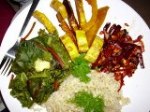
Last week I left my cosy brown rice world (centre) for that of Gordon Brown’s (right pic). An invite from the prime minister was hard to resist. I was not alone. A hundred other members of the British Society of Magazine Editors turned up at number 10 Downing Street for the reception.

The prime minister’s short talk featured self-deprecating anecdotes.

I’d heard him tell some before at a previous reception also organised by the society.

April 2007. After his talk, Gordon Brown, then-chancellor, went on a fifteen-minute steered-mingle round the packed reception room. I introduced myself.

“Elisabeth Winkler from the Soil Association. We were disappointed you did not include agriculture in your green budget.”

I explained how organic farming reduces farming’s carbon footprint because it bans the use of oil-guzzling artificial fertiliser.

He changed the subject by commenting on the growth of farmers’ markets. I furnished him with a figure: farmers’ markets now number over 500. He nodded, echoing the stat.

The trick in these conversations is not to wait for Gordon to give encouraging nods and smiles. You have to deliver your message regardless.

Fast forward to last week – I failed to listen to my own advice. I only got to press his flesh and give my name and rank.

I really wanted to say: if you want an easy win, Gordon, forget GM. It’s uneconomical for farmers and unpopular with the British public.

But I fell under his spell and let him pass.  Listen, I can’t be superwoman all the time.

In his talk, Gordon Brown’s only mention of the current financial crisis was to tell us to blame the Treasury if we did not like the wine (joke). Despite the prime minister’s unwillingness to engage in the topic – and William Green, editor of Time Europe, tried hard enough – the credit crunch cropped up in every other conversation I had.

Several editors asked me if the recession would affect organic farming’s future.

I said organic farming sales had not faltered in the last recession; indeed Green & Black’s organic chocolate launched during that dire time.

And another thing, I continued, food prices are linked to oil. The price of organic food has the potential to become lower than non-organic food because organic farming uses less energy than non-organic farming.

Then I skedaddled down the road to Central Hall, Westminster, where the Soil Association’s new president, Monty Don, was giving the charity’s annual lecture in memory of its 1946 founder, Lady Eve Balfour.

Lady Eve was a cool cat who believed in caring for Mother Earth. She set about proving organic farming is better for the soil than agrichemicals. Food should be eaten as close to its source as possible, she said. Way to go.

Monty Don encouraged us to become organic vegetable gardeners. You can’t get more local than that.

Afterwards, in the Soil Association reception (organic wine, this time) several growers expressed concern that Monty’s message undervalues their skills. It’s the opposite for me: trying (failing) to grow veg has made me value the farmers more than ever.

Monty Don has reservations about the word organic, calling it “an albatross”. He is good with words (I headhunted him for Living Earth, the Soil Association magazine). Later I found myself at the bar with Monty and his wife Sarah. I said: “It’s not the word that’s the problem but the bad press associated with it. Like feminism,” I added (as a feminist).

Monty said the word ‘organic’ can make people feel guilty.

Is organic a good or bad word?

Reblog this post [with Zemanta]