Category Archives: health

Amazing asparagus

amazing-asparagus-blue-plate

I had never tasted asparagus so tender and young before. Out of this world.

Asparagus in the UK has a short season from May to mid-June.

Well, it used to.  The season now starts  in April in the UK. When a fellow food blogger bought hers last week, I was surprised – that’s climate change for you.

In supermarket-land, they appear all year long, spears the regulation length, lined up in rows in small plastic boxes. They look pretty – and are pretty tasteless.

The supermarkets now race to get seasonal British-born asparagus on their shelves.

Waitrose failed the test yesterday according to my mum, the queen of real food lovers. Shocked by its offering of Peruvian asparagus, my 80+ mum made a special trip to Marks & Spencers for the British kind. (Reader, thus is my provenance).

It’s not that I am jingo-istic, set against Johnnie-foreigner.

Nooooo, hardly. a) I believe in a world without borders b) I am of foreign-blood myself.

My love of seasonal stems from common sense. Eating food grown as near to where I live tastes fresher. Looking at the bigger picture, my spears’  journey-to-market is less polluting too.

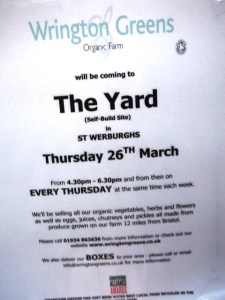
My asparagus came 10 minutes away by foot thanks to the local organic grower setting up stall in the self-build eco-houses at St. Werburgh’s every Thursday afternoon until 6.30pm.

Mike is going to check the name of the grower for us next week. We hope to find out more how it was grown, as growing it organically is supposed to be hard.

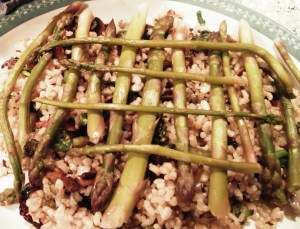
He barely steamed the young spears then latticed them over fried brown rice, chilli and mushrooms (above).

We love brown rice but let’s face it, that’s hardly local.

So, Little Englander or bigger picture and more taste? Why do you like local food?

Stop press: Wrington Greens sell their fresh organic veg every Thursday 4.30-6.30pm at the Self-Build homes at Ashley Vale, St. Werburgh’s – please buy if you like to be wowed…
wrington-green-notice-at-st-werburghs

Turnip tops and haricot beans

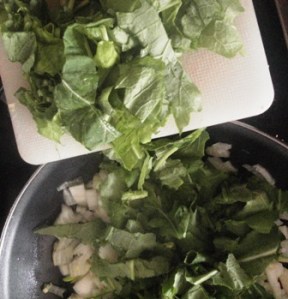
Cut-up turnip tops and into the pan they go

After a lively exchange on Facebook about how to cook turnip tops, I set to con brio.

I also consulted Jane Grigson‘s The Vegetable Book and, as always, she came up trumps with Broccoletti di rape. They eat turnip tops in Italia, you know, and appreciate their health-giving qualities.

Then I winklerfied all the information and this is what happened:

I started the whole process by frying onions because once I have done that – I am committed.

I washed the fresh turnip tops bought the day before at Bristol Farmers’ market from the wonderfully abundant organic Wrington Greens stall.

Leaves so young and fresh, I had no need to remove their stalks – just gathered them on a board and chopped them once or twice.

Then tipped them into the gently frying onions (see pic above) and stirred it all a bit.

But what to add? It’s amazing what is in the fridge. I found haricot beans, cooked at the weekend, perfectly edible and ready to go.

And of course the ubiquitous brown rice, cooked the night before.

Several grinds of black pepper, a smattering of nutmeg, a crunch or two of rock salt, a splatter of soya sauce, and about 5-10 minutes later, the dish was ready to eat.

Voilà , a plate of mean greens and beans…

turnip-greens-with-fried-onions-and-haricot-beans

Vegan nettle pesto and brown rice

nettle-pesto

Nettles came to the rescue today when the cupboard was bare.

Abundantly springing up on our path. Luckily we had Mike’s gloves.

We pinched off fresh tips and dropped them into a foraged plastic bag.

At home I planned to make pesto, having seen a recipe last week.

But vegan as I now eschew dairy for the sake of my delicate gut.

The following came under the force of my hand-held blender:

3 shallots fried in a tablespoon of olive oil

40z nettles drained after plunging in boiling water to de-sting

bit of cinnamon bark

handful of raw sunflower seeds

balsamic vinegar

olive oil

and salt.

I whizzed, obtaining a seriously delicious green sauce.

Served with brown rice (leftover from last night and stir-fried with shallots and ginger) and some freshly soaked and simmered-for-one-hour-till-soft haricots beans.

Ray Mears, author of Wild Food, says Bosnians sold nettles to eat during the war.

But don’t wait for disaster to discover their nutritious qualities.

This is the spirit of  Transition: prepare for climate change by leading a green life now.

Oh dear. I am such a dilettante. How can I transition without my electric blender?

Not to mention the balsamic vinegar

What would you miss/embrace in a low-carbon world?

Reblog this post [with Zemanta]

Nettle soup is the one to make

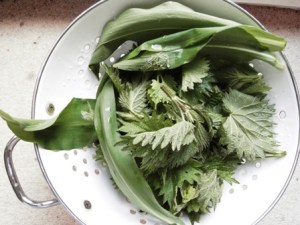
nettles-and-wild-garlic-rinsed-in-colander

Sometimes an idea takes years to come to fruition. It has distinct stages such as scoffing, curiosity, acceptance then habit.

Take nettles. I used to think eating them was weird. But over the years the idea started to intrigue.

Last spring in Westward Ho! Chloë showed me a patch of nettles, and how to pick then with gloves, the freshest top leaves according to another blogger. Nettles were no longer alien as I cooked them in pasta and soup and found them delicious.

Perhaps precisely because nettles are wild and have not been cultivated or hybridised, they taste extra-vibrant and are highly-nutritious.

This spring, in Bristol, I saw nettles growing and thought “soup”. Then on Friday I overheard Leona, the owner of St Werburgh’s City Cafe talking about: “nettles and wild garlic soup.”

The next day Mike and I found ourselves on a magical walk beside the river Avon  in a mysterious part of the city. An abundance of nettles and wild garlic grew.

conham-on-the-river-avon

I picked up a discarded Tesco plastic bag (litter bugs have their place in the universe), sniffed it, found it clean and after borrowing a glove, started pinching off the fresh greens and filling the bag.

The next morning, I weighed the nettles and the wild garlic: 4 ounces.It didn’t seem enough – but it was.

I cut up a fat onion and gently fried it in 2 tablespoons of olive oil in a saucepan. I let it stew for an hour with the lid on, so the onion was soft and a bit caramelised. I was experimenting but you could fry the onion for much less time (like 10 minutes or so).

I added 900 mls of water. To thicken the soup I added 1 ounce of raw oats.

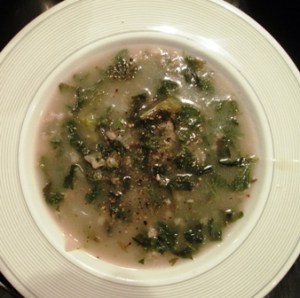
Then I snipped in the washed nettles and wild garlic, and let it simmer for about five minutes and turned off the saucepan. The soup carried on cooking with the lid on.

And it was delicious.

Can you get food more real than nettle soup?

nettle-and-wild-garlic-and-onion-and-oat-soup

Proud to fly the Food Renegade flag, I contribute this blog on local and sustainable Nettle Soup to Fight Back Fridays to help overturn the domination of industrialised food!

foodrenegadefist_150

Reblog this post [with Zemanta]

Fast fish dish

ling-and-sprouting-broccoli

This fish dish had to be fast as it was 11pm at night and we were all tired.

I sliced several shallots thinly and fried them gently in olive oil, with the heat turned right down and the lid on. Using a lid is my new habit; it retains heat so ups a dish’s eco-credits,  as well as moisture and flavour. Win/win/win…

Still in my macrobiotic-mood, I slivered an inch of peeled raw healthy ginger in with the onions. Then I placed the fresh fish fillets on its bed of onions and back went the lid.

I figure the fish cooks by a combination of steam and heat from the aromatic stewing onions. If you can add some scientific know-how, please do!

I had bought the fillets of ling that morning from David Felce, one of two fab fishmongers at Bristol Farmers’ market. Although from the endangered cod family, the ling is line-caught, a method that does not net a ton of other fish at the same time, (then discarded wastefully).

Ling is not considered glamorous but please ignore this illusionary hierarchy of fish. Seasonal and fresh, its flesh is firm, white and flavoursome.

Meanwhile I steamed my beloved purple sprouting broccoli from Radford Mill organic farm shop, having sliced its woody stems into smaller tubes so they would be soft enough to eat.

Purple sprouting broccoli is in season from January to May when other UK-grown greens are sparse, according to my much-recommended Riverford Farm Cook Book.

I had some miso paste left over (a tablespoon of miso blended with water) and added it to the pan with about 50mls of water, for extra flavour.

We served it with organic spelt bread bought at the Common Loaf stall – who make their bread with love and the best raw ingredients-ever – also from the farmers’ market.

And voila, after 20 minutes, the dish was ready. Fast-enough for you?

P.S. The next day I had the pleasure of meeting and having lunch with a fellow blogger, Helen, from Haddock in the Kitchen. Helen was over from France visiting her lovely daughter Holly.

We ate freshly-cooked food at Zazu’s Kitchen – heartily recommended.

We chose frittatta (omelette and potatoes and herbs) and salads (including my adored lentils). I pictured my lunch with Helen’s kind gift, a pot of honey, or miel, comme on dit en français.

The honey was made by a friend of Helen’s in France.  Oooooh I absolutely love real honey.

zazzus-2409

Reblog this post [with Zemanta]

Vegetable soup

vegetable-soup

I made a raid on the fridge last night and seized my suspects. The remains of that celery cowering in the corner? Into the pan you go. That inch of courgette, those flabby carrots? Their fate was sealed. Even the large but softening beetroot was fair game.

I started by frying onions in 2-3 tablespoons of olive oil. I find if I start by frying, it commits me to cooking and I have to carry on.

But one was not enough. This soup had four onions, peeled and chopped. An onion-craving due I believe to the weather turning – after the spring sun, back to British chill. I swear these temperature changes play havoc with the immune system and thus my body was pleading for sustenance.

Who would have thought that the miserable occupants of my fridge plus the onions could help? But they did.

I amused myself by cutting the vegetables as thinly as possible, inspired by browsing through a copy of a recipe book by Boy George and his macrobiotic cook in the Luscious Organic shop in London last Friday.

I peeled everything because although the veg were organic and thus pesticide-free, they looked in need of a beauty peel.

Cooking is so dramatic. Look at the mess I made with the peelings. But aren’t they beautiful? Some naturally interlaced with each other too…

peelings-resized

I was entranced by my vegetable peelings but life is tough and into the compost bin they went.

Meanwhile the mound of veg in my pan (with lid) was stewing away. I gave them a stir every now and then.

Then I added water – about 500 mls – and left the concoction to slowly simmer with the lid on.

I could have added salt to flavour but I had a brain wave. Due to an enduring macrobiotic flirtation, I had some miso in the fridge (it keeps for ages).

Miso is a friend, providing flavour, health and richness just from fermented plants such as soya beans or brown rice or barley.

I squeezed about two tablespoons of the miso into a cup, added some hot water and mixed it to a thin paste, which I added to the soup.

For garnish, I added a handful of nettles I had picked on our walk yesterday, and served the soup with fresh organic bread. It had taken a pleasant half-an-hour to produce from virtually nothing and it was delicious.

I swear I heard my immune system whisper “thank you”.

Reblog this post [with Zemanta]

Brown rice is nice

rice-with-mike

I have ten minutes to write this blog starting from now (8.15pm).

Wow, it usually takes me two hours including uploading pics, checking links etc.

My first link goes to Haddock in the Kitchen for a novel use of my ten-minute rule

– why not use it to complete a blog?

Mike and I have  been eating brown rice with every meal since March 1st (I have been counting) and it is beautiful, truly a superfood.

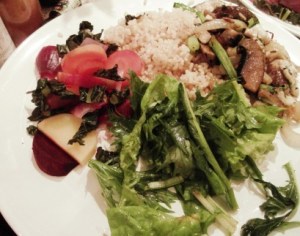
Above, brown rice came with organic local greens, from Radford Mill Farm.

(and mushroom) served with a salad of grated organic carrots

with olive oil and balsamic vinegar.

Below, brown rice with fresh organic veg including steamed beetroot and parsnip.

To my right, a new addition to the blog: my first ad.

What do you think about ads on a blog?

more-brown-rice

Reblog this post [with Zemanta]

Lunch at The Spark

spark-lunch3

Here is lunch at The Spark, the wonderful publication I edit.

I am still at the Soil Association two-days a week as contributing editor. Now I am editor of The Spark on two more days. My inner-Gemini loves having two jobs, especially as both have ethical, sustainable values.

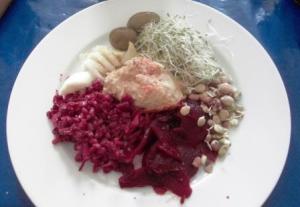
Every week, we stock the small Spark office fridge with fresh provisions from Better Food, the organic supermarket. On my plate is:

Wise healers in Ancient Greece counselled eating from a wide range of food, the origin of mezze. Lunch at The Spark fulfils this criteria for nutritional variety.

It fulfils my appetite on other levels too. Free-thinking and alternative, it’s been part of my life since publisher, John Dawson, bought out the first issue in 1993. It’s now the biggest free ethical quarterly in the southwest.

An independent publication, The Spark is a precious thing. Instead of celebrity gossip and relentless doom, it offers inquisitive editorial and practical solutions. The Spark is optimistic. It embodies the idea that it’s better to shine a light than shout at the darkness.

If I want to shine that beam at myself, The Spark can steer me to self-knowledge. I feel I can be more useful and peaceful for acknowledging my demons. As Gandhi put it:

“Be the change you want to see in the world”

The Spark is brimming with creative ways to make a difference, both inner and outer. Whether looking for a therapist or a course on permaculture, it is THE place to advertise if you want to catch 99,000 like-minded people.

The spring 2009 Spark goes out today to indie food shops and local libraries from Glastonbury to Bristol and beyond Bath.  Join The Spark on Facebook and visit The Spark website (heading for its revamp).

Back to my lunch. We have an hour to eat and clear up. Civilised with time to digest. The conversation ranges wide and is, well, sparky.

How was your lunch?

Reblog this post [with Zemanta]

Homemade yogurt

homemade-yogurt-310109

I made this yogurt. If I can do it, so can you (I am not known for my technical expertise). It tastes wonderfully-different from anything I can buy in a plastic pot. And ’tis joy-supreme not to be adding to the plastic-pot recycling mountain in my hallway.

I stopped making yogurt after being diagnosed as lactose-intolerant last autumn, but I missed all those zillions of friendly bacteria in my gut. I know I could have made it with soya milk, which I do love (in tea and on oats) but somehow could not bring myself to embrace in yogurt.

So I figured I would experiment with my lactose-intolerant boundaries. For surely my fellow lactose-intolerant eastern-european/middle-eastern ancestors ate yogurt? As a fermented food, yogurt is pre-digested so must be easier to tolerate. Is there a nutritionist in the house? What do you think?

Anyway, on a gut level (so to speak) all I know is my intestines smile when yogurt comes its way, saying hi in a welcoming way. Unlike with milk, which feels too viscous and hard work for my sensitive insides.

Now let me introduce you to my friend, the yogurt-maker. This fairly low-tech device that costs about £20 to buy and pennies to run has enabled me to become yogurt-literate.

yogurt-with-yogurt-maker

You can’t see from my pic but the plastic yogurt-maker has a plug. That’s how it works: switch it on and the yogurt-maker keeps the warmed-milk-that-will-be-yogurt at an even temperature.

Hugh Fearnly-Whittingstall says a wide-mouthed warmed thermos flask does the trick and ditto, a towel to wrap it up in and a radiator – but it’s the nifty yogurt-maker for me.

I say low-tech because it does not switch itself off after the regulatory eight-hours. So it does take planning. I have to ask myself before starting: will I be here in eight-hours to turn off the device?

Here are the ingredients you need to make longevity-boosting yogurt:

1.5 pints (850 mls) of organic milk

2 teaspoons of of natural, bio-live, organic yogurt (or from your last yogurt batch)

You have to boil the milk until it bubbles to get rid of bad bacteria and then let it cool down to blood-temperature i.e. I stick a clean finger into the cooled-down milk  and it feels pleasant and warm – not scalding-hot or, at the other extreme, brrrrr on the chilly side.

I found this operation the most taxing because after the novelty of testing too-hot milk wore off, I then forgot all about the cooling milk and by the time I remembered, it was stone-cold again. So my top tip is: try to keep conscious of time as the milk cools.

Once the boiled milk has cooled to blood-temperature, I put it in the yogurt-maker (that I’ve switched on five minutes beforehand to warm up). Then I stir in two teaspoons of yogurt, which always seems too measly to do the job but that’s all it takes to start the fermentation process. Amazing.

I find yogurt very acceptable first thing in the morning because it is non-demanding and soothing. And I add freshly-ground health-giving spices, such as cinammon, cardammon and cloves for extra zing.

Now for my yogurt-award acceptance speech. Thank you, Martin Smith, ex-propriétaire of  Danescombe Valley Hotel, who demystified yogurt-making; my Indian food guru, Mallika, who has inspired me to use freshly-ground spices from scratch; Maninas, for adding cinammon bark and whole cloves to my repertoire. And finally thanks to Beccy and Hannah at the Spark for explaining how to use the grinder-attachment on my blender…

Who would you thank in your oscar-award speech?

Reblog this post [with Zemanta]

Homemade hummus

cast-assembled

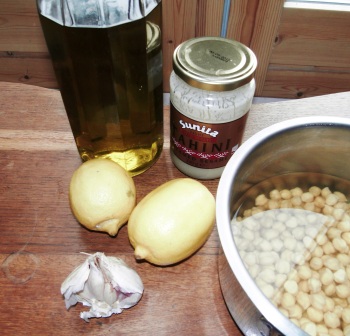
The cast is assembled. The starring ingredients (pictured) in a classic production of hummus are: olive oil, a jar of tahini,  lemons and garlic, and chickpeas soaking in a pan of water.

Thanks to kineseology, I was recently diagnosed as lactose-intolerant. Ah ha! The missing piece of the jigsaw – no wonder I prefer vegan food.

I am sad to ban eating cheese, butter and cream but not when I realise those yummy darlings make my gut sore because I lack the digestive enzymes to process them. Apparently most non-Europeans (including Mediterreanean/Eastern European types like myself) are lactose-intolerant.

This makes me ponder: our dairy-filled western diet may be dominant but is it giving the rest of the world a belly-ache?

So instead of eating cheese, I concoct homemade hummus every week. Although made from plants, hummus is a complete protein because it is combines different groups of plants, in this case, chickpeas and sesame seeds.

You can buy cooked chickpeas in a can in most shops and search out a wholefood shop or Mediterranean/Middle east delicatessen for a jar of tahini (sesame seed paste) and raw chickpeas. This recipe uses raw chickpeas.

The amounts are enough for a party dip, or eight-ten servings. I dollop it on toast, brown rice, grated carrots, lentils, fried eggs…

[Note: Chickpea upped from 100g to 150g following Ingrid Rose’s helpful comments below. So do take note when doing five times the amount, Ingrid Rose!]

150g dried organic chickpeas soaked in over twice the amount of water. Soak overnight (or speed up the process by soaking in boiling-hot water) in a pan. The chickpeas will go from shrunken to plumped-up pellets.

Bring the pan with chickpeas to the boil then simmer for an hour (on a low light with a lid) until they are soft-enough to mash.

Drain the chickpeas (hang on to the cooking water for later) and put them in a large deep bowl ready for mashing (or blending) together with:

3 Tablespoons of organic tahini or sesame seed paste. I use a dessert spoon for measuring because it will fit in the jar – give the tahini a jolly good stir before spooning out.

3 Tablespoons of olive oil

Juice of two lemons – cut in half and rotate a fork vigorously to extract the juice and pulp or use a lemon squeezer. Organic lemons can be smaller than non-organic ones and have more pips but they are more juicy.

2 fat cloves of garlic – crushed with a garlic crusher or the flat of a knife. It’s optional – not everyone loves immune-boosting garlic.

Add salt and black pepper for taste and/or crushed chilli and/or ground cumin.

A word on chickpeas. You can buy them tinned – conveniently and organically – but I prefer dried. Dry, rattly chickpeas which you soak are cheaper, tastier, less watery and have twice the nutrients than canned ones.

blending-chickpeas

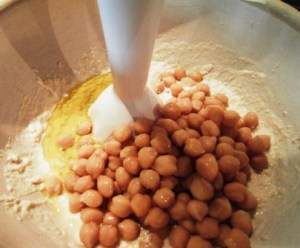
I blend half the drained chickpeas with:

garlic, lemon juice, tahini and olive oil

and whizz till smooth. It’s easier to work in small batches.

Then I add the remaining chickpeas – see picture above. If the mixture is too stiff to blend, add a teaspoonful or two of the cooking water. You are aiming for smooth and creamy not runny.

I am addicted to my electric handheld blender but a strong fork or potato masher will mash the chickpeas – just make sure the garlic is well-crushed before adding.

And here’s the mystery, every homemade hummus turns out differently.

Have you made hummus?

hummus-on-toast

Reblog this post [with Zemanta]