Category Archives: health

GM feeds world? Don’t fall for spin

marrowman

Did you see yesterday’s print supplement to the Guardian?

Titled Agriculture, produced by the Lyonsdown media group, it was basically a huge advert for intensive farming.

Including promoting the use of GM crops in Africa.

Warning!  Spin-alert!

Don’t fall for the propaganda even if (especially if!) it comes with an ever-so-liberal paper such as the Guardian.

It is blatantly calculated to appeal to caring Guardian-reader types.

What makes me so cross is the way Africa is used in the sales talk.

Let us get one thing straight.

There is NO GM crop being grown commercially that improves yield. The only ones being grown are designed to make intensive farming tidier.

Currently, GM plants are engineered to be resistent to pesticide-spraying.  This means when a farm sprays the field, the GM crops won’t die.

How this is supposed to help a farmer in Africa?

All it does is increase dependency on agrichemical companies. The farmers have to buy the GM seed (which cannot be saved) AND the pesticides to go with it AND the licence to use it all.

One of the authors is Professor Derek Burke known as the godfather of biotech.

He writes how organic farmers are a “wealthy lobby group” preventing GM progress.

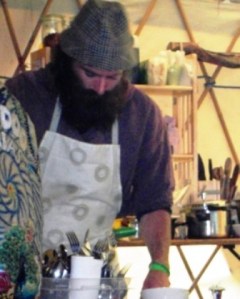
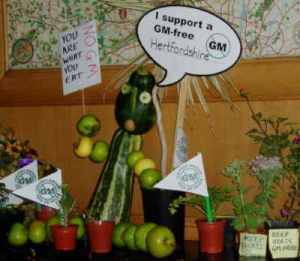
– see pic above for evidence of  “wealthy lobby group”.

So, according to the professor, a section representing 2% 0f the UK food industry, and made up of mainly small family farms, is the only thing holding back GM world domination?

No mention of the European public which does not want GM.

No mention of the African farmers who do not want GM.

And strangely, no mention of the marketing budget of  agrichemical corporations such as Monsanto and Bayer which are aggressively pushing their risky, unproven GM technology.

I wonder what the marketing-spend is on a supplement such as the one in the Guardian?

I can’t imagine a GM company is short of a bob or two for its PR war.

Slipped disc – natural healing

annotated diagram of preconditions for Anterio...

Image via Wikipedia

I am interrupting this food blog to share some useful information: natural healing methods for a slipped disc.

In 2006, I had a slipped disc and although surgery looked on the cards, I recovered naturally. Later, when I was better, I was told by my consultant physiotherapist, that “90% recover naturally”. Wish someone had told me that before.

Today in 2018: This has proved one of my popular blog posts. Although I have had no recurrence, I continue to care for my back daily with the tips below to alleviate pain and promote healing. I also add to the tips as time goes on.

Tips for natural healing of slipped disc

  • Find a healer who believes nature heals and whom you trust. Try several until you find the one who suits you and your condition.
  • The trick is to break the pain/tension/inflammation cycle by relaxing tense muscles and lessening pressure on the nerves. Breathe as if in labour to relax: out through the mouth, in through the nose. Relaxation relieves pain.
  • Immerse in a warm bath with Epsom Salts for at least 15 minutes – the heat will help relaxation. “Epsom salt is absorbed through the skin and will help replenish magnesium stores,” says Dr. Northrup on US Epsom Salt Council.
  • Let gravity be your ally.  Lie down in the Alexander Technique’s semi-supine position (spine flat, knees bent, feet flat and head slightly raised on a pillow) at regular intervals. This position allows the spine to elongate and relax.
  • Stay mobile. Walk, swim or dance. Practice gentle yoga, Pilates or T’ai chi. Avoid positions that increase discomfort such as sitting down on a chair.
  • Before even considering surgery, look at your footwear. I could write a thesis on the tragedy of women’s shoes which only for care for looks – not comfort. The holy grail is a stylish shoe that also supports arches and ankles. I recommend FitFlops – sign up with an email address for regular offers on less popular designs (I got great ankle boots for £30). AS FitFlop has got more successful, it has added a bewildering amount of styles. So make sure the style fits your width – for my slightly wide feet, I choose Microwobbleboard or Anatomicush.
  • How is your bed? Again, before even contemplating surgery, sort out your resting place. I would rather (and I have done) sleep on the floor than on a too soft or unsupporting mattress.
  • Use heat. My best friend was an electric heat-pad (like a mini-electric blanket) for the small of my back when lying down in the semi-supine position.
  • Drink water regularly to plump up those discs.
  • Eat foods with anti-inflammatory ingredients such as turmeric – add turmeric root or ground turmeric to savoury dishes. Or try the Ayurvedic recipe, Golden Milk, a comforting drink of heated milk with turmeric with black pepper which increases the bio-availability of turmeric‘s active ingredient, curcumin. If using plant milk, instead of cow’s milk, add coconut oil – the fat in oil or milk also boosts the bio-availability of curcumin.
  • Use a ginger compress to soften and relax the traumatised tissues. T’ai chi master and massager, Pete Glenn, insisted I use it daily and he was right. This traditional Chinese remedy sounds so simple – but it works. Try it for back or neck pain and be amazed by its effectiveness!

Ginger poultice

1 oz ground ginger simmered for 20 minutes in 1 pint of water.

Let the sludge cool slightly and immerse a flannel. Squeeze out the flannel and apply to the affected part of your spine. Either repeat at regular intervals OR do lazy version: cover the flannel with a plastic bag to contain the drips and wrap the whole lot with a long scarf or towel to keep it in place.

Ginger is hot to eat and aids digestion because it dilates the blood vessels – applied externally it has a similar, and penetrative, effect.

Long after the flannel has cooled down, you will feel the WARMTH of the ginger, doing its zingy thing.

If you do nothing, make and apply a ginger poultice, put on some calming music and lie down in the semi-supine position – now!

Reblog this post [with Zemanta]

Good intentions at Buddhafield

Bahji seller, Buddhafield

Buddhafield Festival boasted fast food: the best onion bhajis I have ever tasted.

Nutritious – made with gram (chick pea) flour, spices of fennel, ajwain and mustard seed, and – here is the miracle – ungreasy. Generous and sustaining, only £1.

The maker was Fish, another fascinating character; makes shamanic drums from deer skin.

Here was another fast food staple from the cafe near the Dance Tent.

Soup with momo dumpling

Stuffed with chunks of fresh vegetables including sweet potato and leeks, with olives for taste and butter beans for protein, and for an extra £1 a beautiful delicate stuffed Tibetan dumpling called a momo, bringing this princely dish to £5.

There was a fire outside the cafe. On the Friday night, I had a good chat with a lovely young woman from Sheffield.

The next night we bumped into each other again. One thing led to another until she said:

She said: “You remind me of someone  know – you have similar energy….Moira”

What? My mate from Somerset who moved to Wales.

Then it all fell into place. Her parents had come to my ante natal classes over 20 years ago. “Omigod!” I said, “I knew you as a baby!” and I could remember her baby dark eyebrows and eyes there in her young woman’s face.

I take issue with that old saying: “The path to Hell is paved with good intentions”

The organisers of Buddhafield set good intentions for the festival. And much good manifested, I am sure, as a result.

Setting an intention can guide you like a compass.

On day one of the festival, a kind stranger lent us his spare sleeping bag.

When we could not find him to return it, I randomly asked his ex-tent’s neighbour:

“You don’t need a sleeping bag, do you?”

“I have not got one! Thank you!” he said.

May that sleeping bag go on to give night-warmth to whomsoever shall needeth it.

Kitchen fairy at Lost Horizons

backstage at Lost Horizons with yogurt

I went to Buddhafield festival and became a kitchen fairy.

I was sitting in a Bedouin tent, as one does, listening to Martha Tilston on stage at Lost Horizons, the legendary travelling café and wood-burning (mostly naked) sauna.

I heard a cry above the music:

“Can someone stir the milk? In exchange for a chai.

Can someone stir the milk?”

“I can stir the milk,” I said.

In the field kitchen, backstage at Lost Horizons, a wooden spoon in hand, I stirred a cauldron of milk coming to the boil.

A dramatic creature with blonde curls, tight trousers and a rocker’s face appeared.

“Turn it off when it comes to the boil. Do you know when it’s cool enough to add the yogurt?” he asked.

“You say Hare krishna hare krishna krishna krishna hare hare hare rama hare rama rama rama hare hare,” he said at such speed and with such authentic inflections that I did not recognise it.

He turned out to be the legendary and talented artiste, Prana, from the Bindoo Babas.

But I got the gist, and the yogurt got made ready to set

albeit with Nyam myo renge kyo a chant I do remember.

I also did loads of washing up.

The combination of working outdoors as the rain bounced off the canvas and being part of a crew gave me unusual washing-up energy.

My reward was a bowl of spicy hearty aduki bean soup with mostly organic ingredients cooked by Richard, the chef.

Richard, Lost Horizons kitchen chef

“Aduki and mung beans are the only ones that don’t need soaking,” he said.

I noticed a chalkboard sign calling for kitchen fairies.

I arranged to come back the next day.

Reblog this post [with Zemanta]

Harvest supper with Grofun

Grofun - 12.7.09

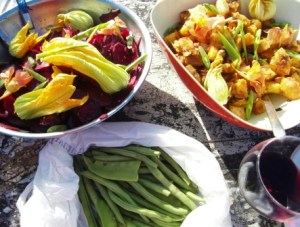
Sunday 6pm. Everything in the picture was grown on our community allotment: the beetroot, turned into slivered (use a potato peeler) salad, and the spiced Mumbai potatoes, both decorated with courgette flowers, and the green beans in their bag – all on the table in the evening sun, waiting to be eaten.

We have GROFUN, Growing Real Organic Food in Urban Neighbourhoods, to thank for this miracle.

Nadia Hillman, GROFUN’s 33 year-old Bristol-based founder, was on BBC’s Gardening World at Easter helping Birmingham set up a similar scheme.

Is your garden overgrown? Would you like help getting it fit to grow organic vegetables?

GROFUN volunteers pitch in and in return for their impressive labour they get reciprocal gardening-help either in their own garden or at the community allotment in St Werburgh’s, Bristol.

We are learning how to grow. And everyone involved gets invited to the harvest meals.

“The best thing for me is the connecting of people” says Nadia.

We sat around the fire into the evening. Mel played a haunting song on the guitar.

It sounds a moment of peace. And it was.

My mother’s tongue

My mother' tongue

My mother heaved the 2-pound tongue onto the serving dish and I offered to skin it.

I eat mainly vegetarian food but I skinned that tongue like a pro, feeling elemental and respectful like a hunter.

My mother foraged for it in Waitrose. The label bore two marks: UK and EU.

My mother went to the customer service desk to check its provenance.

“Cured in Bedford,” said the assistant, “so it must be British.”

“But where did the animal come from?” said my mother.

He checked with the buyer who sent word the animal was UK-bred.

“So why the EU label? It’s still a mystery,” said Ingrid Rose when my mother told us the story as we ate.

My mother said she used to pickle tongue with saltpetre. Now it’s hard to find.

Pickling salt beef and tongue are traditional ways to preserve meat. No refrigeration in the shtetl.

My mother’s tongue – a childhood memory.

My mother talked about the cooking of the 2lb tongue (for £8, 8 servings).

She disagreed with the label’s instructions: to throw away the water after bringing the tongue to the boil seemed a terrible waste, she said.

She and Evelyn Rose are of one mind: wash the tongue well in cold water – there is no need for waste.

Cooking salted/pickled/cured tongue: water to cover + garlic + 1 onion skinned and cut in half + peppercorns + bay leaves. Simmer and cover for 2 hours and 30 minutes. Then drain and skin.

The potato pie: mashed potatoes + 1 tablespoon of goose fat (“My mother used chicken fat,” says my mother) + 2 eggs + salt and pepper plus my mother’s latest addition: chives.

Back to the meat.

What do you want to preserve?

Reblog this post [with Zemanta]

Guild of Food Writers Awards 2009

IMG00083

Last night I was at the Guild of Food Writers Awards 2009 party at the Old Hall, London.

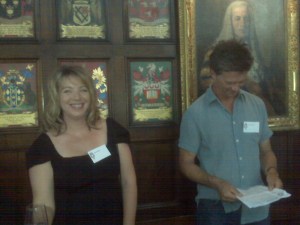
My blog was shortlisted for the New Media award, and I took my mum (see pic, above) along to give me support.

OK, my blog did not win. Tim Haward of the Guardian/ Observer Word of Mouth blog pipped both me and the lovely Helen Yuet Ling Pang of the World Foodie Guide to the (blog) post.

However, the judges said nice things about Real Food Lover such as: “Quirky”, “informative” and “Winkler’s writing rules should be required reading for aspiring writers online or in print”, and ditto in The Guardian.

One of the judges, Rupert Parker, gave me some good advice, saying I should update more often. Like daily. Will give it a go. Viz.

Emma Sturgess and Diane Hendry were also winners and that meant a lot to me because I had voted for them when I was on two previous judging panels.

Being a participant – rather than an observer – took the event to another level. I was high.

And snapped away.

IMG00084

Here is the lovely Jane Baxter and Guy Watson happy with their award (and not knowing they are about to receive another). I love their Riverford Farm Cook Book – and I have mentioned it a few times here at this blog.

Jane said there was no danger of this going to her head. “As I was coming up the steps of the Old Hall, I got a call from my six-year-old: ‘Mum, where is my bicycle pump?”

IMG00092

Here is Mark Hix who is not only a winner but thouroughly helpful. When I told him my niece was a fan, he said: “Can she cook?” and said she could contact him (yippee).

IMG00095

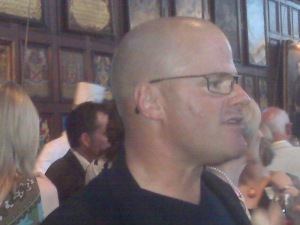
Here is Jay Rayner who was warm and funny. And below is Heston Blumenthal.

IMG00093

As my mum said: “You were up there with the big boys.”

In fact Heston was dead impressed by my mum. She was talking about her parents (circa 1930s) who used to analyse every dish at every meal – an enduring family trait. Heston admired my mum’s energy and told her:

“I want what you’ve got.”

O it was fun. And being shortlisted is a goddamn-fine accolade. Nichola Fletcher told me her publishers put it on her book cover.

So in the words of the song: “They can’t take that away from me.”

Oh no – they can’t take that away from meeeeeeee.

Brain food

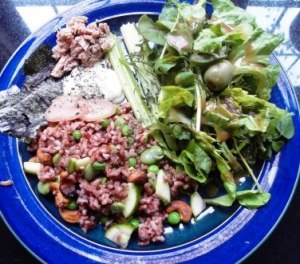
brown rice salad, wasabi mayo and toasted nori

There is nothing like being cooked for, especially when it is your favourite food. Every lunchtime this last week I have feasted on creative vegetarian dishes thanks to Sarah Roy’s inventive nutritional know-how, handsomely assisted by Ali.

These wonderful health-feasts are part of the Symphonic Mind treatment offered by Sarah and her husband, James Roy. As I am helping them with their marketing, they insisted I experience the whole package including daily Yogic massage and brain training.

I have never thought much about my brain or its waves. But according to the emerging sciences of the mind, emotional and physical trauma as well as a range of health conditions can cause imbalance.

For instance, someone might have too many theta waves in the front lobes, or conscious part, of their brain. Theta-induced dreaminess is good for creativity but not for paying bills on time. So after an assessment, Brain State Technology comes up with a precise customised programme to restore balance.

In my case, I have a huge amount of brain waves associated with self-critical judgements in the unconscious part of my brain.

Sarah says this is common. I can believe it. We come from centuries of repression and mind control. It is hard to feel good-enough just to be.

In the brain sessions, I sat back in a comfortable state-of-the-art chair. Sensory electrodes picking up information from my brain were placed on different sections of my head, depending on which part we were working on. I was asked to do a variety of mind-stilling exercises such as focusing on a lit candle while I listened to sounds of my brain waves played back to me.

This is a very pleasant way to spend the day and could not have come in a better time as I transition from employee to entrepreneur, and need to call on all my resources unhampered and to maximum effect.

Brain State Technology translates brainwaves into sounds, colours and shapes. One exercise which appealed to my competitive self was using my mind to move a coloured bar on a screen. If you focus hard-enough the bar goes up or down. How fascinating to see in real-time the value of setting an intention!

The massage treatments sandwiched between the brain work was a way of grounding these changes  in my physical being. James Roy used to train with the masseur of the Dalai Lama and the masseur of the Thai abbots. (Am happy to hear monks get massaged).

For two hours a day I was Breathed and Yoga-ed. I lay on a large mat as James guided my limbs and lungs to do their yogic thing. It is something else to have someone else help you get into postures and breathe deeply. The beauty is I can touch my toes again, something I have been unable to do since a slipped disc injury three years ago.

As for my brains, I overcame a deeply troubling situation leading to the calm of acceptance; and (reporting a few days later), my focus and meditation seems to have improved.

Now for the food. As well as being a neurotherapist and body worker like James, Sarah is a nutritionist. The above dish was brown rice salad with peas (defrosted but raw – works a treat), fresh broad beans and roasted cashew nuts; with toasted nori flakes, pickled ginger, olive paté with cream cheese, green salad leaves from a Riverford Organic veg box, and wasabi added to mayonnaise. Wasabi is that green Japanese horseradish you get with a sushi. Thanks to Sarah, I can now add it to my repertoire.

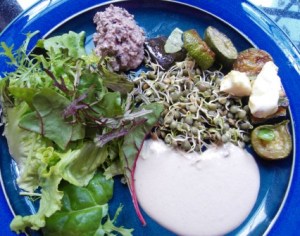
Another one to note is the tahini sauce (below) which Sarah made with lemon juice, tabasco for spice, a little water and – the magic ingredient and a new one for the store cupboard – the saltiness and digestive-enhancement of umboshi paste.

I felt so lucky, I was envying myself.

umboshi tahini sauce

Reblog this post [with Zemanta]

Six salad party food

Plate of party food

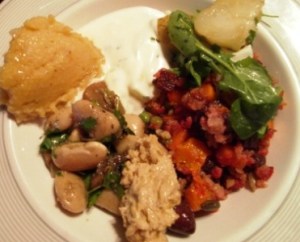
Party food chez Winkler. I was too excited to eat, so took small portions. This one went down a treat despite hostess-nerves: the wild rice salad with oven-roasted morsels of beetroot, pumpkin and carrots, and crunchy oven-roasted pumpkin and sunflower seeds. My off-the-cuff invention, it’s made the grade for next time.

The six vegetarian salads (see unposed picture above) were easy-on-the-purse and high-on-health:

1. Wild rice salad with pumpkin, beetroot and carrot – followed clockwise in the picture by…

2. Ingrid Rose’s hummus (using her 5 x amounts hummus recipe) – her birthday present to me!

3. Butter bean, mushroom and coriander salad with lemon juice

– a perennial winner thanks to Rose Elliot’s The Bean Book

4. Red split lentils with chilli. Simple dhal – light with bite.

5. Organic wholemilk yogurt with diced cucumber, black pepper and mint

6. Classic potato salad – boil halved-and-quartered (if possible NEW) potatoes until soft enough to fall from a a sharp knife when speared.

The party was on Saturday. I aimed to be prepared and avoid last-minute superstress.

Most of the shopping was done midweek.

Thursday I emptied the packet of butter beans (500g) into a large pan and covered the hard ones with water. Overnight they swelled. Some say throw away the rinsing water to reduce farting – what do you think?

Friday I cooked the swelled-up beans in enough water to cover them and boiled them for 1 HOUR, then drained. I defrosted the frozen wild rice I had cooked earlier that week (with chilli). Texture mushy but taste good.

The drained butter beans mingle eventually – with onions fried in olive oil plus 5 teaspoons of cumin sizzling for seconds. Into the spicy mix go sliced mushrooms, lots of them. You may need to add more olive oil to prevent sticking. Once the mushrooms are cooked but not soggy, then you add the drained butter beans.

I  roasted the root vegetables a day-ahead too

– seasonal local beetroots and carrots and (imported) pumpkin roasted for only 20 minutes because they were cut-up so small, and the seeds – they take minutes.

Saturday Boiled potatoes for potato salad and slouched them with olive oil, rock salt and garlic while still warm.

Peeled and diced 3 English cucumbers + mint + 3 large pots of organic yogurt, emptied into a bowl.

Assembled the wild rice salad and cooked roasted root veg and seeds.

Assembled the butter beans + mushrooms + cumin with lemon juice and fresh local organic coriander.

Wow. This was the first time I have been so prepared.

I had even sorted out the serving dishes in advance.

All the more time to party.

Me and my birthday cake Me and Richie

Reblog this post [with Zemanta]

Tofu with coconut

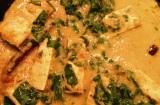
Tofu Rendang

Quite often strange and wonderful foods are packaged with no explanations on how to eat them.

Take aduki beans. Gillian McKeith recommended them on British TV. The nation listened and duly bought them.

But what to do with those aduki beans? I bet you money some are still sitting in the back of people’s cupboards…

The more unusual the food, the more the food makers assume you know what to do with them.

This explains why I was so happy to receive a booklet (in this case free with this Sunday’s the Observer) on interesting ways to cook tofu.

I love the bland, digestible high-protein bean curd. But apart from stir-frying, I never quite know how to eat it.

The booklet from award-winning organic tofu makers, Cauldron, takes its inspiration from Asia where tofu is traditionally used and you are not seen as a weirdo for eating it.

Here’s my Winklerified version of its Rendang paste:

Toast 3 tablespoons of dessicated coconut in a dry, hot frying pan.

Make a paste: Blend (or whizz or pound) the toasted coconut with one cut raw onion, 1 mild fresh chilli, a chunk of raw ginger peeled and chopped, and a teaspoon of turmeric. No liquid needed.

Heat 1 tablespoon of oil in a heavy frying pan and gently fry the paste, stirring until the aroma is released.

Add 250 mls (a bit more than half a can) of coconut milk with 125 mls of water.

Blend a teaspoon of tamarind paste with a tablespoon of water, and add that along with 1 stick of cinnamon (see it floating on left of picture) and 4 star anise (I have had star anise in my cupboard for ages not knowing what to do with it…).

Bring the mixture to the boil, then reduce the heat and simmer for 5 minutes. Add the drained tofu pieces and cook gently for another 10 minutes. Stir in greens chopped in strips, such as fresh coriander or spinach or pak choi.

Serve as I did with brown rice and cubes of roasted sweet potato.

I am not known for my presentation skills when it comes to food. By the time I have cooked, I am in no mood for artistry. Hence the joy of eating out.

One of my fave local eating places is a gastropub on Bristol’s Gloucester Road Robin Hood’s Retreat.

The food is locally sourced and heavenly flavoured. I believe the chef is a master.

I had asparagus from the Wye Valley with a Scotch egg with the egg still warm and runny; pea puree and sea trout on a bed of lentils. Dinner for two with 1 glass of wine and two courses, came to about £50.

And all, as you can see, beautifully presented.

Robin Hood Retreat - asparagus from Wye Valley, scotch egg Robin Hood Retreat - pea puree, lentils (not pot) and sea trout

Reblog this post [with Zemanta]