Category Archives: food

London, 17 May: Symphony of the Soil UK premiere

I am a soil lover.

Some see soil as dirty.

What does that say about our relationship with the world?

Love soil – our lives depend on it.

I am proud to be promoting the Symphony of the Soil UK film premiere on 17 May 2012.

With specially-composed music from a Hollywood great, and original animation, Symphony of the Soil is a multi-media film. Read its roll-call of expert interviewees soil scientists, farmers and campaigners including Dr Vandana Shiva.

Organico, the Mediterranean organic food company, is sponsoring the invitation-only premiere. Do Like Organico on Facebook for the chance to win tickets to this exclusive event.

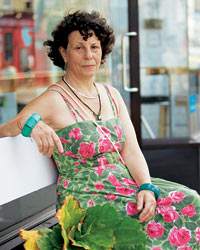
Director and filmmaker, Deborah Koons Garcia (above) will be  talking about Symphony of the Soil with the Soil Association’s Helen Browning OBE and organic farmer.

In 2006, I organised the London premiere of Deborah Koons Garcia’s film documentary The Future of Food. It examined the corporate domination of our food system, sounding the alarm on GM patents, and exposed revolving-door politics between biotetch executives and the US administration.

The Future of Food helped spearhead the US real food movement, currently calling for GM labelling in California.

Deborah Koons Garcia says  that Symphony of the Soil is a positive film because we can all do something, such as make compost or support organic farms.

“I am making a positive film, science presented in an artistic manner [so] that people will fall in love with [soil] and become part of the soil community – because we are anyway. We rise up from it and we go back to it. So we’re part of it and when we are responsible members of the soil community, we give back to it, it gives back to us. …

“When people see this film they’ll actually become even more committed to a positive relationship with soil.”

As I am writing this blog, I hear BBC radio news announce: “Half of Britain is in drought.”

I shout to the radio: “Go organic!”

Organic soils retain more water than non-organic soils, according to long-term research.

If we put back what we take out, the soil can nurture us.

“We don’t grow plants. We grow healthy soil – and the soil grows the plants,” says a grower in the film.

Symphony of the Soil illuminates the complex dynamic relationship between soil life plants – “a dialogue of nutrients.”

It is all common sense. You have to put back what you take out otherwise soil becomes barren.

So why not listen to our common sense?

Follow the money.

Dr Hans Herren co-chaired the IASSTD 400-strong scientific review of agriculture which found that what the world needs now is small-scale ecological farming.

Interviewed in the Symphony of the Soil, Herren says of organic farming:

“…but it does not fill the pockets of the few. It only feeds the consumer and the farmer.”

Symphony of the Soil is a beautiful and moving film – shows how clever and intricate and subtle nature is.

But it will also made me angry and sad because there is so much needless destruction of this natural precious resource.
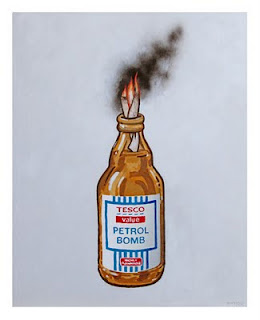
No Tesco in Stokes Croft fundraising party – Chance to win a Banksy!

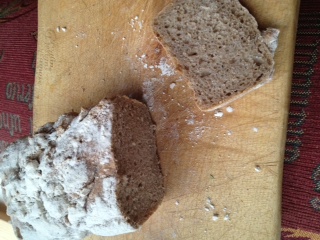
Here (above left) is breakfast, a sourdough loaf from the Stokes Croft pop-up bakery (above right), just across the road from the famously-unwanted Tesco.

“A year ago these streets were the scene of riots following the bitterly opposed opening of a Tesco store. Twelve months on, Stokes Croft, Bristol’s most bohemian neighbourhood, is booming,” wrote Stephen Morris in the Guardian earlier this week.

In a debate in parliament on 17 January 2012, Stephen Williams MP said:

“I am probably the only Member in the Chamber who has experienced a riot in his constituency caused by the opening of a branch of Tesco. It took place over the Easter and royal wedding bank holidays in April last year. I certainly do not condone the antics of those constituents, but I very much share their frustration. Large businesses do not work with the grain of local opinion.”

Here’s some background, briefly: Our No Tesco in Stokes Croft campaign, began February 2010 after Tesco arrived in Stokes Croft by stealth.

Against all odds, we took our legal battle as far we could – to judicial review.

We lost – our court costs are £2,126.50.

We are having a fundraising party on Friday 13 April at 7.30 pm with music, poetry and street theatre at 35 Jamaica Street, Bristol BS2 8JP. Join the group on Facebook.


Buy a limited-edition bone china “I Paid The Fine” mug produced by The People’s Republic of Stokes Croft, and be part of social history.

Twelve of the 250 mugs will be accompanied by one of the original Banksy posters donated by the graffiti artist as a “commemorative souvenir poster.”

Every campaign, whether you win or lose, is worth its weight in gold for it raises awareness of the issues.

I will be part of a round-table discussion – The High Street Fights Back – at the Natural Product Show this Sunday with campaigning journalist and author, Joanna Blythman.

This month, Tesco withdrew its planning application from Herne in Kent after huge local protest.

Thus, I, like my fellow campaigners, remain

relentlessly optimistic.

STOP PRESS 23 April 2012: Last Mug Sold!

What is Tesco Real Food?

Tesco Real Food is the name of of Tesco’s recipe magazine and website, Tesco.com/realfood.

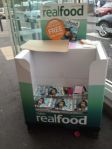
Launched by Tesco PLC in 2011,  the magazine is given away free by Tesco six times a year as a marketing promotion (see pic above).

Tesco sells real food in the sense it is tangible, not imaginary. But Tesco food is not what this Real Food Lover calls real food.

I have had this definition on my Real Food Lover blog since 2008.

“What do I mean by real food? As close to nature as it can get. I want mine grown organically – without chemicals and with respect, as close to my home as possible. And wholefoody and unprocessed too, please.”

Others have a similar definition.

The Real Food Festival says: “Real Food is all about great tasting, sustainably and ethically produced food.”

Real Foods, based in Edinburgh, has, for the last 30 years, sold: “healthy, natural, organic (real) food to the nation at affordable prices.”

In a blog post responding to Tesco’s recent use of the term “real food”, Real Foods writes: “… ‘real food’ is food from which the body can extract the maximum amount of nutrition with the minimum amount of waste; food in its most natural state with the best bits still left in rather than foods that have been processed so that the goodness has been removed and replaced by chemicals which, if not actually harmful, are nutritionally ’empty’.”

Like the efficient retailer it is, Tesco has done its consumer market research and understands the nation’s need for nourishment. The result is its Real Food marketing initiative. Will it help people eat real food?

The magazine promises 32 “seasonal” recipes on the front cover.

Out of Tesco’s three “Season’s Best” recipes, one features mangoes from Peru. Mangoes are not grown in this country. They can never be seasonal for the UK.

Ten out of the 32 “seasonal” recipes were puddings with no fresh produce at all. Some were for Valentine’s day, Pancake day and Mother’s day. Are these annual celebrations what Tesco means by “seasonal”?

If so, Tesco has misunderstood the importance of seasonal for real food lovers.

Eating seasonally is about enjoying freshly-harvested produce. The fresher and more seasonal the produce is, the more nutrients it has and the better it tastes. That is one of the (many) reasons why local is important because it means the food is fresher when you eat it.

Tesco Real Food magazine’s current issue invites readers to Love Local and check out online its “wide variety of food from local producers around the UK”.

I checked out Tesco.com/local with my Bristol postcode and was directed to the Gloucestershire region. I was offered only eight products, four of which were beer. Yes, all good local produce, including Pieminister pies and cold-pressed rape seed oil.

But eight products do not a local-food-supply-chain make.

Like most supermarkets, Tesco sources globally not locally.

This article on apples gives us a clue.

According to the Telegraph, at the height of the UK apple-growing season in 2010, Tesco sourced only ten per cent of apples from Britain. The rest were imported. However its billboard ads promised ten different British varieties (subject to availability).

I get the feeling Tesco likes using words such as real and seasonal and local and organic because they sound good. But does Tesco subscribe to the principles and practices that underpin these words?

Tesco Real Food magazine’s current issue has an advertising feature for Tesco Organic. It says organic produce is grown “with reduced reliance on fertilisers”.

This is incorrect. Let me explain. Natural fertilisers – such as composted green and animal manures, and nitrogen-rich crops – are crucial to organic farming. This is how the soil is nourished.

On the other hand, chemical fertilisers are banned in organic farming because they strip the soil of life and cause environmental damage including water pollution.

Tesco’s Organic range is truly organic, and I am not questioning that [added after publication for clarification]. But does Tesco understand organic farming methods? Or is it using organic to make Tesco’s other products – such as intensively-farmed chickens – seem more wholesome?

Here is another example of the mismatch between Tesco Real Food and the reality of Tesco food.

As far as I know (please tell me I am wrong) Tesco still sells foods with trans fats despite a promise to ban them by 2011. Trans fats may make food last longer, but they are essentially candle-wax with huge health risks.

Trans fats are not real food. In fact, they are not even food.

Tesco’s Real Food magazine is glossy, handbag-size and beautifully-presented. In thick bold type, it emphasises words such as “nutritious” and “soul-warming”.

Is Tesco Real Food  the marketing version of trans fats, a cheap filler that tricks us into thinking we’ve been nourished?

Real food producers can tell you exactly what is in their food: how and when and where it was grown, reared, produced and processed – how the land was fertilised, and the farm animals cared for.

Why is Tesco spending its marketing millions pretending to be real?


Sheepdrove organic goose

There is no getting away from it. Eating meat means taking a life.

I understand the horror vegetarians feel. I love vegan cuisine.

But I am a meat eater. Maybe once a week. I can feel the nutritional value it brings to my body.

If I were a hunter – I imagine – I would kill the animal, and lie down and cry because I had killed it. (I saw this on TV once). Then eat it. Hopefully with reverence.

But I could be romanticising.

The fact is I cannot square killing for food.

At least I can make sure the animal was well looked-after while alive.

Which is why I choose organic meat.

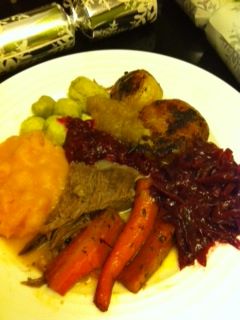
On Christmas day, we cooked and ate a goose from Sheepdrove Organic Farm.

Declaration of interest: I work with Sheepdrove Organic Farm. But – you know me – I can only work with a cause or company I believe in.

Check out Sheepdrove Organic Farm. Lots of great info on its website: including the importance of grass-fed creatures and Eating less meat? Eat better meat!

Sheepdrove Organic Farm’s head butcher, Nick Rapps, is passionate about showing people how to eat organic meat in a budget.

For instance, buy cheaper organic cuts (not pre-cut packages) from an actual butcher who can provide the unusual cheaper cuts. Cheaper cuts need slower cooking.

Nick Rapps’s The Organic Butcher’s Blog at Food Magazine is a treasure trove of tips. Here’s Nick on the organic Christmas turkey on a budget.

My sister, Geraldine, cooked our Christmas goose.

Listen-up. True to our ancestors, she is a real food lover.

My sister said: “How did I cook the goose? It was good, wasn’t it? And simple to cook. I rubbed salt and pepper and fresh grated ginger on the skin. Then scrunched wet greaseproof paper, smoothed it out and covered the goose. The formula is 20 minutes per pound on a low heat roughly 150/Gas Mark 2/300  and 20 minutes over. Our goose took about 5 hours. Regularly,  pour fat off the roasting pan (and keep it later for roasting veg) otherwise the goose fat will overfill the pan. Most importantly, let it “rest” a good half-an-hour after taking it out the oven.”

We served the Sheepdrove goose with an array of colourful vegetables, cooked by other members of the family so not one person did all the work.

Red cabbage and apples, squash and coconut, cranberry sauce, roast potatoes, Brussels sprouts, gravy.

PS I lost my ‘phone over Christmas. However – curiously – on the day I lost my ‘phone, I sent a picture of our Christmas meal (above) to myself. Which was lucky as I had not backed up my images since November so the Christmas meal pic would have been lost. Funny, eh?

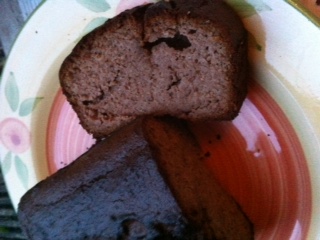
Pecan banana bread made with ground nuts not flour

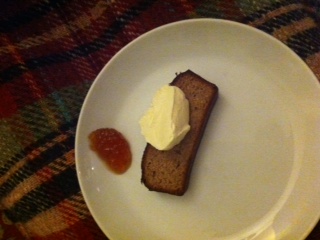
Banana bread + organic creme fraiche + Better Food Spicy Apple and Citrus Preserve

Experiment: Spoke a first draft instead of writing it. Took me five minutes. Could this be the way forward?

Here is what I said (with few amends).

Due to a delicate digestion, I think a lot about how I feel after what I have eaten.

The food is delicious. But how does it sit in my gut?

So I was interested to read in Natural Lifestyle an article by nutritionist Christine Bailey about healing the inflamed gut. A new idea. Is it possible?

The article recommended homemade yogurt (I am a believer), and well-cooked vegetables with meat broth, avoiding all grains.

The article gave a recipe for banana bread using ground pecan nuts instead of flour. No sugar. Honey instead.

Finding-out how to grind the nuts was a mission.

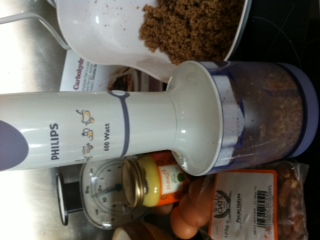
I even bought a new hand blender. I drove myself and the assistant at Kitchens mad questioning the nut-grinding function of every machine and found all nuts when ground eventually go to a paste because of the heat.

So it seemed nut-grinding might be a Shangri-La illusion.

So I bought my £30 Philips hand blender with a grinding attachment and further research found freezing the nuts might stop them getting too oily too fast.

I froze the nuts. I used the nut blender attachment, I found with short burts and not expecting too much fineness, I ground the nuts. It worked.

Pecan nuts are more expensive than flour. Nuts are more expensive than flour.

Here is Christine Bailey‘s recipe. I changed it: got rid of the baking agents, using eggs to make it rise, and two bananas instead of one. It filled one small and one big loaf tin. You could substitute the pecans for other ground nuts.

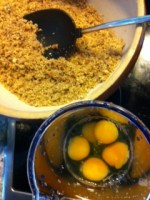
Grind/blend 10 1/2 oz (300g) frozen pecan nuts. A cinnamon stick adds grit to oily nuts. Add 2 tsp ground cinnamon to ground nuts. Whizz four eggs until airy then whizz with two tablespoons of olive oil (I used melted ghee butter) and one large or two small ripe banana until airy and smooth. Combine gently with nuts and cinnamon. Pour into two oiled loaf tins. Bake 180C Gas Mark 4 for 40 minutes until firm to touch. 

The banana bread tasted a bit worthy and I did go non-vegan spreading it with organic butter.

It must be noted, it was easy to eat, not sickly-eating sweetness

and afterwards my gut felt good.

It would not have been so happy with the grain.

The banana bread is a keeper but it does need a spread and I wonder what you might add to luxuriate the baked bread.

And have you grappled with nut-grinding?

Sprouts and raw hummus

I was told yesterday that today is the last day of the Mayan calendar.

That means the end of 28,000 years of hierarchy and oppression.

Yippee!

And I have finally found a spouting system that works.

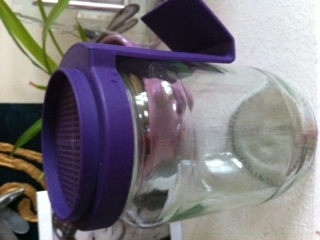
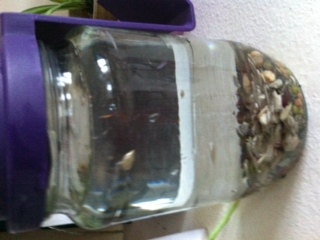
I bought this jar with its plastic perforated lid from Harvest, part of Essential Trading Worker Co-op.

DIY types can make their own. Or use old tights or muslin as the lovely Alys Fowler suggests.

Or buy one like mine (after years of experimentation, I can vouch that This One Works), and get loads of sprouting info from Living Food of St Ives.

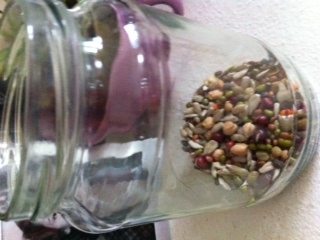
First you put the dry (organic) seeds in the jar.

Add water and leave them overnight to bring them to life.

After that first long soak, you wash the seeds daily (or twice, thrice).

The seeds like being clean and wet (not soaked or drowned).

So after filling the jar with water, swill the seeds around then drain away the water (hence the natty perforated lid which makes life so much easier).

And how is this for a virtuous circle? I drain the water on the indoor plants so they get a regular watering.

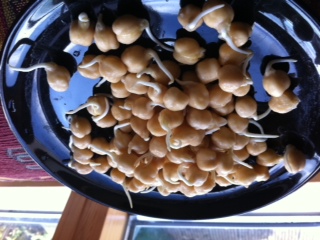
After a few days, I have produced living things.

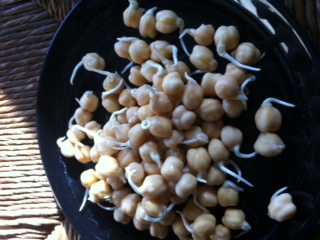
Here are some sprouting chickpeas, looking positively Lawrentian.

(DH Lawrence being one of my fave authors because he describes life on its different levels: soul, mundane etc and because: “Lawrence believed that industrialised Western culture was dehumanising…”).

So now I am going sprout-mad. Sprouts in stews. On toast with cream cheese.

Whizzed with Organico Artichoke Spread for instant hummus.

Hold on a minute. Did I say hummus?

I ask myself: WHY make hummus with cooked chickpeas when you can use extra-bursting-with-vitality FRESH sprouting raw chickpeas?

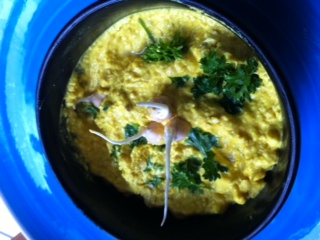
So, I substitute the cooked chickpeas for my Lawrentian darlings, add some turmeric and crushed coriander seeds (must sprout THEM one day) and of course lemon juice, olive oil, tahini, raw garlic, as in my usual recipe for hummus .

And it was delicious.

Trans fats are not food so why do we eat them?

I like fat. Butter, cream, olive oil.

But trans fats give fat a bad name.

Artificial trans fats are made by an industrial process of hardening, or “hydrogenating”, oil.

Trans fats are in food – but they are not food.

Trans fat is basically candle wax made from vegetable oil.

The food industrialists use it because it is a cheap filler, prolongs shelf life and has useful cosmetic attributes i.e. it can make a cake look light and fluffy.

As you can imagine, eating candle wax is not good for you: trans fats are toxic and clog up arteries.

There is plenty of scientific evidence to show trans fats are a huge health risk.

Based on the Precautionary Principle (why take an unnecessary risk?), organic standards have always banned trans fats.

Several enlightened countries, as well as New York City, Seattle and the state of California have now also banned them.

The Independent recently asked: why are trans fats still legal in the UK?

Trans fats may appear on a packet as: shortening; hydrogenated vegetable oils; HVO; partially hydrogenated vegetable oils; PHVO.

It’s up to the trans fats manufacturers how to describe trans fats; there are no regulations on terminology.

Dr Alex Richardson, author of They Are What You Feed Them and founder-director of the charity, Food and Behaviour Research, says:

“Good foods make bad commodities; good commodities make bad food.”

What a great quote – sums up our current food crisis…

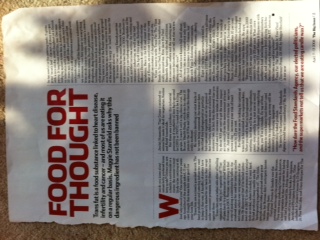
I have been hanging on to this cutting from The Big Issue since 2008.

It’s an article by Maggie Stanfield, the author of Trans Fat: The Time Bomb in your Food (Souvenir Press).   See the book cover at top of this post.

According to Maggie Stanfield, eight of the big supermarkets said in January 2007 they would remove all trans fats from their own brand ranges. “Some managed it. Others didn’t.”

According to the Independent, Marks & Spencer, Waitrose and the Co-operative own-brands are now trans-fat free. And, I believe, Sainsbury’s.

In 2010, the National Health Service watchdog, Nice, called for a total ban but instead we got more paper pledges:  in March 2011, McDonald’s, Pizza Hut and KFC (and many more) promised to remove artificial trans fats by the end of this year. So did Tesco and Asda.

They promised. By the end of 2011.

What do you think? Can we trust ’em?

Fish4Ever challenges big brands

As a journalist and food campaigner, I help Fish4Ever with its communications. I cannot work for a cause or company I don’t believe in.

So, I have the privilege of asking nosy questions and learning about the politics of fish.

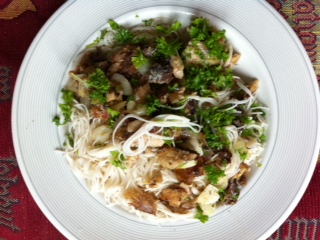
Lunch: a fried-medley of Fish4Ever sardine fillets (Steenberg’s Organic online £1.60) on a bed of organic rice vermicelli.

Medly: I fry sliced shallots/onions, garlic and chilli in the organic oil in which the fish are canned – Fish4Ever uses 100% organic land ingredients.

I add the sardine fillets, mashing them (was that respectful?). I snip-in fresh parsley .

Fish4Ever canned fish is in a class of its own, fished traditionally (70% MSC-certified, the rest artisan) and quickly-conserved for freshness.

I am a real food lover and here’s why: you do good – it tastes good.

Why is it important to look after the fish?

Fishing technology is too effective. Desired species are being hunted to extinction.

Its hunting methods are indiscriminate, killing turtles, sea birds, dolphins.

There are too many factory boats and not enough fish. Regulations to control catches are insufficient and often ignored. Out at sea, where no one is looking, rules can be flouted. Poor countries suffer from foreign piracy on an industrial scale.

Hugh’s Fish Fight on Channel 4 earlier this month focused on changing the fishing methods of the big tuna brands and own-label supermarkets.

The food corporations’ proposed changes are far better than nothing.

However, although the big brands may well promise a “pole and line” range, their primary business remains likely unchanged.

Each Fish4Ever can has a story – including the smallest tuna fishing boats in the world.

This is not an eco-add-on. Fish4Ever’s raison d’être is care of land, sea and people.

That’s what I call an ethical company.

Meditation pot-luck lunch with Claude AnShin

“Bring cushion, blanket and vegetarian food to share,” were the instructions for yesterday’s meditation workshop at the Pierian Centre.

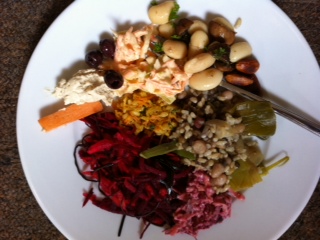
I have never known a pot luck not to work: my plate was filled with favourite foods such as raw beetroot and seaweed, butter bean salad, rice and lentil salad, raw carrot and hummus…

We practiced eating meditation. We ate in silence, aiming to chew each mouthful consciously, with 50 chews.

Eating silently and slowly in company was strangely relaxing.

I had helped promote this event with Saint Stephen’s and the Pierian Centre so it made sense to go.

But I had dreaded it. What? A whole day of meditation? I felt trapped.

Instead the day was rich and intense.

The workshop was led by Claude AnShin Thomas supported by KenShin.

(“How do I address you?” I had asked KenShin. “Ken – like Ken and Barbie – and shin as in leg,” she answered.)

Claude AnShin Thomas was a Vietnam veteran with post-traumatic stress – like many in the military or caught in war.

His spiritual practice helped him cope with flashbacks and emotional pain.

Meditation does not make horrifying experiences go away.

But being conscious, or awake, paradoxically makes trauma easier to cope with.

You learn to sit with discomforting feelings rather than self-medicate or distract yourself to push them away.

Claude AnShin Thomas is funny, straightforward, down-to-earth, profound and deeply touching.

A mendicant monk, he is homeless, goes wherever he can make a difference, and lives on donations.

He works for peace with the Zaltho Foundation by being as conscious as possible. “Everyone has their Vietnam,” he says.

I have marched for peace but peace activists can work for peace by healing the war inside, too.

I am reading his book, At Hell’s GateBeautifully written, so worth reading.

He’s not a new-age guru making money from spirituality, but a man with a troubled past who found his spiritual practice bought him peace, and who has dedicated his life to sharing this to help others.

And this real-ness transmits, I swear.

Organic Food Awards 2011

This year I was a Soil Association Organic Food Awards judge, judging cheese (wonderful taste memories, quality outstanding).

So I was invited to the actual awards last Wednesday.

They were held this year at the launch of the 12-day Start festival to celebrate sustainable living.

And at Clarence House gardens, open to the public for the first time.

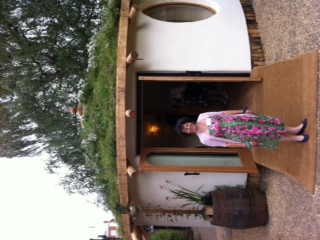
So I made an effort, bought a reclaimed frock for £25 at Dutty’s in Bristol, caught the coach (National Express not golden) to Victoria, and walked to the Mall.


Me (in sister’s shoes) in front of earth house with grass roof and circular windows.

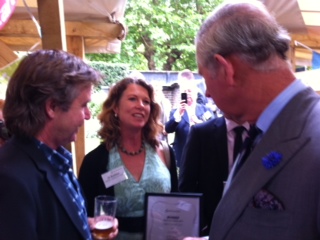
My first royal photo of Higher Hacknell Farm Organic Food Award winners, Jo and her husband Tim Budden, receiving rightful organic congratulations from HRH Prince Charles.

I had a touching royal moment myself exchanging greetings – I feel Prince Charles (and Soil Association patron) is an earth ally, and uses his position well. I award him the Winkler Seal of Approval.

It was an uplifting evening, meeting old friends and new, especially enlivening because it was held outdoors. Outdoors on a summer evening = good!

Here is a pic from the Bee keeping stall with Daylesford foundation

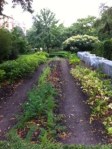
And a pic of the organic veg garden at Clarence House (could the bare earth do with more plants growing, permaculture-style?).

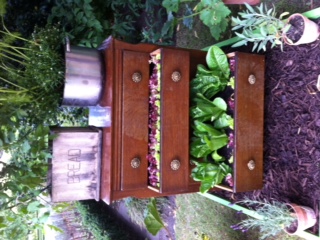
Here is a chest of drawers imaginatively filled with plants from Garden Organic

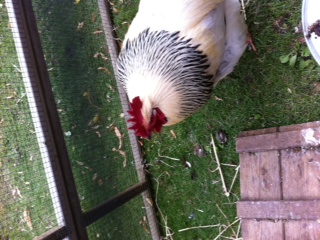
And an organic chicken

Pic of the Organic Food Awards certificates awaiting collection by their winners.

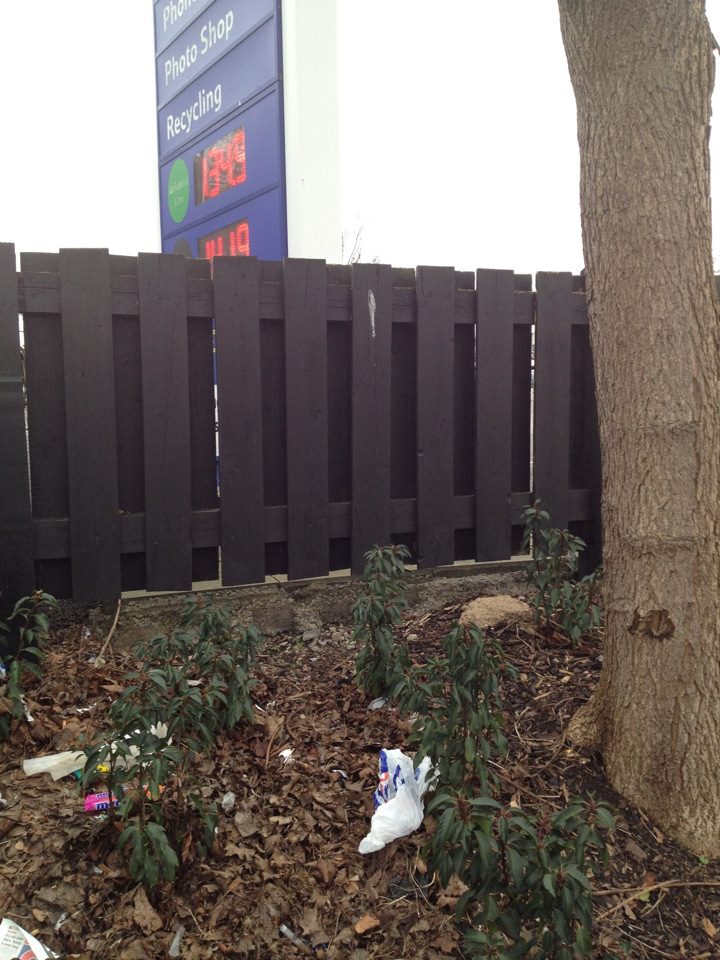
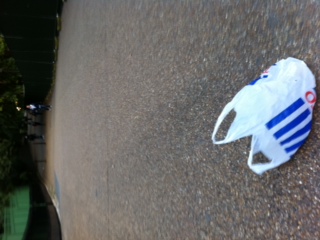
At the end of the evening, on my way to Green Park station, I saw the ubiquitous discarded Tesco plastic bag.

Funny. Because my day had begun by taking a Guardian photographer round Stokes Croft in Bristol for a feature by John Harris in next weekend’s Weekend Guardian on UK-wide campaigns against Tescos.

What does it mean?

PS Here is the pic that Guardian photographer, Jon Tonks, took of me outside Cafe Kino in my Dutty royal get-up.