Category Archives: food

Soho hummus

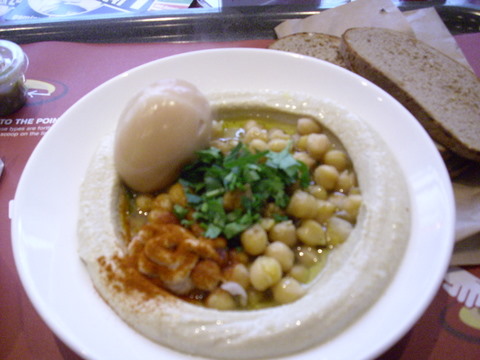
A dish of hummus

Down memory lane in London’s Soho. 1978, unmarried, pregnant, I saw a poster in a funky vegetarian cafe’s noticeboard that changed my life.

Fast forward to 2008. I walked past Food for Thought (it’s still there!) and smiled nostalgically. I did not stop as I was on my way to the 24/7 internet cafe, Netstream.

Starving at 2pm on Wardour Street I found my dream eaterie, Hummus Bros. If you love hummus and in London, you have to go.

Hummus Bros serve each dish (see pic) with a free and unexpected egg, a choice of rye bread (from Fresh and Wild) instead of the traditional pita bread, chilli relish, extra lemon juice and if that wasn’t enough love, a complimentary glass of mint tea made with the fresh herb.

One of my top fave foods, hummus is both comforting and nourishing. It packs protein by combining plant foods. Two different plant groups roughly equals one complete protein, and hummus, with pita, offers three: chickpeas (bean), tahini (seed), and the pita bread (grain).

I yearn to tell you how to make hummus at home because it will be a lifelong friend. The cooked (high fibre, low-GI) chickpeas are mixed in a blender to a creamy gunk with olive oil, lemon juice, a bit of garlic and tahini – now that’s a convenience food I approve of. I also prize tinned organic chickpeas as a larder-friend. (So there, Delia.)

Cooking from scratch saves money and takes planning (beans need an overnight soak and one hour of cooking). This recipe explains it really well. I have never used yogurt, as it suggests. Must try.
Love smoothie

smoothie.jpg

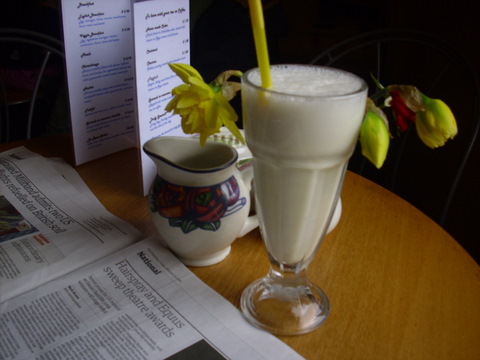
There is nothing more pleasant than a smoothie and its pleasures are fairly instant. If you love drinking smoothies in a café (as I did in La Ruca, see pic) it’s worth investing in a blender or smoothie maker. You need electricity to make a smoothie smooth. (If anyone knows differently, tell me.)

For those planning to live on smoothies (we all have times in our life like that) then vary the ingredients as much as possible.

The delight we derive from variety is nature’s way of making sure we get diverse nutrients.

Smoothies are personal. Everyone has different tastes. This website has loads of smoothie recipes to choose from. Luckily, so I can be lazy and tell you my favourite.

You need to stock up on a few things. I find cow’s milk makes me snuffle so I use soya milk (organic because I don’t want them GM beans) and also (if this is a week’s siege) I would splash out on a carton or two of rice or nut milk. You can make your own.

Banana forms the basis because it is a mood stabiliser (all that potassium, you know), as well as easy-to-eat and sweet. Add a grape or two, or a mango sliver. What fruits do you like?

Start by whisking/blending the banana. A teaspoon of nut butter (peanut, almond or cashew) for added protein? Some raw porridge oats? This is the time to whiz ’em in a mash with a tablespoon of milk or apple juice.

Pour the milk in slowly (a mugful for one). Look, if it gets gloopy, add liquid to gently thin it out.

You can blend in raw grated or ground ginger (great for my digestion) if you like. What I also adore is cinnamon.

Cooking is a bit of an experiment (no dish is the same each time) – that’s what keeps it interesting.

Scallops for the faint-hearted

dsci0005.jpg

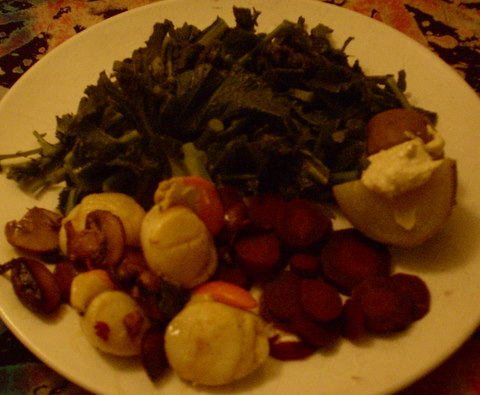
Scallops are easy to cook. I bought a dozen for ten pounds at the Hand Picked Shellfish stall at Bristol Farmers’ Market. They take minutes to cook in a frying pan with olive oil and tiny slices of fresh chilli. You only need a couple per person to add utter luxury to a dish (four if you are feeling flush) and I added fried mushrooms for further economy.

I served the scallops with boiled potatoes topped with a dollop of taramasalata from the Radford Mill farm shop on Picton street. Plus chard and purple carrots. Yes, purple. Apparently this was a carrot’s original colour but when the protestant William of Orange nabbed the British throne in 1698, carrots were bred orange in celebration. Crikey, I only discovered that on Wednesday – a real food lover never stops learning.

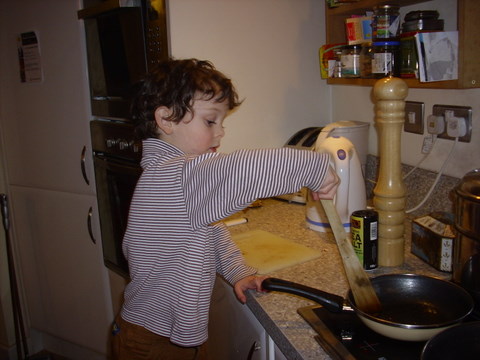
Talking about learning, three-year-old Mackensie fried his own mushroom and scallops.
dsci0002.jpg
It is never too early to get up close and physical with cooking. As my mother (the real food lover empress) says: “Food is the best education you can give a child.” It’s a guaranteed life skill. Once you know how to choose raw ingredients and cook them, you can eat well for less.

Mackensie’s mama is a faint-hearted fish eater who hates bones. This was her first taste of scallops and they went down well. “They’ve got the texture of lychees,” she said. “And they are so easy to eat.”

Purple carrots on a chopping board

Couscous cousins

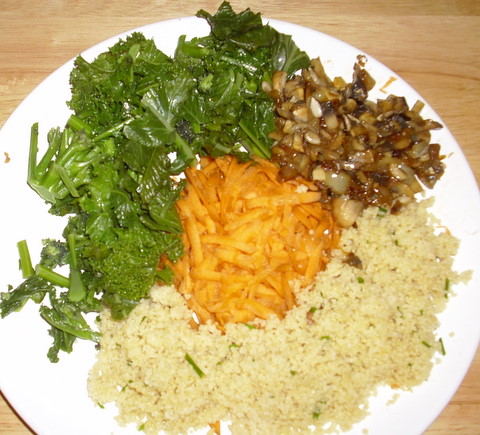
Plate with grated carrots, greens and couscous

Why do people eat pot noodles when there is couscous is in the world? Listen, all you do is pour boiling water over the grains (processed to a teeny size), let five minutes go by while they plump up with water, add olive oil and lo, instant food.

My current top favourite couscous is made from kamut (by Probios) which is good news for all you wheat-sensitive types.

Tonight I added to the couscous, chives (one of the few herbs I can grow as I have pink fingers). I fried onions, mushrooms and chilli, then grated raw carrots (organic of course) and served them with steamed kale and purple sprouting broccoli (cut up quite small).

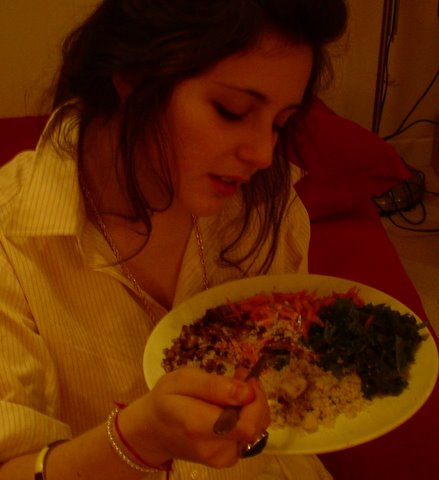
I made one meal stretch for two unexpected guests, Sarah, my middle daughter, and Juliette, my eldest niece. Juliette, just turned 18, explained how traumatic it was. However she immediately noticed the benefits of being grown up.

How? quizzed Sarah, my daughter the social anthropologist.

Juliette said: “Like. Oh. My. God. I suddenly stopped listening to my story tapes.”

Juliette (pictured) jujudsc10013.jpgwas also disappointed with Delia. “People who are interested in food are just not going to buy Delia. She seems really old fashioned now,” she said.

My mum – the original real food lover empress – is also incensed with Delia for recommending convenience foods while so-called championing the poor. My mother’s letter begins: “Bleeding heart Delia has not done her sums right.”

My mother’s family, immigrants from Russia, lived in the East End of London. They had little on the table and very rarely meat. But they ate well because they knew about food.

Reader, such is my provenance.

Disappointed in Delia

I am still feeling disappointed in Delia.

Claiming to eschew the “politics of food”, she makes this sweeping political statement:

“If the whole world goes organic then the state of the Third World will really be twice as bad as it is at the moment and I’m much more interested in people getting enough to eat.”

Get your facts right, Delia. (And spare me the sanctimony).

Farming organically actually improves the food security of poor countries. It also means farmers in the two-thirds world are not reliant on agrochemicals – which are bad for their health and purse and environment.

The only ‘Delia effect’ I am getting right now is intense irritation at her misinformation.

Delia Smith for poor food

The TV queen of cookery has displeased me. Delia Smith has made rude remarks in the UK media about something very dear to my real food lover heart: she has dissed organic food.

I am miffed she is using the politics of food to promote her comeback. Delia “retired” six years ago to be director of a football club but now she is back on our screens with a new cookery show.

Her new book, How to Cheat at Cooking, makes a point of using ingredients such as tinned lamb. Look, I have nothing against convenience foods. But she should at least give people correct information so they can make up their own minds.

She said on national radio that organic chickens are expensive (without explaining why) and poor people can eat the caged ones from factory farms.

Delia claims to despise the cult of the celebrity chef but I can’t help feeling she is using her celebrity to seize the People’s Cook crown.

If she really cared about poor people she would have explained how to buy food on a working-class estate. Or how to cook an organic chicken on state benefits by make it last for twelve meals.

You can eat organic on a budget if you cook from scratch. (It’s actually those convenience foods that hike a food bill.)

Instead the People’s Cook is telling people to buy convenience foods from middle-class supermarkets. You’ll be lucky to find a Sainsbury’s in a food desert, Delia.

Law of attraction

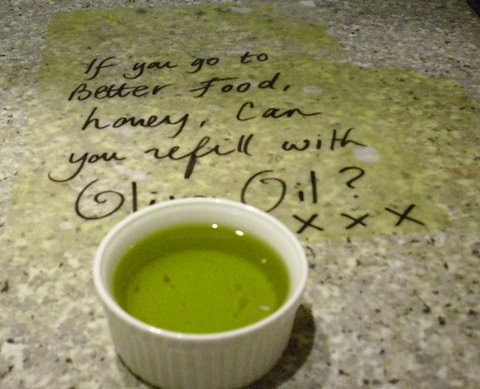
Spilt olive oil and reminder note to buy more

Valentine evening began on a real food lover note. A salad of organic fresh leaves from Better Food and sprouted radish from Aconbury, with sunflower seeds and vinaigrette. Steaming brown rice mixed with flakes of roasted organic salmon.

Listen, the fish is oak smoked by David Felce in his own kiln. The royal real food lover (my mother) says his smoked organic salmon is the best. It’s a family aspiration to have a good fishmonger. Can a girl have two? Bristol Farmers’ Market fulfills that role twice over – more on my next shopping trip. (Pic of David Felce below).

The Law of Attraction deems positive thinking can manifest wishes. I had duly “visualised” us grooving in a club. But post-dinner, things started to unravel. Winkler unprepared for travel action google-maps for directions, only to find the disco hall in disappointing darkness. Expectations of Valentine-harmony menace to take a dive. The only answer is funky Cheltenham Road on Bristol’s East Side.

11pm. The Valentine diners have dined. Bar one30 has had a tough night – the DJ was chef and the glass washer broke. But nothing dinted their welcome. It was like being at a festival – raw and real. The mixologist created a dream cocktail from my particular predilections: Baileys Irish Cream, Amaretto and honey vodka poured over crushed ice and sprinkled with ground cinnamon. Wow. (Seriously. Wow.) We named it Cocktail Zizi after one of my personalities.

When we left, the manager blew kisses, and the mixologist apologised for the chaos. Mike said, “It is much more interesting being at the edge of Valentine’s Day.”

David Felce, fishmonger, listening to animated customer

What’s in your cupboard?

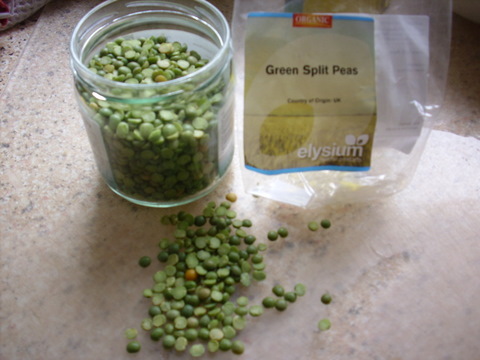
Green split peas dried

Today I decided to explore the forgotten corners of the kitchen cupboard.

That’s where I found the dried peas. Cinderellas of the store cupboard, they scrub up well when you take them to the ball. Feeling like a fairy godmother, I whisked them away from their dreary existence.

I rattled them into a pan, then added water and a peeled whole onion pierced with a few dried cloves. (Respect and credit to Rose Elliot’s The Bean Book).

That in itself (with salt and black pepper to taste) will make a fine pea soup in twenty minutes.

But I was an experimental mood so I continued my expedition in the Land of Cupboard.

Peering into unlabelled jars, I unearthed more treasures. Into the soup went a palmful of buckwheat, the same of puy lentils and (I thought this rather masterful) ground almonds.

The result was a lovable, luxurious yet light and comforting soup.

What’s in your cupboard?

Real bread

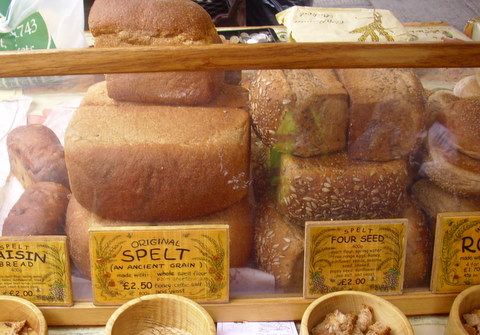
Spelt bread stall

I live in several places at the moment and today it’s Bristol’s turn. Hello city, I say, saluting its stone buildings, built to impress. I am at its medieval trading centre and, time travellers, Corn Street is still buzzing centuries later.

Every Wednesday, Bristol’s farmers’ market takes over the historic street and here’s the glorious thing: its stalls are bursting with real food bounty.

I buy fresh halibut from David Felce, the fishmonger (see mini pic below). I won’t talk about fish right now. (Except to say I pan fried the halibut gently for five minutes in olive oil. I usually use butter so that was an experiment. Served it with purple sprouting broccoli. Yup, it was good, she says smacking her lips after dinner. Simple and seasonal.)

The god of convenience has blessed me. My local Bristol farmers’ market also hosts the best bread in the world.

The Common Loaf Bakery uses spelt and rye, flours that have not been hybridised out of their natural existence like wheat has.

I bought a four-seeded (sesame, linseed, sunflower and poppy) spelt loaf and a spelt fruit bread laden with figs, prunes and raisins soaked in sherry, plus hazelnuts, dates, cloves and nutmeg. Not to mention the Celtic sea salt.

Hand crafted artisan bread. It doesn’t get more real than that. (I love those Christians with Hebrew names who make the bread, and keep the price down by living as one family. Respect.)

While in Pie Minister, Bristol’s pie shop, I pick up a copy of Fork.

Promising “no celebrity chefs,” its strap line says: the real food magazine.

Sounds just down my street…

David Felce, the fishmonger, sleeves rolled up, with fish stall

Guilty food secret

When I said I hate tomatoes – and mentioned tomato-substitute, Nomato – I got a comment that made me feel like a ketchup bottle getting a shake.

My commentator, Neil Basil (I keep wanting to call him Captain Vegan, but in a nice way) asked: “Why cook a pretend tomato for someone who doesn’t like tomatoes?”

He’s right. In addition, what place does pretend food have when real food is at stake?

I myself am rather snobby about food technology concoctions such as vegetarian mince and – dare I say it? – vegan cheese.

But stop. Before I cast out someone else’s mote, I should pull out mine own beam.

It’s time to confess: I am addicted to a factory-made milk substitute, soya milk. I prefer it to milk which I find too animal-y in a cup of tea.

I feel I cannot justify my love of organic soya (and oat and nut) milks because they are highly processed and come in Tetrapak cartons that are hard to recycle – although not impossible.

One day when I am living in my dream eco-cottage I will make my own soya milk.