Category Archives: food

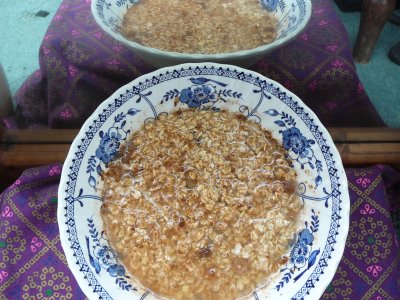
Raw oats soaking

Oats with sultanas soaking in a cereal bowl in fron of a mirror


If you find it hard to eat first thing in the morning (as I often do) try this for breakfast. Cover a cupful of oats with water (preferably overnight but an hour is better than none).

Soaking in water makes oats extra-smooth and digestible because the proteins get broken down. You will hardly notice the soaked oats slide down your gullet yet they pack a nutritional punch.

Oats are full of fibre so good for a regular system. Fibre (as the name suggests) is the steady and reliable sort which also slows down the release of sugars into your bloodstream. No drama with oats. In fact they are a mood-soother. We all need loved ones like that.

To the soaking oats, I add sultanas. The water well-plumps them up. I sprinkle cinammon for its immune-boosting properties and sweet taste.

Make all the ingredients organic or biodynamic and you will be laughing all the way to the vitamin bank.

Nettle soup

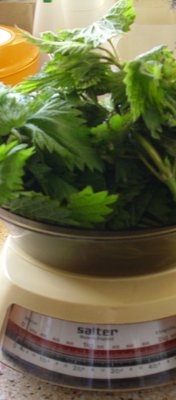
Nettles piled on scales

On the first day of spring I resolved to pick wild nettles for soup. I’d read about it often enough.

Luckily I was with Chloë who pointed out we had just passed a clump of nettles. I can understand why I have never made made soup from them before. They were indistinguishable from the rest of the greenery – until I felt the familiar sting from pinching their fresh tops.

Wearing gloves, I filled a small plastic bag. Back home (see pic) I weighed the young nettles. My yield? Four ounces. Not bad for a first wild harvest

I melted organic butter (2oz) in a pan, and gently fried an organically-grown onion, sliced thinly.

Most recipes use boiled potatoes to thicken the soup, or flour. I chose protein-rich ground almonds (2oz). And why not some cooked chickpeas too?

I took the nettle tops I had washed (discarding any brown ones) to the onions softening in butter. I turned the mass of nettles over in the pan with a wooden spoon. As the green leaves touched the bottom of the pan, they felt the heat and wilted.

I added this nettle mixture to a bigger pan holding half a pint of salted water (for stock) with aforementioned almonds and chick peas, crushed .

I simmered the nettle soup for a few minutes (most of the other recipes said 10 – too long). Then, using the noisy hand-held liquidiser, I vroomed my way through the chickpeas and nettles, so they became more creamy.

The soup needed contrast so I fried sunflower seeds in a little oil, and they crisped up nicely. (Seeds whack-up a dish’s nutritional value. The next best thing to fresh, because, given the right condition (water/light), seeds can sprout new life.)

The nettles tasted amazing as if they had captured water in their strong cells and were bursting with lushness. This was wild food. It tasted different. Enlivening.

Birthday lunch at Bordeaux Quay

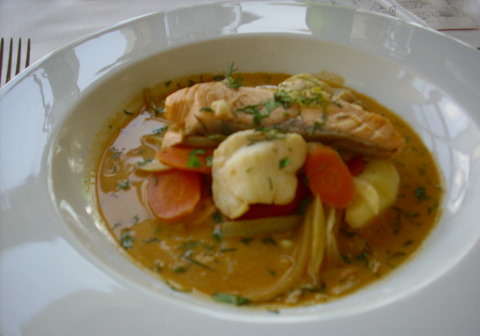
Bowl of fish soup, elegant and simple

My mother’s birthday so we booked a table at Bordeaux Quay. Downstairs is the buzzy brasserie for everyday (good honest dishes), but on this special occasion, we swept upstairs in a lordly way to the restaurant, overlooking Bristol’s waterfront.

We ate so well, and relaxed too. I started with Salade Paysanne, a tumble of leaves with tempting pieces of chicken and duck livers and crispy bacon (perhaps I do eat pork, after all). I ceased eating chicken livers in the 1980s when I realised most were polluted by toxins. Today was different because I could trust the meat came from happy and naturally-fed poultry.

Bordeaux Quay is not merely nodding at sustainable sourcing – its chef proprietor Barny Haughton is the real thing. He has been cooking with organic ingredients (first at Rocinantes, which then morphed into Quartier Vert) for over twenty years – and not even telling his diners because organic was considered too hippy at the time…

You can hear my interview with Barny here where I got to quiz him about his provenance. Barny’s family are organic dudes too, what with his brother, Phil (Better Food) and Liz (The Folk House). Yes, we are well served in Bristol thanks to the Haughtons – god bless their parents for producing such sustainably-minded offspring.

Like Barny, I received my food education at my mother’s knee for which I am eternally grateful.

Next I had cotriade (see pic), a fish stew from Brittany. The (organic) salmon and (line-caught) cod were steamed separately, and added to this dream of a cream crab sauce with sliced earthy carrots and aromatic tarragon and fennel.

My mother – who is the empress of Real Food Lovers – said the meal restored her faith in humankind. Look, when it comes to food, it is no mean feat to please my mother. I hope Barny realises this.

“It’s such a relief to know the ingredients are well-sourced,” I said.

“And you can tell,” said my sister, Geraldine. “It’s all so naturally flavoursome – not just a big plate of nothing.”

Geraldine had masterfully chosen the most marvellous wine, the 2004 Riesling, les Princes Abbés, from Domaines Schlumberger, that even had my daughter Maude raving about its “delicate” flavour.

My mother spoke of her grandmother (another foodie) who left her village, Slonim, in Bellarusse (a hop and a skip from Vilnius) in Czarist Russia, for the east end of London.

“You said she was a revolutionary?” I asked hopefully.

“Nonsense,” said my mum (pic below). “She became very observant and spiritual as she got older but, well, as a girl, she was an atheist and went to secret socialist meetings in Russia.”

“Ha,” I said triumphantly. “And you wonder how we all turned out Bolshie.”

The blog author’s mama at 80-ish, with red hair and stylish floppy hat

The drama of chili

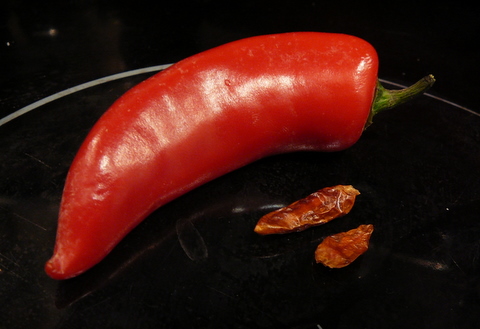
Fresh red chili looming over dried up dark red chili

The other day I blithely told you to use some chili. As if chili is easy-peasy.

Cooking with chili is always a drama. How hot will your dish be? It all depends on the behaviour of the fiery and unpredictable ones.

The big chili in the picture was fresh. I had never come across it before so I had no previous experience of its performance.

In contrast, the tiny dark red ones (see pic again) were dried, so easily available. They were my mates. Or were they?

Therein lies the drama. A half chili could make a dish. A whole one might ruin it. Friend or foe?

There’s the added uncertainty of how much food you are trying to flavour. Take dried chilis. One could be insignificant in a stew for seven.

But at least dried chilis are constant in their fashion. After a few times of using the wizened but easily-stored ones, you can control the spiciness of your dish.

How did tonight’s drama end?

The half of FRESH chili, sliced in a stir-fry (mushroom, onions and sprouted seeds) was pretty tame. Poor thing. It was a supermarket and non-organic chili so didn’t stand a chance. Bred and sprayed to look good rather than taste real.

As for the half of a DRIED chili (sliced thin), it was mighty hot in some mouthfuls of stir-fry. I tell you, those dried-up devils pack a punch.

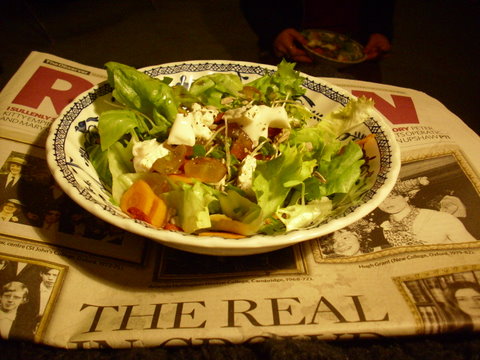
Goat’s cheese salad with grapes and goji berries

Bowl with salad and goat’s cheese and grapes

I was feeling a bit under the weather but this salad revived me.

Chloe (who by now knows I won’t touch a raw tomato, nor am enamoured of radish or spring onion) made me a Winkler-friendly version.

Extending her repertoire to cater for my fussiness, she found new ways to palate-please by adding sliced grapes and goji berries to Marshford‘s organic salad leaves and carrots.

The salty creaminess of the (organic) goat’s cheese with the sweet wetness of the grape with the earthy-tartness (oi, earth tart!) of the goji was indeed a felicitous mixture.

Maude (above) also approved (and is not a salad-lover like me).

I had consciously let go of kitchen-control, sat instead while others cooked (steamed turnips and baked fish followed the restorative salad).

My attempts at zen-like submission were rewarded.

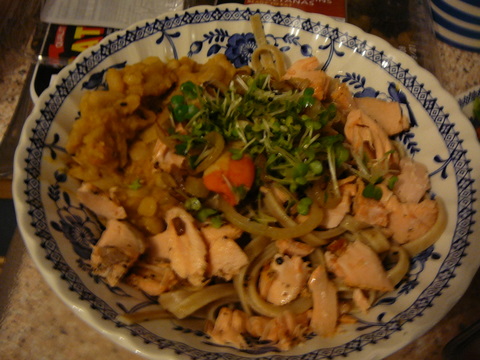
Kamut tagliatelle, salmon and scallops

Bowl of kamut pasta and salmon flakes and scallops and haricot bean casserole

The bean and pumpkin casserole put in another appearance the next day, nestling in nicely to this wheat-free pasta dish. Kamut is a beautiful grain and it makes a fine pasta. After cooking the kamut tagliatelle in boiling water for ten minutes and draining it, we flaked in cooked salmon and topped the bowl with scallops (fried for a few minutes in a pan) and mustard cress for greenness.

As for cooking the salmon cutlets, we did it Mike’s way (after a restrained and reasonably polite wrangle). He put the fish on a baking tray into a cold oven and then whacked up the oven’s heat very high. After about ten minutes, the first side was cooked, so he flipped over the salmon cutlets.

Beware. With the Mike method, the other side cooks very quickly (a few minutes) because by this time the oven is very hot indeed. So don’t get distracted.

The salmon was non-organic and farmed so I had to close my mind to the horrors of over-crowded fish dosed up on antibiotics. Organic salmon is better (though still contentious) and, for taste, nothing beats sustainably-caught wild.

(But the truth is salmon is overfished, a precious creature now factory-farmed. So, no. I cannot justify my purchase).

Both the salmon and the scallops came from the supermarket. This gives me no joy to tell you, either. I am of the view the less we buy from supermarkets, the better it is for the world.

Sometimes I do not follow my own principles and this was one of those times.

The meal was actually a feast, and it would have been disrespectful not to have enjoyed it. So I did.

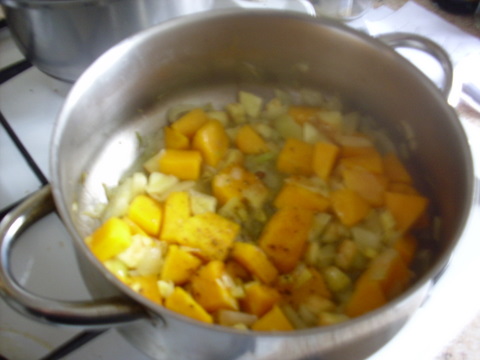
Haricot beans and pumpkin

A pan on stove with beans and cut up pumpkin and sweet potato

As a cook, I’d say my forte is ‘gunge’. OK, it’s never going to win a beauty contest but the concoction is reliable and balanced. What more do you want from a lifetime companion?

I had covered the dried organic haricots beans with water, soaking them overnight. The next day, I struck a light under their pan’s bottom and let the beans simmer away in bubbling hot water for a good hour and a half.

I fried a whole onion (sliced) in olive oil and added a dried chili, finely sliced. Wait. Chili is important. I did not discover it until mid-life. If it passed me by, could it have passed you by too? If so, I beg you to experiment with the fiery creature. Let me know how you get on.

I then attacked the half of a butternut pumpkin loitering in a forgotten corner of the fridge and after peeling and de-seeding it, then cutting it in cubes, I hurled it into the frying onions. After that, I felt calmer. After adding more olive oil, I let it slowly braise with the onions (with Neil Basilo’s tips for unctuousness ringing in my ears), stirring it occasionally to stop the mixture sticking.

Typically, I then lost my focus and did something else. Not good for a dish. It feels neglected and doesn’t give its all. Realising the pumpkin had gone too soft, I quickly peeled, cubed and boiled a sweet potato in another pan. This flirtation with another veg produced fresh bright orangeness (although I felt a bit disloyal to the overcooked pumpkin). Then I assembled them all with the drained beans (see above).

When the time came to serve, I heated it all up again extremely hot with brown rice from the night before (always blast cooked-again food with bug-obliterating heat).

Having morphed into a kind of risotto and topped with some fresh organic leaves, the dish didn’t look half bad (see below) and tasted even better.

Voilà – a classic gunge. Everyday fare. Might not get a fanfare. But treats you fair.

Rice with pumkins and beans in a bowl topped with green leaves

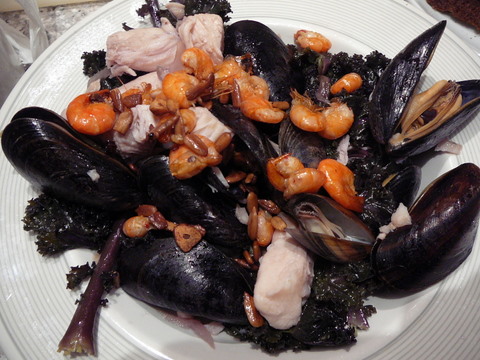
Fish soup with mussels and chilli prawns

Fish soup in a bowl with mussels sticking out and tiny prawns

I am an ungrateful girlfriend. Here was Mike slaving at the stove and here was me finding fault: the kale was too big, and (listen to this bitterness) he never praised my cooking as much as he did his own.

He was raving about this dish (above) and I was jealous. He reassured me that a) he saw it as ‘our’ dish (especially as I had sourced the ingredients) and b) he was particularly chuffed because in the past this would have taken him all day to cook, what with making a fish stock from the bones.

And we (I feel I can say ‘we’ now) had rustled it up in half-an-hour.

Let me recap. One onion fried in olive oil, plus half a mug of water. Added snippets of smoked haddock for salty taste, and monkfish cheeks, in chunks. Then the purple kale.

I was detailed to remove the shells from the shrimps (but not obsessively – I was amazed by what Mike said I could leave on, and the remaining shells cooked up well-crispy). I fried the little creatures in a pan (see below) with sliced dried chili and two sliced cloves of garlic in olive oil.

I reflected how cooking makes the raw and free fall under our dominion. What power.

Mike added the scrubbed mussels (shells tightly closed) to the fish soup and kale.

Nigel Slater, who inspired this dish, says the mussels add more flavour at this point than the rest of the fish put together. I agree.

The shrimps fried with chili and garlic added another layer of gutsiness with the shells’ crispy crunchiness adding a spicy ‘wow’ to the final bowl (See top pic – the broth must have lingered at the bottom of the bowl because not visible in pic but most definitely there).

To Mike, Nigel, the mussels, shrimps, haddock and monkfish, a big thank you for one of the tastiest finger-slurping fish soup experiences of my existence.

Shrimps frying in pan

Help with mussels

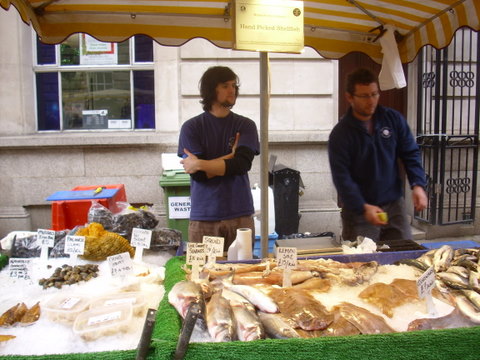
Shellfish stall at farmers’ market

I felt at sea (pardon pun) with the mussels, purchased earlier that day from the Handpicked Shellfish Company at Bristol farmers’ market (see pic, taken a few weeks ago).

10pm on Wednesday and we had not eaten supper. Luckily Mike took over. He was brought up by the sea so knows his fish.

He scrubbed the kilo of mussels (sounds a lot but their shells are heavy) under the tap with a brush, taking off any grey crusty barnacles.

Preparing fresh mussels is hardcore. They are (hopefully) alive when you buy them because a dead one is not fresh and could give you food poisoning. Scary.

When a mussel is dead, its tightly-closed shell opens. So, if when cleaning them, you find one open, you must chuck it. Mike only had to throw one away, which out of a whole kilo, is a testament of freshness.

Top recap. If it is open (before cooking), the mussel could poison you. Bad.

However, when you cook the mussels, the hot steam of your bubbling broth kills them. So the shells open. That’s Good. (Means the mussels are ready to eat).

Listen up, this is complex. If mussel’s shell remains tightly-closed, after cooking, that’s Bad. Means the mussel was unfresh before you started. Throw it away.

(I begun to see why the elders back in the desert said no to mussels.)

I wanted to sweat tinned anchovies (rinsed of the oil they were stored in) just like Nigel Slater told me about last Sunday. But I had none, so I fried an onion in olive oil instead and added half a mug water, slowly.

We now had a bit of bouillon going. Mike popped in some smoked haddock for salty flavouring and the monkfish cheeks, cut in chunky pieces. A firm fish, it keep that firmness when simmered in a stew or soup.

Then Mike added the organic purple kale from Better Food. At this moment I felt the pang of my lesser status, as commis to his chef. Could we not cut up the kale up a bit? I asked, looking with dismay at the large leaves in the pan.

The trouble with accepting help is you lose control. I had lost the right to muscle in on the mussels.

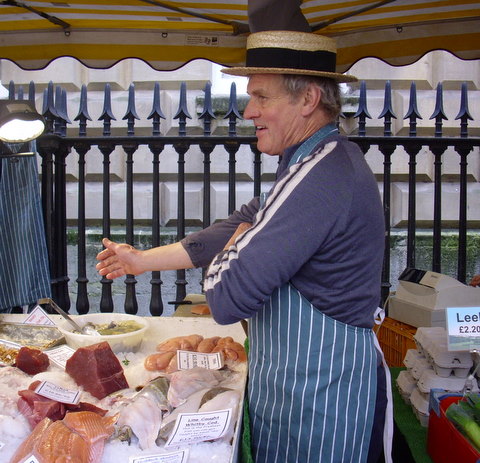
Two fishmongers

David Felce, fishmonger, at his stall, in profile

A fishmonger is like a hairdresser – a gal is only meant to have one at a time. Bristol Farmers’ market is blessed with two wet fish stalls, each in sight of the other. This makes any pretense of exclusivity hard to maintain.

On Wednesday my mission was to buy the ingredients for a fish soup, including mussels. This meant a visit to both fishmongers.

I went first to David Felce‘s (see above). I bought raw monkfish cheeks (enough for one and a half people) and smoked haddock (two fillets) smoked by the fishmonger himself.

Feeling disloyal to David, I sidled over to the Handpicked Shellfish Company. Outside a gale threatened, so both stalls were huddled in the same area, even closer together than usual. (The above pic was taken the week before when David’s stall was outside, as normal).

I am new to buying shellfish – it is not in my tribal background. In fact the old testament decrees no. Listen, why should that stop me? I bought mussels (1kg) and 100g of (cooked) prawns.

The mussels are well scary. They can cause food poisoning if they not fresh. So, you have to buy fresh ones, alive. Why did I take on this dish (because Nigel Slater inspired me last Sunday)? Read on.