Category Archives: food

Spinach soup thickened with couscous

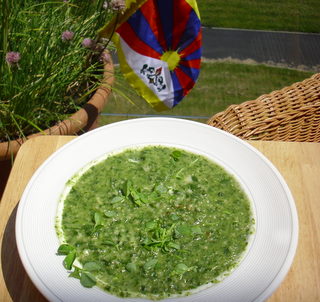
Spinach soup

I would be useless in a post-peak oil world. What would I do without my electric blender?

My teeth are troubling me so I made this spinach soup soothing with the help of the handheld machine. Its on-grid whirls fashioned the soup into a luxury item.

Here’s how I got there. The washed organic spinach leaves, stalks and all, went in a large pan. Spinach cooks in the water it is washed in (no need to add more) but do put a lid on to retain that moisture.

Once the spinach was cooked soft and waterless (drain to make sure), I added butter and immune-boosting garlic to frazzle in the meltedness.

But how to thicken it? I could have used flour but what is life without risk? So for the first time I sprinkled a smattering of couscous (I used organic kamut) to thicken a soup. I let it cook for a while then added a mugful of water, slowly, stirring all the time.

Reader, it worked. The couscous made it creamy.

Encouraged, I snipped in organic sprouted snow peas as a garnish.

The organic produce came from Bristol’s organic supermarket, Better Food, which is well-pleased, I imagine, with Sunday’s announcement as a finalist in the Observer Ethical Awards 2008.

Fluttering in the background is the Tibetan flag. Apparently it is illegal to fly in its home country, so it’s getting a workout on my balcony.

Chicken goes far

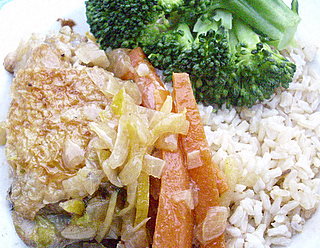
Chicken with carrots, broccoli and brown rice

Isn’t it a treat to be fed? I am always filled with gratitude when someone else cooks. Praise be to Paul for the aromatic chicken he served last night to my sister and me.

The surprise ingredient was the lemon peel which Paul added (after searing the chicken), with the chicken stock, parsley and celery. The peel (and juice) was fresh and tangy, while chilli added an undernote of fiery bite.

My sister and I much admired Paul’s precision and patience for he cut both lemon peel and carrots into long rectangle matchsticks, julienne-style.

We ate in the garden, sitting long after June’s hot sun had faded.

My sister quoted her colleague, Jess, who says: “It’s less rude to say you are a vegetarian than ask whether the meat was happy or battery.”

Paul’s chick was free range, from Sainsbury’s.

I was fascinated by the price issue. Paul had originally wanted four chicken breasts but the cost was not much different from two whole chickens (about £6.50 each).

From two chickens he made the following: teriyaki chicken breasts for four (one breast each); chicken noodle soup from both carcasses; two fried wings for salad; our aromatic chicken (two legs and two thighs). And he still had two legs, two thighs and two wings left over.

But are people put off by butchering a carcass, I pondered? We agreed you need a good pair of scissors and a sharp knife (plus no squeamishness).

Paul was recycling his newspapers and I grabbed the Guardian‘s June 4 supplement before it went to paper-pulp heaven.

Appropriately, G2 (how I love the supplements more than the news) had a review by witty Zoe Williams about the just-released, The Kitchen Revolution.

It’s is all about saving money by not letting the food you buy waste away at the back of your fridge. It is about eating well and saving food miles by cooking from scratch.

In other words it is about reversing the horrors of a junk food culture to return to everything real food lovers care about passionately.

Viva la revoluzione!

Food waste? Bless compost

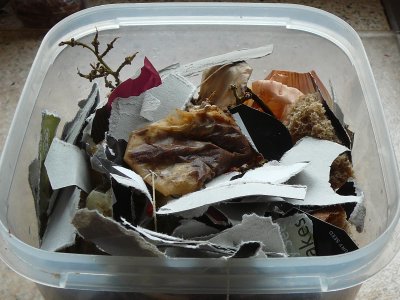
Food waste becoming compost

I admit the contents of the plastic box (above) – with its stalks, stale bread, peelings, torn-up cardboard (more later) and discarded tea bag – is not a pretty sight.

But don’t be deceived by its appearance. The present detritus of our kitchens is the future fertiliser of our food.

Sensitive souls often feel guilty about wasting food. Guys, your instinct is correct – those scraps are meant to be put to good use.

When my eco-friend Chris showed me how to compost, my life changed. Instead of throwing old food in the landfill, I became a guilt-free fertiliser queen.

Compost is a basic principle of organic farming, and hence a friend of real food. It replenishes the soil with an amazing array of nutrients – for free.

(Chemical fertiliser is not a patch on the real thing. Plus its production is oil-guzzling, polluting and greenhouse-gas causing).

You start the composting process by collecting kitchen scraps (including cooked food). Then you need to find a covered bin (preferably outdoors) where the waste can compost down in peace.

Anything which lived can be composted. The smaller it is, the quicker it breaks down so it can go from waste to ‘black-gold’ in nine months.

I added cardboard (which used to be a tree) for dryness, and tore it up, making it easier for the worms and bugs to munch it down in the garden compost bin.

What if you have no garden? Check out the Bokashi system for indoor or balcony composting (see mine below). Brave people keep wormeries in their kitchen. The waste-turned-to-crumbly-soil or fertiliser juice (yum) can be added to plant pots or a friend’s garden.

If indoor composting does not appeal, scour your vicinity – any outdoor space to be pressed into service?

What stands in your way to happy composting? Let’s break it down…

Bokashi compost bin

Tamarind and green tea noodles

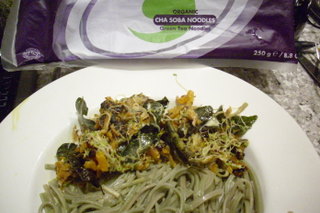
Green tea noodles and tamarind stir fry

Cooking is like dancing – to keep it fresh you need to learn new steps.

Thanks to Mallika’s Quick Indian Cooking, I have added curry leaves and tamarind to my repertoire.

I had to improvise with the other ingredients.

Tonight was cold and misty so instead of eating grated organic carrots as a salad, I fried them in olive oil. In this bold mood, I also fried organic alfafa sprouts, the first time ever.

At the carrot stage, I also fried ten dried curry leaves, which wilted aromatically – not scary at all. Then mustard seeds and a teaspoon of tamarind paste.

I could not resist adding a quarter of a tin of coconut milk and snippets of dried chilli for spicy creaminess.

I finished off a packet of organic cha sob green tea noodles that had been lurking in my store cupboard – they only took three minutes to cook.

It was a quick supper to make and delightful to eat, while the tamarind emparted a tart lemony-lusciousness – my new exciting dance step, definitely.

Brown rice, chives – and chewing

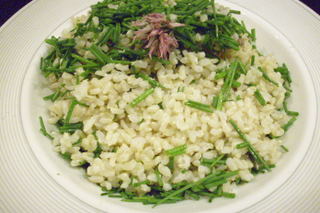
Brown rice and chives

When all else fails nothing beats a bowl of brown rice. It is a soothing superfood. With its husk still intact, brown rice brings strength – more vitamins and fibre than its denuded sister, white rice.

My brown rice is organic – what’s the point of eating a superfood if sprayed with chemicals?

I added chopped chives (and its mauve flower), olive oil and a tiny smattering of Atlantic salt to the cooked rice.

Organic brown rice a store cupboard-must because it’s nutritious, economical and sits there Buddha-like till needed.

It requires little attention while cooking. One mug of rice does for two, generously. Add to a pan with twice the amount of water (2 mugs of water for one of brown rice) and bring to the boil. Simmer for 30-40 minutes with the lid on. Brown rice is soft and chewy when cooked.

The macrobiotics swear by brown rice and so do I. It’s so yang, it relaxes the digestion and detoxifies.

If you really want to be macrobiotic, you stay in the moment while eating it. Spiritual warriors aim for 50 chews a mouthful to calm their mind and their digestion.

I can manage about four mouthfuls of conscious chewing before my natural impatience takes over.

How many chews do you give a mouthful?

Nettles in Amsterdam

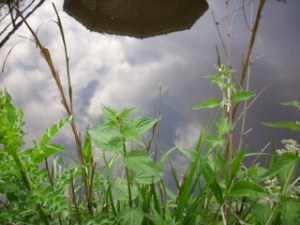
Nettles opposite bandstand

I nibbled on these nettles in Amsterdam, a week ago. Nettle-picking tip: pick the leaf, grasping only its outside and fold into a parcel, stings safely within. The top leaves were not stingy at all.

Appropriately, this was Be Nice to Nettles week (14-25 May), which aims to change our perception of nettles from an inconvenient weed to the healing nutritious herb it is.

What a strange world we live in, where nettles are not valued and other weeds with beneficial effects also get a bad press.

The nettles in question faced Vondle Park’s bandstand. You can glimpse its reflection in the picture above. (Don’t you just love an empty bandstand? Although abandonned, it promises spectacle).

Next to the bandstand is the Blue Treehouse, a cafe serving dishes such as fish pasta salad. Spaceship-like, it’s on two circular levels, surrounded by the leafy trees of May. A dj played grooves until it got dark.

We snacked a lot in Amsterdam, grazing from foodie delicatessens, or fuelling up with falafel or chips with mayonnaise, after dancing at the Bourbon Street jazz club or Cafe de Hortjes.

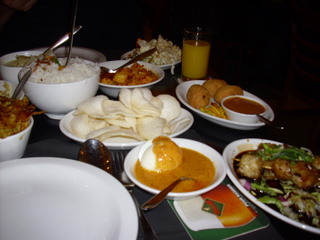
Twice we had an Indonesian rijsttafel, a Dutch-colonial rice feast with many dishes and most fiery.

Restaurant Kantjil & de Tijger (Spuistraat 291) was the one for me (see left below). I loved the use of tofu in the vegetarian variety. My big discovery was seroendeng, finely-shredded toasted coconut, a condiment I must have – now.

We travelled by rail and sail with Stenaline. Amazingly reasonable, it was £150 for two, including Liverpool Street-Amsterdam trains and a dinky cabin for one North Sea crossing.

We stayed on the Amstel Botel, moored excitingly right next to the Greenpeace boat (see below). This is on redeveloped docks with a free municipal ferry (carrying city-folk and their bikes) to the train station.

To paraphrase Eloise, oooooh I absolutely love Amsterdam.

Rice dishGreenpeace ship mooredAmstel botelBlogger in Amsterdam

Life is a beach – then you die

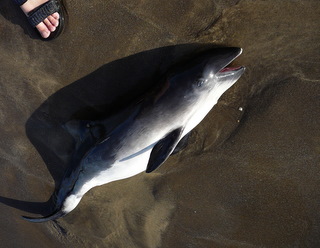
Porpoise washed-up on north Devon beach

This baby porpoise was washed up on the beach at Westward Ho! on Friday.

One by one, people gathered, in consternation.

It was a rare sight, and, unusually early for baby porpoises (let alone dead ones).

The female passers-by were especially concerned, touched by the infant’s fate. I had a feeling of (unspoken) support passing from woman-to-woman: it is ok to feel concerned and want to do something about it.

So one of the women rung the Royal Society for the Prevention of Cruelty to Animals and the police, to report the sighting. Then she gently pulled the porpoise to the dry rocks.

I could not help wondering if you could eat it.

Everyone wandered off and a lad in chef’s trousers appeared and crouched beside the porpoise. It was like a dream – the very person I needed to discuss the eating-merits of the beach-version of road-kill.

The young chef did not think it right to eat it but he did say (when I asked him) that porpoise might taste like tuna.

(He also said it was the third dead baby porpoise he’d seen this week, which was unusual and worrying. He thought they’d been caught in the huge nets beyond Lundy island, and discarded back to the sea, victims of unsustainable fishing.)

When the woman who had rung the RSPCA and the police returned, I tried to share my excitement of having a cheffy conversation just when I needed one.

She was shocked by my talk of eating the poor creature.

I felt I’d lost any compassion-points I’d previously gained. (Me and my big mouth. Literally.).

I had intended my foodie-interest in a respectful ceremonial hunter-gatherer sort-of-way. In my ignorance, if not my defence, I thought it was a fish. Now I know a porpoise is a mammal.

Plus, the unusually-early porpoise sighting had triggered apocalyptic-angst: what will we eat when the oil runs out?

I felt the baby porpoise needed honouring so suggested encircling it with stones. This would both give it protection until the police arrived, and a kind of ritual.

A pair of female walkers had now joined us, and one of them gave me confidence to carry out this concept.

“Good idea,” she said. “Do it!”

(I believe women sometimes need extra support to do female-centric acts in a world designed by men).

Thus encouraged, I set to work collecting stones. The other women, including the one whom I’d inadvertently shocked, joined in.

Mike then wrote in the sand: “Please do not touch. Police notified.”

(I observed he did not need to negotiate but just did it).

But the message interrupted the stones. Under my breath, I said: “I want to close the circle.”

The female walker overheard me. Again she encouraged me to follow my intuition. “Yes, close the circle,” she said.

When it was finished, I said: “Good team work.”

As she left, the woman who’d rung the RSPCA and the police called over her shoulder at me:

“Don’t eat it!”

Porpoise on beach

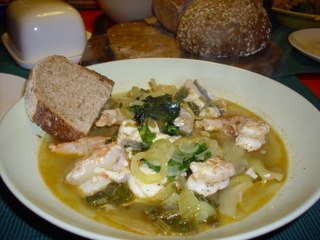
Soup with Fishworks fish

Soup with Fishworks fish

We bought fish at the Fishworks stall at the Real food festival to cook at my friend S’s that evening.

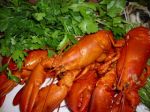
We asked for a piece of monkfish (from our shores) and nine wild prawns (from Australia). The Fishworks stall was piled high with fresh fish and shellfish (see lobsters in the pic at the end of this blog) looking fabulously fresh and real.

Back at S’s, we slithered the prawns’ coats from them, putting their shells in a pot with water to cover and some tastes like salt, parsley and the feathery bits of a fennel.

We simmered it for half-an-hour to make a speedy fish stock, which we strained through a sieve.

We discarded the shells (after a discussion about whether we could compost them).

Meanwhile I sliced fennel and leeks with my small sharp magic knife also from the Real food festival. An impulse buy I won’t regret. It cost £10 and has ergonomic holes making it cut most efficiently.

We sweated the veg in olive oil and added it to the strained fish stock.

Then we plopped in the monkfish cut in fat chunks (which performs well under pressure and doesn’t go all flaky) followed by the naked prawns. We also wilted spinach bought at the wondrous Green Lanes which has shops (even a barber) open at night, just like I like my shops.

We served the soup with organic sourdough bread from Judges Bakery (also forraged from the Real food festival).

In half-an-hour we had produced a soup to make S go mnnnn. I was so happy to cook for my dear friend and say thank you for giving us sanctuary in the capital city.

Lobsters and parsley on the Fishworks stall 24/4/08

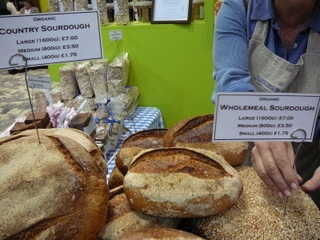
Judges Bakery – real bread

Judges bread stall

I had a glamorous moment at the Real food festival when I bought bread at the same time as Trudi Styler. She has an organic farm and had just taken part in the festival panel with Zac Goldsmith, of the Ecologist, who also chanced by.

So there I was checking out Craig’s organic bread at Judges stall and suddenly I was surrounded by celebrities.

I’ll do the goss then get on to the bread.

Judges is owned by Craig Sams and Josephine Fairley. Their relationship gave birth to Green & Black’s chocolate – it’s a great story, soon published.

Before marrying Josephine (a top editor), Craig made healthy eating accessible. You could buy wholefood peanut butter in the supermarket in the 1980s thanks to his company, Whole Earth.

My gratitude goes back to 1968. I was a teenage Londoner who went to Seed, Craig and his brother‘s macrobiotic restaurant in a Paddington basement.

Later, (and living communally) I could buy brown rice from their organic and wholefood shop, Ceres, in Notting Hill Gate.

Later again (now with a child in 1978), I would buy the most delicious health-giving bread ever from the Sams’ bakery.

That brings me to the present. The Sams’ bread today is just as bread should be. Real, substantial, and tempting.

No wonder it has flavour and texture. Judges’ organic loaves rise slowly overnight before being baked.

(Most commercial bread is whipped into a frenzy with air and additives).

Slow dough breads are easier on the digestion too. During the slow rising, enzymes have a chance to start breaking the bread down.

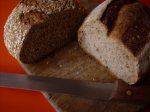
The pic below is of two Judges’ loaves from the Real food festival at my friend’s breakfast table.

It reminds me how at home I felt there. (We go back to the 1970s too.)

Bread

Fay’s pavlova and the Real food festival

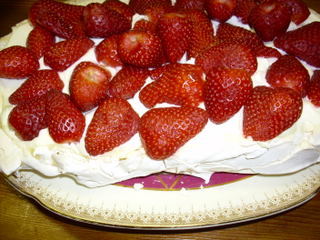
Fay\'s pavlova

Fay’s pavlova is legendary. How does she get the meringue so light on the inside yet crispy on the outside?

Piled high with strawberries (out-of-season but hey, only g-d is perfect), imbedded in whipped organic double cream, the delectable concoction is hard to resist.

Fay and I both rely on the late Evelyn Rose’s recipe for a perfect pavlova. It’s worth buying her book just for that, although (I promise), you will find a ton of other indispensable recipes there too.

Whip four egg whites to stiff peaks, then fold in double the amounts of caster sugar (that makes eight ounces. Sorry, I am so unmetric when it comes to cooking although I am trying, I really am). Fay uses half of white caster sugar and the other half golden caster sugar.

The secret Evelyn Rose ingredient is one teaspoon of vinegar (plus one teaspoon of vanilla). The vinegar seems to ensure that crispy outside and unsticky inside although I am not sure how it works scientifically.

Then spread the mixture on a greased baking sheet and bake in a low oven for two hours.

Being such a purist, my mum (for that is who Fay is) is no freezer-cook but she does (to my surprise) freeze egg whites.

I want to take my mum to the Real food festival on Thursday 24 April as she so appreciates fine raw ingredients.

“You can’t make a silk purse out of a sow’s ear,” she says. You have to buy the best (be it organic, free-range, fresh, seasonal, local and/or artisan) to make a good meal, she says.

If the ingredients are good, no need for complicated recipes (as her mother said before her).

Ingredients, ingredients, ingredients. The only three words you need to know when it comes to cooking.