Category Archives: food

FSA wastes my money on rubbish organic research

Preparing for pesticide application.
Image via Wikipedia

The UK government food watchdog, the Food Standards Agency, has published a new report on organic food.

“Let’s stop this tomfoolery once-and-for-all about organic food being better for you,” seems to be the subtext.

In its attempts to convince us we are wrong to trust our senses (including common sense and sense of taste), the Food Standards Agency has had to undertake some mind-bending contortions. See for yourself – the actual report is here.

The Food Standards Agency (FSA) claims to have conducted an exhaustive review of all the literature comparing organic and non-organic produce in the last 50 years.

Its review of 162 studies seems rather meagre compared to the Soil Association‘s 2001 review by Shane Heaton of over 400 studies.

Perhaps the FSA managed to keep its numbers low by omitting studies. It conveniently left out:

  • studies on contaminants such as pesticide residues (see pic)
  • studies examining the environmental benefits of organic farming
  • results of a major European Union-funded study involving 31 research and university institutes and the publication of more than 100 scientific papers earlier this year.

Professor Carlo Leifert, who conducted the above EU-study, which found organic milk is way-much better for you than non-organic milk, remarked:

“With these literature reviews you can influence the outcome by the way that you select the papers that you use for your meta-analysis…My feeling – and quite a lot of people think this – is that this is probably the study that delivers what the FSA wanted as an outcome.”

The FSA could find only eleven studies that fitted its meta-criteria.

Hello?

I am no scientist, but since when was eleven a big-enough sample to draw conclusions?

The fact is we need more research on the nutritional differences.

But I don’t want my tax spent on a biased analysis.

The FSA has a reputation for being hysterically anti-organic and pro-GM.

This report is making me think its rep is live and kickin’ again.

Addendum 19 September 2009

Reblog this post [with Zemanta]My understanding of this report continues to grow.
Let me share my findings: the FSA report DID show higher levels of key nutrients in organic food in some of the data.
The London School of Hygiene and Tropical Medicine carried out the survey (goodness knows why)
rejected the findings because the samples did not meet its criteria.
If you add the samples together, the results would show organic food does have more nutrients.
Crikey – complicated, eh?
It’s the deceptions and obfuscations which make things hard to understand.
I always say: the truth is simple.

Slipped disc – natural healing

annotated diagram of preconditions for Anterio...

Image via Wikipedia

I am interrupting this food blog to share some useful information: natural healing methods for a slipped disc.

In 2006, I had a slipped disc and although surgery looked on the cards, I recovered naturally. Later, when I was better, I was told by my consultant physiotherapist, that “90% recover naturally”. Wish someone had told me that before.

Today in 2018: This has proved one of my popular blog posts. Although I have had no recurrence, I continue to care for my back daily with the tips below to alleviate pain and promote healing. I also add to the tips as time goes on.

Tips for natural healing of slipped disc

  • Find a healer who believes nature heals and whom you trust. Try several until you find the one who suits you and your condition.
  • The trick is to break the pain/tension/inflammation cycle by relaxing tense muscles and lessening pressure on the nerves. Breathe as if in labour to relax: out through the mouth, in through the nose. Relaxation relieves pain.
  • Immerse in a warm bath with Epsom Salts for at least 15 minutes – the heat will help relaxation. “Epsom salt is absorbed through the skin and will help replenish magnesium stores,” says Dr. Northrup on US Epsom Salt Council.
  • Let gravity be your ally.  Lie down in the Alexander Technique’s semi-supine position (spine flat, knees bent, feet flat and head slightly raised on a pillow) at regular intervals. This position allows the spine to elongate and relax.
  • Stay mobile. Walk, swim or dance. Practice gentle yoga, Pilates or T’ai chi. Avoid positions that increase discomfort such as sitting down on a chair.
  • Before even considering surgery, look at your footwear. I could write a thesis on the tragedy of women’s shoes which only for care for looks – not comfort. The holy grail is a stylish shoe that also supports arches and ankles. I recommend FitFlops – sign up with an email address for regular offers on less popular designs (I got great ankle boots for £30). AS FitFlop has got more successful, it has added a bewildering amount of styles. So make sure the style fits your width – for my slightly wide feet, I choose Microwobbleboard or Anatomicush.
  • How is your bed? Again, before even contemplating surgery, sort out your resting place. I would rather (and I have done) sleep on the floor than on a too soft or unsupporting mattress.
  • Use heat. My best friend was an electric heat-pad (like a mini-electric blanket) for the small of my back when lying down in the semi-supine position.
  • Drink water regularly to plump up those discs.
  • Eat foods with anti-inflammatory ingredients such as turmeric – add turmeric root or ground turmeric to savoury dishes. Or try the Ayurvedic recipe, Golden Milk, a comforting drink of heated milk with turmeric with black pepper which increases the bio-availability of turmeric‘s active ingredient, curcumin. If using plant milk, instead of cow’s milk, add coconut oil – the fat in oil or milk also boosts the bio-availability of curcumin.
  • Use a ginger compress to soften and relax the traumatised tissues. T’ai chi master and massager, Pete Glenn, insisted I use it daily and he was right. This traditional Chinese remedy sounds so simple – but it works. Try it for back or neck pain and be amazed by its effectiveness!

Ginger poultice

1 oz ground ginger simmered for 20 minutes in 1 pint of water.

Let the sludge cool slightly and immerse a flannel. Squeeze out the flannel and apply to the affected part of your spine. Either repeat at regular intervals OR do lazy version: cover the flannel with a plastic bag to contain the drips and wrap the whole lot with a long scarf or towel to keep it in place.

Ginger is hot to eat and aids digestion because it dilates the blood vessels – applied externally it has a similar, and penetrative, effect.

Long after the flannel has cooled down, you will feel the WARMTH of the ginger, doing its zingy thing.

If you do nothing, make and apply a ginger poultice, put on some calming music and lie down in the semi-supine position – now!

Reblog this post [with Zemanta]

Good intentions at Buddhafield

Bahji seller, Buddhafield

Buddhafield Festival boasted fast food: the best onion bhajis I have ever tasted.

Nutritious – made with gram (chick pea) flour, spices of fennel, ajwain and mustard seed, and – here is the miracle – ungreasy. Generous and sustaining, only £1.

The maker was Fish, another fascinating character; makes shamanic drums from deer skin.

Here was another fast food staple from the cafe near the Dance Tent.

Soup with momo dumpling

Stuffed with chunks of fresh vegetables including sweet potato and leeks, with olives for taste and butter beans for protein, and for an extra £1 a beautiful delicate stuffed Tibetan dumpling called a momo, bringing this princely dish to £5.

There was a fire outside the cafe. On the Friday night, I had a good chat with a lovely young woman from Sheffield.

The next night we bumped into each other again. One thing led to another until she said:

She said: “You remind me of someone  know – you have similar energy….Moira”

What? My mate from Somerset who moved to Wales.

Then it all fell into place. Her parents had come to my ante natal classes over 20 years ago. “Omigod!” I said, “I knew you as a baby!” and I could remember her baby dark eyebrows and eyes there in her young woman’s face.

I take issue with that old saying: “The path to Hell is paved with good intentions”

The organisers of Buddhafield set good intentions for the festival. And much good manifested, I am sure, as a result.

Setting an intention can guide you like a compass.

On day one of the festival, a kind stranger lent us his spare sleeping bag.

When we could not find him to return it, I randomly asked his ex-tent’s neighbour:

“You don’t need a sleeping bag, do you?”

“I have not got one! Thank you!” he said.

May that sleeping bag go on to give night-warmth to whomsoever shall needeth it.

MSG-free food leads to love

Pacific island soup

It rained on Buddhafield festival but I was dry and warm in the Lost Horizons travelling cafe.

My kitchen fairy-duties: cut courgettes at slivered angles, trim broccoli from woody stalks, grate organic ginger (unpeeled) and lemon zest for Pacific Island soup, above.

Brought up in New Zealand, Richard the chef was inspired by his feminist mother leaving most of the cooking to his stepfather.

As I prepped, I learnt. Here for me to remember (and to share) are Richard’s tips:

  • Cleaning a rusty wok: heat dry wok till rust pops, add a little water then heat till it evaporates. Dry wok. Add two palmfuls of salt, heat, then wipe away the dirty salt with its abrasive and oxydising action. Next, add salt and water, and heat till it has nearly evaporated. This time the salt is clean and can stay, adding flavour to your dish.
  • Cooking kidney beans: soak for a minimum of 16 hours then cook until beans dissolve like mash potato. A monocotyledon such as corn added to the cooking increases the kidney bean’s protein-availability. “In Bogota in Columbia,” said Tim, a fellow Lost Horizons cook, “we cooked kidney beans with plantain into a mush and served it with ground coriander.”
  • Monosodium Glutamate (MSG), as we know, is the nicotine of food. Addictive and a health-risk (banned from the start from EU organic standards), it bypasses the taste buds straight to the brain. Richard added a new idea: MSG destroys the part of the brain that makes us compassionate.

No MSG at Buddhafield Festival. So we could go around being kind and hug-gy.

Lunch was ready.

Lost Horizons lunchtime

Gwennie, the Washing-up Angel, is in the foreground (There  some discussion about the differing job descriptions between angels and kitchen fairies…)

I ate my well-earned soup listening to the open, engaging Janna Goodwille.

Janna Goodwille

Janna Goodwille (her real name) sang memorable songs with riveting lyrics. Her new album used sustainable waterless printing for its cover, and was recorded at the UK’s first solar-powered studio.

Pacific Island soup ingredients:

Onion + water + Thai red curry paste or Thai spices if available + dried seaweed + seasonal veg (cook what is hardest and biggest like carrot-chunks with slivered courgette last of all) + grated ginger + lemon zest + noodles.

Richard also sawed a coconut in half and chunked out bits for the soup.

All for £5 with fresh organic salad and bread. And leaves compassion-brain-cells intact.

Lunch board, Lost Horizons

Reblog this post [with Zemanta]

Kitchen fairy at Lost Horizons

backstage at Lost Horizons with yogurt

I went to Buddhafield festival and became a kitchen fairy.

I was sitting in a Bedouin tent, as one does, listening to Martha Tilston on stage at Lost Horizons, the legendary travelling café and wood-burning (mostly naked) sauna.

I heard a cry above the music:

“Can someone stir the milk? In exchange for a chai.

Can someone stir the milk?”

“I can stir the milk,” I said.

In the field kitchen, backstage at Lost Horizons, a wooden spoon in hand, I stirred a cauldron of milk coming to the boil.

A dramatic creature with blonde curls, tight trousers and a rocker’s face appeared.

“Turn it off when it comes to the boil. Do you know when it’s cool enough to add the yogurt?” he asked.

“You say Hare krishna hare krishna krishna krishna hare hare hare rama hare rama rama rama hare hare,” he said at such speed and with such authentic inflections that I did not recognise it.

He turned out to be the legendary and talented artiste, Prana, from the Bindoo Babas.

But I got the gist, and the yogurt got made ready to set

albeit with Nyam myo renge kyo a chant I do remember.

I also did loads of washing up.

The combination of working outdoors as the rain bounced off the canvas and being part of a crew gave me unusual washing-up energy.

My reward was a bowl of spicy hearty aduki bean soup with mostly organic ingredients cooked by Richard, the chef.

Richard, Lost Horizons kitchen chef

“Aduki and mung beans are the only ones that don’t need soaking,” he said.

I noticed a chalkboard sign calling for kitchen fairies.

I arranged to come back the next day.

Reblog this post [with Zemanta]

Harvest supper with Grofun

Grofun - 12.7.09

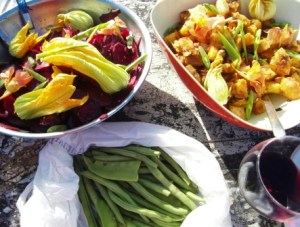
Sunday 6pm. Everything in the picture was grown on our community allotment: the beetroot, turned into slivered (use a potato peeler) salad, and the spiced Mumbai potatoes, both decorated with courgette flowers, and the green beans in their bag – all on the table in the evening sun, waiting to be eaten.

We have GROFUN, Growing Real Organic Food in Urban Neighbourhoods, to thank for this miracle.

Nadia Hillman, GROFUN’s 33 year-old Bristol-based founder, was on BBC’s Gardening World at Easter helping Birmingham set up a similar scheme.

Is your garden overgrown? Would you like help getting it fit to grow organic vegetables?

GROFUN volunteers pitch in and in return for their impressive labour they get reciprocal gardening-help either in their own garden or at the community allotment in St Werburgh’s, Bristol.

We are learning how to grow. And everyone involved gets invited to the harvest meals.

“The best thing for me is the connecting of people” says Nadia.

We sat around the fire into the evening. Mel played a haunting song on the guitar.

It sounds a moment of peace. And it was.

Better health at Better Food

Better health campaign launch

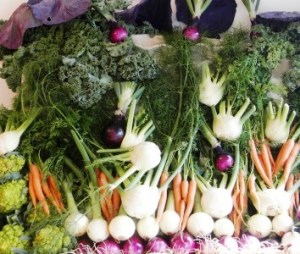
The vegetables in the picture were organically grown by my local supermarket in a field at Chew Magna, seven miles outside Bristol.

They were on display on a table in the Better Food company‘s shop for its launch last Thursday of a three-month education campaign for Better Health.

Health begins with healthy soil as we organicists know. Phil Haughton, owner and grower put it well: “Without soil we don’t exist and good soil produces abundance like this.”

Then he introduced the two speakers, nutritionist Jamie Richards, who is the shop’s health supplement guru, and Alex Kirchin from Viridian, the ethical vitamins company with a Soil Association organic range.

I tool copious notes. Jamie’s campaign aims to offer ideas for lifestyle changes that are cheap, simple, safe, effective – and proven.

The smallest changes often make the biggest difference.

Here are some of my favourites from Jamie:

  • Make sure at least half your plateful is non-starchy veg (i.e. not potatoes)
  • All carbs to be complex such as brown rice
  • Eat oily foods such as nuts, seeds, fish
  • And breathe.

Alex Kirchin reminded us to take care of ourselves and used the analogy of putting on the oxygen mask in a plane before helping anyone else.

My favourite Viridian tip concerned Vitamin C.

When animals are stressed they manufacture extra Vitamin C.

However we are one of the few species who do not make Vitamin C at all.

That’s why we have to eat a lot of fresh fruit and vegetables.

I have a guilty secret: I don’t think I get enough immune-boosting Vitamin C in my diet.

So at the first hint of swollen glands, I take 1,000mg a day and have seen off many a cold or sore throat. In fact I believe Vitamin C could more useful than Tamiflu in beating swine flu.

Anyone else with a secret supplement habit?

Reblog this post [with Zemanta]

My mother’s tongue

My mother' tongue

My mother heaved the 2-pound tongue onto the serving dish and I offered to skin it.

I eat mainly vegetarian food but I skinned that tongue like a pro, feeling elemental and respectful like a hunter.

My mother foraged for it in Waitrose. The label bore two marks: UK and EU.

My mother went to the customer service desk to check its provenance.

“Cured in Bedford,” said the assistant, “so it must be British.”

“But where did the animal come from?” said my mother.

He checked with the buyer who sent word the animal was UK-bred.

“So why the EU label? It’s still a mystery,” said Ingrid Rose when my mother told us the story as we ate.

My mother said she used to pickle tongue with saltpetre. Now it’s hard to find.

Pickling salt beef and tongue are traditional ways to preserve meat. No refrigeration in the shtetl.

My mother’s tongue – a childhood memory.

My mother talked about the cooking of the 2lb tongue (for £8, 8 servings).

She disagreed with the label’s instructions: to throw away the water after bringing the tongue to the boil seemed a terrible waste, she said.

She and Evelyn Rose are of one mind: wash the tongue well in cold water – there is no need for waste.

Cooking salted/pickled/cured tongue: water to cover + garlic + 1 onion skinned and cut in half + peppercorns + bay leaves. Simmer and cover for 2 hours and 30 minutes. Then drain and skin.

The potato pie: mashed potatoes + 1 tablespoon of goose fat (“My mother used chicken fat,” says my mother) + 2 eggs + salt and pepper plus my mother’s latest addition: chives.

Back to the meat.

What do you want to preserve?

Reblog this post [with Zemanta]

The Organic Food Festival 2009

Lido couscous cropped again

We met last night to discuss the Organic Food Festival 12-13 September 2009 in association with the Soil Association.

First my starter (above) which made me think: my favourite dishes are mush-tastic. I eat lots of grains and pulses, and, let’s face it, they blob.

Please don’t reject my love because of their apparent lack of finesse.

Nourishing, healthy and economical, grains and pulses lend themselves to many tastes.

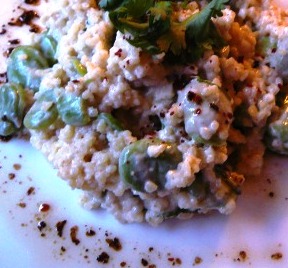
I ate the above starter (£6.50) last night at the Lido (saved and restored to its Victorian-swimming-baths-original thanks to a community campaign).

Couscous with yogurt, fresh broad beans and coriander – delicious, soothing.

Even when eating out I am drawn to mushy grains.

But why be ashamed? Eating for substance is the organic way.

“We are about inner quality, not outer appearance – that is our hallmark.”

So said Patrick Holden, Soil Association director, recently quoted in the Independent apropos the abolition of those wonky EU-rules on wonky veg.

Which brings us back to the Organic Food Festival.

Last night’s dinner was the inauguration of two things:

1) I was in my new role as food editor of The Source.

2) The Source is helping produce the programme for the Organic Food Festival 2009. And that’s what we doing, round a table at the Lido.

Every September, Bristol Harbourside transforms into Europe’s largest organic market place. The Soil Association organic festival used to be free but became so popular it got rammed so, there has been a charge. This year £1 of the £5 entry fee goes to the Soil Association.

My message?

Join us!

The Organic Food Festival in Bristol Harbourside on 12 – 13 September 2009

Taste the future

Organic is more than a product

– it is our sustainable future.

Slow food and fast dancing

Son Tropical

I love these guys. A nine-piece band, fresh from Havana and en route for the Barbican, London, brought to Bristol last night thanks to Bristol Slow Food.

The venue was Jesters on the Cheltenham Road. Tickets were £10 and the Cuban-style dishes, devised and prepared by Chris Wicks of Bell’s Diner were about £8.50.

Mike and I had the shrimps and avocado.

There was no mention of organic even though Cuba is the great organic inspiration. Following the collapse of the Soviet Union and no more cheap pesticides and chemical fertilisers, Cuba went organic. Many public spaces in Havana are now given over to growing organic veg. ie State-supported agriculture without fossil fuels. Don’t you love it? Just shows it can be done.

The shrimps were plump, grilled and well-tasty and the fresh pea shoots (part of the salad dressed with lemon juice) looked enchanting and tasted earthy. I have never eaten pea tendrils before – and why not? They are delicious.

The dish was the size of a generous starter but actually perfect because I needed to be light on my feet to dance.

I forgot to take a picture of my plate but I got several pictures of the band.

It was so groovy because these guys in the band were middle-aged (i.e. about my age) and older.

And they rocked.

If I wanted to nitpick about the evening, I’d say Jesters could have sold twice as many drinks with more bar staff. My sister said you needed to apply in triplicate for a Cuban cocktail – but when it came, she said: It was worth it.

They could have sold twice the food too.

But I don’t think Bristol Slow Food knew how rammed the event would get. Apparently they only confirmed Son Tropical two weeks ago. And then bookings went ballistic.

Which shows that great music and dancing may be the missing ingredient to Slow Food.

Reblog this post [with Zemanta]