Category Archives: food

My night in Bristol’s rebel restaurant

Ra-ta-ta-tat on the big red door.

Entry into the wood panelled hall of Quay House.

Once Bristol’s customs house, now disused offices, the Quay House is squatted on behalf of Cloak and Dinner, Bristol’s rebel restaurant.

Seems criminal that such a place lies empty.

Good on the squatters, for invoking Section 6 and making such creative use of it.

For four nights, Quay house is host to what the Guardian calls the hottest ticket in town.

I pass the candlelit lounge where guests will be served gin and tonic.

Up another flight, past the red-curtained dining area, also wood panelled and candle-lit, where the diners will be served a four-course meal with vegan and vegetarian options.

Up the next flight to the brightly lit kitchen milling with volunteer helpers, which reduces to a core team of about seven, myself included.

An anarchist kitchen is the opposite of a  Gordon Ramsay one.

Amidst cries of “Table 7 just finished their starters” and “four vegetarian mains”, the kitchen is calm.

No one is throwing their weight around or shouting.

Anarchists believe – as do I – that human nature is basically cooperative.

And cooperate we did.
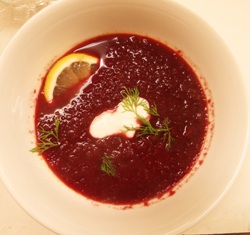
“Best borscht soup I’ve ever tasted,”  says a customer at the end of the night, the dreadlocked waiter reports.

Eve had made a soffrito of celery, onions, leeks – added grated beetroot and water to simmer. Blended when cooked. With Cabernet Sauvignon vinegar, grated lemon zest and sugar to taste. Indeed the best.

For starters: pillows of filo pastry filled with mashed pumpkin, carrots, wilted rocket and walnuts, served with Caerphilly cut from a truckle of cheese.

Steam rising on bean stew served on a cabbage leaf on top of potato mash flavoured with mustard seeds.
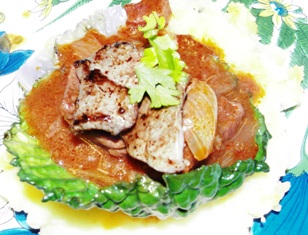
The venison comes from Fair Game in Nailsea. The young farmer shot the deer, skinned and butchered it last week. Chef Christopher cooked it with sloe gin and the bones until aromatically tender. “The venison was superb,” says another guest who visits the kitchen to praise.
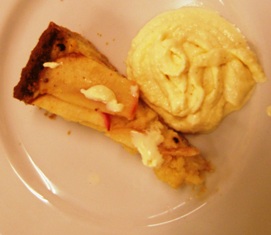
Canterbury pie about to be plated. The recipe for sweetened pastry comes courtesy of Irish chef, Richard Corrigan, while apple puree topped with thin apple slices is from classic cook, Mary Berry. The vanilla ice-cream is homemade, by Eve.

The vegan option at the open window.

I make the pies, following Sarah’s  instructions, based on the available ingredients. No scales, just guess work. My sort of cooking.

Crush biscuits in a bag, mix with melted Pure organic marge (just enough to moisten crumbs). Press into a plate. Mash bananas with ground almonds and cinnamon. Drizzle melted dark chocolate, add hazel and walnuts and drizzle more chocolate. That’s it.
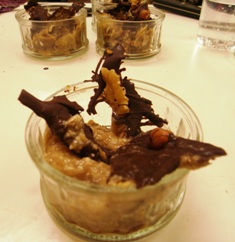
The banana mixture was too slurpy to cut cleanly so it became a concoction in a ramekin with chocolate and nut lattice broken to sit on top.

The washer upper working with grace all evening, backbone of the operation.

Darren, Saturday’s chef, sweeping the floor in readiness for his shift the next night.
His day job, The Kensington Arms, lent the linen for the rebel restaurant.

“Some people like vegging out in front of the TV. But something like this brings people together,” he says.
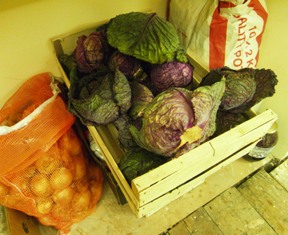
Cabbage in crates. Darren considers how to use them for his chef-shift.
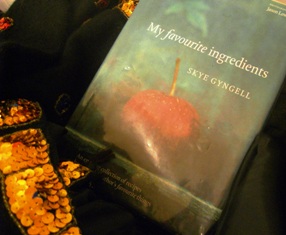

Skye Gyngell’s cookery book, My favourite ingredients, amongst the coats.


Art by Libby in the lounge where gin and tonic is served as the punters arrive.
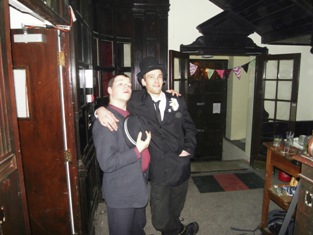
Happy customers.

“Most restaurants have no soul,” says a guest. He and his girlfriend heard about the rebel restaurant through Facebook. The 50+ covers a night got booked up as soon as word got out.

Each chef has £75 a night to conjure with, money made from a previous project, topped up with food donations from local food businesses.

People paid what they could afford. Last night we made £800 – to go towards the next project.

Everyone gives their time freely. I end the night with a heart full of love.

Bristol’s rebel restaurant

Here I am posing outside the premises for tonight’s rebel restaurant.

Here’s what the Guardian thought after dining there on Wednesday.

The anarchist collective has squatted this fine historic building (shocking it lies normally empty, eh?) and, working for free, has turned it into a mysterious restaurant.

The idea is to create an autonomous space – free space unmediated by landlords or employers.

It’s also about eating locally and seasonally – for donations of what you can afford.

Too late to dine, I am afraid – the 50 covers for each of the four nights of the restaurant’s ephemeral existence were booked a week ago, as soon as word got out.

The tables are laid, Cloak and Dinner‘s chefs and waiting staff with maitre d’ are at the ready.

I am crewing tonight for the chef and her team.

To report back!

Food 2030 – spin not substance


Venue magazine asked me for my view on Food 2030 for its Feb 3 issue. That got me thinking:

The government’s food strategy for the next 20 years sounded like good news.

“Britain must grow more sustainable food,” went the Guardian headline as farming minister, Hilary Benn, launched Food 2030 at the Oxford Farming Conference.

Hilary was using all the right words: climate change, food security, homegrown food.

Hilary even included this rallying call:

“People power can help bring about a revolution in the way food is produced and sold.”

That sentence could have come straight from the planet-friendly Soil Association. Hold on a minute. I think it did. I remember writing something similar when I was editor of the organic charity’s magazine, Living Earth.

So, has the government finally got the green message?

Look, I hate to be cynical but there is an election coming up.

The fact is – and you might as well know sooner than later – New Labour (and Conservatives when in power) are as wedded to the dominant global food system as ever.

Food 2030 pretends to be open-minded about GM but I am not convinced.

According to Hilary Benn’s performance at the Soil Association 2008 conference, the minister does not inspire confidence.

(Watch out for Hilary at the Soil Association conference in February).

So Hilary tries to reassure us that the government is on the case because it is spending £90m over the next five years “to fund innovative technological research and development” with the Biotechnology and Biological Sciences Research Council.

Sounds like quick-fix technology to me – good for corporate finances but not for us mere mortals.

You can bet that not-much of that £90m will go on researching already-existing healthy farming models such as organic farming or permaculture.

Food 2030 pretends to be looking for solutions but instead dumps the burden on consumers and farmers.

(Reminds me of that ghastly government advert on climate change where the little kid sees a picture of a puppy dying in the rising tide. O, so kids must feel guilty while the government carries on with business-as-usual? No, minister, that is not what I would call positive action against climate change).

Back to Food 2030 and Hilary’s big push against food waste. Yes, we waste food but hold on a minute. Why focus on what we citizens keep rotting in our fridge when supermarkets throw away far more food than we do?

And as for telling farmers to produce more local food when – hello? – council farms are being sold off.

Benn’s only vaguely substantial idea was to be more honest about labelling meat’s country of origin.

But then that was a Tory idea anyway.

So, sorry – not impressed.

Are you?

_______________________________________________________________

Stop press (added 03.05.2010): The Soil Association has produced a report investigating the big fat lie that the UK needs to double food production by 2050.

Making marmalade


Marmalade lovers, if you have only ever eaten shop-bought marmalade, you MUST try making homemade marmalade at least once in your life.

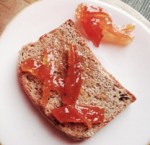
Last Sunday at 7.30pm, I committed myself to an evening of marmalade making so I could enjoy real marmalade on toast (above).

Ingredients and cost

4lbs (1.80kg) Seville oranges

I bought 1.975g  of organic Seville oranges for £5.89 at Better Food organic supermarket

4lbs (1.80kg) granulated sugar

I bought the non-organic kind at Scoopaway – 1.990g white sugar @ 1.29kg = £2.57

Sugar

Sugar is cheap compared to the fruit because it is so heavily subsidised. As a commodity, its future gets gambled on and prices look set to rise.

Would much prefer organic vegetables to be subsidised, rather than sugar.

I weighed out 4 lbs (1.8kg) granulated sugar into a pan, now warming in a low oven.

Warming the sugar makes it easier to melt into the fruit.

Softening oranges

I scrubbed the oranges and removed the stalks on each one.

They are now in a preserving pan with 4 pints of boiling water.

I have found a baking tray to cover the pan. The pan hisses.

Katie Stewart says it takes 1.5 hours to soften the oranges.

Katie (whom I once met when she won a Guild of Food Writers Lifetime Achievement Award) says 3lbs of fruit, 6lbs of sugar and 5 pints of water. In my bid for less sugar, I have experimented over the years and now use equal sugar to fruit.

Christabel who works at Better Food suggested adding orange blossom water for extra orange zing.

Haiti

Very aware of Haiti. Grateful for my life where I can calmly make marmalade. A fellow food blogger, Sabrina Ghayour is organising a Food Lovers fundraiser for Haiti. Please support this event with donations and helping promote it.

Pectin

9.30pm. I have cut the softened oranges in half and scooped out pith and pips with a teaspoon. Pith and pips (repeat-very-fast) are boiling for 10 minutes in 1 extra pint of water to extract the pectin. Pectin is crucial for helping the jam to set.

After 10 minutes of vigorous boiling, I strain the pith and pips. This takes ages as I can only get a small amount in my small strainer. The pectin-filled water goes into the preserving pan with the cut-up peel and the warmed sugar. I add the juice of two lemons.  And its flesh for good luck.

If you don’t have a preserving pan, use your biggest pan or divide amounts into two pans. You need to boil sugar-fruit-water super-vigorously for 15-30 minutes without worrying about it boiling over the sides.

Making up for lost water

The lid on the softening oranges was makeshift and inadequate, and I am paying the price: I lost precious pints in steam. I ended up (after adding strained pith-and-pips water) with 1.5pts in total. I have boldly added an extra 2pts making it up water total to 3.5 pints.

PS A few days later: And it worked! Marmalade as delicious ever.

Boiling fast to set

10.30pm. I have added the sugar to the cut-up peel and water

For some reason Jeanette Winterson is in my head. I am thinking about her organic shop in East London and wondering if she is as driven to write now she has her shop. But perhaps she arrived in my mind because Oranges Are Not The Only Fruit.

11.20pm. The marmalade has been fast-boiling for 20 minutes.

I draw it off the heat to test for a set because if you over-boil, it can lose its setting point. Who says cooking is boring? It is full of drama.

Earlier I put two plates in the freezer. I will now drip some hot jam on its cold surface and wait a few minutes. If the cooling jam crinkles when I push it with my finger – then success, it has set.

Then finally – after the second lot of 15 mins of fast boiling, that tell-tale crinkling. Joy.

The marmalade cooled while I set up a Facebook page for Foodlovers Fundraiser for Haiti, a small thing that I could do to help this cause.

12.45am. And here are my 8 pots of marmalade.

It was a palaver but it was worth it.

What do you think?

Butternut squash and spinach lasagne

Snowed-in.  Good excuse to make Butternut and spinach lasagne.

Christmas has had me confused: am I vegan or carnivore?  This light vegetably vegetarian dish is a compromise.

And..it does NOT require a white sauce!

As I had been planning to make the dish for a week, I had the main ingredients:

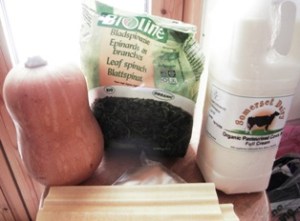
In my pic, lined up for their photoshoot, from left to right:

1 organic butternut squash, 1 packet of frozen organic spinach, 1 organic milk and 3 sheets of lasagne pasta. You need mozzarella for topping.

I got the recipe from a free promotional recipe booklet from Olive Magazine two years ago (when I had advised Hardeep Singh Kholi on going organic).

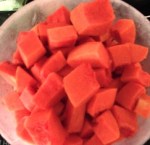
Here is the beautiful butternut squash cut in half.

I used the whole squash for the recipe and produced just over the 500g required.

I cut the squash into manageable pieces with a small sharp knife, peeled the skin using a potato peeler and scooped out the seeds.

Love the way the butternut squash is so orange.

You fry 1 onion in a large frying pan then add the 500g cut-up squash. I cut-them up smaller when I realised they had to fry.

The recipe said fry until tender and slightly brown round edges but I put the lid on – answered a few emails – and in 15 minutes it had gone very soft indeed, but not brown.

Then add 100 mls of milk (or plant milk, vegan-me).

The BEST things about this recipe are:

  • no need for a white sauce
  • 500g of squash and 150g of (frozen) spinach makes it LIGHT and vegetably.

So you cook the 3 lasagne sheets in boiling water for 3 minutes then drain.

Then layer: one sheet of pasta, followed by half of the cooked squash and half the warmed spinach.

Another sheet of lasagne pasta, then rest of squash and spinach.

Finish with the third lasagne sheet and tear a 125g ball of mozzarella over it.

(I used Buffalo Mozzarella from Laverstoke Farm, the organic farm ‘university’ owned and run by ex-racing car driver, Jody Scheckter. 20% off in Better Food organic supermarket just before New Year).

Put the dish under a heated grill until it bubbles and browns.

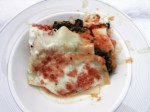
I photographed it against the snow.

No food-stylist, I! Look at the food splashes…not very stylish.

But definitely delicious.

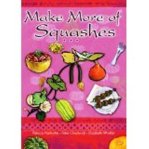
For more squash recipes, including recipes for carnivores and vegetarians, nutritional information and how to grow squash from seed, see the book I co-authored, Make More of Squash. Aad on the right of this post offers 20% discount…

Interested in reviewing a copy? Email me at elisabeth.winkler   AT yahoo.co.uk

Christmas 2009 – how was yours?

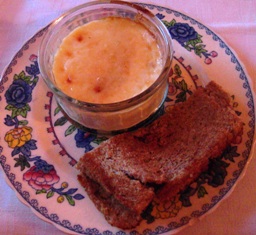
Christmas lunch. First course: parmesan custard with anchovy toast, recipe from Café Anglais, executed by my niece, Charlotte.

There was a time when my mother, Fay, good Jewish mother that she is, would insist on cooking every morsel of Christmas fare.

Finally we managed to persuade her we were old enough to take over.

Now we share the cooking.

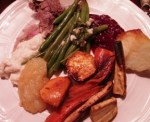
My sister, Geraldine, cooked the goose reared by wise animal welfare expert, Sheepdrove Organic Farm, which has a shop in Bristol.

From top left clockwise:  the goose, then green bean, cranberry sauce, roast potato, roast parsnips, roast carrots, roast sweet potato, apple sauce and bread sauce.

It sounds bloody grand and it was. A local Big Issue vendor ate nothing on Christmas day, he told me today.

Juliette, eldest niece, cooked all of vegetables including her own concoction, green beans with olive oil, lemon juice, garlic, mint and a little sugar.

I made the tiramisu. None of my books had a recipe but luckily I found Tiramisu Heaven.

Mine did not look like Tiramisu Heaven pic above.

Mine looked splodgy – see below.

Yet it was delicious, if both bread-puddingy and way-creamy. I used less sugar than recipe (3oz instead of 4oz/ 1/2 cup) and brioche instead of ladyfingers. Lots of strong coffee.

I made the tiramisu late-at-night and last-minute. After carefully separating eggs, I made fatal mistake and did to egg whites what should have been done to yolks.

My mum does not use eggs at all. How sensible is that? Just 8oz mascarpone +brandy +  coffee-soaked ladyfingers, sprinkling each creamy-layer with cocoa powder, and topping with rest of coffee-soaked cake.

Geraldine provided an extra treat: mince pies with homemade pastry.

She homemade the mincemeat too: you assemble the fruit and suet, and warm. “Dead simple,” says mincemeat-demystifier, Delia Smith.

This feast was manageable thanks to six of us cooking. I made my dish in advance while others cooked on Christmas day. So division of labour was not equal.

How did you manage Christmas?

Reblog this post [with Zemanta]

Jamie Oliver – good food in 15 minutes?


Ah, I like Jamie Oliver. I have interviewed him, and I do think he is the Real Thing.

So Jamie has won the 2010 TED prize. Of course it is a bit annoying when high-earning celebrities win $100,000 prizes – I can think of equally worthy but cash-starved causes.

On the other hand, the TED prize is prestigious, international and sends a powerful message:  healthy food for children matters.

Jamie says: “Good food can be made in 15 minutes.”

I like the principle but my mind has gone blank.

Thinks: omelette / ciabatta…? (But I don’t like wheat or too many eggs).

I am currently enamoured of casseroles:

Cooked brown rice or pearl barley in a casserole with (tinned/homecooked) haricot beans, sliced raw onions and cut-up-small raw squash. Add fiery seasoning such as chilli, and/or mango chutney (or any other chutney lingering, neglected, at back of fridge) and cook in the oven with lid on, gas mark 5 for 40 minutes.

That’s dead-quick and no last-minute cooking-stress before eating.

But 15 minutes, it ain’t.

What good food would you cook in 15 minutes?

Copenhagen 2009 – green book signing

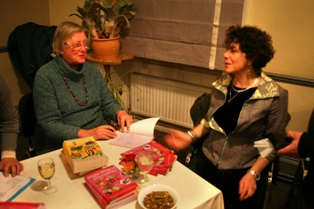
Book signing last Tuesday. Said a few words, quoting my mate Robin, quoting his mate, Tony Juniper:

Whatever happens at Copenhagen, it’s people’s cultural change that’s crucial.”

Cultural change: such as the way we eat food.

So blessed in Bristol with independent shops and local organic farmers.

We made food bought from Scoopaway, La Ruca, Saxon’s Farm at Bristol Farmers’ Market and Better Food organic supermarket.

The recipes are written by co-writer Patricia Harbottle who came to sign books.

I copied Pat’s choice of recipes from the book, which Pat had cooked for the Dorset launch.

Spicy pumpkin seeds roasted and crunchy in egg white masala.

Pea, leeks and courgette fritatta.

Hey, I now know the secret of making fritatta, thanks to Patricia’s recipe.

You finish cooking omelette and vegetables by placing under the grill.

 (Thank you, Lynne, for loan of fritatta pan that goes on the stove AND under a grill – otherwise leave your frying pan’s plastic handle sticking out away from the heat.).

And we also baked Courgette cake.

For 100 people. I repeat: a hundred.

Patricia was a top London caterer before she retired to Dorset. She helped me “scale up”.

I have decided not to be a caterer when I grow up as I had low-level fear of food poisoning and had to taste everything and not die first.

I am indebted to Ros and Charlotte for patient and relentless weighing, mixing, chopping, stirring and spreading. Not to mention style counsel.

And Chris Johnstone, author of Find Your Power, for inspired dulcimer-playing.

The best bit of the book signing was when people in the audience

spontaneously suggested ways to help Make More of Squash, and Make More of Beans & Peas go far and wide.

As well as giving nutritional info, the Make More of Vegetables series show you how to grow from seed and cook from scratch

– profound ways to create a healthy, vibrant, low-carbon, resource-saving green world

…because it’s no good waiting for our business-as-usual politicians to do so.

Stop press: I checked with Tony Juniper if it was OK to quote him. He replied:

Thanks Elisabeth. Of course I am delighted for you to quote these words. The only thing I might add is to flag up the 10:10 campaign, which seems like a logical reaction to what just happened in Denmark. I was there – it was truly shocking.”

Anjum’s Gujarati lamb curry

My children are carnivores so when they (now grown-up) visit, meat is a treat.

Cheaply produced meat means people can eat it every day as a cheap takeaway.

But eating meat daily is neither good for the health of the animals, consumers or planet.

Some people need to eat meat, while others argue our soils need  manure for soil-strength.

We just don’t need to be mass-producing meat on an industrial scale.

So it’s about trying to get a balance. There’s a spontaneous revival of the traditional way of eating:  have a feast of (well-reared) meat once a week and live on the leftovers.

Join the Feastarians, Weekend Carnivore or Paul McCartney on a Meat-free Monday.

Which leads me to this delicious lamb curry.

Quadrille Books had offered – on Twitter – a free copy of Anjum’s New Indian.

Canny New Media marketing device, eh? I like – and copied it for my own books!

So I contacted Quadrille on Twitter and the big beautiful hardback copy signed-by-Anjum arrived by post.

Its subtitle is Indian Food Made Easy.

Sadly, not easy enough for me. The ingredients list looked too long. The pages too big and glossy.

I felt daunted.

For simplified Indian dishes, I rate Quick Indian Cooking.

However after months of free-book-on-Twitter-guilt, I finally tackled a recipe.

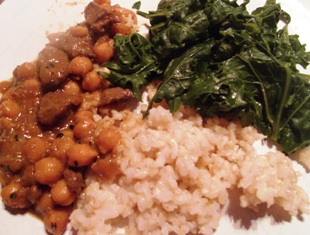
Gujarati lamb and dumpling stew – it was bloody delicious.

But I did simplify it. I left out the dumplings for a start.

Note: I substituted raw ginger for horseradish because Middle Child cannot stand ginger and takes it Very Personally if I cook with it.

Horseradish works incredibly well. Grate it raw, cover with white wine vinegar and it keeps in a jar in the fridge for 3-4 weeks.

Here’s my version: 

Ask the butcher for lamb for stewing – or mutton. Mutton is cheaper because it is  a grown-up animal. Stewing will soften the tough older meat of mutton.

Unlike pigs and poultry, it is harder to farm sheep intensively – sheep continue to roam freely and eat grass. So if you are going to eat non-organic meat, lamb is your best bet.  

I bought about 400g of organic lamb (about £4) which fed 4. I cut up the pieces quite small.

Then I browned the lamb pieces in a pan to seal the taste, then removed them.

Add a teaspoon of mustard seeds and when they pop, add the sliced onions and fry until brown.

My gratitude to Anjum grew – I don’t know what to do with mustard seeds and now I was using them like a pro.

Meanwhile, in a blender (I used the grinder attachment), make a paste of 20g of ginger – or raw grated horseradish – and 5 large peeled garlic.

This paste is a great discovery. I use it for spicy vegetarian dishes too.

Add the paste to the onions until it gently colours, about 3 minutes. Add salt to taste (I omitted the 1 tsp. of sugar), 1 Tbs of ground coriander and 1 Tbs of ground cumin; 1/2 tsp of turmeric and 1/2 tsp of chilli powder. Cook for 20 seconds.

Add about 100 ml water (I omitted the 3 pureed tomatoes) and cook gently until completely reduced, then fry the paste for 5 mins until the oil comes out.

These instructions were brill as I tend to overcook spices and not get the ratio of water-to-spices right (too watery or too dry). This worked! Thanks, Anjum.

I added a quarter of a block of coconut, not the recipe’s can of coconut milk. I also forgot the 1-2 tsp of lemon juice. I didn’t measure the water but Anjum said 200ml (for 600g of lamb).

I forgot the sweet potato but that would have been a wonderful addition.

I chose this recipe because of the chickpeas. I can’t eat a lot of meat – although I do love its rich gravy flavours – so I was happy to have meat-bits with my beloved chickpeas.

I had already soaked 200g of the raw chickpeas overnight and cooked them for an hour (or, as Anjum says, use a can).

I served it with organic curly kale and brown rice.

And it went down a treat with the carnivores.

Beetroot soup and a good deed gone wrong

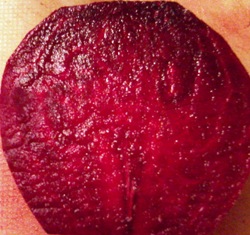
Last night’s cut raw organic beetroot.

Its insides look so mysterious.

I was making beetroot soup (again). Simplifying it.

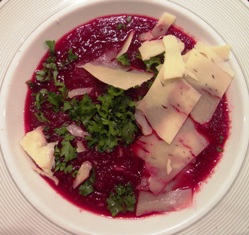
Cut up two large peeled/scrubbed organic beetroot and place in a large pan with two peeled onions, sliced. Cover with water and bring to the boil, then simmer with a lid for 30 minutes.

I blend with an electric hand blender, my favourite kitchen power tool.

Mine was £20 second-hand, or try Freecycle for a free one, or Just for the love of it for swops.

While blending the beets (bought from Better Food), I travelled back in time:

– to fifteen years ago, and I was trying to be helpful in someone else’s kitchen.

I was in charge of the chocolate mousse.

I poured it into the mixer and pressed the button to mix.

Mayem. Chocolate mousse on every kitchen surface in spattering distance.

I had forgotten to out the lid on the mixer.

So now I practice conscious blending.

Schadenfreude means the pleasure you get from someone’s else’s pain.

I wonder if there is a word to describe the ouch you feel when you end up

causing even more ouch to the very person you are trying to help?

Served with home-grown parsley, plant from St Werburgh’s City Farm, and Yeo Valley organic cheddar shavings.