Category Archives: eating well on a budget

Do we really need more meat?

We need to double food output by 2050.

Oh yeah?

Who says?

Monsanto and a few other agri-companies say so.

Not the most trusted sources, as far as I am concerned.

A far more trusted source, the organic charity, the Soil Association, believes that the message currently driving food-policy to “double food production by 2050” is based on a lie.

This call to double food production (convenient for agribiz) is based on a forecast that production of animal feed would need to increase by 70% in order to feed developing countries with the same fast-food junk that is making the west ill.

Apparently half the world’s crops are feeding animals not humans. This is nuts. Do we really need more meat?  If we ate less meat, we could use the crops to feed more humans.

The ideal organic vision is for a “closed” system – that is, where the animals are fed by crops grown on the farm, and in turn help fertilise the soil with their poo.

This is Simon Fairlie’s argument in his new book, Meat, which even persuaded George Monbiot that meat thus produced could be ethical.

A mixed farming system (crops+animals+poo all on the same farm) is completely different way of producing meat in factory farms – where the animals are treated as a commodities without sensibilities and their poo goes to waste (literally).

Carnivores – eat meat by all means – but in moderation (remember when we had chicken as a treat?) and from mixed organic farms.

I am at the launch of a new Soil Association report.

Peter Melchett, policy director, gives us the lowdown, starting with above context.

Feeding the animals that feed us is the first of several Soil Association reports on the future of farming including phosphate, water and oil.

Not promising answers – more starting a discussion.

Organic premium – who profits?

Why do we need organic food?

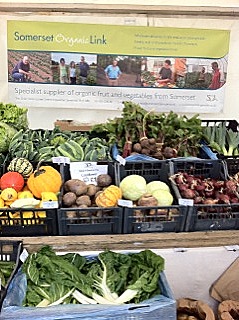
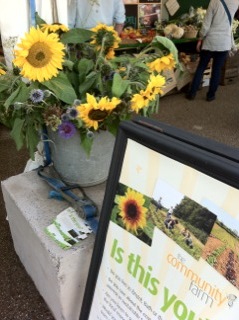
(As in the picture above of the beautiful stall from Somerset Organic Link, the farmers’ cooperative, at the Organic Food Festival last September).

What kind of topsy-turvy world do we live in that organic food has to be ring-fenced by regulations? Organic food should be the norm. It is food grown with chemicals that is the aberration!

NON-organic food should have to jump through all the hoops to be certified. Those that use the farm chemicals and potentially-harmful food additives should be paying extra in time and money to be regulated.

And people should pay more for the privilege: if industrial food factories had to pay for the damage they do – for instance polluting rivers and encouraging obesity – non-organic food would be very expensive indeed.

Instead it is organic food that attracts a “premium” (i.e. costs more).

Sometimes I wonder: Why? Who profits?

I include this letter from a farmer in the latest issue of Organic Farming which indicates that the profiteer is the supermarket.

“…If the Soil Association is serious [about challenging the public’s perception that organic is too expensive] it might do well to investigate the ongoing disparity between the supermarket shelf ‘premium’ and the ‘premium’ paid to farmers. Take lamb mince as an example: on 1 July 2010 Tesco was selling organic at £7.48/kg, compared to £5.74/kg for non-organic – that’s a difference of £1.74/kg or 23 per cent. Yet I am lucky to get a 5 per cent premium…..”

It’s annoying that eating organic often costs more (unless you are canny and take the extra effort to eat organic on a budget.)

It strikes me as grossly unfair that those of us who want to eat food – grown as nature intended – have to take more time, effort and money to do so.

What do you think?

Tesco on Stokes Croft halted

Will Tesco open on Stokes Croft?

No. Tesco does not have the planning permission it needs to open the 39th Tesco store in Bristol. (39th? O yes. Please see Tesco’s own store locator).

Here’s how:

Following the planning meeting on the 22 September, Tesco has to modify its shop front before Bristol City Council planning committee will give permission for it.

More significantly, the council did not approve Tesco’s application for “external works and installation of plant and machinery”.

The planning committee asked instead for a noise assessment.

Currently the plant Tesco would need to use to run the store would be far too noisy.

You may well ask why this was not done beforehand.

Our own campaigners managed to get an acoustic report done, included in its 37-page report (which by the way the planners advised the councillors not to read in depth as the planners insisted that all our points – including about noise and traffic – are “not material considerations” and thus irrelevant. Whaaaat?! I think we will find out in due course the planners got it very, very wrong. )

This comment from someone called Ruth at Bristol 247.com sums it up well:

“The planners gave very strict criteria for extra noise when they approved change of use for the site, and the plant Tesco want to install can’t meet it. It was concerns about this that caused councillors to delay the vote on this application. If the council doesn’t want to sign off on a breach of the condition it itself imposed less than a year ago (which would be an interesting thing to do from a legal standpoint, as some officials seem to be aware), the council can’t approve the application.”

What I would like to know: are increases of traffic also included as criteria for change-of-use?

Like all multi-nationals, Tesco exploits regulations.

O!  The wrongness of Tesco using a third party to apply for change-of-use, which hoodwinked the planning people into thinking they were giving permission for an ordinary shop.

From a traffic point-of-view there is a huge difference: an ordinary shop has to store its stock on-site, while Tesco delivers stock when needed.

Tesco’s six-a-day delivery lorries will create traffic problems on the Cheltenham Road, as Claire Milne points out.

But it is not just the food deliveries I object to: it is the Tesco marketing that promises cheapness that does not deliver and damages local communities instead.

Stokes Croft is an exciting up-and-coming area developing from the grass-roots up. People come from outside Bristol and different countries to admire its uniqueness. And this is just the beginning.

Stokes Croft is an asset to Bristol.

Let’s keep it that way.

Organic Food Festival 2010, Bristol

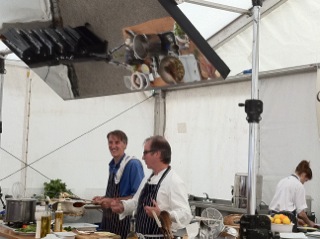
The Soil Association Organic Food Festival (see Demo kitchen above) now in its tenth year, lifts my spirits.

“79% of food we buy comes from just four shops,” says Real Food Festival’s Philip Lowery at the launch of Europe’s biggest organic food market.

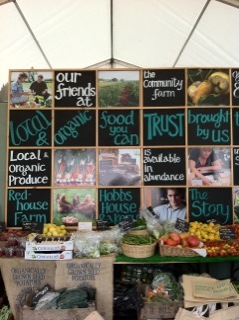
The Organic Food Festival showcases real food producers who cannot be shoehorned into the supermarket-system, with its gargantuan requirement for uniformity.

After a week objecting to a multi-billion-backed Tesco (39th store in Bristol) in Stokes Croft, this is just what I need to revive my flagging spirits.

Somerset Organic Link displays freshly-harvested vegetables grown in carbon-rich organic soil without polluting the land with nitrate fertiliser.

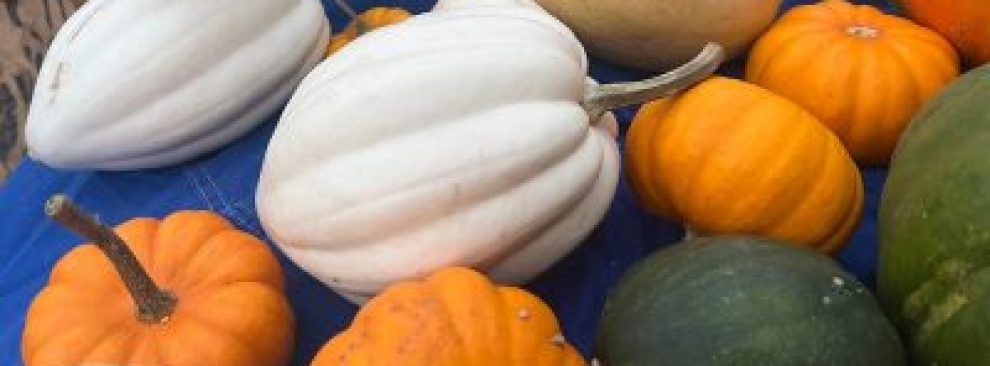
And a variety of pumpkins you won’t find in a supermarket.

Better Food Company (a 20 minutes walk from the proposed Tesco) has a field outside Bristol supplying the shop with much of its seasonal local organic produce.

Better Food’s Community Farm is open to all, including helping in return for a share of the harvest.

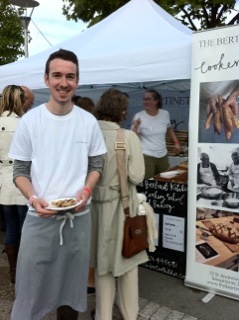
I buy a spelt loaf from the Bertinet Bakery based in Bath.

Bertinet Bakery were exhilarated having just been awarded a Soil Association Organic Food award for Baked Goods by Hugh Fearnley-Whittingstall at the awards ceremony held earlier that day in At-bristol.

The theme of this year’s Organic Fortnight is Choose Organic Everyday.

According to the latest Soil Association market report on the recession-hit 2009, 33% of organic purchases are now made by shoppers including manual and casual workers, students, pensioners and people on benefits.

In other words, recession or not, people care about healthy food, where it comes from and how it was grown.

Some organic businesses in common with many non-organic ones were hurt by the recession – overall a near 13% decline in 2009 organic sales.

But  others resisted the downward trend: organic milk sales were up 1%, organic baby food up 21%. By 2010 UK farmland that is organic rises above 5% for the first time.

Junk food high in cheap fat, sugar and additives, or chickens raised in giant sheds  never seeing natural daylight – these are the product of an industrialised and centralised food system that profits shareholders – not the consumer.

Tesco and the other three supermarkets control over three-quarters of our food. They seek market-dominance and make vast profits – Tesco’s profits increased 12% in half-year profits to £1.6bn. [October 2010 figures added after blog was posted].

Supermarkets promise cheapness but it’s an illusion.

The costs are externalised – in other words, they are picked up elsewhere: rivers polluted by farm chemicals are cleaned by taxpayers’ money; obesity from eating junk food is paid for by the NHS. Farmers are squeezed; animals farmed inhumanely.

A shopping survey in Stokes Croft – the Bristol area currently fighting off a Tesco – shows food is cheaper in the local shops than Tesco Express.

Devon-based Riverford farm’s monthly price comparisons show the organic fruit and veg in its delivery box is on average 20% cheaper than supermarkets.

Can you imagine a world where the only food you can buy comes from industrialised food systems?

(Well, that is if oil supplies remain steady because if not we will be stuffed if we are relying on only four suppliers ferrying in food from afar).

Another – local organic – world is possible.

PS Thanks to Juliet Wilson for encouraging this post.

PPS Deadline for objecting to Tesco in Stokes Croft: 14 September.

Why I object to Tesco in Stokes Croft, Bristol

On Tuesday I ate (well) in Zazu’s Kitchen in the cultural quarter of Stokes Croft.

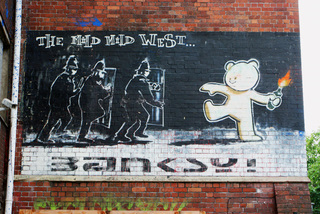
A unique area featuring street art from vintage Banksy
to up-to-the-minute street art attracting visitors from far and wide including Italian food blogger, Jasmine.

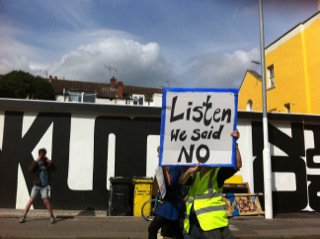
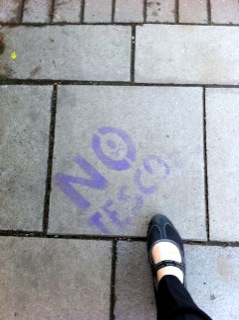
“93% of local people say NO to Tesco in Stokes Croft,” says the fresh notice on Stokes Croft’s  creative response to street drinking, Turbo Island.

How many Tescos does a city need? There are already 38 Tescos in Bristol according to Tesco – and two within five minutes of the proposed site.

Tesco picked the wrong place to wield its corporate takeover of the high street when it set its sights on the eighteenth-century building at 138-142 Cheltenham Road in Stokes Croft.

Using an intermediary (to deflect suspicion?), it bought the lease on Jesters comedy club and applied for change-of-use to shop in November 2009.

Apparently, one Bristol City councillor said: had he known it was Tesco applying, he would not have agreed. But the application got passed, unnoticed.

Thus Tesco infiltrated the heartland of Stokes Croft, as part of its taking advantage of the recession master-plan. What a double-win for Tesco: cheapness and take-over. The more shops Tesco has, the less competition.

Local shops cannot compete against a supermarket’s marketing millions. Hello supermarket means goodbye local family businesses.

Stokes Croft happens to bring together a powerful group of people: freethinkers, food activists and artists. The area’s independent shops offer a wealth of cultural diversity and quality food – including a long-established Italian delicatessen and organic farm shop – and community.

People know each other and help each other.

The local shops have an informal agreement not to sell cheap-as-dirt super-strength alcohol – the liver-rotting stuff supermarkets sell. It will be the beginning of the end if Tesco moves in.

As Joni Mitchell sung in the Sixties: “They paved Paradise and put up a parking lot… You don’t know what you’ve got till it’s gone.”

There is still time to stop the juggernaut. All Bristolians have a right to object.

It’s true that current planning laws do not allow a Council to protect its own local shops as the Channel 4 Dispatches documentary: Tesco – the supermarket eating Britain – shows.

However the formal objection process against a shop front still gives plenty of scope for voicing concerns. Tesco front store branding promises cheapness but is a lie. Our local shops are cheaper than Tesco Express, according to a local survey.

I am helping run workshops to help people write their letters. We all need encouragement. I know I did.

The No Tesco in Stokes Croft campaignwebsite has a template letter to email to Bristol City Council. Copy and paste, then top-and-tail with a list of your concerns and your postal address.

The deadline for emailing your objection is the 14 September 2010.

I have also sent my written statement asking to speak at the planning committee on 22 September at Bristol City Council on College Green.

There will be a party on College Green from 12.30 – 2.00pm to celebrate our campaign. Whatever happens, our fight for fair planning laws has just begun.

Top Chef DC – real-life reality food


Back in the UK.

Blog-mind filled with unwritten posts.

Like that Tuesday in Washington DC.

We’d been on the Amtrak train since 5.30am Sunday morning

– passed Gallup and our Dine (Navajo) friends (another blog to come)

– woke that morning in Kansas station where I stretched my legs in the light and sun

– ate three meals a day in the dining car and watched Amerika‘s gigantic land roll by.

Planned to do the tourist thing at Washington DC.

Its railway station heralded grandeur.

But by the time we reached our hostel, we were exhausted.

After two days of train-rocking, all we wanted was stillness.

A night-in.

What a night-in!

Turned out we were in the funkiest hostel in the funkiest part of town.

On a empty parking lot, surrounded by modern neighbours, the 19th century wood-panelled brick house with sash windows (first sash windows in six weeks of US travel!) that had belonged to the National Advancement of Colored People.

To add to the hostel’s homeliness, a shared (modern, paint-white) kitchen.

A good place for gossip: a TV journalist showed us a picture on his phone of David Cameron’s visit that day to the White House.

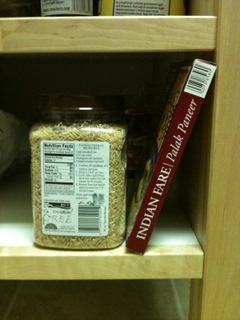
While cooking my staple stand-by, brown rice, I found a unopened packet of interesting Indian spices and spinach from Trader Joe’s. A previous guest had labelled it: “to share”.

I debated with myself: was it selfish or unselfish to use it?

A young Danish guest urged me to. He said I reminded him of his mother, also a brown rice ex-hippy. (And like my children would have done, encouraging me to think of myself).

Enter the hostel manager, Kevin, who turned out to be a would-be blogger for the hostel (and I about to give a social media workshop when I got back to the UK) and into real food.

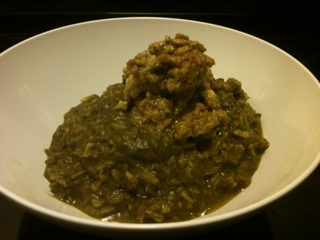
So we shared the brown rice and spicy spinach, and Kevin invented a crunchy-soft topping of avocado and peanut butter. Like most home concoctions, its looks belie its taste.

Since arriving in the US, six weeks before, I had been watching reality TV show, Top Chef DC, marvelling how the US,  as mired as the UK in obesity and junk food, is as obsessed as the UK with food on TV.

Now I was in the foodie capital, eating the kind of spontaneous, messy, healthy, tasty concoction I would eat at home.

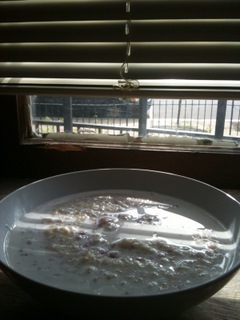
And here’s a picture of my bowl of porridge the next morning – real-life reality food, and my take on Top Chef DC.

Thank you, Capital View.

Carrot cake at the Grand Canyon

I ask the Grand Canyon rancher: “What is the trail for the scaredy-cats with no heads for heights?”

Nonplussed, she sends us to the start of the Bright Angel trail.

Looks steep and scary to me.

I do not dare take in the view. Just focus on my feet.

Try to ignore the images of pitching headlong over the edge which my mind is generously supplying.

We see a zag of lightning.

Thunder hollers in the canyon.

Anxiety about heat exhaustion (it was 100 degrees when we started) is replaced by fear of being struck by lightning.

Fat plops of rain fall.

When we reach the Mile-and-a-half shelter, I am soaked. Chilly.

Three US students and a  family from Amsterdam are also sheltering. We commiserate over Holland losing the World Cup.

The students have been hiking since early morning.

They witnessed a helicopter rescue for a hiker with a scorpion bite. The helicopter took six hours to arrive, the rancher two.

Not enough money, say the students. The Grand Canyon is feeling the recession.

The rain stops.

We set off on our return journey up the trail.

Miraculously, my mind is no longer furnishing scenes of disaster.

I am no longer hugging the side of the rock.

I am taking in the view. And stride.  A miracle.

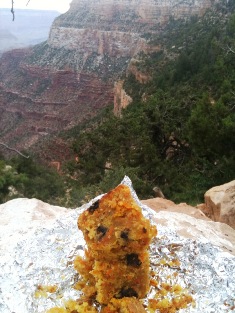
Time for the carrot cake’s photo-shoot (see pic above).

I baked it the night before, amalgamating and adjusting several recipes found on the web for the simplest.

Here it is before I forget it.

Whisk five small eggs (or four big ones) with 1+1/4 cups of sugar and 1+1/4 of organic coconut oil

Fold in 2 cups of organic flour and 2 teaspoons of cinnamon.

Plus 3 cups of grated organic carrot and some cut-up raisins.

Bake in a greased loaf tin for 1 hour at 350 degrees.

Insert a knife to check it is not wet when withdrawn. If wet, the cake is not sufficiently cooked.

Because of the high altitude (7,000 feet) of Flagstaff, the cake took another twenty minutes.

I concocted a separate topping of whisked organic tofu, lime juice and organic agave nectar (the un-organic kind is highly processed and not worth it).

The topping did not come with us to the Grand Canyon.

Unlike the brave carrot cake, that did.

Vardo, Venice

I walk the boardwalk from Santa Monica to Venice.

The sky is overcast (yummy, just like home in England). The locals call it June gloom.

I am hungry but nothing takes my fancy.

It looks touristy and, well, not real food.

I can’t get this restaurant out of my head that I had passed earlier.

The sign had said: ethnic, vegan, vegetarian…

I don’t like retracing my steps, or leaving the ocean.

But I am glad I did.

It is rare to find somewhere where I want to eat every dish on the menu.

This is the place for me.

An oasis. Delicate flavours, vegan and vegetarian delights, raw food desserts and all ingredients organic.

I had the aromatic gently spicy dhal and spinach curries and salad, beautifully dressed with homemade vinaigrette.

followed by this sweetheart of raw chocolate with fresh mint and coconut filling.

Vardo means gypsy in Roma.

And suited this gypsy queen down to the ground.

Eat organic – reduce carbon

Today I met my friend and ex-Soil Association colleague, Gundula Azeez, for lunch.

She wrote the Soil Association 2010 report, Soil carbon and organic farming.

I confess carbon used to confuse me.

As a journalist, my ignorance is my strength. If I can understand it, so can you.

Gundula kindly went back to basics for a beginner’s mind explanation.

Is carbon good or bad?

Carbon is both good and bad depending on where it is.

When it is in the soil, or locked up in oil and coal, it’s good.

When it’s in the atmosphere, it’s bad.

Carbon-in-the-air i.e. carbon dioxide is something we need to breathe OUT.

In the case of current planetary concerns, rising levels of carbon dioxide (or CO2) create rising greenhouse gases – too much of which contributes to climate change.

(Sentence rewritten following Georgie’s comment below).

Organic farming and the carbon cycle

Plants remove carbon from the atmosphere by breathing IN carbon dioxide.

That’s good.

When plants decay, the carbon is stored in the soil.

That’s good too.

Organic farmers uses this natural cycle to replenish the soil.

According to the Soil Association report, if all UK farmland were converted to organic farming, at least 3.2 million tonnes of carbon would be stored in the soil each year – the equivalent of taking nearly 1 million cars off the road

Not only that – but when carbon is stored in the soil, it does a LOT of good.

That’s because it is stored as organic matter which retains nutrients, soil structure and water.

Organic farmers create more carbon-rich organic matter through their farming practices.

They grow green manures and add compost to enrich the soil.

Soil life

Introducing soil microbes, the tiniest creatures on earth that perform vital functions to keep the soil healthy.

These soil microbes are exterminated by chemical farming practices but are actually encouraged by organic farmers.

Soil micro-organisms are essential to life on earth.

They help deliver nutrients to the growing plant.

They help it decompose when it is dead.

Thus creating more organic matter and its carbon-storage capacity.

Clods of earth

The soil actually clumps – or aggregates – around the carbon to protect it.

This delicious crumbly soil also provides a holding place for water, nutrients and air.

Which is why majority-world countries benefit from organic farming practices because they increase yield, and create water-retaining soil.

This gives developing countries more economic independence too.

They don’t have to pay the West for chemicals to feed the soil because organic farming does it naturally – by using the planet’s natural carbon cycle.

Lunch at Saint Stephen’s cafe

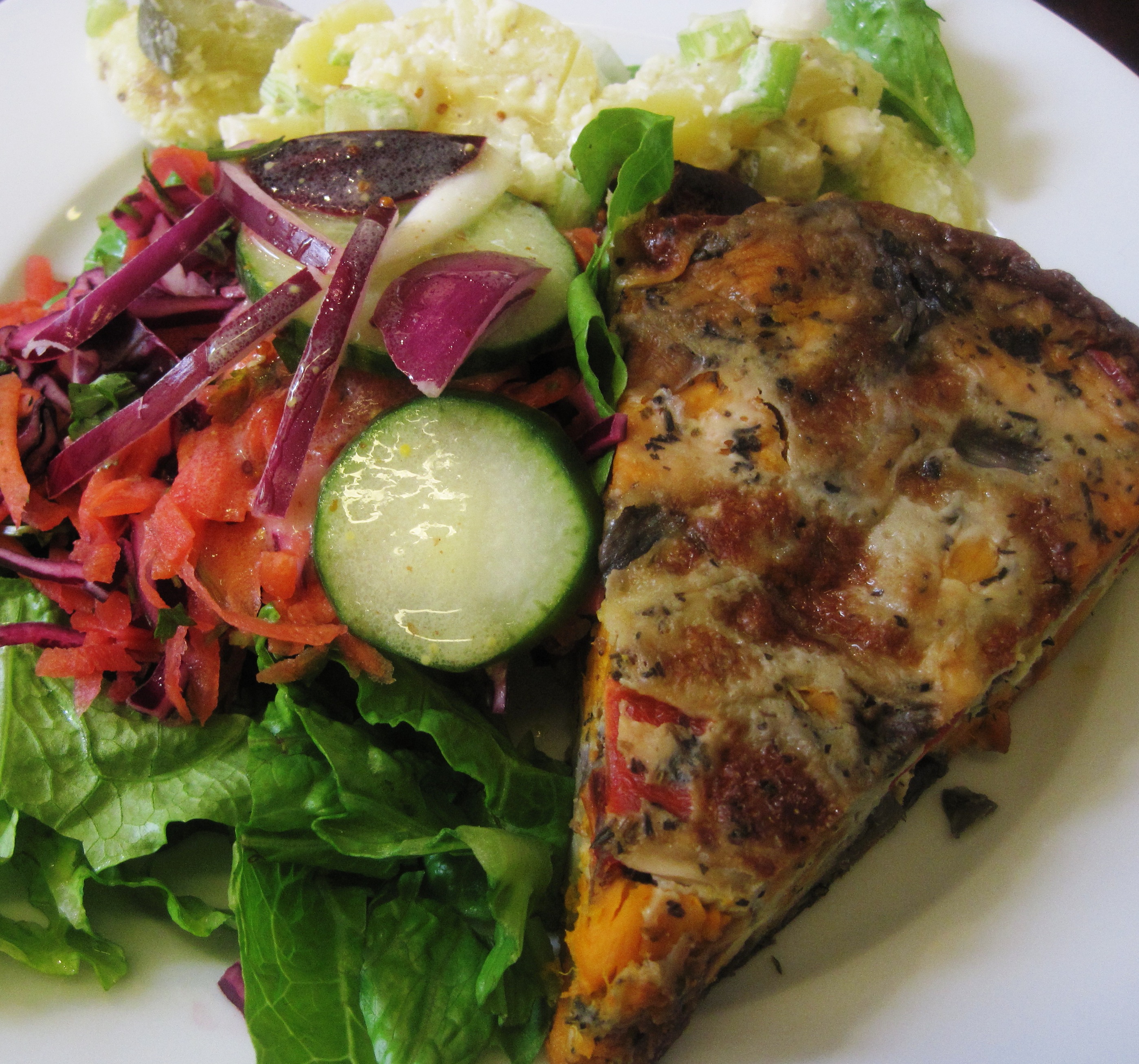
I had sweet potato frittata and salad – pictured – at Saint Stephen’s cafe.

The food is amazing – home-cooked and organic, seasonal, fair trade and local where possible.

Saint Stephen’s church cares deeply about the environment and this is reflected in its cafe food, conceived by one of Bristol’s best cooks, Edna Yeffet Summerel.

Nice to know when I eat organic food that I am enriching the soil and helping store carbon…

Bristol eco-village

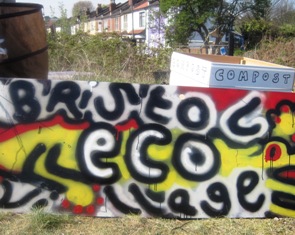
Welcome to Bristol eco-village.

Welcome.

The squatters moved in on Saturday and already three acres of desolate wasteland in inner-city Bristol have been transformed.

What is dead has been brought back to life.

The beans are planted in the soil – on lined raised beds as the land used to be a scrapyard and may be contaminated by toxins.

The squatters are conducting soil tests.

If contamination is found, the squatters plan some soil restoration, such as feeding with compost tea and planting with nitrate-fixing plants (such as beans).

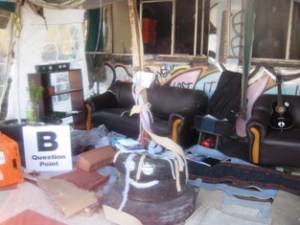
Here is their reception area where visitors can get more info.

It looks like something out of Mad Max or a similar post-apocalyptic movie – and that’s the point.

Rather than be victims of a future likely eco-disaster, some people would rather prepare positively in the present.

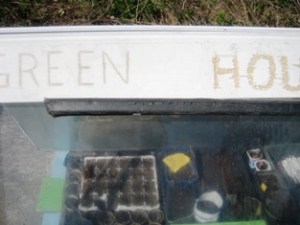
Here is a makeshift green house.

On Tuesday the squatters must got to court.

Why?

Must the land be repossessed by the owners so it may lie unused for another twenty years?

Or can it be restored to life as the squatters are doing, growing vegetables and rebuilding soil fertility?

“We come in peace they said

To dig and sow

We come to work the lands in common

And to make the waste ground grow

This earth divided

We will make whole

So it will be

A common treasury for all

We work, we eat together

We need no swords

We will not bow to the masters

Or pay rent to the lords.

Still we are free

Though we are poor

You Diggers all stand up for glory

Stand up now!”