Category Archives: eating well on a budget

Junior doctors strike and Cullen skink

My glam mum aged 93

My mum, aged 93, (her pic, left) made me the traditional Scottish dish, Cullen skink.

She bought the smoked haddock at Whole Foods Market.

“Only use undyed haddock” she commands.
A bowl of home made cullen skink

Recipe for Cullen skink

Here is the recipe my mother uses: 

Put undyed smoked haddock (500g) in cold water (300 mls) water, bring to boil and simmer for 8-10 mins until fish is cooked. Remove fish with slotted spoon, and set aside. 

Peel and chop 2 large onions and 2 large potatoes (instead of potatoes use Jerusalem artichokes). Add pepper for seasoning (no salt as the smoked fish is salty). Cook the vegetables in the haddock’s cooking water for glorious fish taste; if there is not enough haddock water to cover the potatoes, add some more water to cover them. Cook until potatoes are soft and tender – about 15/20 mins. 

While veg are cooking, skin the fish, flake into chunks removing any bones, and set aside.

Take the cooked vegetables off heat, roughly mash contents, add (450 ml) whole milk and (2g) unsalted butter. Bring to boil, turn down to simmer and gently add fish.

Gently, reheat. Serve with chopped chives and if desired, creme fraiche. 

(Or drink it cold from a jar as I did happily on my return train to Bristol).

The next day, I received a call that my Cullen skink-maker. My mum had fallen and hurt her head. Luckily she had been able to press her Community Alarm and, within five minutes of being alerted, an ambulance team had arrived and had taken her to a large London teaching hospital.

And this the day of the Junior Doctors’ strike! It had not compromised her care. We could carry on supporting the strike with impunity: it is against a new contract that will be, “Bad for patients, bad for doctors and bad for the NHS,” according to the British Medical Association, reports the New Economic Foundation.

After a scan, my mother was kept in for monitoring, and a battery of tests to ascertain why she keeps losing her balance.

God bless the National Health Service (NHS).

My late dad was one of its first GPs – see Dr John Winkler’s obituary in the Guardian.

The NHS is free health care for all – the embodiment of the world I want to live in.

God bless the NHS.

Simple oat cake recipe

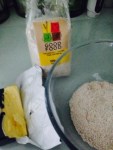
Good Food oatmeal flour packet and butter with bowl of oatmeal
When I am out-and-about, and get hungry, I need healthy food, such as slow-release carbs for sustaining energy. Oats are the nutritional answer. My oatcake recipe comes from Jane Mannings of World Jungle.

Award-winning social enterprise, World Jungle brings people together creating healthier communities.

African drummers and drums

Based in Gloucestershire, World Jungle also holds regular dance classes, and organises festivals and events including African drumming and dance (see pic) . Dance is a great way to bring people together.

I like this recipe because it only uses two ingredients and there is no fancy pastry-cutting involved.

Simple oatcake recipe

200g fine oatmeal – Jane used Good Food organic oatmeal.
50g butter.

Heat the oven to hot – Gas 7 \ 425° \ 220°C

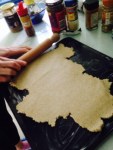
Squish the oatmeal and butter together with a fork adding a little water to bind into a dough. Roll pastry dough (on a floured board ) as thin as you can without it breaking. Lift the flattened shape, draped over rolling pin, place on a greased baking tray, and bake for 15 minutes. Eat warm, or store in an airtight container for when you are out-and-about.

I might experiment by replacing oatmeal with buckwheat flour, butter with olive oil, and adding salt, or caraway seeds.

What ingredients would you use in your oatcakes?

Knob of butter atop oatmeal in mixing bowl

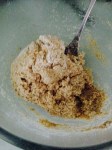
Fork assembling squidge of oatmeal dough

img_6096-1

Easy fruit smoothie 

wine glass of creamy looking smoothie Ta da.

Start the day with a health-boosting refreshing fresh fruit drink.

You need an electric hand-blender to do the whizzing. I use the cheapest, least fancy (about £20) – my most valuable and versatile piece of kitchen technology.

Banana is the base – add fruit such as apple/pear/orange/berries.
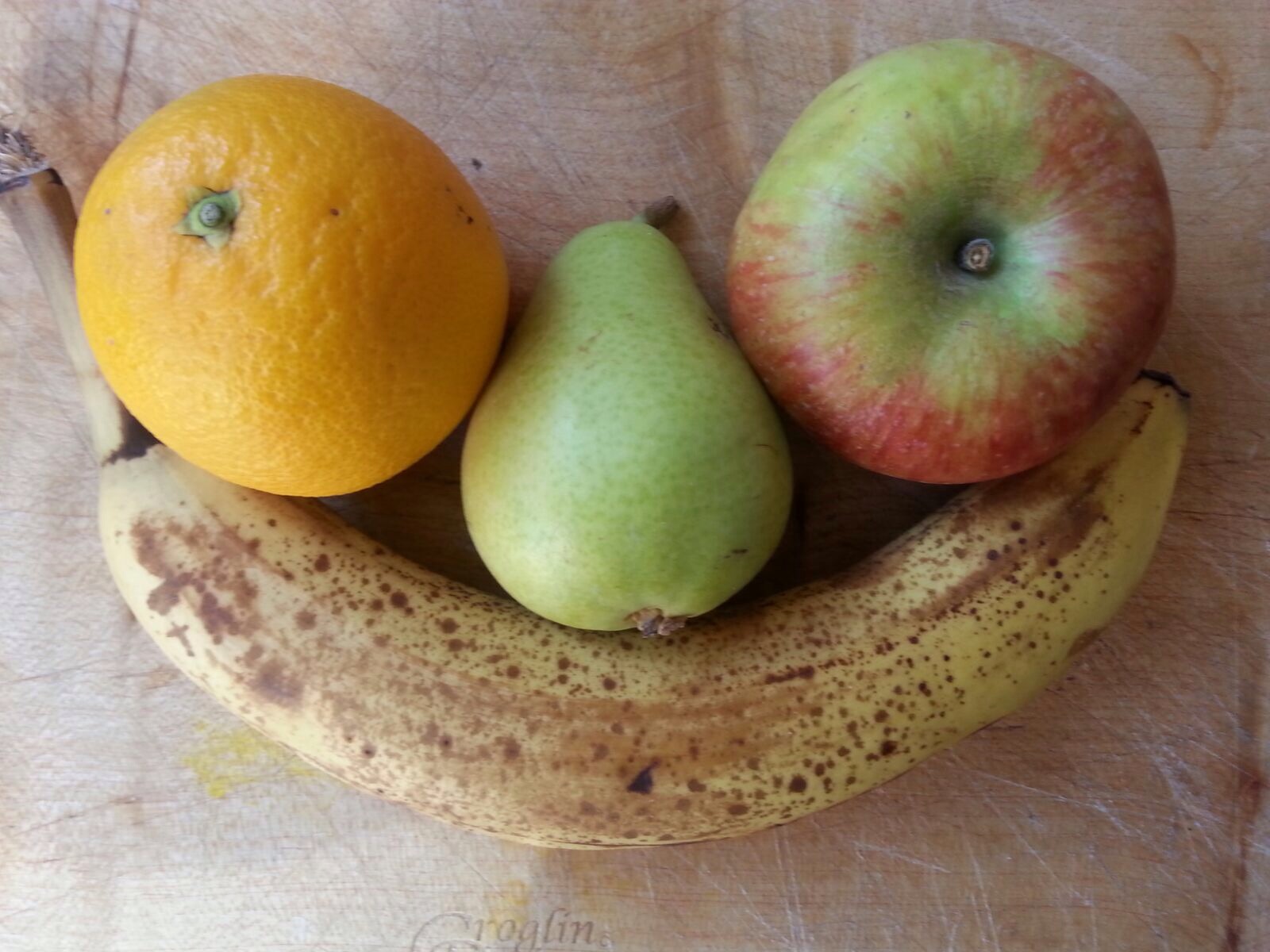
Apple, orange and pear in the curve of banana's

Use the whole apple/pear: whizz it up, pips, peel and all. Don’t even peel the apple/pear (especially if organic).

Yes, take stones out of mango/peach/plum/apricot. (Blender blade can’t cope).
Yes, peel the orange.

But no need to de-pith orange. Whizz it up with pith, and pips.

Fruit in cut up piecesI learned this time-saving tip at a raw food workshop by Kira G Goldy. Kira is also a healer.

She encouraged me to write creatively: “You have all these voices inside that want to be heard.”

As a journalist, a challenge. But her words rung true. I focused on writing and two things have developed from my new intention.

I give courses to facilitate creative writing (and at the same time teach myself as it turns out).

And I have written a verbatim play based on interviews of people facing eviction in the hyper-regeneration of Brixton, and Lambeth council estates.

Verbatim is like journalism because it is entirely made of people’s quotes, like a documentary. The subject – how profit-driven thinking wrecks human lives – is a subject close to my campaigning heart.

The play is a collaboration with Changing Face Collective and director Lucy Curtis.

Where Will We Live? premieres at Southwark Playhouse on 25 – 28 November 2015.

I will need to keep my strength up. Time to make an easy smoothie!

Smoothie recipe for 1 – 2

Use organic fruit if possible. Why organic?

1 apple (cut-up with pips and peel ) 
1 orange (cut-up with pith and pips) 
1 banana (peeled and sliced)
Half a glass of water/milk (dairy/plant) to thin
A dollop of peanut butter and/or coconut oil and/or yogurt for protein and good fats. Or a handful of cashew nuts soaked overnight in water 
Optional: ground cinnamon/raw ginger
Blend with a hand-blender in a jug, pour and enjoy.

Ta da!

Making chicken soup from scratch

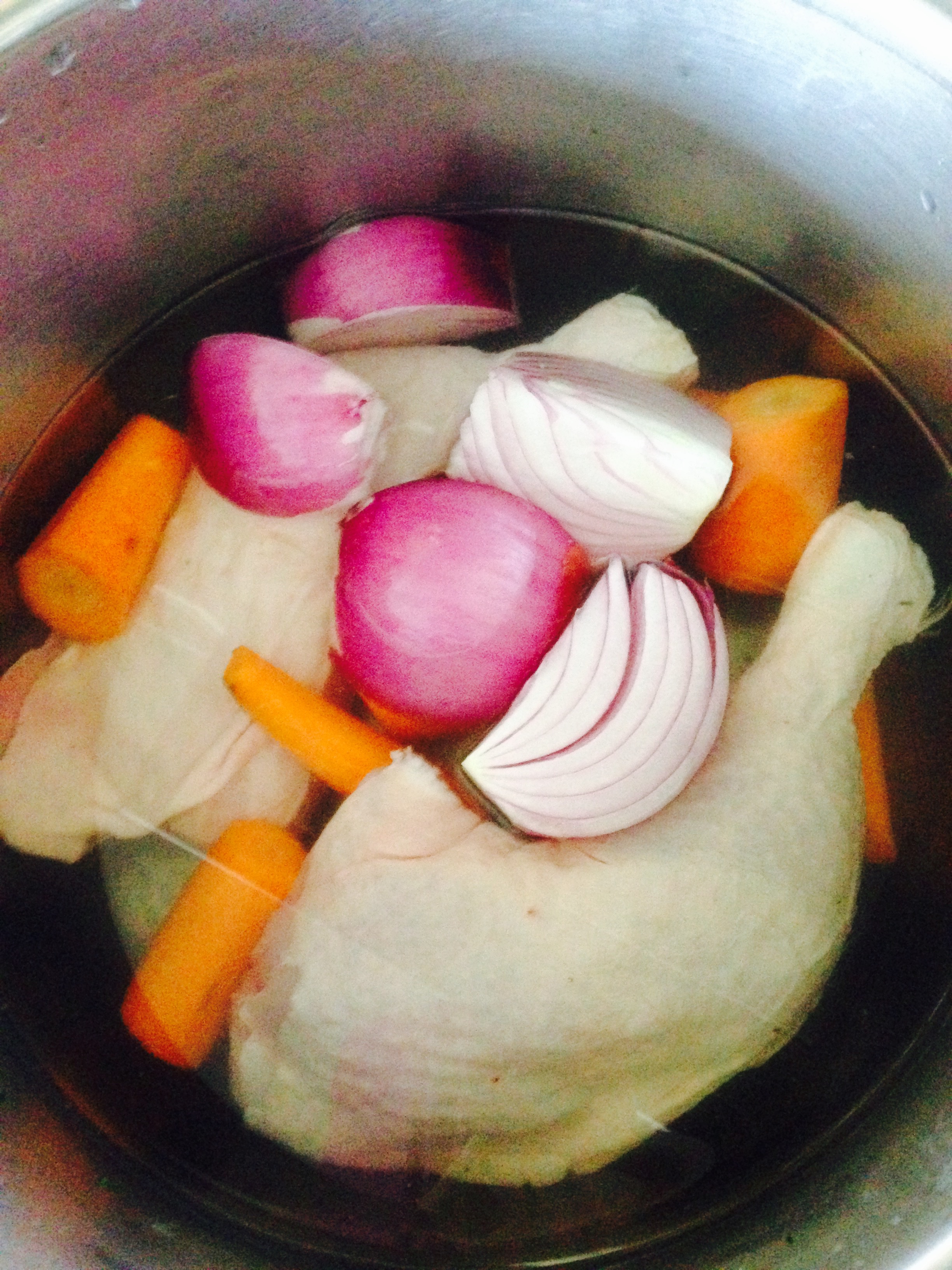
Raw high-welfare chicken and cut-up carrots and red onion covered with water in a panThe secret of chicken soup is to use raw chicken.

By all means, use a cooked chicken carcass to make stock but if you want to make healing chicken soup, start from scratch with raw chicken.

I used two legs from Abel and Cole high-welfare chickens.

Add a cut-up onion and carrots. Cover with water. If you use loads of water, it will dilute the soup. But just covering the chicken and veg with water will create the right concentrated amount.

Bring to the boil and simmer for about one and a half hours to two hours until the chicken is tender and falls away from the bone.

The next secret – imparted by my mother – is not to let the precious liquid boil away. So keep a lid on the pan. Season with salt and pepper to taste.

Strain to drink the healing soup – this article explains why chicken soup has healing properties.

The beautifully-tender chicken and vegetables will make another meal.

It is simple to make, and will bring strength.

My grandmother’s beetroot soup

Cup of purple coloured soup pictured from above against big pink flowers

Image: Michael Caplan

I ring my mother. She is 92.

“Do you use beef stock to make beetroot soup?” I ask.

“No,” Fay says, “we never used beef stock. This is how we did it,” said my mother. “This is my mother’s recipe.”

Sarah’s beetroot soup

Slice the beetroots.

Cover with water. Simmer for about half an hour until tender. 

Drain the sliced beetroot and keep the beetroot stock. 

(You don’t use the sliced beetroot for the soup. My mum says: use them in a salad with sour cream with sliced onions). 

Crack and Beat 2 whole eggs with the juice of one lemon.

Add eggs carefully – or they will curdle – to some of the warmed beetroot stock.  

Once the beaten eggs are incorporated into this small amount, tip it into the main soup.

Reheat carefully – very carefully – so the eggs don’t curdle. 

Add sour cream if desired.  

Thanks, mum.

The ingredients were organic (what my grandparents called “food“) for improved quality and taste.

The purple soup enabled nourishment to slip-in unsuspected via beetroot-sweet, lemony lightness.

My grandmother Sarah died when I was 16. She was warm, earthy and wise, with fierce opinions I did not always agree with. Born in 1899 in London, her parents were migrants from anti-semitic Tsarist Belarus and Lithuania. I think of her so much in my heart.

My mother says the older she gets, the more she thinks of her grandmother, Jesse, (Sarah’s mother). Jesse died when my mother was ten years old.  My mother says: “I talk to her every day. I call to her by her Yiddish name, Yeshki. She used to read the Yiddish translation of Shakespeare’s plays.”

I am showing my mum this blog on my phone

(I only learned that bit yesterday when reading out this blog to my mum – see pic above).

My mother repeats stories endlessly so we remember them. My mother’s recollection of her grandmother are imprinted on my DNA since childhood so I have absorbed Jess’s “live each day as if it were your last” philosophy as if it were my own.

My mum again:  “Jesse used to say: I am not frightened of death.’ She would point to the window and say: ‘It’s as if I’m passing to the other side of that net curtain.'” 

So, eat beetroot soup, and enjoy this precious life!

Try organic food… or as your grandparents called it, food ...


Gut gastronomy beef broth

A bowl of beef broth

Beef broth soothes the digestion and produces easy-to-absorb minerals including calcium. Made with bones, it is a low-cost way of sustaining your health. Bones cost a few pounds.

(Apologies to vegetarians and vegans and please let us know your best tonics.)

“A good broth will resurrect the dead,”

– South American proverb. 

Read more about broth’s healing powers at the Weston Price Foundation and the way broth also delivers easy-to-absorb broken-down material from cartilage and tendons that might help arthritis and joint pain.

I bought the beef rib bones from Sheepdrove Organic Farm for £2.50 per kg. 

Why organic? Because I want to eat meat from an animal which has not been given routine antibiotics, which has chewed fresh grass in the fields as nature intended (not convenience-food grain that gives the beast a belly-ache), and can follow its natural animal behaviour. 

I used a recipe from Gut Gastronomy by nutritional therapist Vicky Edgson and Grayshott spa chef Adam Palmer based on the spa’s health regime. Published by Jacqui Small, this fine book with beautiful images by Lisa Linder is filled with highly nutritious recipes to help increase digestive health, and repair and nourish the body.  

The Gut Gastronomy recipe uses beef marrow bones. 

Here is the recipe (for four) slightly adapted.

Ingredients

3 kg (6lb 10 oz) beef marrow bones – ask the butcher to chop them into manageable chunks, about 3-5 cms (1-2 inches) pieces 

4 carrots, 3 large onions, 4 celery sticks (optional), roughly chopped

5 litres (8 3/4 pints/20 cups) of cold water
(I used my biggest pan, about 5 pints, and this made a lovely, concentrated broth)

2 bay leaves, 10 whole peppercorns

If you have some, add half bunch of thyme. 

I also added dried chilli for extra hotness. 

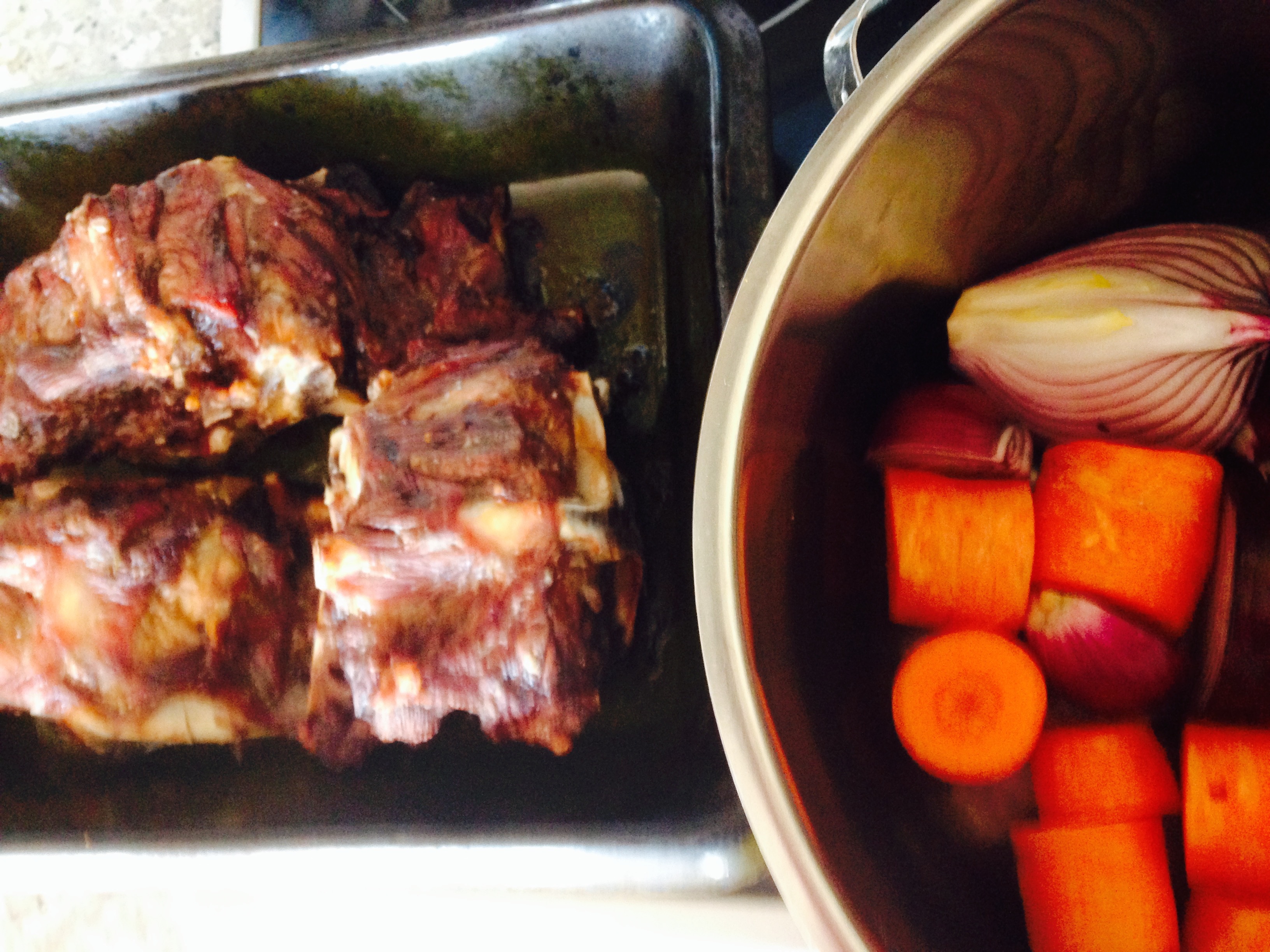
roasted bones and pan with carrots and onions

Method
Roast the cut bones in a large roasting dish for 30 – 40 minutes at Gas Mark 7. 

Drain 2 teaspoons of the fat from the bones into a large saucepan and sauté the veg.

(There was no fat from my rib bones so I omitted this stage and added the carrots and onions at the next stage, without frying them.)

Add the bay leaves, peppercorns (and dried chilli), sprigs of thyme and roasted bones and cover with 5 litres (8 3/4 pints/ 20 cups) of cold water. Skim any fat as you bring it to a simmer. Gently cook for 5 – 6 hours. 

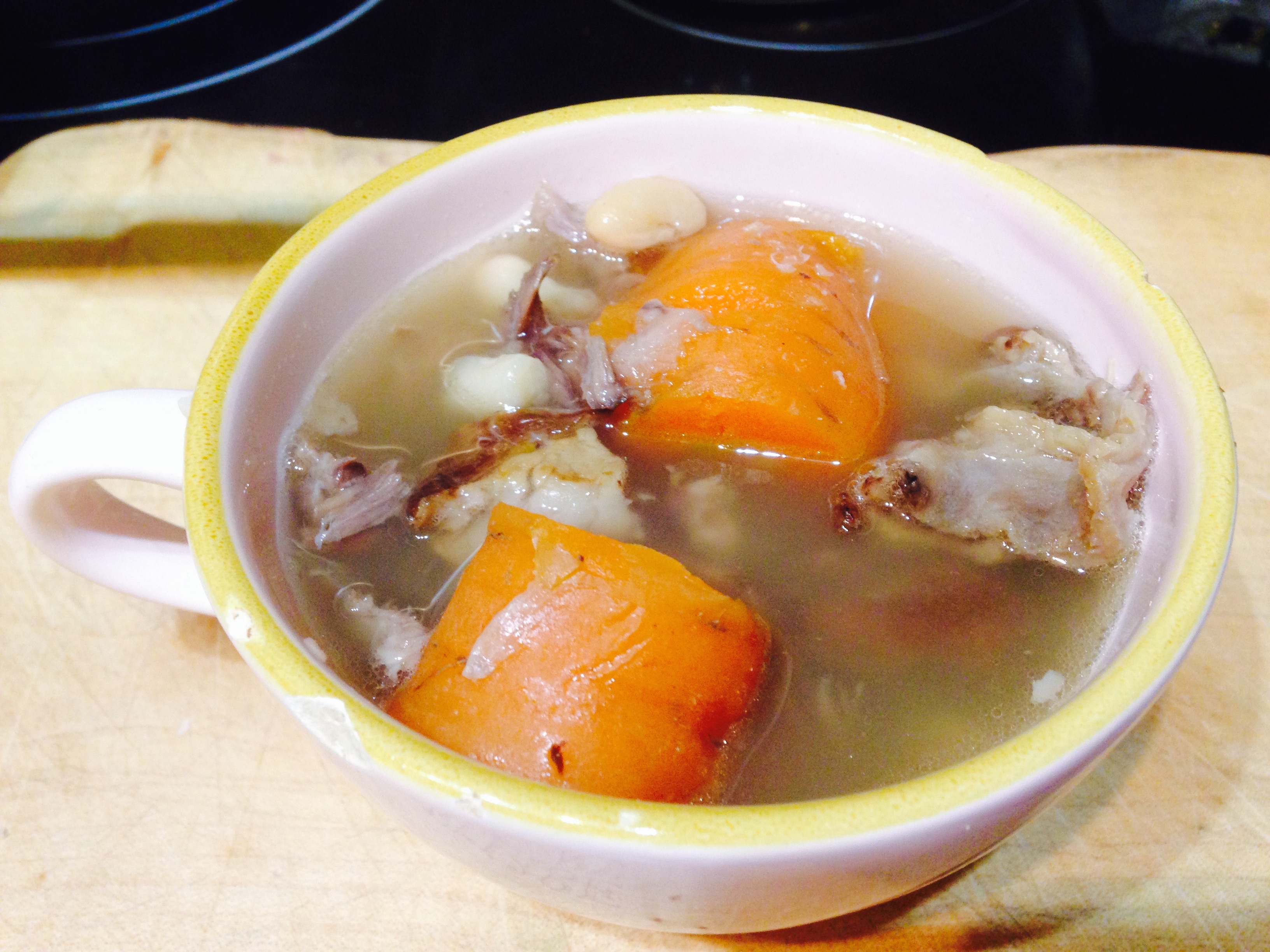
Broth is served clear, strained of meat and vegetables. Strain to make consommé, and cool before freezing. I shredded the plentiful meat from the bones and made several servings of delicious broth with meat (see top pic). 

I swear I cured my poor inflamed gums thanks to this healing soup.

Fellow blogger, Annie Levy at Kitchen Counter Culture, suggested I used some of the broth for borscht, which I did, using my grandmother’s recipe.

And that is for the next blog post.

Update (January 2016): This recipe cured another bout of gum infection after two days of drinking 5 pints of the above broth (this time made with non-organic bones). It worked its magic.

Honour the pumpkin

Pumpkin photo-shoot

18,000 tonnes of edible pumpkin are thrown away every Halloween in the UK; that’s the equivalent of 1,500 double decker buses, according to the Independent.

Time to join the tweetathon using #pumpkinrescue hashtag.

The Ecologist reports on the #pumpkinrescue manifesto.


Here are a few points from the manifesto.

  1. All supermarkets to make publicly available the amount of food waste they create and detail what happens to it.
  2. All supermarkets to ensure safe and healthy surplus food is redistributed to those on low incomes.
  3. Government to increase their investment in the Love Food Hate Waste campaign.

I am pleased with my organic pumpkin’s potential as a lantern. It has a flat bottom so won’t roll around and it is fresh with a long stem making it easier to lift off the lid.

I am even more pleased with my pumpkin’s nutritional qualities: gentle, soluble fibre, immune-boosting vitamins and minerals, as well as carbohydrates, providing sustainable, slow-release (yet low-fat) energy.

(Above para from a book I co-wrote, Make More of Squashes).

I want to honour the pumpkin as food.

The easiest way to prepare a pumpkin is to bake it. That way you only need to slice it in two, and scoop out the innards (put the inner ligaments in the compost bin and and bake the seeds for 5 minutes in a hot oven with soya sauce, or fry them).

Here’s a great blog on how to bake a pumpkin in ten steps, including cutting tips.

If you are making a lantern, then there is no escape: you have to make the effort of scooping out the flesh. So  you might as well make the most of your hard work and not discard the goodness.

Use the pumpkin flesh in a soup with coconut milk/stock/water, and spices, or cubed in a stew.

What is your favourite pumpkin recipe?

Pan-fried pumpkin flesh atop a bed of curried coconut lentils

Pan-fried pumpkin flesh atop a bed of curried coconut lentils


Carved pumpkin lantern's photo shoot


Probiotic heaven

My delicate digestion is crazy for probiotics for their soothing and restorative effect. Probiotics? They are good bacteria which stop bad bacteria giving your gut a hard time (bloating etc).

Probiotics are not some new-fangled idea – every traditional society has its fermented ‘good bacteria’ food, such as sauerkraut.

Annie Levy (and the Guardian sustainable blog of the week) sent me a jar of her homemade (fermented) plum kimchi.

I have never tasted anything as wildly spicy and salty, gut-zingy and healing .

Plum kimchi with vegetarian lunch

I had it as an accompaniment to Co-exist Community Kitchen tenants’ (£2.50) vegetarian lunch (see pic).

Then I got home and ate the rest of the jar (it goes with everything savoury).

Please see Annie Levy’s recipe for Plum Kimchi at her blog, Kitchen Counter Culture (great name for a radical blog).

Here’s how I made the crazy condiment.

Assemble in a large bowl:

All the cloves in a head of garlic (grown by Nadia Hillman)
Grated raw ginger (large thumb – or more)
2 raw red onions sliced
1 lemon chopped
1 large orange chopped

half of 1/4 American cup hot pepper powder

1/4 American cup of (sea) salt 

Add to 1 pint of raw uncooked plums (slice with sharp knife to remove stones). Use organic wherever possible because organic is different – fewer chemicals and more goodness

Place a plate to press down the raw veg/fruit mix and leave it for two days at room temperature before spooning into jars. The salt draws out the water in the raw veg/fruit, thus pickled in its own salty water.

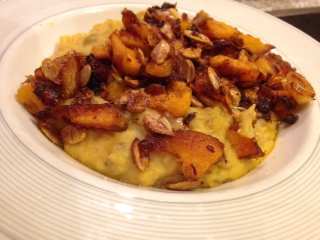
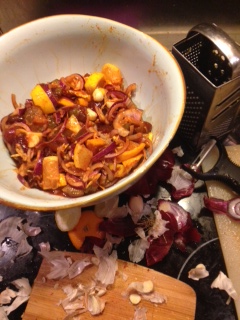
photo (4) Plum kimchi in the making

The first pic shows the cast assembled, the second is the cast cut-up  and mixed with spice and salt. Note: creative chaos. Why eat boring same-old packet food when you can go mad in the kitchen?!

Three announcements.

1. Check out Annie Levy’s food fermentation workshops. “A true kitchen witch, Annie’s food fermentation workshop is an informative & exciting, deliciously interactive learning experience and exploration of food alchemy.”

2. Bristol is hosting a probiotic event on Saturday 15 November 2014 at 3 – 6 pm.
The power of probiotics foods for digestive and immune healing – rebuild your gut heal your life. Fermentation Fetish with Holly Paige and Kenny Bountiful Sun Tickets (£15) – book here.

3. And finally for everyone who loves real food including fermentation – please check out and pledge for the publication of Living Food – A feast for soil and soul, from soil sister, Daphne Lambert.

Making sauerkraut

A jar of purple sauerkraut looking jewel-likeSauerkraut is a traditional fermented food which produces probiotics, cheaply and naturally.

Probiotics are good bacteria which help good digestion, as Sacramento Natural Food Co-op explains.

“Fermented” food can sound a turn-off to our modern ears. But, for aeons, every traditional society has used lacto-fermented food – kimchi from Korea and cortido from Latin America, says Nourishing Days – for healthiness.

Sauerkraut hails (as do my ancestors) from Eastern Europe, Germany/Poland etc

I have been thinking about making sauerkraut for ages.

I bought a Kilner jar in preparation. I procrastinated. I had never made it before so feared failure. Making any food is a leap of faith. Will its mysterious alchemy work?

Then, by chance, I got a comment from Annie Levy, who holds UK-based lacto-fermentation workshops. Can you imagine? The maven of probiotics turns up on this ‘ere blog. Of course, I have to make sauerkraut. Now.

So I read Annie Levy’s great piece on making sauerkraut.

I also consulted this sauerkraut one from the Kitchn and a few others. Exciting to be in the zeitgist – there is no shortage of posts on lacto-fermentation.

Lacto, I query? It means the type of bacteria which creates lactic acid. Lactic acid protects fermented food from being invaded by bad bacteria, says Natural News.

Basically, to make sauerkraut, you add salt to cut-up raw vegetables. Salt naturally draws out the water from the veg. Then the veg soaks in its own salty water for days (and then keeps in a fridge for weeks). The soaking-in-the veg’s-own-water creates the fermentation process which in turn produces sauerkraut with loads of friendly bacteria.

Sauerkraut 

1 raw cabbage (and/or raw carrots/garlic etc)

1 tablespoon salt

Spices of choice: I used 1 dried chilli, fenugreek, cumin seeds and black peppercorns

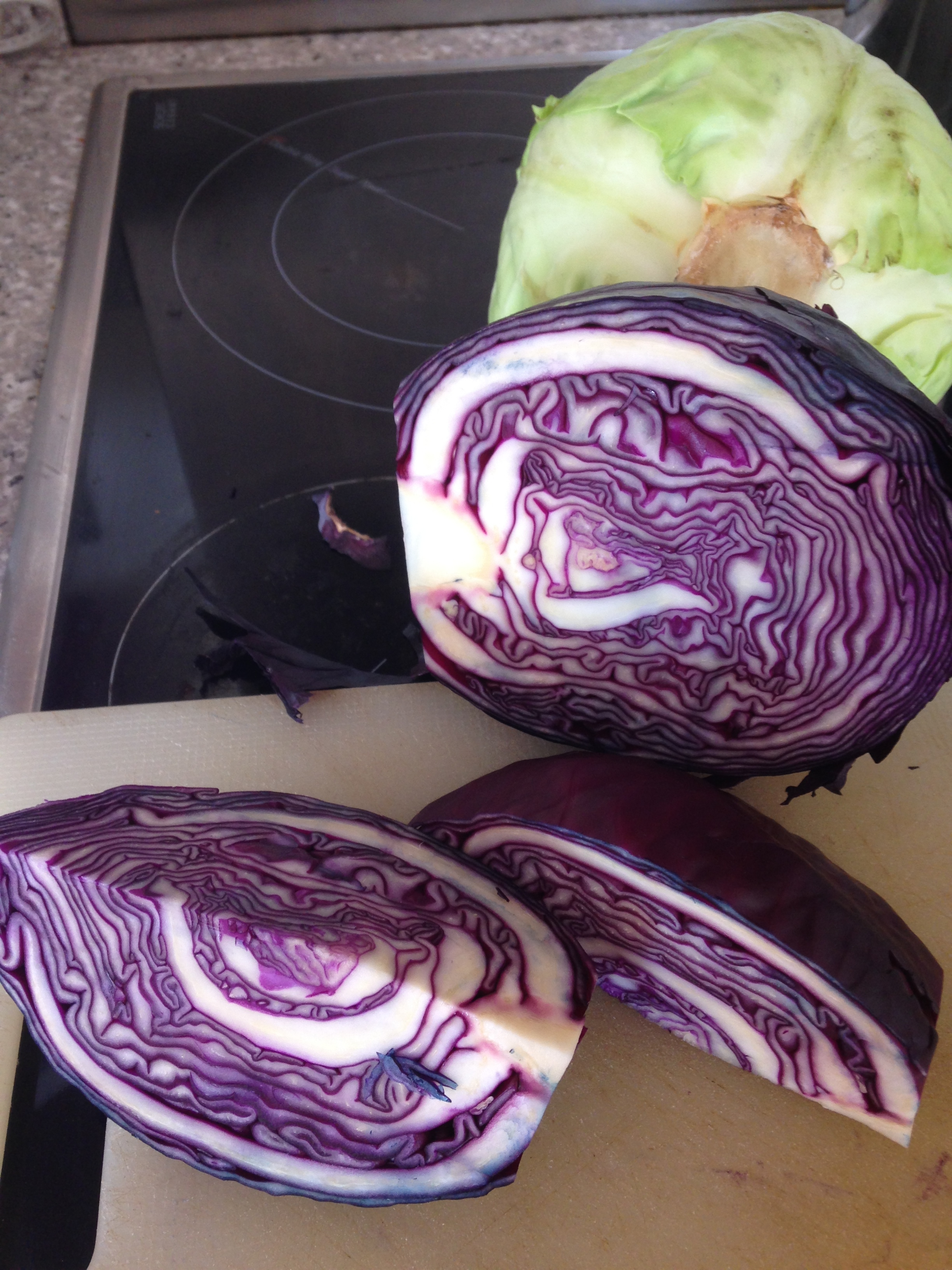
organic purple cabbage sliced in half

Method: Slice cabbage thinly (my food processor did the job otherwise use a sharp knife). Mix the salt and veg in a bowl, rubbing the salt in with your fingers. Leave the salted veg in a covered bowl. I am amazed how quickly I was squeezing water out of salted cabbage. Mix again. Keep cabbage submerged in its water with a heavy plate.

Making sauerkrautHere is me submerging the veg in the Kilner jar using a cabbage leave to press it down. I got anxious about this bit. However, it is OK to add a few dessertspoons of water to make the sure the veg is covered. After 12-24 hours, transfer the salty cabbage from covered bowl to a Kilner jar and keep in the fridge.

I used two organic cabbages (and two tablespoons of salt). I thought two cabbages would not fit in the Kilner jar …but they did not even fill it!

The quantity of salt to use is up to you, but 3 tablespoons per 5 pounds of vegetables is a good ratio to follow, says website, Paleo Leap.

The result: Having lived with my jar of sauerkraut for the month of July, with regular servings with a variety of dishes, I can report: it is delicious. A blend of salty and sweet, and easy to eat.

And, it works. For instance, last night, my digestion felt weak. I could not be bothered to eat. So, I had a small bowl of sauerkraut and within an hour, my appetite had returned, heartily. The magic of friendly bacteria!

Reclaim real food with Organix #nojunk campaign

Happy grandchild with chocolate bean cake

I wish Organix had been around in the 1980s when my children were little. 

Organix produces healthy food for children so it is a godsend. Because it is certified organic, the junk is already excluded.

I love a good ban. Here is a small example of the junk which has always been banned from organic standards. 

  • Hydrogenated fats 
  • All colourings whether or not natural (except annatto)
  • All artificial flavourings.

You will never find the above in organic food because their standards are based on the Precautionary Principle: why take an unnecessary risk?

And what an unnecessary risk.

Hydrogenated fats or trans fats are industrially produced. A cheap filler, they prolong shelf life and make a fake cake look cake-like. They are linked to the UK’s obesity crisis. Child obesity is a huge health risk and is NOT FAIR to kids.

Artificial flavourings and colourings mask the yuk taste of the junk, and are linked to hyper-activity and allergies. Like trans fats, these additives are a cheap alternative to real ingredients, and a health risk. There is currently no requirement to reveal their exact quantity in food.

I love Organix’s latest campaign.

“I pledge to eat and feed my family only real ingredients I can recognise or spell.

I signed the pledge. I am sick of food ingredients that only a chemist can understand. I do not want food technology – I want REAL FOOD!

Organix was founded in 1992 by Lizzie Vann. After a childhood rife with asthma and eczema, she learned as an adult about the link between food and health (cut out those nasty additives for a start!).

As well as making tasty organic food for children, Organix also educates carers about how to make real food, and campaigns for nutritious food in hospitals, schools and nurseries. 

Awarded an MBE in 2000 for services to children’s food, Lizzie Vann was also a founding member of Food for Life, the multi-charity programme transforming school meals one meal at a time.

Food for Life’s manageable targets: 70% unprocessed, 50% local and 30% organic.

Lizzie Vann says: “A growing infant is not a miniature version of an adult. Their key body systems…are in a state of fast development for most of their early childhood. During this dynamic time, it is essential that the environment in which they grow is free of toxins, and the foods they are fed are pure and offer quality nutrition.”

If I were emperor for the day, I would command the food industry to stop being reckless with our children’s health.

I would ban the use of cheap, empty, risky, filler ingredients which make huge profits for manufacturers but are ruining our children’s health. 

I would decree food manufacturing magnates be force-fed the junk they peddle to children. From henceforth, the only food they would be allowed to sell would be stacked with nutritious goodness, with no toxic nasties. 

Please do sign the No Junk pledge.

PS The pic at the start of the blog is of my granddaughter and a healthy chocolate cake…recipe next week!