
Category Archives: eating well on a budget

Barley and thank you

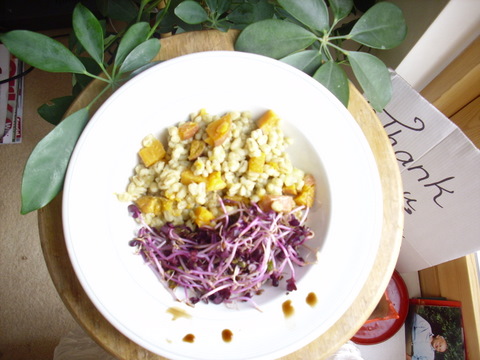
Barley and purple sprouts in white bowl, photo in very far corner

Sometimes I don’t pay attention while cooking. The other evening I put barley in the pan to boil for an hour and shook spirulina in for flavour and nutrition. I thought the raw superfood would add seaweed interest. (And my mind was elsewhere).

I was in denial for most of the hour barley was cooking then conceded defeat. I’d put too much of the strong algae powder in – it was revolting. I gave the barley grains (with sliced fennel) a quick rinse and started again.

New water, and now cubed sweet potato for colour and sweetness. It was touch-and-go but turned out alright. Especially served with Aconbury’s purple organic radish sprouts (a raw super salad) bought at Better Food in Bristol, and flicked with balsamic vinegar.

(I rate balsamic above all vinegars. Worth every penny.)

I served the dish up again for its photo shoot the next morning by the window next to my “Thank you John”.

John is my dad. He has had a big stroke that has changed him. In the light of losing him (last September) I suddenly became aware of how much I was made from him.
The Delia effect

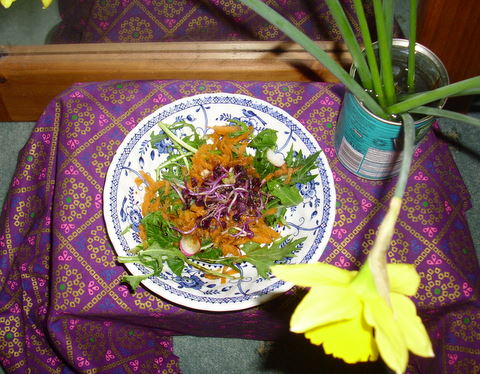
Small bowl of salad (green leaves, carrots and purple radish sprouts)

When Delia spoke to the masses and decreed the poor can eat battery-farmed chickens, did their sales rise?

The “Delia effect” describes the unprecedented sale of certain ingredients after being recommended by TV cook Delia Smith. Her influence is so vast that “Delia” has entered the dictionary.

I am pleased to report that sales for free-range poultry have soared.

This follows the high-profile campaign on TV’s Channel 4 by two other famous cooks, Hugh Fearnley-Whittingstall and Jamie Oliver. They called for higher standards of chicken welfare for all concerned, chickens and their eaters alike.

Sales of free-range poultry rose by 35 per cent in January (compared with January 2007) while sales of standard indoor birds fell by 7 per cent, according to market research company TNS. In response, Tesco doubled its order for higher-welfare chickens.

I mentioned what Delia said to my hairdresser.

Sharp intake of breath. “How can it ever be alright to eat a battery-farmed chicken?” she said.

Listen, she is an apprentice hairdresser so it was gratifying to hear being short of cash does not mean skimping on food quality.

Of course, you have to be a bit canny and cook from scratch. But that’s how most people in the world eat, and why so-called peasant food (such as pasta dishes, stews, curries) tastes so good.

Today’s picture is of a salad made by Chloe, with organic leaves, grated carrots and sprouting radish, that accompanied brown rice and lentils with fried onions, mushrooms and egg, that her dad Mike made. (PS the vase may be corporate but the beans were organic).

This princely meal that cost us about £1.50 each. I rest my case.

Porridge with heart

Porridge with heart-shaped cinnamon and nuts

I love porridge so much I could marry it – it is good for me and treats me nice.

You know when grown ups say: don’t play with your food? Wrong! Playing is the best way to learn.

There is always a moment in cooking where I think: this looks a mess.

“Be quiet,” I order my inner critic. I know I must persevere regardless, adding a bit of this, a bit of that.

The thing about porridge is it is meant to look like slop.

You can add fruit, nuts and seeds for extra taste and nutrition. I like sultanas, cinnamon, pecan nuts and pomegranate (see pic).

I love raw oats too. They are my top favourite comfort snack food with soya or rice milk, and sometimes, when in a dairy mood, organic cream.

This is how I make porridge. Using a cup – or half a mug – of jumbo oats (organic of course) per person, I soak them in water overnight.

If I forget to soak them (sometimes there are other things on a girl’s mind), I use rolled oats because they cook quickly without soaking.

So you get your oats, put them in a saucepan, add water and gently bring to the boil, stirring regularly with a wooden spoon to stop them sticking to the pan.

How much water? Well, enough to cover the oats, then add about a half a cupful more and keep simmering and stirring. Eventually the oats absorb the water and by trial and error, you can make porridge as lumpy or smooth as you like. Maybe you need to add more water, maybe you need to cook it a bit more (generally takes 10-15 minutes).

I would like to be more precise but it is not in my nature. Cooking is about experimenting.

It all comes good in the end – so take heart.